The Super Nintendo Entertainment System (SNES), known as the Super Famicom (スーパーファミコン, Sūpā Famikon) in Japan, is a 16-bit home video game console developed and manufactured by Nintendo. Released in 1990 in Japan and South Korea, 1991 in North America, and 1992 in Europe and Australasia, the SNES was Nintendo's second home console, following the NES. It competed primarily with the Sega Mega Drive/Genesis and became one of the best-selling consoles of its era.
🧠 Architecture and Processor
The SNES is powered by the Ricoh 5A22 processor, a custom 16-bit CPU based on the WDC 65C816 core. It runs at variable clock speeds between 1.79 MHz and 3.58 MHz, depending on the operation and video mode. The system architecture allows for advanced graphics and sound capabilities, with support for hardware-accelerated effects such as Mode 7 rotation and scaling.
💾 Memory and Storage
The console features 128 KB of general-purpose RAM and 64 KB of video RAM (VRAM). Game data is stored on ROM cartridges, with sizes ranging from 2 Mbit (256 KB) up to 48 Mbit (6 MB) in later releases. Some cartridges include additional chips for enhanced graphics (e.g., Super FX) or memory.
🖥️ Display and Graphics
The SNES supports a variety of resolutions, typically 256×224 or 512×448 pixels, and can display up to 256 colours simultaneously from a palette of 32,768. The Picture Processing Unit (PPU) enables multiple background layers, hardware sprites, and special effects such as transparency, mosaic, and the famed Mode 7 for pseudo-3D visuals.
🔊 Sound Capabilities
Audio is handled by a dedicated Sony SPC700 8-bit processor and a 16-bit DSP, providing 8-channel PCM audio at up to 32 kHz. The sound subsystem supports advanced features such as echo, pitch modulation, and sample-based music, contributing to the SNES's renowned soundtrack quality.
🎮 Input/Output and Expansion
The SNES has two controller ports supporting the standard gamepad and peripherals such as the Super Scope, Multitap, and Mouse. Expansion ports include a cartridge slot, an AV Multi Out for composite, RGB, and S-Video, and a bottom-side expansion port (unused in most regions).
🧰 General Maintenance
The SNES is generally reliable, but common issues include yellowing of the plastic casing due to brominated flame retardants and worn controller ports. Regular cleaning of cartridge contacts and proper storage can help maintain functionality.
🧾 PCB Schematics & Service Guide
Official service manuals and schematics are available for authorised repair centres. The mainboard layout varies by region and revision, with notable differences between the original and "SNS-101" (SNES Jr.) models.
Capacitor failure is rare on SNES mainboards, but if audio or video issues occur, consult a capacitor list for your revision and use quality replacements. Desolder with care to avoid PCB damage.
Retrobrite
Yellowed SNES plastics can be treated with retrobrite (hydrogen peroxide-based) methods, but results may vary and overexposure can cause brittleness.
Troubleshooting
No power: Check power supply and power switch contacts.
No video/audio: Inspect AV cables and cartridge slot for debris.
Cartridge not reading: Clean contacts with isopropyl alcohol.
Controller issues: Test with known-good controller; inspect ports for wear.


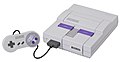 North American SNES (front)
 Super Famicom (Japan)
 PAL SNES (Europe)
 SNES Controller


