|
|
| (3 intermediate revisions by the same user not shown) |
| Line 5: |
Line 5: |
| | manufacturer = Acorn Computers Ltd | | | manufacturer = Acorn Computers Ltd |
| | type = Personal Computer | | | type = Personal Computer |
| | release date = September 1990 | | | release date = June 1990 |
| | discontinued = 1992 | | | discontinued = 1992 |
| | price = £2,995 (1990) | | | price = £2,495 + VAT (1990) |
| | cpu = ARM3 @ 26 MHz | | | cpu = ARM3 @ 25-26 MHz (variants at 30 MHz, 33 MHz) |
| | memory = 4 MB RAM (expandable to 16 MB) | | | memory = 4 MB RAM (expandable to 16 MB) |
| | storage = 3.5" floppy drive (1.6 MB), 100 MB SCSI hard drive | | | storage = 3.5" floppy drive (800 KB), 100 MB SCSI hard drive |
| | display = 640×512 (16 colours), 800×600 (256 colours), 1152×896 (256 colours)
| | | sound = 8-channel stereo, 8-bit |
| | sound = 8-channel stereo, 8-bit logarithmic DAC | |
| | dimensions = 415 mm × 355 mm × 104 mm
| |
| | weight = 10 kg
| |
| | os = RISC OS 2.01 | | | os = RISC OS 2.01 |
| | predecessor = [[Acorn Archimedes A440]] | | | predecessor = [[Acorn Archimedes A440]] |
| | successor = [[Acorn A5000]] | | | successor = [[Acorn A5000]] |
| | codename =
| |
| | model =
| |
| }} | | }} |
|
| |
|
| The '''Acorn Archimedes A540''' was introduced in September 1990 as the flagship model of the second-generation Archimedes range. First Archimedes to feature the ARM3 processor as standard, the A540 delivered unprecedented performance for the platform while introducing SCSI storage and enhanced memory capabilities that positioned it as a serious Unix workstation. | | The '''Acorn Archimedes A540''' was introduced in June 1990 as the flagship model of the Archimedes range. It was Acorn's first machine to be fitted with the ARM3 processor as standard, supporting up to 16 MB of RAM, and included higher speed SCSI and provision for connecting genlock devices. |
|
| |
|
| == Overview == | | == Overview == |
|
| |
|
| The A540 represented Acorn's response to criticism that the original Archimedes lacked the performance for professional workstation applications. The ARM3 processor, running at 26 MHz with 4 KB of cache memory, provided approximately four times the processing power of the ARM2-based models. Combined with a 100 MB SCSI hard drive and support for up to 16 MB of RAM, the A540 competed directly with entry-level Sun and HP workstations at a fraction of the cost. | | The A540 represented Acorn's response to the need for a high-performance workstation in the Archimedes range. It was an anticipated consequence of Acorn's Unix workstation development, offering the same general specification as Acorn's R260 Unix workstation (running RISC iX) but without built-in Ethernet support and running RISC OS 2 instead of Unix. At £2,495 plus VAT, it was positioned as the top-of-the-range model, substantially more expensive than other Archimedes computers but offering unprecedented performance for the platform. |
|
| |
|
| Acorn positioned the A540 primarily at the Unix workstation market, bundling RISC iX with many systems. The machine also attracted high-end educational users, CAD operators, and desktop publishing professionals who required maximum performance from the RISC OS platform. At £2,995, the A540 cost significantly more than the A440 it replaced, but delivered specifications that justified the premium for demanding applications.
| | The A540 hardware was essentially identical to the R260 except that RISC iX was not installed; it could be purchased separately and installed on an A540. The machine was designed to appeal to professional users, educational institutions requiring maximum performance, and as a potential Unix workstation. |
|
| |
|
| == Architecture == | | == Hardware Specifications == |
| | |
| The A540 introduced significant architectural improvements over first-generation machines. The ARM3 processor maintained instruction set compatibility with ARM2 while adding cache memory and higher clock speeds. The MEMC1a memory controller supported larger memory configurations through bank switching, while the enhanced VIDC20 video controller provided improved color depth and resolution support.
| |
| | |
| === ARM3 Processor ===
| |
|
| |
|
| {| class="wikitable styled-table" style="width:85%; text-align:center;"
| | === Processor === |
| ! Feature !! ARM2 (A440) !! ARM3 (A540) !! Improvement
| | The A540 featured an ARM3 processor on a replaceable CPU card. Initial models shipped with processors running at 25-26 MHz, though variants existed running at 30 MHz and 33 MHz. The 26 MHz version used a 52 MHz oscillator, while some machines used 60 MHz oscillators for 30 MHz operation. The ARM3 included 4 KB of cache memory, providing substantial performance improvements over ARM2-based models. |
| |-
| |
| | Clock speed || 8 MHz || 26 MHz || 3.25×
| |
| |-
| |
| | Cache || None || 4 KB unified || N/A
| |
| |-
| |
| | Process || 3µm || 1.5µm || 50% reduction
| |
| |-
| |
| | Transistors || 25,000 || 300,000 || 12×
| |
| |-
| |
| | Power || 1W || 1.5W || 50% increase
| |
| |-
| |
| | IPC || 0.5 || 0.9 with cache || 80% improvement
| |
| |}
| |
|
| |
|
| The 4 KB cache proved crucial for performance, reducing memory bandwidth requirements by approximately 75% for typical code. Cache operation was fully transparent to software, with hardware maintaining coherency for DMA operations. The write-through design simplified implementation while providing substantial performance benefits. | | The CPU card could accommodate an FPA10 (Floating Point Accelerator), with FPA11 also being compatible with later variants. The 33 MHz ARM3 CPU with FPA10 combination represented the highest performance configuration available. The ceramic ARM3 processors used in some machines could be overclocked, with reports of stable operation at up to 40+ MHz. |
|
| |
|
| === Memory System === | | === Memory System === |
| | The A540 had 4 MB RAM by default but could be expanded to 16 MB with additional RAM cards, each with its own 4 MB RAM and MEMC1a memory controller. This unique multi-MEMC configuration allowed the A540 to exceed the 4 MB limitation of single-MEMC systems. |
|
| |
|
| The A540 supported dramatically expanded memory configurations: | | The memory expansion was achieved through up to three additional RAM cards, giving possible configurations of 4 MB, 8 MB, 12 MB, or 16 MB total. Both Acorn and third-party manufacturers like Simtec produced RAM cards for the system. The memory cards were noted to be somewhat temperamental and liable to become dislodged if the machine wasn't used for extended periods. |
| | |
| {| class="wikitable styled-table" style="width:85%; text-align:center;"
| |
| ! Configuration !! SIMM Type !! Banks !! Total RAM !! Notes
| |
| |-
| |
| | Standard || 4× 1M×9 || 1 bank || 4 MB || Single MEMC1a
| |
| |-
| |
| | Expanded || 4× 1M×9 || 4 banks || 16 MB || Requires MEMC podule
| |
| |-
| |
| | Maximum (unofficial) || 4× 4M×9 || 4 banks || 64 MB || Third-party modification
| |
| |}
| |
| | |
| The standard MEMC1a controller addressed 4 MB directly. Larger configurations required the MEMC podule, which implemented bank switching to access additional memory. While RISC OS could only directly use 4 MB for applications, the additional memory served as RAM disc or cache for Unix operations.
| |
| | |
| == Hardware Specifications ==
| |
| | |
| The A540 motherboard represented a significant revision from earlier models, optimized for the ARM3 processor and enhanced peripherals.
| |
| | |
| === Motherboard Design ===
| |
| | |
| Key improvements included:
| |
| * '''Six-layer PCB:''' Improved signal integrity and EMI reduction
| |
| * '''Surface-mount technology:''' Reduced size and improved reliability
| |
| * '''Enhanced power distribution:''' Separate planes for digital and analog supplies
| |
| * '''Improved grounding:''' Star ground configuration reduced noise
| |
| * '''Modular connectors:''' Simplified assembly and service
| |
| | |
| The ARM3 processor mounted in a 160-pin QFP socket, allowing field replacement if necessary. The cache RAM utilized fast 15ns static RAM chips, essential for single-cycle operation at 26 MHz.
| |
| | |
| === SCSI Subsystem ===
| |
| | |
| {| class="wikitable styled-table" style="width:90%; text-align:center;"
| |
| ! Component !! Specification !! Performance
| |
| |-
| |
| | Controller || NCR 53C90A || Asynchronous SCSI-1
| |
| |-
| |
| | Interface || 50-pin IDC || Internal and external
| |
| |-
| |
| | Transfer rate || 5 MB/s maximum || 2.5 MB/s typical
| |
| |-
| |
| | Devices || 7 maximum || 2 internal, 5 external
| |
| |-
| |
| | Termination || Active || Automatic detection
| |
| |}
| |
| | |
| The integrated SCSI controller eliminated the podule slot requirement of earlier models, freeing expansion capacity for other uses. The NCR chip provided hardware command queuing and disconnect/reconnect capability, improving multi-device performance.
| |
| | |
| === Standard Drive Configuration ===
| |
| | |
| The A540 shipped with various drive options:
| |
| | |
| {| class="wikitable styled-table" style="width:85%; text-align:center;"
| |
| ! Model !! Drive Type !! Capacity !! Access Time !! Cache
| |
| |-
| |
| | A540 base || Conner CP30100 || 100 MB || 19ms || None
| |
| |-
| |
| | A540/120 || Quantum ProDrive || 120 MB || 17ms || 64 KB
| |
| |-
| |
| | A540/200 || Maxtor 7213 || 200 MB || 15ms || 64 KB
| |
| |}
| |
| | |
| All drives utilized embedded SCSI controllers, eliminating the reliability issues associated with ST506 interfaces. The faster seek times and command queuing capability provided substantial performance improvements for multi-tasking operations.
| |
| | |
| == Video System ==
| |
| | |
| The A540 incorporated the enhanced VIDC20 video controller, though early units used VIDC1a:
| |
| | |
| === VIDC20 Capabilities ===
| |
| | |
| {| class="wikitable styled-table" style="width:90%; text-align:center;"
| |
| ! Feature !! VIDC1a !! VIDC20 !! Benefit
| |
| |-
| |
| | Color depth || 8-bit || 8/16/32-bit || True color support
| |
| |-
| |
| | Palette || 4096 colors || 16.7 million || Photographic quality
| |
| |-
| |
| | Maximum resolution || 1152×896 || 1280×1024 || Industry standard
| |
| |-
| |
| | Pixel clock || 24 MHz || 36 MHz || Higher refresh rates
| |
| |-
| |
| | Hardware cursor || 32×32 || 32×32×3 || Colored pointers
| |
| |}
| |
| | |
| The VIDC20 required 2 MB of VRAM for high-color modes, installed separately from main memory. This dedicated video memory eliminated the bandwidth contention that plagued earlier models in high-resolution modes.
| |
| | |
| === Display Modes ===
| |
| | |
| {| class="wikitable styled-table" style="width:85%; text-align:center;"
| |
| ! Mode !! Resolution !! Colors !! Refresh !! VRAM Required
| |
| |-
| |
| | 21 || 640×512 || 256 || 75 Hz || 320 KB
| |
| |-
| |
| | 24 || 800×600 || 256 || 60 Hz || 480 KB
| |
| |-
| |
| | 28 || 1024×768 || 256 || 70 Hz || 768 KB
| |
| |-
| |
| | 31 || 1280×1024 || 16 || 60 Hz || 640 KB
| |
| |-
| |
| | X || 640×480 || 32768 || 60 Hz || 600 KB
| |
| |}
| |
| | |
| The expanded mode selection supported industry-standard resolutions, improving monitor compatibility and enabling professional graphics applications previously impossible on the platform.
| |
| | |
| == Expansion Capabilities ==
| |
| | |
| The A540 provided four podule slots, all available for expansion due to the integrated SCSI controller:
| |
| | |
| === Professional Expansion Cards ===
| |
| | |
| Common podule configurations included:
| |
| * '''Ethernet cards:''' i-cubed EtherLan 500/600 for TCP/IP networking
| |
| * '''Graphics accelerators:''' Colour Card Gold for 24-bit color
| |
| * '''Video digitizers:''' Eagle M2 for multimedia applications
| |
| * '''DSP cards:''' Lark A16 for audio processing
| |
| * '''PC cards:''' Aleph One 486 emulator
| |
| * '''MIDI interfaces:''' EMR Studio 24 Plus
| |
| | |
| The four-slot capacity allowed sophisticated system configurations impossible on earlier models with SCSI podules consuming expansion space.
| |
| | |
| === Memory Expansion ===
| |
| | |
| The MEMC podule provided access to additional memory banks:
| |
| | |
| {| class="wikitable styled-table" style="width:85%; text-align:center;"
| |
| ! Podule Type !! Additional RAM !! Total System RAM !! Primary Use
| |
| |-
| |
| | Atomwide MEMC || 12 MB || 16 MB || RISC iX
| |
| |-
| |
| | Simtec MEMC || 28 MB || 32 MB || Large RAM disc
| |
| |-
| |
| | IFEL MEMC || 60 MB || 64 MB || Specialized applications
| |
| |}
| |
| | |
| RISC OS applications could only directly access 4 MB, but the additional memory served as ultra-fast storage or workspace for Unix operations.
| |
| | |
| == Operating System Support ==
| |
| | |
| The A540 shipped with RISC OS 2.01, addressing bugs in the 2.00 release:
| |
| | |
| === RISC OS 2.01 Improvements ===
| |
| | |
| * '''ARM3 support:''' Cache control and configuration
| |
| * '''SCSI manager::** Native SCSI device handling
| |
| * '''Memory management::** Support for >4 MB configurations
| |
| * '''Bug fixes::** Printer driver stability, font manager leaks
| |
| * '''Performance::** Optimized for ARM3 cache
| |
| | |
| The ROM-based operating system provided instant startup and immunity from corruption, crucial for reliability in professional environments.
| |
| | |
| === RISC iX Capabilities ===
| |
| | |
| Many A540s ran Acorn's RISC iX Unix variant:
| |
| | |
| {| class="wikitable styled-table" style="width:85%; text-align:center;"
| |
| ! Specification !! Requirement !! A540 Capability
| |
| |-
| |
| | Minimum RAM || 8 MB || 16 MB typical
| |
| |-
| |
| | Swap space || 32 MB || 100 MB available
| |
| |-
| |
| | X Windows || 4 MB RAM || Comfortable operation
| |
| |-
| |
| | Concurrent users || 2-4 || Via serial terminals
| |
| |-
| |
| | Compilation speed || N/A || 4× faster than A440
| |
| |}
| |
| | |
| RISC iX on the A540 provided genuine workstation capabilities, supporting software development, scientific computing, and multi-user operation competitive with contemporary Sun SPARCstation 1+ systems.
| |
| | |
| == Performance Analysis ==
| |
| | |
| The A540 delivered exceptional performance for its era:
| |
| | |
| === Benchmark Comparisons (1990) ===
| |
| | |
| {| class="wikitable styled-table" style="width:90%; text-align:center;"
| |
| ! System !! Processor !! Dhrystone 2.1 !! SPECint89 !! Price
| |
| |-
| |
| | Archimedes A540 || ARM3 26 MHz || 21,000 || 13.9 || £2,995
| |
| |-
| |
| | Sun SPARCstation 1+ || SPARC 25 MHz || 22,000 || 15.8 || £5,995
| |
| |-
| |
| | HP 9000/425 || 68040 25 MHz || 20,000 || 14.2 || £8,500
| |
| |-
| |
| | IBM RS/6000 320 || POWER 20 MHz || 24,000 || 17.3 || £12,000
| |
| |-
| |
| | A440 (for comparison) || ARM2 8 MHz || 4,100 || 3.2 || £2,499
| |
| |}
| |
| | |
| The A540 matched workstations costing twice as much while dramatically outperforming its predecessor. Cache efficiency and the optimized RISC instruction set compensated for the relatively modest clock speed.
| |
| | |
| == Software Optimization ==
| |
| | |
| Software developers quickly adapted to the A540's capabilities:
| |
| | |
| === Development Tools ===
| |
| | |
| Professional development environments included:
| |
| * '''Acorn Desktop C:''' Optimized for ARM3 code generation
| |
| * '''Norcroft C++:''' Object-oriented development
| |
| * '''Desktop Assembler::** Integrated ARM assembly
| |
| * '''GCC::** GNU compiler collection port
| |
| * '''CrossWorks::** Cross-platform development
| |
| | |
| The ARM3's cache benefited compiled code substantially, with typical applications running 3-5 times faster than ARM2 versions without recompilation. | |
| | |
| === Professional Applications ===
| |
| | |
| High-end software leveraged the A540's power:
| |
| * '''Impression Publisher Professional::** Desktop publishing with color separation
| |
| * '''ProArtisan 24::** 24-bit image processing
| |
| * '''Sibelius 7::** Professional music notation
| |
| * '''Clares Render Bender::** 3D ray tracing
| |
| * '''Schema 2::** Electronic PCB design
| |
| | |
| These applications required the A540's performance and memory capacity for practical operation, driving system sales in professional markets.
| |
| | |
| == Manufacturing and Variants ==
| |
| | |
| The A540 underwent several revisions during production:
| |
| | |
| {| class="wikitable styled-table" style="width:85%; text-align:center;"
| |
| ! Period !! Revision !! Changes !! Notes
| |
| |-
| |
| | Sep 1990-Mar 1991 || Issue 1 || VIDC1a, NCR 53C90 || Initial release
| |
| |-
| |
| | Apr-Oct 1991 || Issue 2 || VIDC20 standard || Enhanced video
| |
| |-
| |
| | Nov 1991-May 1992 || Issue 3 || NCR 53C90A || Improved SCSI
| |
| |-
| |
| | Jun-Sep 1992 || Issue 4 || Cost reduction || Final production
| |
| |}
| |
| | |
| Total production remained under 8,000 units, reflecting the limited market for high-end ARM workstations. Universities and research institutions purchased approximately 45% of production, with commercial users accounting for 30% and advanced educational institutions the remainder.
| |
| | |
| == Common Issues and Reliability ==
| |
| | |
| The A540's complexity created specific maintenance requirements:
| |
| | |
| === Component Reliability ===
| |
| | |
| {| class="wikitable styled-table" style="width:85%; text-align:center;"
| |
| ! Component !! MTBF !! Common Failure Mode !! Resolution
| |
| |-
| |
| | ARM3 processor || >100,000 hours || Cache RAM failure || Replace cache chips
| |
| |-
| |
| | SCSI controller || >50,000 hours || Termination issues || Check terminator power
| |
| |-
| |
| | Power supply || 30,000 hours || Capacitor degradation || Recap required
| |
| |-
| |
| | SCSI drive || 40,000 hours || Bearing wear || Replace drive
| |
| |-
| |
| | VIDC20 || >100,000 hours || Thermal stress || Improve cooling
| |
| |}
| |
| | |
| The ARM3 processor proved remarkably reliable, with most failures traced to the external cache RAM rather than the processor itself. The switch-mode power supply, while more efficient than earlier linear designs, required periodic capacitor replacement.
| |
| | |
| === Thermal Management ===
| |
| | |
| Heat dissipation remained challenging:
| |
| * '''ARM3 dissipation::** 1.5W requiring heatsink
| |
| * '''System total::** 65W typical operation
| |
| * '''Internal temperature::** 40-45°C with proper ventilation
| |
| * '''Critical components::** Power supply, hard drive, ARM3
| |
| | |
| Many users added supplementary cooling fans, particularly for systems running continuously as Unix servers. The standard rear exhaust fan proved marginal for fully-loaded systems.
| |
| | |
| == Upgrade Paths ==
| |
| | |
| Limited upgrade options existed for the A540:
| |
| | |
| === Processor Enhancements ===
| |
| | |
| * '''Clock speed increase::** 30-33 MHz possible with cooling
| |
| * '''Cache expansion::** 8 KB or 16 KB third-party upgrades
| |
| * '''FPA11 coprocessor::** Hardware floating-point
| |
| * '''ARM3 variants::** 36 MHz parts in later production
| |
| | |
| Clock speed increases required careful attention to cache RAM timing and system cooling. The performance gain rarely justified the reliability risks.
| |
| | |
| === Storage Upgrades ===
| |
| | |
| SCSI standardization simplified storage expansion:
| |
| * '''Internal drives::** Up to 2 GB with driver updates
| |
| * '''External arrays::** Multiple drives for capacity
| |
| * '''Removable media::** ZIP, JAZ, magneto-optical
| |
| * '''Tape backup::** DAT or Exabyte drives
| |
| | |
| The SCSI interface's longevity meant modern solutions like SCSI2SD adapters could replace mechanical drives, essential for current operation given hard drive failures.
| |
| | |
| == Unix Workstation Role ==
| |
|
| |
|
| The A540 achieved recognition as a legitimate Unix workstation:
| | === Storage === |
| | Unlike the rest of the Archimedes range, the A540 had a SCSI interface as standard, specifically using an NCR 53C90 or 53C90A controller. The machine shipped with a 100 MB SCSI hard disc, with the Acorn AKA31 or AKA32 SCSI interface providing both internal and external SCSI connectivity. The system retained the standard 800 KB double-density 3.5" floppy drive used across the Archimedes range. |
|
| |
|
| === RISC iX Performance === | | === Video System === |
| | The A540 used the VIDC1a (Video Controller) chip and included three BNC connectors unique to the A540 and R260 models. The system supported various display modes with resolutions up to 1152×896 pixels and could display 256 colors from a palette of 4096. The memory access frequency was raised to 12 MHz in the A540, compared to 8 MHz in earlier models, providing enhanced system performance. |
|
| |
|
| {| class="wikitable styled-table" style="width:85%; text-align:center;"
| | === Power Supply and Cooling === |
| ! Operation !! A440 RISC iX !! A540 RISC iX !! Improvement
| | The A540 featured a larger power supply than standard Archimedes machines, containing two fans for cooling. The system was noted to generate considerable heat, particularly with fully loaded configurations, and the memory cards were susceptible to heat-related issues. |
| |-
| |
| | Kernel compile || 45 minutes || 11 minutes || 4.1×
| |
| |-
| |
| | X Windows startup || 35 seconds || 8 seconds || 4.4×
| |
| |-
| |
| | Database query || 12 seconds || 3 seconds || 4.0×
| |
| |-
| |
| | LaTeX document || 8 seconds || 2 seconds || 4.0×
| |
| |}
| |
|
| |
|
| The ARM3 cache particularly benefited Unix operations, reducing memory bandwidth demands for kernel operations and improving multi-user response times. | | === Expansion === |
| | The machine provided four podule (expansion card) slots, with all four remaining available for expansion since SCSI was integrated on the motherboard. The backplane supported various expansion cards including: |
| | * Atomwide Ethernet IV cards for networking |
| | * Computer Concepts Colour Card Gold for enhanced graphics |
| | * Aleph1 386 PC emulation cards |
| | * ScanLight podules for scanning |
| | * MIDI interfaces |
|
| |
|
| === Research Applications === | | == Operating System == |
|
| |
|
| Universities utilized A540 systems for:
| | The A540 was launched with RISC OS 2.01, which included bug fixes and improvements over the earlier 2.00 release. The ROM-based operating system provided: |
| * '''Compiler research::** ARM provided ideal RISC target | | * ARM3 processor support with cache control |
| * '''Parallel processing::** Clusters of A540s via Ethernet | | * Native SCSI device handling through the SCSI manager |
| * '''Graphics research::** VIDC20 programmability | | * Support for memory configurations beyond 4 MB |
| * '''Real-time systems::** Predictable interrupt latency | | * Improved printer driver stability and font manager fixes |
| * '''Network protocols::** TCP/IP stack development
| |
|
| |
|
| The open architecture and comprehensive documentation enabled research impossible on proprietary workstations.
| | Many A540s were later upgraded to RISC OS 3.10 or 3.11, with the Acorn Universal Boot system being a popular addition for enhanced functionality. Some machines, particularly ex-Acorn examples, retained RISC OS 2.01 with specialized software such as SJResearch Nexus Level 4 fileserver software for Econet networks. |
|
| |
|
| == Market Position == | | == RISC iX Capability == |
|
| |
|
| The A540 faced challenging market dynamics: | | While sold as a RISC OS machine, the A540 could run RISC iX (Acorn's BSD Unix variant) when purchased separately. The hardware provided genuine Unix workstation capabilities, supporting: |
| | * Multi-user operation via serial terminals |
| | * X Windows System |
| | * Standard Unix development tools |
| | * Network operation via optional Ethernet cards |
|
| |
|
| === Competitive Landscape (1990-1992) ===
| | Performance under RISC iX was reported to be competitive with contemporary Unix workstations, with the ARM3's cache particularly benefiting Unix operations. |
|
| |
|
| Advantages:
| | == Technical Details == |
| * Exceptional price/performance ratio
| |
| * Native RISC architecture
| |
| * Integrated development environment
| |
| * Educational market presence
| |
| * Low power consumption
| |
|
| |
|
| Disadvantages:
| | === Motherboard Revisions === |
| * Limited software availability | | The A540 motherboard existed in at least two documented versions: |
| * Weak third-party support | | * Issue 1: Initial production version |
| * No industry-standard bus
| | * Issue 2: Revised version with minor improvements |
| * Limited marketing resources
| |
| * Proprietary architecture
| |
|
| |
|
| The emergence of 486-based PCs and affordable SPARC workstations eroded the A540's competitive position. By 1992, standard workstations offered comparable performance with vastly superior software ecosystems. | | The motherboard design utilized PAL chips to alter addressing for each MEMC, enabling the multi-MEMC memory configuration. The system used different phases of the memory clock (derived from a 72 MHz oscillator) for each MEMC, with abort signals ANDed together so an abort only occurred if all MEMCs failed to translate an address. |
| | |
| == Service and Support ==
| |
| | |
| Acorn provided comprehensive support for the A540:
| |
| | |
| === Documentation ===
| |
| | |
| * '''Technical Reference Manual::** Complete hardware documentation
| |
| * '''Programmer's Reference::** Software interfaces
| |
| * '''RISC iX Administration::** Unix system management
| |
| * '''Service Manual::** Diagnostic and repair procedures
| |
| | |
| The documentation quality exceeded industry standards, enabling third-party development and simplifying maintenance.
| |
| | |
| === Diagnostic Tools ===
| |
| | |
| * '''POST ROM::** Power-on self-test routines
| |
| * '''RISC OS utilities::** Memory and disk verification
| |
| * '''RISC iX diagnostics::** Comprehensive hardware testing
| |
| * '''Third-party tools::** ZIDEFS, Killer, System Devices
| |
| | |
| These tools enabled field diagnosis without specialized equipment, crucial for educational institutions with limited technical resources.
| |
| | |
| == General Maintenance ==
| |
| {{Main|Acorn Archimedes A540 General Maintenance}}
| |
| | |
| Critical maintenance focuses on thermal management and power supply health. The ARM3 processor heatsink requires periodic cleaning and thermal compound replacement. SCSI termination needs verification when adding or removing devices. Power supply capacitors show age-related degradation requiring inspection and replacement after 25-30 years. The VIDC20 runs hot, benefiting from additional heatsinking. Battery replacement every 5 years prevents configuration loss and potential corrosion damage.
| |
| | |
| == Troubleshooting ==
| |
| {{Main|Acorn Archimedes A540 Troubleshooting}}
| |
| | |
| Common fault patterns include cache-related crashes indicating failing cache RAM, SCSI timeout errors from termination problems or cable issues, and power supply instability under load. Video corruption at high resolutions suggests VRAM timing problems. System instability often traces to thermal issues, resolved through improved cooling. The diagnostic process should verify power supply voltages, test cache operation, check SCSI chain integrity, and validate memory configuration.
| |
| | |
| == Capacitor Replacement Guide ==
| |
| {{Main|Acorn Archimedes A540 Capacitor Replacement Guide}}
| |
| | |
| The switch-mode power supply contains critical capacitors: primary side (100µF 400V, 47µF 400V), secondary filtering (2200µF 16V ×2, 1000µF 25V ×2, 470µF 35V ×3), and regulation circuits (100µF 25V ×8). Motherboard capacitors include processor decoupling (100µF 16V ×4), VIDC20 supply (220µF 16V ×2), and general distribution (47µF 16V ×12). SCSI termination uses precision capacitors requiring exact replacement values. | |
| | |
| == End of Production ==
| |
| | |
| Acorn discontinued the A540 in September 1992, replacing it with the A5000. Factors contributing to discontinuation included:
| |
| * Limited market acceptance outside education
| |
| * Competition from affordable Unix workstations
| |
| * Development costs for next-generation architecture
| |
| * Strategic focus on education market
| |
| | |
| Remaining inventory sold slowly, with some units available into 1993. The A5000 offered similar performance at lower cost but lacked the A540's expansion capacity and Unix focus.
| |
| | |
| == Legacy ==
| |
| | |
| The A540 represented the pinnacle of the original Archimedes architecture, demonstrating ARM's potential for workstation applications. While commercial success remained elusive, the technical achievement was substantial. The system proved that British companies could compete with established American and Japanese manufacturers in sophisticated computer design.
| |
| | |
| The A540's influence extended through software development, with applications optimized for ARM3 cache architectures. These optimization techniques proved valuable for subsequent ARM developments, contributing to the architecture's eventual mobile dominance.
| |
| | |
| Modern collectors value A540 systems as the ultimate expression of Acorn's engineering capabilities. However, restoration challenges include failing power supplies, degraded capacitors, and increasingly scarce SCSI drives. The relative complexity compared to other Archimedes models makes maintenance demanding but rewarding for dedicated enthusiasts.
| |
|
| |
|
| == See Also == | | == See Also == |
| * [[Acorn Archimedes A440]] | | * [[Acorn Archimedes A440]] |
| * [[Acorn Archimedes A5000]] | | * [[Acorn A5000]] |
| | |
| | == External Links == |
| | * [http://chrisacorns.computinghistory.org.uk/Computers/A540.html Chris's Acorns: Acorn Archimedes A540] |
| | * [http://www.computinghistory.org.uk/ Centre for Computing History] |
| | * [https://www.4corn.co.uk/archimedes.php 4corn Computers: The Acorn Archimedes] |
|
| |
|
| [[Category:Acorn Computers]] | | [[Category:Acorn Computers]] |
| {{Navbox-AcornComputers}}
| |
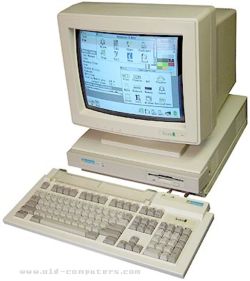
Acorn Archimedes A540
 |
| Acorn Archimedes A540 |
| Specifications |
|---|
| Manufacturer | Acorn Computers Ltd |
|---|
| Type | Personal Computer |
|---|
| Released | June 1990 |
|---|
| Discontinued | 1992 |
|---|
| Intro price | £2,495 + VAT (1990) |
|---|
| CPU | ARM3 @ 25-26 MHz (variants at 30 MHz, 33 MHz) |
|---|
| Memory | 4 MB RAM (expandable to 16 MB) |
|---|
| Storage | 3.5" floppy drive (800 KB), 100 MB SCSI hard drive |
|---|
| Display | — |
|---|
| Sound | 8-channel stereo, 8-bit |
|---|
| OS / Firmware | RISC OS 2.01 |
|---|
| Predecessor | Acorn Archimedes A440 |
|---|
| Successor | Acorn A5000 |
|---|
The Acorn Archimedes A540 was introduced in June 1990 as the flagship model of the Archimedes range. It was Acorn's first machine to be fitted with the ARM3 processor as standard, supporting up to 16 MB of RAM, and included higher speed SCSI and provision for connecting genlock devices.
The A540 represented Acorn's response to the need for a high-performance workstation in the Archimedes range. It was an anticipated consequence of Acorn's Unix workstation development, offering the same general specification as Acorn's R260 Unix workstation (running RISC iX) but without built-in Ethernet support and running RISC OS 2 instead of Unix. At £2,495 plus VAT, it was positioned as the top-of-the-range model, substantially more expensive than other Archimedes computers but offering unprecedented performance for the platform.
The A540 hardware was essentially identical to the R260 except that RISC iX was not installed; it could be purchased separately and installed on an A540. The machine was designed to appeal to professional users, educational institutions requiring maximum performance, and as a potential Unix workstation.
The A540 featured an ARM3 processor on a replaceable CPU card. Initial models shipped with processors running at 25-26 MHz, though variants existed running at 30 MHz and 33 MHz. The 26 MHz version used a 52 MHz oscillator, while some machines used 60 MHz oscillators for 30 MHz operation. The ARM3 included 4 KB of cache memory, providing substantial performance improvements over ARM2-based models.
The CPU card could accommodate an FPA10 (Floating Point Accelerator), with FPA11 also being compatible with later variants. The 33 MHz ARM3 CPU with FPA10 combination represented the highest performance configuration available. The ceramic ARM3 processors used in some machines could be overclocked, with reports of stable operation at up to 40+ MHz.
The A540 had 4 MB RAM by default but could be expanded to 16 MB with additional RAM cards, each with its own 4 MB RAM and MEMC1a memory controller. This unique multi-MEMC configuration allowed the A540 to exceed the 4 MB limitation of single-MEMC systems.
The memory expansion was achieved through up to three additional RAM cards, giving possible configurations of 4 MB, 8 MB, 12 MB, or 16 MB total. Both Acorn and third-party manufacturers like Simtec produced RAM cards for the system. The memory cards were noted to be somewhat temperamental and liable to become dislodged if the machine wasn't used for extended periods.
Unlike the rest of the Archimedes range, the A540 had a SCSI interface as standard, specifically using an NCR 53C90 or 53C90A controller. The machine shipped with a 100 MB SCSI hard disc, with the Acorn AKA31 or AKA32 SCSI interface providing both internal and external SCSI connectivity. The system retained the standard 800 KB double-density 3.5" floppy drive used across the Archimedes range.
The A540 used the VIDC1a (Video Controller) chip and included three BNC connectors unique to the A540 and R260 models. The system supported various display modes with resolutions up to 1152×896 pixels and could display 256 colors from a palette of 4096. The memory access frequency was raised to 12 MHz in the A540, compared to 8 MHz in earlier models, providing enhanced system performance.
The A540 featured a larger power supply than standard Archimedes machines, containing two fans for cooling. The system was noted to generate considerable heat, particularly with fully loaded configurations, and the memory cards were susceptible to heat-related issues.
The machine provided four podule (expansion card) slots, with all four remaining available for expansion since SCSI was integrated on the motherboard. The backplane supported various expansion cards including:
- Atomwide Ethernet IV cards for networking
- Computer Concepts Colour Card Gold for enhanced graphics
- Aleph1 386 PC emulation cards
- ScanLight podules for scanning
- MIDI interfaces
The A540 was launched with RISC OS 2.01, which included bug fixes and improvements over the earlier 2.00 release. The ROM-based operating system provided:
- ARM3 processor support with cache control
- Native SCSI device handling through the SCSI manager
- Support for memory configurations beyond 4 MB
- Improved printer driver stability and font manager fixes
Many A540s were later upgraded to RISC OS 3.10 or 3.11, with the Acorn Universal Boot system being a popular addition for enhanced functionality. Some machines, particularly ex-Acorn examples, retained RISC OS 2.01 with specialized software such as SJResearch Nexus Level 4 fileserver software for Econet networks.
While sold as a RISC OS machine, the A540 could run RISC iX (Acorn's BSD Unix variant) when purchased separately. The hardware provided genuine Unix workstation capabilities, supporting:
- Multi-user operation via serial terminals
- X Windows System
- Standard Unix development tools
- Network operation via optional Ethernet cards
Performance under RISC iX was reported to be competitive with contemporary Unix workstations, with the ARM3's cache particularly benefiting Unix operations.
The A540 motherboard existed in at least two documented versions:
- Issue 1: Initial production version
- Issue 2: Revised version with minor improvements
The motherboard design utilized PAL chips to alter addressing for each MEMC, enabling the multi-MEMC memory configuration. The system used different phases of the memory clock (derived from a 72 MHz oscillator) for each MEMC, with abort signals ANDed together so an abort only occurred if all MEMCs failed to translate an address.


