

Osborne Executive: Difference between revisions
No edit summary |
|||
| (3 intermediate revisions by the same user not shown) | |||
| Line 1: | Line 1: | ||
{{Infobox computer | {{Infobox computer | ||
| name = Osborne Executive | | name = Osborne Executive | ||
| image = [[File:Osbourne | | image = [[File:Osbourne-executive.jpg|250px]] | ||
| caption = Osborne Executive portable computer | | caption = Osborne Executive portable computer | ||
| manufacturer = Osborne Computer Corporation | | manufacturer = Osborne Computer Corporation | ||
| Line 24: | Line 24: | ||
The '''Osborne Executive''' is a portable CP/M-based computer released by Osborne Computer Corporation in 1982 as the successor to the Osborne 1. It featured a larger screen, more memory, and enhanced storage capacity, targeting business users seeking improved portability and performance. | The '''Osborne Executive''' is a portable CP/M-based computer released by Osborne Computer Corporation in 1982 as the successor to the Osborne 1. It featured a larger screen, more memory, and enhanced storage capacity, targeting business users seeking improved portability and performance. | ||
== | == Architecture and Processor == | ||
At its core, the Osborne Executive utilised a '''Zilog Z80A''' microprocessor running at 4 MHz. This 8-bit CPU was widely used in CP/M systems of the era, providing compatibility with a large library of business and productivity software. | At its core, the Osborne Executive utilised a '''Zilog Z80A''' microprocessor running at 4 MHz. This 8-bit CPU was widely used in CP/M systems of the era, providing compatibility with a large library of business and productivity software. | ||
The system architecture was designed to maximise performance within the CP/M environment, supporting bank-switched memory to address up to 128 KB of RAM—double that of its predecessor. | The system architecture was designed to maximise performance within the CP/M environment, supporting bank-switched memory to address up to 128 KB of RAM—double that of its predecessor. | ||
== | == Memory and Storage == | ||
The Executive shipped with: | The Executive shipped with: | ||
* '''128 KB RAM''' (bank-switched, with 64 KB accessible at a time under CP/M 2.2) | * '''128 KB RAM''' (bank-switched, with 64 KB accessible at a time under CP/M 2.2) | ||
| Line 39: | Line 39: | ||
* No internal hard disk; all storage was floppy-based. | * No internal hard disk; all storage was floppy-based. | ||
== | == Display and Graphics == | ||
A key improvement over the Osborne 1 was the Executive's display: | A key improvement over the Osborne 1 was the Executive's display: | ||
* '''7-inch amber monochrome CRT''' | * '''7-inch amber monochrome CRT''' | ||
| Line 47: | Line 47: | ||
The larger, higher-resolution screen made the Executive more suitable for word processing and spreadsheet applications. | The larger, higher-resolution screen made the Executive more suitable for word processing and spreadsheet applications. | ||
== | == Sound Capabilities == | ||
The Osborne Executive did not include dedicated sound hardware. Any audio output was limited to system beeps generated by a simple internal speaker. | The Osborne Executive did not include dedicated sound hardware. Any audio output was limited to system beeps generated by a simple internal speaker. | ||
== | == Input/Output and Expansion == | ||
The Executive provided a range of I/O ports for peripheral connectivity: | The Executive provided a range of I/O ports for peripheral connectivity: | ||
* '''IEEE-488 (GPIB) port''' for printers and external devices | * '''IEEE-488 (GPIB) port''' for printers and external devices | ||
| Line 61: | Line 61: | ||
The system was bundled with a suite of productivity software, including WordStar, SuperCalc, and dBase II. | The system was bundled with a suite of productivity software, including WordStar, SuperCalc, and dBase II. | ||
== | == PCB Schematics & Service Manual == | ||
<templatestyles src="Template:StyledTable/styles.css" /> | <templatestyles src="Template:StyledTable/styles.css" /> | ||
| Line 71: | Line 71: | ||
|- | |- | ||
| [[File:Osborne-Executive-Motherboard.jpg|thumb|center|300px|Osborne Executive Main Logic Board]] | | [[File:Osborne-Executive-Motherboard.jpg|thumb|center|300px|Osborne Executive Main Logic Board]] | ||
| [[File:Osborne | | [[File:Osborne Exec Schematic.pdf|center|thumb|Osborne Executive Schematics]] | ||
|} | |} | ||
For full service documentation, see the | For full service documentation, see the [[:Category:Osborne Documentation|Osborne Documentation]] category. | ||
== | == Gallery == | ||
<gallery mode="packed" heights="200"> | <gallery mode="packed" heights="200"> | ||
File: | File:Osbourne-executive.jpg|Osborne Executive portable computer (open) | ||
File: | File:Osborne_exec_keyboard_ditached.jpg|Osborne Executive with keyboard detached | ||
File: | File:Osborneexecutive-crt.jpg|7" amber CRT display (80×24 text) | ||
File:Osborne-Executive-Motherboard.jpg|Main logic board | File:Osborne-Executive-Motherboard.jpg|Main logic board | ||
</gallery> | </gallery> | ||
== | == Related Pages == | ||
* [[Osborne Executive Maintenance Guide]] | * [[Osborne Executive Maintenance Guide]] | ||
* [[Osborne Executive Troubleshooting Guide]] | * [[Osborne Executive Troubleshooting Guide]] | ||
Latest revision as of 19:05, 12 May 2025
 | |
| Osborne Executive portable computer | |
| Specifications | |
|---|---|
| Manufacturer | Osborne Computer Corporation |
| Type | Portable Computer |
| Released | 1982 |
| Discontinued | 1983 |
| Intro price | US$2,495 (1982) |
| CPU | Zilog Z80A @ 4 MHz |
| Memory | 128 KB RAM |
| Storage | Dual 5.25" double-sided, double-density floppy drives (each 360 KB) |
| Display | 7" amber monochrome CRT (80×24 text) |
| Sound | None |
| Dimensions | 18.5" × 11.25" × 7.5" |
| Weight | 28 lbs (12.7 kg) |
| OS / Firmware | CP/M 2.2 |
| Predecessor | Osborne 1 |
| Successor | Osborne Vixen |
| Model no. | OCC Executive |
The Osborne Executive is a portable CP/M-based computer released by Osborne Computer Corporation in 1982 as the successor to the Osborne 1. It featured a larger screen, more memory, and enhanced storage capacity, targeting business users seeking improved portability and performance.
Architecture and Processor
[edit | edit source]At its core, the Osborne Executive utilised a Zilog Z80A microprocessor running at 4 MHz. This 8-bit CPU was widely used in CP/M systems of the era, providing compatibility with a large library of business and productivity software.
The system architecture was designed to maximise performance within the CP/M environment, supporting bank-switched memory to address up to 128 KB of RAM—double that of its predecessor.
Memory and Storage
[edit | edit source]The Executive shipped with:
- 128 KB RAM (bank-switched, with 64 KB accessible at a time under CP/M 2.2)
- ROM containing the boot loader and system utilities
For mass storage, the Executive featured:
- Dual 5.25" double-sided, double-density floppy drives
- Each drive stored up to 360 KB per disk, for a total of 720 KB of removable storage.
- No internal hard disk; all storage was floppy-based.
Display and Graphics
[edit | edit source]A key improvement over the Osborne 1 was the Executive's display:
- 7-inch amber monochrome CRT
- 80 columns × 24 rows of text (compared to the Osborne 1's 52×24)
- No bitmap graphics capability; text-only output
The larger, higher-resolution screen made the Executive more suitable for word processing and spreadsheet applications.
Sound Capabilities
[edit | edit source]The Osborne Executive did not include dedicated sound hardware. Any audio output was limited to system beeps generated by a simple internal speaker.
Input/Output and Expansion
[edit | edit source]The Executive provided a range of I/O ports for peripheral connectivity:
- IEEE-488 (GPIB) port for printers and external devices
- RS-232C serial port for modems and serial peripherals
- Parallel (Centronics) port for printers
- Video output for external monitor (monochrome composite)
- Keyboard – detachable, full-stroke, 69-key keyboard with numeric keypad
- Expansion slot for optional modem or other add-ons
The system was bundled with a suite of productivity software, including WordStar, SuperCalc, and dBase II.
PCB Schematics & Service Manual
[edit | edit source]The Osborne Executive's hardware comprised a main logic board and a separate power supply board. Detailed schematics and service documentation were provided to support field repairs and upgrades.
| Main Logic Board | Logic Board Schematics |
|---|---|
 |
File:Osborne Exec Schematic.pdf |
For full service documentation, see the Osborne Documentation category.
Gallery
[edit | edit source]-
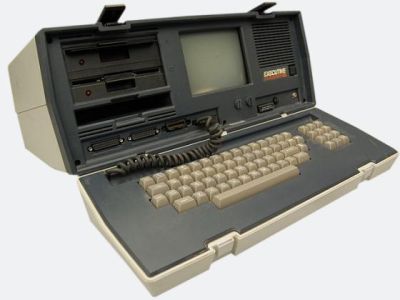 Osborne Executive portable computer (open)
 -
 Osborne Executive with keyboard detached
 -
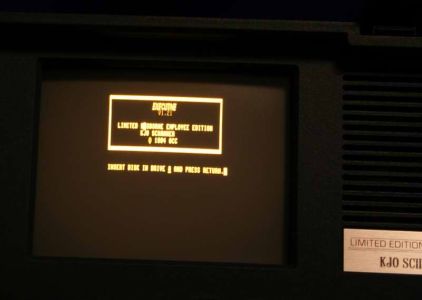 7" amber CRT display (80×24 text)
 -
 Main logic board

