
Osborne Executive
The Osborne Executive is a portable CP/M-based computer released by Osborne Computer Corporation in 1982 as the successor to the Osborne 1. It featured a larger screen, more memory, and enhanced storage capacity, targeting business users seeking improved portability and performance.
 | |
| Osborne Executive portable computer | |
| Specifications | |
|---|---|
| Manufacturer | Osborne Computer Corporation |
| Type | Portable Computer |
| Released | 1982 |
| Discontinued | 1983 |
| Intro price | US$2,495 (1982) |
| CPU | Zilog Z80A @ 4 MHz |
| Memory | 128 KB RAM |
| Storage | Dual 5.25" double-sided, double-density floppy drives (each 360 KB) |
| Display | 7" amber monochrome CRT (80×24 text) |
| Sound | None |
| Dimensions | 18.5" × 11.25" × 7.5" |
| Weight | 28 lbs (12.7 kg) |
| OS / Firmware | CP/M 2.2 |
| Predecessor | Osborne 1 |
| Successor | Osborne Vixen |
| Model no. | OCC Executive |
Architecture and Processor
editAt its core, the Osborne Executive utilised a Zilog Z80A microprocessor running at 4 MHz. This 8-bit CPU was widely used in CP/M systems of the era, providing compatibility with a large library of business and productivity software.
The system architecture was designed to maximise performance within the CP/M environment, supporting bank-switched memory to address up to 128 KB of RAM—double that of its predecessor.
Memory and Storage
editThe Executive shipped with:
- 128 KB RAM (bank-switched, with 64 KB accessible at a time under CP/M 2.2)
- ROM containing the boot loader and system utilities
For mass storage, the Executive featured:
- Dual 5.25" double-sided, double-density floppy drives
- Each drive stored up to 360 KB per disk, for a total of 720 KB of removable storage.
- No internal hard disk; all storage was floppy-based.
Display and Graphics
editA key improvement over the Osborne 1 was the Executive's display:
- 7-inch amber monochrome CRT
- 80 columns × 24 rows of text (compared to the Osborne 1's 52×24)
- No bitmap graphics capability; text-only output
The larger, higher-resolution screen made the Executive more suitable for word processing and spreadsheet applications.
Sound Capabilities
editThe Osborne Executive did not include dedicated sound hardware. Any audio output was limited to system beeps generated by a simple internal speaker.
Input/Output and Expansion
editThe Executive provided a range of I/O ports for peripheral connectivity:
- IEEE-488 (GPIB) port for printers and external devices
- RS-232C serial port for modems and serial peripherals
- Parallel (Centronics) port for printers
- Video output for external monitor (monochrome composite)
- Keyboard – detachable, full-stroke, 69-key keyboard with numeric keypad
- Expansion slot for optional modem or other add-ons
The system was bundled with a suite of productivity software, including WordStar, SuperCalc, and dBase II.
PCB Schematics & Service Manual
editThe Osborne Executive's hardware comprised a main logic board and a separate power supply board. Detailed schematics and service documentation were provided to support field repairs and upgrades.
| Main Logic Board | Logic Board Schematics |
|---|---|
 |
File:Osborne Exec Schematic.pdf |
For full service documentation, see the Osborne Documentation category.
Gallery
edit-
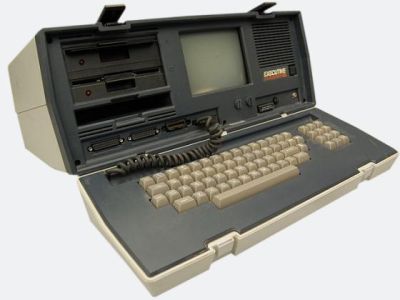 Osborne Executive portable computer (open)
 -
 Osborne Executive with keyboard detached
 -
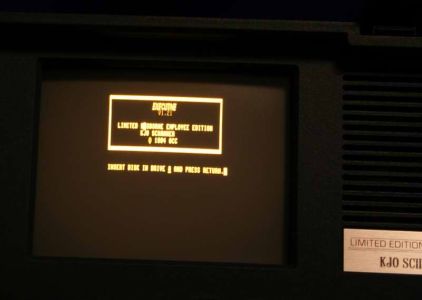 7" amber CRT display (80×24 text)
 -
 Main logic board

