

Sega Dreamcast
 | |
 | |
| Sega Dreamcast console, controller, and VMU | |
| Specifications | |
|---|---|
| Manufacturer | Sega |
| Type | Home video game console |
| Released | 27 November 1998 (JP); 9 September 1999 (NA); 14 October 1999 (EU); 30 November 1999 (AU) |
| Discontinued | 31 March 2001 (hardware) |
| Intro price | JP¥29,000 (JP launch); US$199 (NA launch) |
| CPU | Hitachi SH-4 RISC @ 200 MHz |
| Memory | 16 MB main RAM, 8 MB video RAM, 2 MB sound RAM |
| Storage | GD-ROM (1.2 GB), VMU flash memory (128 KB) |
| Display | 640×480 pixels, 16.77 million colours (24-bit), VGA output supported |
| Sound | Yamaha AICA, 64-channel PCM/ADPCM, 32-bit ARM7 @ 45 MHz |
| Dimensions | 190 mm × 195 mm × 76 mm |
| Weight | 1.5 kg |
| OS / Firmware | Sega OS (Katana SDK), custom middleware |
| Predecessor | Sega Saturn (Model 2) |
| Codename | Katana |
| Model no. | HKT-3000 (JP/NA/EU/AU) |
The Sega Dreamcast is a home video game console released by Sega in late 1998 in Japan and worldwide in 1999. As Sega's final console, it introduced several innovations, including built-in modem support for online play and a versatile architecture aimed at both arcade and home gaming.
Architecture and Processor
[edit | edit source]At its core, the Dreamcast is powered by a Hitachi SH-4 32-bit RISC CPU running at 200 MHz, delivering 360 MIPS and 1.4 GFLOPS. The SH-4 features a superscalar architecture with a 128-bit SIMD DSP for fast floating-point operations, making it well-suited for 3D graphics and arcade-quality games.
The system’s graphics are handled by the PowerVR2 CLX2 GPU, developed by NEC and VideoLogic, capable of hardware transform and lighting, bump mapping, anti-aliasing, and order-independent transparency.
Memory and Storage
[edit | edit source]The Dreamcast’s memory subsystem comprises:
- 16 MB 64-bit main RAM
- 8 MB video RAM (VRAM)
- 2 MB sound RAM (AICA)
For storage, the Dreamcast uses proprietary GD-ROM discs (1.2 GB capacity), providing more space than standard CDs. Save data is stored on VMU (Visual Memory Unit) memory cards, each with 128 KB flash memory, which also function as mini-game devices and secondary screens.
Display and Graphics
[edit | edit source]The graphics subsystem is built around the PowerVR2 CLX2 GPU, offering:
- 640×480 pixels maximum resolution (progressive scan)
- 16.77 million colours (24-bit RGB)
- VGA output (via optional cable), S-Video, composite, and RGB SCART (region dependent)
- Advanced features: hardware Z-buffering, anti-aliasing, environment mapping, and real-time texture decompression
The GPU can render approximately 3–5 million polygons per second in real-world scenarios, enabling arcade-quality visuals.
Sound Capabilities
[edit | edit source]Audio is managed by the Yamaha AICA sound processor, which includes:
- 64 hardware channels (PCM/ADPCM)
- 32-bit ARM7 RISC CPU @ 45 MHz dedicated to audio tasks
- 2 MB dedicated sound RAM
- 44.1 kHz/48 kHz stereo output, with real-time effects and MIDI synthesis
This architecture allows for complex soundtracks, voice samples, and immersive sound effects.
Input/Output and Expansion
[edit | edit source]The Dreamcast features a range of I/O and expansion options:
- Four controller ports for standard controllers, light guns, arcade sticks, and other peripherals
- Visual Memory Unit (VMU) slots in each controller for save data, mini-games, and status displays
- Built-in 56k modem (RJ-11) for online multiplayer and web browsing (10BASE-T LAN adapter available in Japan)
- AV output supporting composite, S-Video, RGB, and VGA (with adapter)
- Serial expansion port (for link cable, debugging, or broadband adapter)
- Optional peripherals: keyboard, mouse, microphone, camera, and more
PCB Schematics & Service Manual
[edit | edit source]| Mainboard | Mainboard Schematic |
|---|---|
 |
The Dreamcast’s mainboard integrates the SH-4 CPU, PowerVR2 GPU, AICA sound processor, and RAM. The power supply board is a separate, easily replaceable module. Official service manuals and schematics are available via Sega Dreamcast Service Manual (PDF) and enthusiast resources.
Gallery
[edit | edit source]-
 Dreamcast console, controller, and VMU
 -
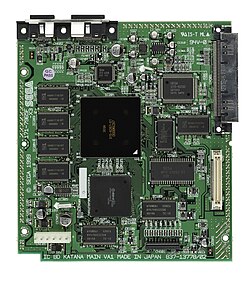 Dreamcast mainboard (top view)
 -
 Standard controller with VMU inserted
 -
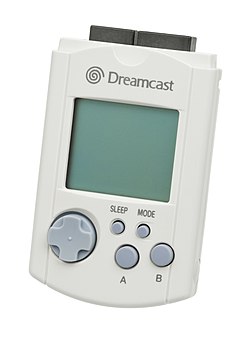 Visual Memory Unit (VMU)
 -
 Broadband adapter peripheral


