

Amstrad CPC 664
 | |
 | |
| CPC 664 with the CTM644 colour monitor | |
| Specifications | |
|---|---|
| Developer | Amstrad |
| Manufacturer | Amstrad Consumer Electronics plc |
| Type | Home computer |
| Released | 25 April 1985 |
| Discontinued | 1985 |
| Intro price | £339 with green monitor, £449 with colour monitor |
| CPU | Zilog Z80A at 4 MHz |
| Memory | 64 KB RAM |
| Storage | Built-in 3-inch disc drive |
| Display | 160 × 200 (16 colours), 320 × 200 (4) or 640 × 200 (2) from 27 |
| Sound | General Instrument AY-3-8912, three voices |
| ROM | 32 KB (operating system and Locomotive BASIC 1.1), 16 KB AMSDOS ROM |
| Power | 5 V and 12 V DC from the monitor |
| OS / Firmware | Amstrad firmware, Locomotive BASIC 1.1, AMSDOS, CP/M 2.2 |
| Predecessor | Amstrad CPC 464 |
| Successor | Amstrad CPC 6128 |
| Model no. | CPC 664 |
The Amstrad CPC 664 is the second model of the Amstrad CPC range. It keeps the 64 KB of RAM of the Amstrad CPC 464 but replaces the cassette deck with a built-in 3-inch disc drive, and it has Locomotive BASIC 1.1. It was introduced in the UK on 25 April 1985 at £339 with a green monitor or £449 with a colour monitor, and was made for only about six months: when the CPC 6128 reached Europe on 15 August 1985, Amstrad dropped the 664.[1] In Germany, Austria and Switzerland it was sold as the Schneider CPC 664, with grey keys.[1]
Power
Like the 464, the CPC 664 has no mains connection and no power supply of its own, but it needs two DC feeds. Amstrad's specification lists a 5 mm socket for the 5 V supply from the monitor and a 5 mm plug and lead that goes to the 12 V disc power socket on the monitor. The power supply entry reads "Screen System: 240V AC 50Hz (keyboard and disc drive power supplied by screen system)".[2] The CTM644 colour monitor and the GT65 green monitor provide both rails. In the parts list the DC jack is J301 and the 12 V cord CD301; the 5-pin DIN socket J302 is for an external cassette recorder, not power.[3] The monitors contain the mains supply and a CRT; see CRT Discharge Procedure.
Hardware
Amstrad's specification lists a Z80A at 4 MHz, 64 KB of RAM with over 41 KB available to the user, 32 KB of ROM for BASIC and the operating system, a 6845 CRT controller, an AY-3-8912 sound chip (three voices, eight octaves), an 8255 parallel interface and 74 keys.[2] The parts list names:[3]
- IC111, Z8400APS (Z80A CPU)
- IC103, TMM-23256P-1952, Amstrad part 40022 (system ROM)
- IC204, TMM-23128P-1951, part 40015 (AMSDOS ROM)
- IC116, HSG3130/3170, part 40010 (gate array)
- IC108, HD6845SP; IC107, M5L8255AP-5; IC102, AY-3-8912
- IC117–124, eight HM4864U-2 DRAMs
- IC201, µPD765AC disc controller; IC202, FDC9216BT data separator
- IC301, LA4140, and IC302, LA63585, with relay RY301, for the cassette interface
Part 40012 in the same list is IC211, a 74LS27, not a ROM.[3]
The screen modes are the same as the 464's: 160 × 200 in 16 colours, 320 × 200 in 4 and 640 × 200 in 2, from a palette of 27.[2]
Main board
The CPC 664 has a single main board, Z70205, 475 × 155 mm, seen in two versions.[4] MC0005A has an 8-pin data separator. MC0005B is found in German Schneider machines and usually carries a patch resistor between pin 9 (A0) and pin 14 (/CASADDR) of IC105; it is R160 in the schematic but has no legend on the board, so it is a factory addition, not a previous owner's repair.[4] The CPC 464 boards are listed on the CPC 464 page.
Disc drive
Amstrad's specification describes a 3-inch drive "conforming to the Hitachi/Panasonic standard", with the software set for a 12 ms step rate and 30 ms settling time, and a second-drive socket; the system controls at most two drives.[2] The mechanism is a Matsushita EME-150A with its own board, PCB 30001. On this model the spindle speed is set with VR201 on that board; the 3-inch drives turn at 300 rpm, a 200 ms index period.[5] Amstrad's flow chart gives the same target: adjust with VR201 to 200 ±1 ms.[6]
The drive is single-sided, 40 tracks; the user turns the disc over to use the other side, and each side has its own write-protect clip.[2] AMSDOS and CP/M share three formats:[2]
| Format | Sectors per track | Reserved tracks | Capacity |
|---|---|---|---|
| SYSTEM | 9 | 2 | 169K |
| DATA only | 9 | none | 178K |
| IBM | 8 | 1 | 154K |
The drive belt is the usual cause of a drive that runs its motor without turning the disc. CPCWiki gives the replacement belt as 3 mm wide, 0.6 mm thick and 230 mm in outer circumference, often sold as "115 mm".[7] Amstrad's manual marks its drive alignment pages for information only: "Service Agents must not carry out any repair or adjustment to the Drive mechanism and its associated PCB 30001 during warranty."[6] The Amstrad CPC 664 Maintenance Guide covers the belt and the speed adjustment.
Specification
| Item | Figure |
|---|---|
| Processor | Z80A at 4 MHz |
| Memory | 64K RAM (over 41K available to the user); 32K ROM for BASIC and OS |
| Expansion | Up to 252 additional 16K ROMs |
| Keyboard unit | 580 × 70 × 170 mm, 2.4 kg |
| CTM644 monitor | 375 × 340 × 365 mm, 10.6 kg |
| GT65 monitor | 305 × 315 × 335 mm, 6.3 kg |
| Mains | 240 V AC 50 Hz, at the monitor |
Documentation
- Amstrad CPC 664 Service Manual – Amstrad's service manual for the CPC 664, CTM644 and GT65
Gallery
-
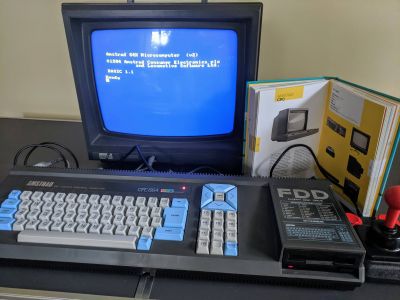 CPC 664 with the CTM644 colour monitor
 -
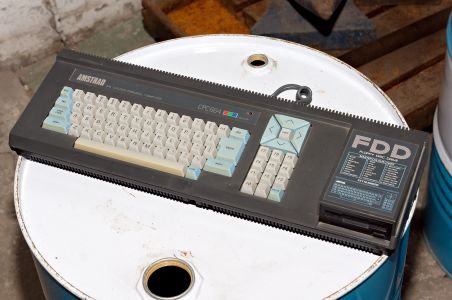 The keyboard unit and disc drive
 -
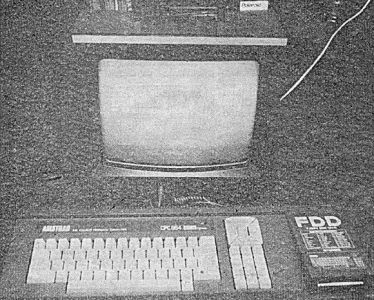 CPC 664 in a 1985 catalogue photograph
 -
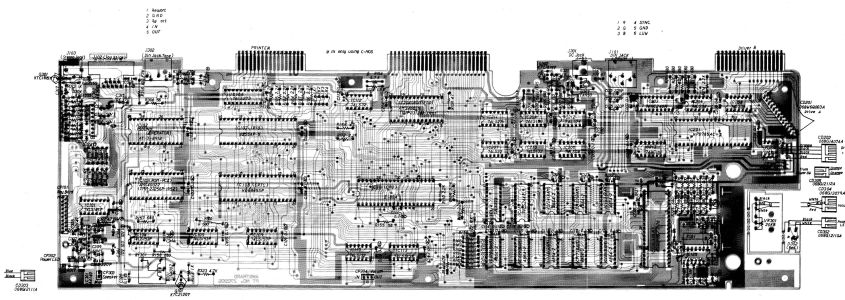 Main PCB layout from Amstrad's service manual


Related pages
- Amstrad CPC 664 Maintenance Guide
- Amstrad CPC 664 Troubleshooting Guide
- Amstrad CPC 664 Capacitor Replacement Guide
- Amstrad CPC 464 · Amstrad 6128
- CRT Discharge Procedure
References
- ↑ 1.0 1.1 Wikipedia, "Amstrad CPC", sections "CPC 664", "CPC 6128" and "Schneider CPC". Retrieved 2026-10-01. Gives the 664's introduction date and prices, its short production run, the 6128's European launch date and the Schneider distribution in German-speaking Europe.
- ↑ 2.0 2.1 2.2 2.3 2.4 2.5 2.6 Amstrad Consumer Electronics plc, CPC664 Micro Computer / CTM644 Colour Monitor / GT65 Green Monitor Service Manual, back page "CPC664 Technical Specification". Described at Amstrad CPC 664 Service Manual.
- ↑ 3.0 3.1 3.2 Amstrad Consumer Electronics plc, CPC664 Micro Computer / CTM644 Colour Monitor / GT65 Green Monitor Service Manual, p. 21 "Electrical Parts List CPC664". Described at Amstrad CPC 664 Service Manual.
- ↑ 4.0 4.1 CPCWiki, "Mainboard Versions". Retrieved 2026-10-01. Community catalogue of board markings and per-version changes, compiled from photographed boards.
- ↑ CPCWiki, "Amstrad FDD part". Retrieved 2026-10-01. Lists the Matsushita mechanisms Amstrad used (EME-150A on PCB 30001 in the CPC 664 and early DDI-1 and 6128, then EME-155, EME-156, EME-156V and EME-157), their common characteristics, and speed adjustment.
- ↑ 6.0 6.1 Amstrad Consumer Electronics plc, CPC664 Micro Computer / CTM644 Colour Monitor / GT65 Green Monitor Service Manual, pp. 8–11 "Diagnostic Flow Chart" and p. 12 "Alignment Checks". Described at Amstrad CPC 664 Service Manual.
- ↑ CPCWiki, "Changing the drive belt". Retrieved 2026-10-01. Gives the belt size and a removal procedure for the CPC 6128, which it says is nearly the same on other CPCs and the DDI-1.