

BBC Micro Model A/B: Difference between revisions
No edit summary |
|||
| (2 intermediate revisions by the same user not shown) | |||
| Line 25: | Line 25: | ||
The '''BBC Microcomputer System''' (commonly known as the '''BBC Micro''') was a series of microcomputers designed and built by Acorn Computers Ltd for the BBC Computer Literacy Project. Launched in late 1981, it became a defining educational and home computer in the UK, renowned for its robust design, expandability, and role in British computing history. | The '''BBC Microcomputer System''' (commonly known as the '''BBC Micro''') was a series of microcomputers designed and built by Acorn Computers Ltd for the BBC Computer Literacy Project. Launched in late 1981, it became a defining educational and home computer in the UK, renowned for its robust design, expandability, and role in British computing history. | ||
== | == Architecture and Processor == | ||
At its heart, the BBC Micro employed the '''MOS Technology 6502A''' 8-bit microprocessor, clocked at 2 MHz. The system architecture was designed for flexibility and performance, with a fast system bus and a highly modular layout supporting a wide range of expansion options. | At its heart, the BBC Micro employed the '''MOS Technology 6502A''' 8-bit microprocessor, clocked at 2 MHz. The system architecture was designed for flexibility and performance, with a fast system bus and a highly modular layout supporting a wide range of expansion options. | ||
| Line 34: | Line 34: | ||
* '''Custom ULA''': Unified Logic Array for video, keyboard, and I/O timing | * '''Custom ULA''': Unified Logic Array for video, keyboard, and I/O timing | ||
== | == Memory and Storage == | ||
The BBC Micro was available in two main variants: | The BBC Micro was available in two main variants: | ||
* '''Model A''': 16 KB RAM | * '''Model A''': 16 KB RAM | ||
| Line 49: | Line 49: | ||
* '''ROM cartridge slots''' for instant software loading | * '''ROM cartridge slots''' for instant software loading | ||
== | == Display and Graphics == | ||
Graphics and video output were handled by a custom ULA and Motorola 6845 CRTC, supporting a range of text and graphics modes: | Graphics and video output were handled by a custom ULA and Motorola 6845 CRTC, supporting a range of text and graphics modes: | ||
| Line 75: | Line 75: | ||
* '''Hardware scrolling''', cursor, and palette controls. | * '''Hardware scrolling''', cursor, and palette controls. | ||
== | == Sound Capabilities == | ||
Audio was provided by the '''Texas Instruments SN76489''' programmable sound generator, offering: | Audio was provided by the '''Texas Instruments SN76489''' programmable sound generator, offering: | ||
* '''3 tone channels''' (independent pitch and volume) | * '''3 tone channels''' (independent pitch and volume) | ||
| Line 84: | Line 84: | ||
The BBC Micro's sound system was widely used in educational software, games, and music applications. | The BBC Micro's sound system was widely used in educational software, games, and music applications. | ||
== | == Input/Output and Expansion == | ||
The BBC Micro was designed for expandability, with a comprehensive set of I/O ports and internal connectors: | The BBC Micro was designed for expandability, with a comprehensive set of I/O ports and internal connectors: | ||
| Line 100: | Line 100: | ||
The Model B included all ports as standard; Model A required upgrades for some interfaces. | The Model B included all ports as standard; Model A required upgrades for some interfaces. | ||
== | == PCB Schematics & Service Manual == | ||
The BBC Micro featured a robust motherboard design, with separate logic and power supply boards in most models. | The BBC Micro featured a robust motherboard design, with separate logic and power supply boards in most models. | ||
{| class="wikitable styled-table" style="width:80%; text-align:center;" | {| class="wikitable styled-table" style="width:80%; text-align:center;" | ||
! | ! Logic Board | ||
! | ! Logic Board Schematic | ||
|- | |- | ||
| [[File:BBC Micro Motherboard.jpg|center|thumb|321x321px|BBC Micro Model B Logic Board]] | | [[File:BBC Micro Motherboard.jpg|center|thumb|321x321px|BBC Micro Model B Logic Board]] | ||
| Line 112: | Line 112: | ||
Full service manuals and schematics are available at [[BBC Microcomputer Service Manual October 1985]] | Full service manuals and schematics are available at [[BBC Microcomputer Service Manual October 1985]] | ||
== | == Gallery == | ||
<gallery mode="packed" heights="200"> | <gallery mode="packed" heights="200"> | ||
File:BBC Micro Front Restored.jpg|BBC Micro Model B (front view) | File:BBC Micro Front Restored.jpg|BBC Micro Model B (front view) | ||
| Line 119: | Line 119: | ||
</gallery> | </gallery> | ||
== | == Related Pages == | ||
* [[BBC Micro Model A/B General Maintenance]] | * [[BBC Micro Model A/B General Maintenance]] | ||
* [[BBC Micro Model A/B Troubleshooting Guide]] | * [[BBC Micro Model A/B Troubleshooting Guide]] | ||
Latest revision as of 00:42, 5 September 2025
 | |
 | |
| BBC Micro Model B | |
| Specifications | |
|---|---|
| Manufacturer | Acorn Computers Ltd |
| Type | Home Computer |
| Released | 1 December 1981 |
| Discontinued | 1986 |
| Intro price | Model A: £235, Model B: £335 (1981, inc. VAT) |
| CPU | MOS Technology 6502A @ 2 MHz |
| Memory | Model A: 16 KB RAM, Model B: 32 KB RAM; 32 KB ROM (BASIC, MOS, DFS) |
| Storage | Cassette tape, optional 5.25" floppy disk (DFS), ROM cartridge |
| Display | Teletext, 640×256 (monochrome), 320×256 (4 colours), 160×256 (8 colours), 80×25 text |
| Sound | Texas Instruments SN76489: 3 sound channels + 1 noise channel |
| Dimensions | 40 cm × 34 cm × 8 cm |
| Weight | 4.5 kg |
| OS / Firmware | Acorn MOS (Machine Operating System) in ROM |
| Predecessor | Acorn Atom |
| Successor | BBC Micro Model B+ |
| Codename | Proton |
| Model no. | Model A, Model B, Model B+ |
The BBC Microcomputer System (commonly known as the BBC Micro) was a series of microcomputers designed and built by Acorn Computers Ltd for the BBC Computer Literacy Project. Launched in late 1981, it became a defining educational and home computer in the UK, renowned for its robust design, expandability, and role in British computing history.
Architecture and Processor
[edit | edit source]At its heart, the BBC Micro employed the MOS Technology 6502A 8-bit microprocessor, clocked at 2 MHz. The system architecture was designed for flexibility and performance, with a fast system bus and a highly modular layout supporting a wide range of expansion options.
Key features:
- CPU: MOS 6502A @ 2 MHz
- System bus: 8-bit data, 16-bit address (64 KB address space)
- ROM: 32 KB (split between BASIC II, Acorn MOS, and optionally DFS or other utilities)
- Custom ULA: Unified Logic Array for video, keyboard, and I/O timing
Memory and Storage
[edit | edit source]The BBC Micro was available in two main variants:
- Model A: 16 KB RAM
- Model B: 32 KB RAM (most popular)
Both models included 32 KB of ROM, containing:
- Acorn MOS (operating system)
- BBC BASIC II
- Optional: Disc Filing System (DFS) or other ROMs in cartridge slots
Storage options:
- Cassette tape interface (standard, 1200 baud)
- 5.25" floppy disk drive (optional, via DFS)
- ROM cartridge slots for instant software loading
Display and Graphics
[edit | edit source]Graphics and video output were handled by a custom ULA and Motorola 6845 CRTC, supporting a range of text and graphics modes:
| Mode | Resolution | Colours | Text Columns × Rows |
|---|---|---|---|
| 0 | 640×256 | 2 (monochrome) | 80 × 25 |
| 1 | 320×256 | 4 | 40 × 25 |
| 2 | 160×256 | 8 | 20 × 25 |
| 3 | 640×256 | 2 (monochrome) | 80 × 25 (text only) |
| 4 | 320×256 | 2 | 40 × 25 |
| 5 | 160×256 | 4 | 20 × 25 |
| 6 | 320×256 | 2 | 40 × 25 (reduced memory) |
| 7 | Teletext (Mode 7) | 8 (Teletext) | 40 × 25 |
- Teletext Mode 7: Hardware support for the UK's teletext broadcast standard, enabling high-quality text and simple graphics.
- Hardware scrolling, cursor, and palette controls.
Sound Capabilities
[edit | edit source]Audio was provided by the Texas Instruments SN76489 programmable sound generator, offering:
- 3 tone channels (independent pitch and volume)
- 1 noise channel
- 7-octave range
- Internal speaker (mono), with line-level output
The BBC Micro's sound system was widely used in educational software, games, and music applications.
Input/Output and Expansion
[edit | edit source]The BBC Micro was designed for expandability, with a comprehensive set of I/O ports and internal connectors:
- User port (8-bit parallel, TTL-level)
- Printer port (Centronics parallel)
- RS-423 serial port (for modems, printers)
- Analogue port (joysticks, ADC)
- RGB, composite, and UHF video outputs
- Cassette interface
- Econet network port (optional)
- Tube interface (for second processor expansion, e.g., 6502, Z80, 32016, ARM)
- 1 MHz bus (for peripherals such as ADC, IEEE-488, etc.)
- ROM cartridge sockets (up to 4 sideways ROMs)
The Model B included all ports as standard; Model A required upgrades for some interfaces.
PCB Schematics & Service Manual
[edit | edit source]The BBC Micro featured a robust motherboard design, with separate logic and power supply boards in most models.
| Logic Board | Logic Board Schematic |
|---|---|
 |
 |
Full service manuals and schematics are available at BBC Microcomputer Service Manual October 1985
Gallery
[edit | edit source]-
 BBC Micro Model B (front view)
 -
 Rear panel with I/O ports
 -
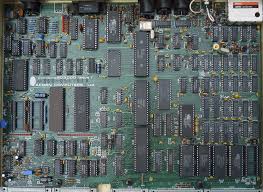 BBC Micro Model B motherboard
