

BBC Micro Model A/B: Difference between revisions
No edit summary |
|||
| Line 25: | Line 25: | ||
The '''BBC Microcomputer System''' (commonly known as the '''BBC Micro''') was a series of microcomputers designed and built by Acorn Computers Ltd for the BBC Computer Literacy Project. Launched in late 1981, it became a defining educational and home computer in the UK, renowned for its robust design, expandability, and role in British computing history. | The '''BBC Microcomputer System''' (commonly known as the '''BBC Micro''') was a series of microcomputers designed and built by Acorn Computers Ltd for the BBC Computer Literacy Project. Launched in late 1981, it became a defining educational and home computer in the UK, renowned for its robust design, expandability, and role in British computing history. | ||
== | == Architecture and Processor == | ||
At its heart, the BBC Micro employed the '''MOS Technology 6502A''' 8-bit microprocessor, clocked at 2 MHz. The system architecture was designed for flexibility and performance, with a fast system bus and a highly modular layout supporting a wide range of expansion options. | At its heart, the BBC Micro employed the '''MOS Technology 6502A''' 8-bit microprocessor, clocked at 2 MHz. The system architecture was designed for flexibility and performance, with a fast system bus and a highly modular layout supporting a wide range of expansion options. | ||
| Line 34: | Line 34: | ||
* '''Custom ULA''': Unified Logic Array for video, keyboard, and I/O timing | * '''Custom ULA''': Unified Logic Array for video, keyboard, and I/O timing | ||
== | == Memory and Storage == | ||
The BBC Micro was available in two main variants: | The BBC Micro was available in two main variants: | ||
* '''Model A''': 16 KB RAM | * '''Model A''': 16 KB RAM | ||
| Line 49: | Line 49: | ||
* '''ROM cartridge slots''' for instant software loading | * '''ROM cartridge slots''' for instant software loading | ||
== | == Display and Graphics == | ||
Graphics and video output were handled by a custom ULA and Motorola 6845 CRTC, supporting a range of text and graphics modes: | Graphics and video output were handled by a custom ULA and Motorola 6845 CRTC, supporting a range of text and graphics modes: | ||
| Line 75: | Line 75: | ||
* '''Hardware scrolling''', cursor, and palette controls. | * '''Hardware scrolling''', cursor, and palette controls. | ||
== | == Sound Capabilities == | ||
Audio was provided by the '''Texas Instruments SN76489''' programmable sound generator, offering: | Audio was provided by the '''Texas Instruments SN76489''' programmable sound generator, offering: | ||
* '''3 tone channels''' (independent pitch and volume) | * '''3 tone channels''' (independent pitch and volume) | ||
| Line 84: | Line 84: | ||
The BBC Micro's sound system was widely used in educational software, games, and music applications. | The BBC Micro's sound system was widely used in educational software, games, and music applications. | ||
== | == Input/Output and Expansion == | ||
The BBC Micro was designed for expandability, with a comprehensive set of I/O ports and internal connectors: | The BBC Micro was designed for expandability, with a comprehensive set of I/O ports and internal connectors: | ||
| Line 100: | Line 100: | ||
The Model B included all ports as standard; Model A required upgrades for some interfaces. | The Model B included all ports as standard; Model A required upgrades for some interfaces. | ||
== | == PCB Schematics & Service Manual == | ||
The BBC Micro featured a robust motherboard design, with separate logic and power supply boards in most models. | The BBC Micro featured a robust motherboard design, with separate logic and power supply boards in most models. | ||
| Line 112: | Line 112: | ||
Full service manuals and schematics are available at [[BBC Microcomputer Service Manual October 1985]] | Full service manuals and schematics are available at [[BBC Microcomputer Service Manual October 1985]] | ||
== | == Gallery == | ||
<gallery mode="packed" heights="200"> | <gallery mode="packed" heights="200"> | ||
File:BBC Micro Front Restored.jpg|BBC Micro Model B (front view) | File:BBC Micro Front Restored.jpg|BBC Micro Model B (front view) | ||
Revision as of 21:27, 9 August 2025
 | |
 | |
| BBC Micro Model B | |
| Specifications | |
|---|---|
| Manufacturer | Acorn Computers Ltd |
| Type | Home Computer |
| Released | 1 December 1981 |
| Discontinued | 1986 |
| Intro price | Model A: £235, Model B: £335 (1981, inc. VAT) |
| CPU | MOS Technology 6502A @ 2 MHz |
| Memory | Model A: 16 KB RAM, Model B: 32 KB RAM; 32 KB ROM (BASIC, MOS, DFS) |
| Storage | Cassette tape, optional 5.25" floppy disk (DFS), ROM cartridge |
| Display | Teletext, 640×256 (monochrome), 320×256 (4 colours), 160×256 (8 colours), 80×25 text |
| Sound | Texas Instruments SN76489: 3 sound channels + 1 noise channel |
| Dimensions | 40 cm × 34 cm × 8 cm |
| Weight | 4.5 kg |
| OS / Firmware | Acorn MOS (Machine Operating System) in ROM |
| Predecessor | Acorn Atom |
| Successor | BBC Micro Model B+ |
| Codename | Proton |
| Model no. | Model A, Model B, Model B+ |
The BBC Microcomputer System (commonly known as the BBC Micro) was a series of microcomputers designed and built by Acorn Computers Ltd for the BBC Computer Literacy Project. Launched in late 1981, it became a defining educational and home computer in the UK, renowned for its robust design, expandability, and role in British computing history.
Architecture and Processor
At its heart, the BBC Micro employed the MOS Technology 6502A 8-bit microprocessor, clocked at 2 MHz. The system architecture was designed for flexibility and performance, with a fast system bus and a highly modular layout supporting a wide range of expansion options.
Key features:
- CPU: MOS 6502A @ 2 MHz
- System bus: 8-bit data, 16-bit address (64 KB address space)
- ROM: 32 KB (split between BASIC II, Acorn MOS, and optionally DFS or other utilities)
- Custom ULA: Unified Logic Array for video, keyboard, and I/O timing
Memory and Storage
The BBC Micro was available in two main variants:
- Model A: 16 KB RAM
- Model B: 32 KB RAM (most popular)
Both models included 32 KB of ROM, containing:
- Acorn MOS (operating system)
- BBC BASIC II
- Optional: Disc Filing System (DFS) or other ROMs in cartridge slots
Storage options:
- Cassette tape interface (standard, 1200 baud)
- 5.25" floppy disk drive (optional, via DFS)
- ROM cartridge slots for instant software loading
Display and Graphics
Graphics and video output were handled by a custom ULA and Motorola 6845 CRTC, supporting a range of text and graphics modes:
| Mode | Resolution | Colours | Text Columns × Rows |
|---|---|---|---|
| 0 | 640×256 | 2 (monochrome) | 80 × 25 |
| 1 | 320×256 | 4 | 40 × 25 |
| 2 | 160×256 | 8 | 20 × 25 |
| 3 | 640×256 | 2 (monochrome) | 80 × 25 (text only) |
| 4 | 320×256 | 2 | 40 × 25 |
| 5 | 160×256 | 4 | 20 × 25 |
| 6 | 320×256 | 2 | 40 × 25 (reduced memory) |
| 7 | Teletext (Mode 7) | 8 (Teletext) | 40 × 25 |
- Teletext Mode 7: Hardware support for the UK's teletext broadcast standard, enabling high-quality text and simple graphics.
- Hardware scrolling, cursor, and palette controls.
Sound Capabilities
Audio was provided by the Texas Instruments SN76489 programmable sound generator, offering:
- 3 tone channels (independent pitch and volume)
- 1 noise channel
- 7-octave range
- Internal speaker (mono), with line-level output
The BBC Micro's sound system was widely used in educational software, games, and music applications.
Input/Output and Expansion
The BBC Micro was designed for expandability, with a comprehensive set of I/O ports and internal connectors:
- User port (8-bit parallel, TTL-level)
- Printer port (Centronics parallel)
- RS-423 serial port (for modems, printers)
- Analogue port (joysticks, ADC)
- RGB, composite, and UHF video outputs
- Cassette interface
- Econet network port (optional)
- Tube interface (for second processor expansion, e.g., 6502, Z80, 32016, ARM)
- 1 MHz bus (for peripherals such as ADC, IEEE-488, etc.)
- ROM cartridge sockets (up to 4 sideways ROMs)
The Model B included all ports as standard; Model A required upgrades for some interfaces.
PCB Schematics & Service Manual
The BBC Micro featured a robust motherboard design, with separate logic and power supply boards in most models.
| Logic Board | Logic Board Schematic |
|---|---|
 |
 |
Full service manuals and schematics are available at BBC Microcomputer Service Manual October 1985
Gallery
-
 BBC Micro Model B (front view)
 -
 Rear panel with I/O ports
 -
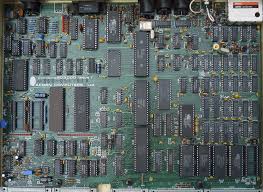 BBC Micro Model B motherboard
