
IBM PCjr
The IBM PCjr (model 4860) was IBM's first attempt at a low-cost home personal computer. It was announced on November 1, 1983 and shipped from March 19, 1984. After poor sales and persistent criticism, IBM withdrew the line on March 19, 1985 — exactly one year after launch. Approximately 250,000 PCjrs were produced before the line ended.
 | |
 | |
| IBM PCjr (4860) with its companion IBM 4863 display | |
| Specifications | |
|---|---|
| Developer | IBM Entry Systems Division, Boca Raton |
| Manufacturer | IBM |
| Type | Home / consumer personal computer |
| Released | March 19, 1984 (announced November 1, 1983) |
| Discontinued | March 19, 1985 |
| CPU | Intel 8088 @ 4.77 MHz |
| Memory | 64 KB on-board (4860-004) or 128 KB on-board (4860-067); expandable to 512 KB and beyond via sidecar memory modules |
| Storage | One 5.25" 360 KB half-height floppy drive (4860-067 only); cassette port; two ROM cartridge ports |
| Display | Built-in CGA-compatible video with extra 16-colour 320×200 and 4-colour 640×200 modes; RGB DIN, composite video, audio out, RF modulator via IBM PCjr TV Connector |
| Sound | Texas Instruments SN76496 3-voice tone generator with one noise channel, plus PC speaker |
| Dimensions | ~14" W × 11.4" D × 3.8" H (35.6 × 29 × 9.5 cm) |
| Weight | ~11.7 lb (5.3 kg) system unit, without keyboard or monitor |
| OS / Firmware | IBM PC DOS 2.1 (introduced specifically for the PCjr); IBM Cassette BASIC J1.0 in ROM |
| Predecessor | None — new product line |
| Successor | None — line ended after one year |
| Model no. | 4860 |
The PCjr is broadly compatible with the IBM PC at the BIOS level, but several hardware differences (no DMA controller, different memory map, SN76496 sound chip in place of the speaker, ROM cartridges instead of expansion slots, infrared wireless keyboard, sidecar bus instead of ISA) make it a separate platform in practice. Software designed for the PCjr's "Tandy/PCjr" video and sound modes is also fully compatible with the Tandy 1000.
Models
editThe PCjr was offered as two off-the-shelf configurations.
| Submodel | On-board RAM | Floppy | Modem | Original US list price |
|---|---|---|---|---|
| 4860-004 (Entry) | 64 KB | none | none | US $669 |
| 4860-067 (Enhanced) | 128 KB | 360 KB 5.25" | Optional internal 300 baud modem | US $1269 |
Architecture
editThe PCjr is based on an Intel 8088 running at 4.77 MHz, the same CPU clock as the 5150 and 5160. It does not have an Intel 8237 DMA controller; all I/O including floppy operations is done by PIO. As a result, keystrokes can be lost while the floppy drive is being accessed (the keyboard receiver also drops scan codes during disk operation, which is a known PCjr limitation).
Key chips on the motherboard include:
- Intel 8088 — CPU (no second-source NEC V20 was officially endorsed for the PCjr).
- Intel 8259A — programmable interrupt controller.
- Intel 8253 — programmable interval timer.
- Intel 8255A — programmable peripheral interface.
- Motorola MC6845 — CRT controller, embedded on the motherboard rather than on a video card.
- Texas Instruments SN76496 — sound chip with three square-wave tone generators plus a noise channel. The same chip used on the Tandy 1000, which is why the chip and its register layout are commonly called "PCjr/Tandy sound."
The PCjr motherboard does not implement memory parity, in order to save chip count and cost. Bit errors in DRAM are not reported.
Memory
editThe 4860-004 has 64 KB of on-board DRAM. The 4860-067 has 128 KB of on-board DRAM. Additional RAM is provided via sidecar memory expansion modules:
- IBM PCjr Memory Expansion Attachment — 128 KB sidecar (and its variants), commonly stacked to reach 384 KB or 512 KB.
- Third-party memory sidecars from Tecmar (Captain Jr.), Microsoft (Booster), Racore (PC Drive) and others extended the PCjr to 640 KB and beyond.
A known software limitation (the "PCjr cliff") is that some PC-compatible software written before late 1984 fails on the PCjr when it tries to use video memory at A0000h, because the PCjr video memory is mapped at the top of system memory and shadows the area expected by some software.
Video
editVideo is built into the motherboard, based on the MC6845 CRTC. The PCjr offers all of the standard CGA modes (40-column text, 80-column text, 320×200×4 colour graphics, 640×200×2 colour graphics) and two additional modes:
- 320 × 200 × 16 colours.
- 640 × 200 × 4 colours.
These two extra modes are commonly referred to as "PCjr/Tandy graphics" because Tandy reused them in the Tandy 1000. Video output is available as TTL RGB (DIN-6), composite video, and via the optional IBM PCjr TV Connector as RF for a domestic TV. The IBM 4863 Display is the matched CRT monitor sold for the PCjr.
Sound
editSound is produced by the Texas Instruments SN76496. The chip provides three square-wave tone channels (with programmable frequency and 16-step amplitude) and one noise channel. Output is mixed with the PC speaker on the motherboard and exposed on a 1/8" mono audio jack on the rear. Sound from the SN76496 is output to either an external amplifier or, via the TV Connector, to the TV speaker.
Keyboard
editThe PCjr keyboard is a 62-key infrared wireless unit. The first revision is the famously criticised "chiclet" keyboard with small flat blank rubber keycaps. IBM replaced it in mid-1984 with a revised keyboard that has full-travel keycaps with printed legends and a similar key layout (still 62 keys).

The keyboard communicates with the system unit via an infrared (IR) link. The IR receiver is at the front of the system unit. Strong sunlight, certain fluorescent lighting and other IR sources can interfere with reception; for reliable typing, IBM also supplied an optional cable that connects the keyboard directly to the system unit.
The keyboard can be operated in Fn-key mode (where a secondary legend printed in green/blue on the front face of each key is accessed via the Fn modifier) or normally. Plastic keytop overlays were supplied for several software products to relabel the keys.
Cartridge and Sidecar Expansion
editThe PCjr exposes two ROM cartridge ports on the front of the system unit (below the diskette drive). Each cartridge contains up to 64 KB of ROM and is memory-mapped at fixed system locations. Cartridge ROM may also substitute for the system BIOS or BASIC, via chip selects /CS6 and /CS7 routed through the connector.
On the right-hand side of the system unit, behind a removable cover, is a proprietary sidecar bus. Sidecars latch onto the side of the system unit and extend it horizontally. Multiple sidecars can be chained. IBM-sold sidecars include the Memory Expansion Attachment (128 KB), the Parallel Printer Attachment, the PCjr Power Expansion Attachment (a second power supply for sidecars), the IBM PCjr Internal Modem (300 baud), and the PCjr Cluster Attachment.

The sidecar bus is not the same as the 8-bit ISA bus and is not electrically compatible with PC/XT cards.
Power
editThe PCjr uses an external AC power brick that connects to the rear of the system unit. The brick supplies regulated DC to the motherboard. Sidecars that require additional current can be powered through the optional IBM Power Expansion Attachment.
General Maintenance
editBattery care (the PCjr does not have a CMOS battery), keyboard IR receiver care, sidecar latching and motherboard inspection are documented in IBM PCjr Maintenance Guide.
Troubleshooting
editPOST beep codes, the limited PCjr error code set, keystroke loss during floppy access, sidecar power problems and the well-known IR keyboard interference issues are documented in IBM PCjr Troubleshooting Guide.
Capacitor Replacement
editTantalum capacitor failure on the PCjr motherboard and AC adapter is documented in IBM PCjr Capacitor Replacement Guide.
Gallery
edit-
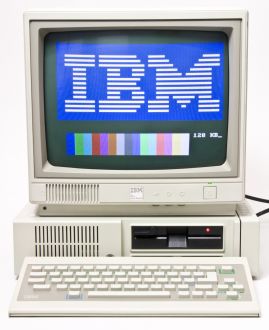 IBM PCjr with the IBM 4863 display
 -
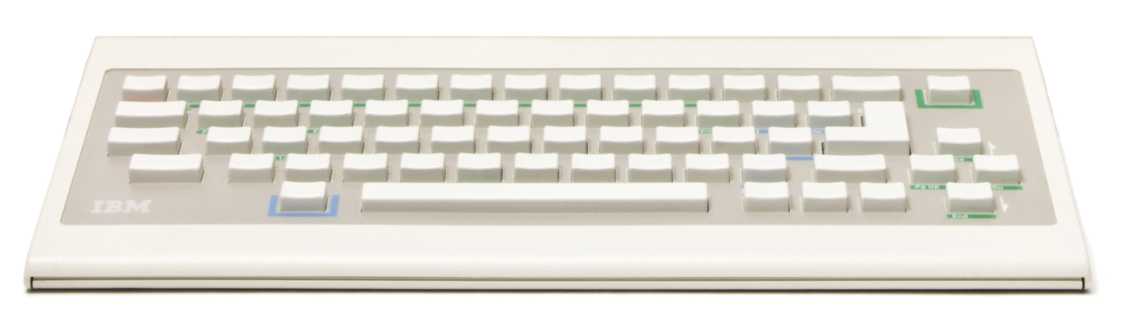 62-key infrared wireless keyboard
 -
 IBM PCjr motherboard
 -
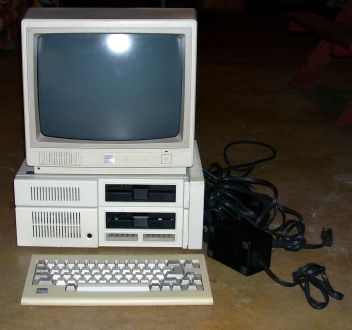 IBM PCjr with several sidecars attached
 -
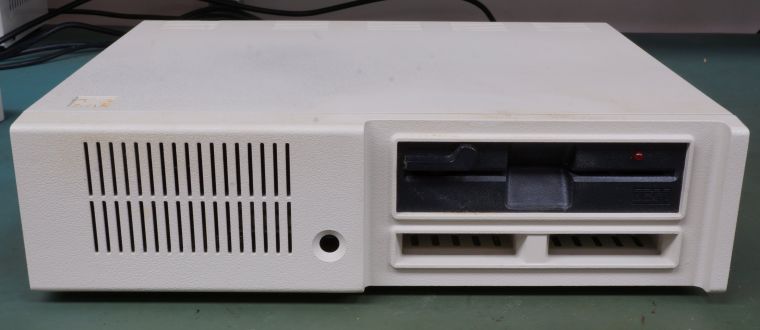 IBM PCjr internal teardown


Related Pages
edit- IBM PCjr Maintenance Guide
- IBM PCjr Troubleshooting Guide
- IBM PCjr Capacitor Replacement Guide
- IBM PC (5150) — sibling product (business-oriented PC)
References
edit- IBM PCjr — Wikipedia. Source for release/withdrawal dates, model prices, sales figures and chronology.
- Mike Brutman's PCjr resource. Reference for keyboard handling, hardware specifics and software notes.
- IBM 4860 (PCjr) — Documentation pointers, minuszerodegrees.net.
- IBM, IBM PCjr Technical Reference. Source for SN76496 register layout, sidecar bus, cartridge interface chip-select assignments (/CS2–/CS7), and motherboard chip layout.
- The Journey of the PCjr/Tandy Sound Chip. Reference for the SN76496 and its reuse on the Tandy 1000.