

DECpc LP
.jpg) | |
| DECpc LP with monitor, keyboard and DEC's DOS and Windows manuals (David Hall, zx.net.nz) | |
| Specifications | |
|---|---|
| Manufacturer | Digital Equipment Corporation |
| Type | Low-profile desktop personal computer |
| Released | 25 August 1992 (announced)[1] |
| Intro price | US$1,549 (340dxLP) to US$2,199 (466d2LP), September 1992[1] |
| CPU | AMD 386DX-40 (340dxLP); 486SX-25, Intel 486DX-33, 486DX2-50 or 486DX2-66 (others), on a plug-in CPU module[1][2] |
| Memory | 4 to 64 MB in 4 MB or 16 MB 36-bit SIMMs, 70 ns[3] |
| Storage | 3.5-inch diskette drive; up to two internal 3.5-inch IDE disks[1][4] |
| Display | 32-bit local bus SVGA with 512 KB VRAM, 1 MB optional[5] |
| Sound | — |
| Expansion | Three ISA slots on a riser board[5] |
| Power | Delta DPS-145PB-4, 145.5 W (one surviving machine)[6] |
| OS / Firmware | MS-DOS 5.0 or 6.0 with Windows 3.1[1] |
| Model no. | PC734 (333sxLP), PC736 (340dxLP), PC741 (425sxLP), PC743 (433dxLP), PC744 (450d2LP), PC746 (466d2LP)[7] |
The DECpc LP is a range of low-profile desktop personal computers that Digital Equipment Corporation announced on 25 August 1992.[1] Apart from the entry 333sxLP, whose processor is soldered and cannot be upgraded, every model carries its processor on a plug-in CPU module, so a 386 machine can be turned into a 486 by changing the module; the main logic board is the same for both.[1] DEC's service manual groups the six models as the DECpc 3xx/4xx LP.[7]
The earlier DECpc 320sxLP and 325sxLP of April 1992, with Oak graphics and a different board, are covered on DECpc 325. DEC reused the name 325sxLP for a later machine with Cirrus Logic graphics described in its DECpc 325/333 sxLP User's Guide (ER-PC733-UA.A01).[8]
Models
[edit | edit source]| Model | DEC model number | Processor | List price, September 1992 |
|---|---|---|---|
| 333sxLP | PC734 | 386SX-33, soldered | – |
| 340dxLP | PC736 | AMD 386DX-40 | US$1,549 |
| 425sxLP | PC741 | 486SX-25, soldered to the module | US$1,649 |
| 433dxLP | PC743 | Intel 486DX-33 | US$1,849 |
| 450d2LP | PC744 | Intel 486DX2-50 | US$1,999 |
| 466d2LP | PC746 | Intel 486DX2-66 | US$2,199 |
Hardware
[edit | edit source]DEC's service manual lists three ISA expansion slots, the OPTi 496/497 chip set, dual IDE interfaces, a 32-bit local bus SVGA controller with 512 KB of VRAM (another 512 KB optional), an optional external cache, and room for four storage devices.[5] The 486 CPU modules have a vacancy socket for an Intel OverDrive or upgrade processor; the 433dxLP module has 128 KB of secondary cache, expandable to 256 KB.[2] David Hall found the 425sx module's processor soldered and the others socketed, and recommends DEC's S3 924 graphics drivers.[1]
Memory is fitted in four banks of 36-bit SIMMs of 70 ns or faster, 4 MB or 16 MB only, in the combinations DEC's table allows, up to 64 MB.[3] The BIOS has no automatic hard disk detection and no LBA support; user-defined drive types 48 and 49 take manual cylinder, head and sector values.[1] There is a turbo LED but no turbo button: CPU speed is set on page 3 of BIOS Setup.[1]
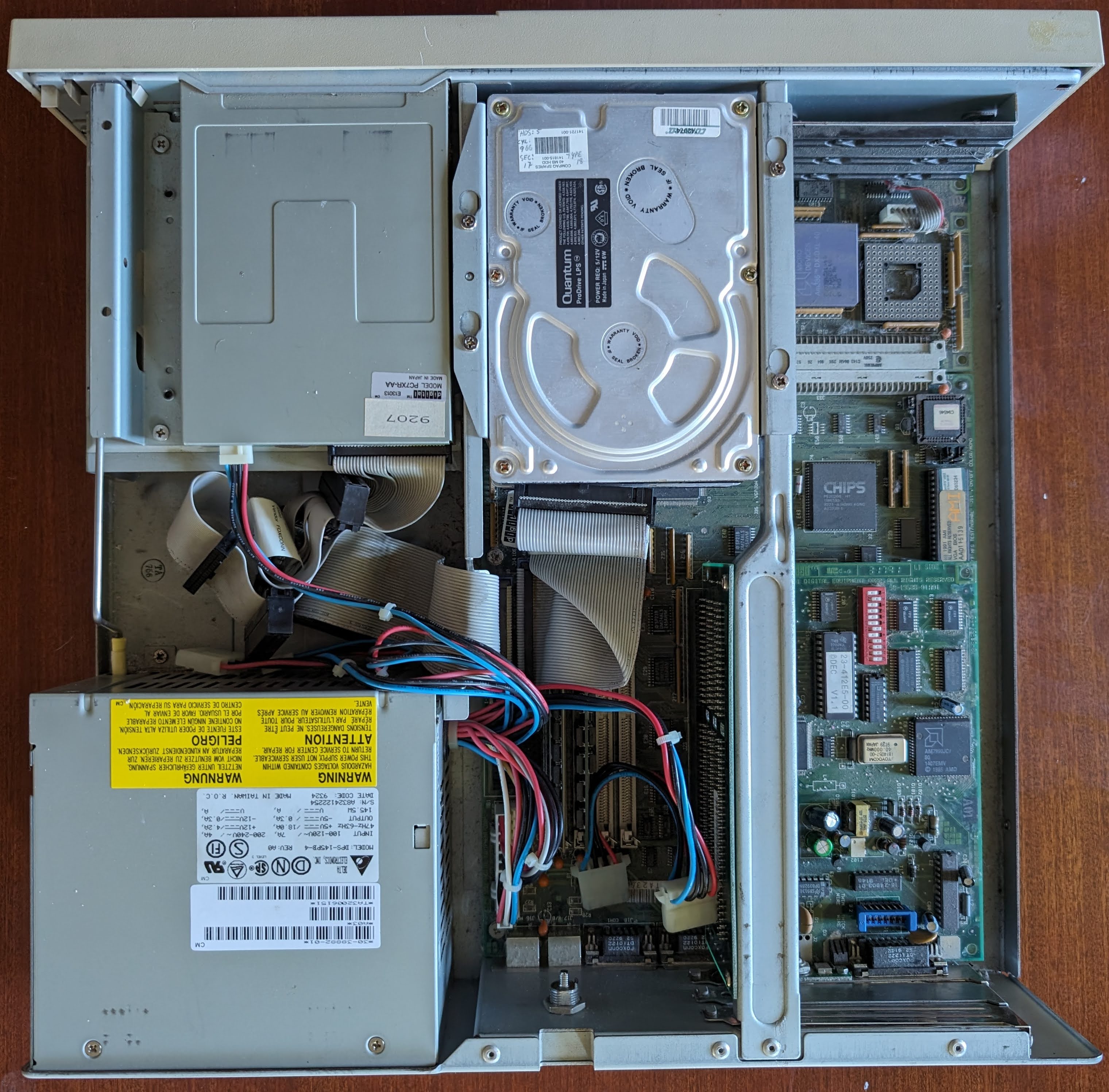
The machine is powered by an AT-style supply whose switch sits inside the supply, worked from the front button through a linkage.[1] One of David Hall's machines has a Delta DPS-145PB-4 rated at 145.5 W, carrying the DEC barcode 30-38882-01.[6] See DECpc LP Power Supply Service.
Known faults
[edit | edit source]- Clock battery leakage. The machines shipped with a Rayovac 840 4.5 V alkaline battery stuck with Velcro next to the power connector; Hall reports that it leaks and does serious damage and advises removing it on sight.[1]
- Dead power button. The short rubber tube joining the switch linkage to the supply's switch disintegrates on every machine Hall has seen, so the front button stops working.[1]
- Memory fussiness. Hall finds the machines likely work only with fast-page-mode SIMMs.[1]
See DECpc LP General Maintenance and DECpc LP Troubleshooting Guide.
Documentation
[edit | edit source]- DECpc LP PC Service Maintenance Manual, K-MN-SD00000-21-JG00.A, March 1996: File:DECpc LP Service Maintenance Manual (K-MN-SD00000-21-JG00.A).pdf
- CPU module booklets: File:DECpc 433dxLP CPU Specifications (ER-PC743-CA.A02).pdf, File:DECpc 450D2LP CPU Specifications (ER-PC744-CA.A01).pdf, File:DECpc 466D2LP CPU Specifications (ER-PC746-CA.A01).pdf
Gallery
[edit | edit source]-
 Interior, power supply at lower left (David Hall)
 -
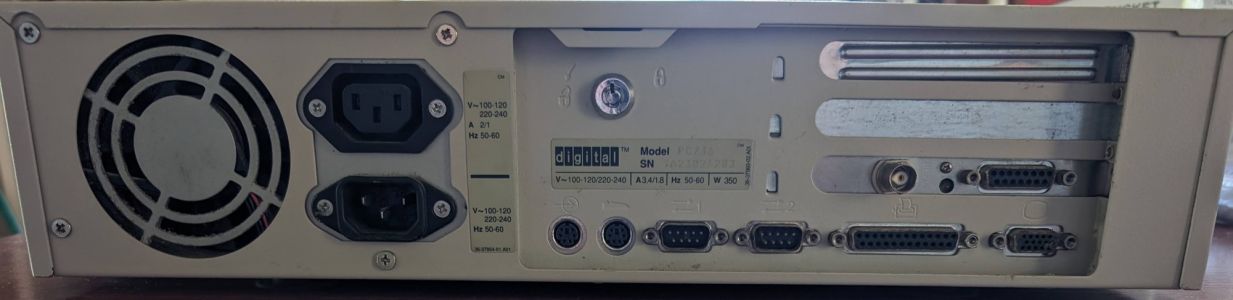 Rear panel (David Hall)
 -
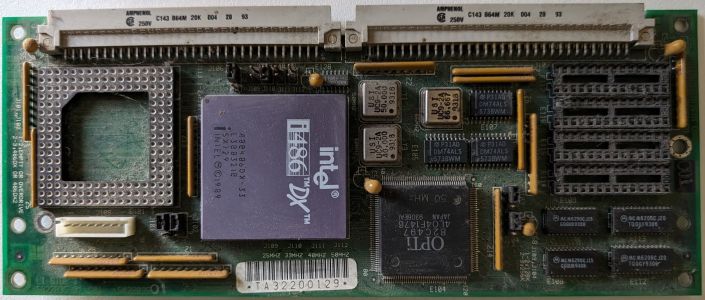 433dxLP CPU module with empty vacancy socket (David Hall)
.jpg)
.jpg)
.jpg)
Related pages
[edit | edit source]- DECpc LP General Maintenance
- DECpc LP Troubleshooting Guide
- DECpc LP Power Supply Service
- DECpc LP Documentation
- DECpc 325
- DECpc 433
References
[edit | edit source]- ↑ 1.00 1.01 1.02 1.03 1.04 1.05 1.06 1.07 1.08 1.09 1.10 1.11 1.12 1.13 1.14 David Hall, "Digital DECpc 340dx LP/425sx LP/433dx LP/450d2 LP/466d2 LP", zxnet, last modified 2 February 2024, zx.net.nz. Announcement date, prices, CPU modules, battery, power switch linkage, memory, BIOS limits.
- ↑ 2.0 2.1 Digital Equipment Corporation, DECpc 433dxLP CPU Specifications, ER-PC743-CA.A02, August 1992, pp. 1–7 (File:DECpc 433dxLP CPU Specifications (ER-PC743-CA.A02).pdf). 33 MHz 486DX, cache, vacancy socket.
- ↑ 3.0 3.1 DEC, K-MN-SD00000-21-JG00.A, p. 32. Computer memory configurations.
- ↑ DEC, K-MN-SD00000-21-JG00.A, p. 41. Connecting mass storage; diskette drive cabling.
- ↑ 5.0 5.1 5.2 Digital Equipment Corporation, DECpc LP PC Service Maintenance Manual, K-MN-SD00000-21-JG00.A, March 1996, p. 11 (File:DECpc LP Service Maintenance Manual (K-MN-SD00000-21-JG00.A).pdf). Product introduction and features.
- ↑ 6.0 6.1 Rating label of the power supply in a DECpc LP, photographed by David Hall, zx.net.nz (File:DECpc LP Delta DPS-145PB-4 power supply label (zx.net.nz).jpg).
- ↑ 7.0 7.1 7.2 DEC, K-MN-SD00000-21-JG00.A, p. 12. DECpc LP models information.
- ↑ David Hall, "Digital DECpc 320sxLP/325sxLP", zxnet, last modified 31 May 2024, zx.net.nz. The two machines named 325sxLP.
.jpg)