

IBM PS/ValuePoint
 | |
 | |
| IBM PS/ValuePoint 325T (machine type 6381 / 6384 with IBM 386SLC-25 CPU) | |
| Specifications | |
|---|---|
| Developer | IBM Personal Computer Company |
| Manufacturer | IBM |
| Type | Corporate / SMB desktop personal computer family — ISA / VLB / PCI |
| Released | 20 October 1992 |
| Discontinued | July 1995 (replaced by IBM PC Series 300) |
| CPU | IBM 386SLC-25; Intel 486SX-25/33, 486DX-33, 486DX2-50/66, 486DX4-100; Intel Pentium 60 (Pentium 60 only — Pentium 75/90/100 belong to the successor PC Series 300/700) |
| Memory | 30-pin parity SIMM (early 6384), 72-pin parity SIMM (all others) — 16 MB (325T) / 32 MB (early 6384) / 64 MB (most 486 boards) / 128 MB (P60/D) |
| Storage | On-planar IDE/ATA primary (max 2 IDE devices); on-planar floppy controller (1.44 MB on 486 boards, 2.88 MB on P60/D); optional 8-bit or 16-bit Future Domain SCSI adapter |
| Display | On-planar SVGA: Cirrus Logic CL-GD5422 (325T), Tseng ET4000 / ET4000-W32 (1992 6384 / /Si), Cirrus CL-GD5428 (6381-Fxx), S3 86C805 (/S, /D, /T), S3 Vision864 (/Sp, /Dp, /Tp PCI), ATI Mach32 68800AX (P60/D) |
| Sound | PC piezo beeper (no speaker) |
| OS / Firmware | IBM PC DOS 5.0 / 6.x / 7.0; Microsoft Windows 3.1 / WfWg 3.11 / Windows 95; IBM OS/2 2.x / Warp 3 |
| Predecessor | IBM PS/2 Model 30 (corporate ISA-based ancestor) |
| Successor | IBM PC Series 300 (and PC 700) |
| Model no. | 6381, 6382, 6384, 6387; later transitional MTs 6472, 6482, 6484, 6492, 6494 |
The IBM PS/ValuePoint is IBM's corporate / SMB desktop PC line, announced on 20 October 1992 and withdrawn in July 1995. It sat below the high-end PS/2 (Micro Channel) and above the consumer IBM PS/1, using commodity industry standards — ISA bus, SVGA, IDE — to compete in the price-competitive corporate-clone market that the PS/2's proprietary Micro Channel could not address.[1] The line was IBM's belated answer to the PC clone vendors (Compaq, Dell, Gateway, Northgate, AST) and saw VESA Local Bus added in the 1993 486 refresh, then PCI added with the Pentium 60 P60/D submodel in 1994.[2]
The line was succeeded in 1995–1996 by the IBM PC Series 300 (entry/midrange) and IBM PC Series 700 (high-end), which dropped the "PS/ValuePoint" name entirely. Marketing-tier siblings during the PS/ValuePoint's lifetime were the IBM Ambra (mail-order brand) and the consumer IBM Aptiva.
Note on Machine-Type Numbering
[edit | edit source]The PS/ValuePoint line uses four IBM machine types (MTs): 6381, 6382, 6384, 6387. The Wikipedia infobox once listed the mini-tower as 8387, but every primary IBM source (Hardware Maintenance Manual S61G-1423, PSRef withdrawn-products book, the kev009 mirror of IBM service documents) gives the mini-tower MT as 6387.[3][4] This article uses 6387.
Later (1994–1995) machine types in the 64xx series (6472, 6482, 6484, 6492, 6494) carry the PS/ValuePoint brand into a transitional "VP2" / PC 300 era and share the same beep-code index as the 638x family.[5]
Machine-Type and Form-Factor Map
[edit | edit source]| MT | Form factor | Slots | Bays | Notes |
|---|---|---|---|---|
| 6381 | Introductory space-saving desktop (suffix /Si) | 3 ISA on riser | 3 | Entry SX boards, Cirrus video, 100 W PSU |
| 6382 | Space-saving desktop (suffix /S) | 3 | 3 | VLB era 486 boards, S3 video |
| 6384 | Desktop and Pentium "P60/D" variant (suffix /D) | 5 | 5 | Main desktop family |
| 6387 | Mini-tower (suffix /T) | 8 (1 VLB+ISA shared + 5 full ISA + 2 half ISA) | 6 | Tower form factor |
Submodel Reference
[edit | edit source]| Submodel | CPU | Bus | Video | Memory ceiling | Notes |
|---|---|---|---|---|---|
| 325T (6381 / 6384) | IBM 386SLC-25 | ISA | Cirrus CL-GD5422 (1 MB) | 16 MB | IBM 386SLC, 8 KB internal cache, no L2; 2 MB soldered + 2 × 72-pin SIMM[6] |
| 425SX (6384, 1992) | Intel 486SX-25 | ISA | Tseng ET4000 (1 MB) | 32 MB (30-pin SIMM) | |
| 433DX (6384, 1992) | Intel 486DX-33 | ISA | Tseng ET4000 (1 MB) | 32 MB (30-pin SIMM) | |
| 466DX2 (6384, 1992) | Intel 486DX2-66 | ISA | Tseng ET4000 (1 MB) | 32 MB (30-pin SIMM) | |
| 425SX/Si (6381-Fxx) | Intel 486SX-25 + P24T OverDrive socket | VLB | Cirrus CL-GD5428 (512K–1 MB) | 64 MB | SiS 85C461 chipset, no L2, CR2032 battery[7][8] |
| 433SX/Si (6381) | Intel 486SX-33 | VLB | Cirrus CL-GD5428 | 64 MB | |
| 433DX/Si (6381) | Intel 486DX-33 | VLB | Tseng ET4000-W32 | 64 MB | 128 / 256 KB L2 field-upgradeable |
| 466DX2/Si (6381) | Intel 486DX2-66 | VLB | Tseng ET4000-W32 | 64 MB | |
| 425SX – 466DX2 /S, /D, /T (6382, 6384, 6387) | 486SX-25/33, DX-33, DX2-50/66 | VLB | S3 86C805 (1–2 MB) | 64 MB | Most common family; Type 1 vs Type 2 planar — see below |
| 100DX4/Sp, /Tp | Intel 486DX4-100 | VLB or PCI | S3 Vision864 | 64 MB | "p" suffix = PCI / Vision864 platform |
| 466DX2/Sp, /Dp, /Tp | Intel 486DX2-66 | VLB or PCI | S3 Vision864 | 64 MB | |
| P60/D (6384, models 189, 193, 199, 1A3, 1A9) | Intel Pentium 60 | PCI + ISA | ATI Mach32 68800AX (1–2 MB) | 128 MB | 16 KB L1 + 256 KB L2 write-back; no OverDrive path[9] |
The PS/ValuePoint line offers only the Pentium 60 as a Pentium-class option — Pentium 75/90/100 belong to the successor IBM PC Series 300 / 700.

Architecture and Planar Notes
[edit | edit source]Type 1 vs Type 2 (486 VLB Boards)
[edit | edit source]The 486 VLB-era planars on the 6382, 6384, 6387 exist in two revisions:
- Type 1 — write-through L2 cache; SIMM sockets run left-to-right.
- Type 2 — write-back L2 cache; SIMM sockets run front-to-back when the I/O ports face away.
Distinguish them by SIMM socket orientation.[10] OverDrive jumpers differ: J10 / J11 on Type 1 boards; J17 / J18 on Type 2 boards. P24T-83 Pentium OverDrive requires BIOS v68 or later.[11]
Chipsets
[edit | edit source]- 325T (386SLC) — IBM-custom planar, ISA only.
- 6381 425SX/Si — SiS 85C461 system controller (VLB).[12]
- 6382/S, 6384/D, 6387/T (VLB 486) — IBM-custom planar with VLB.
- /Sp, /Dp, /Tp (PCI) — PCI-equipped planar with S3 Vision864.
- P60/D — Intel 430LX "Mercury" or comparable Pentium chipset on PCI.

Memory Topology
[edit | edit source]| Submodel family | SIMM | Banks | Max |
|---|---|---|---|
| 325T (386SLC) | 72-pin parity, 70–85 ns | 2 MB soldered + 2 sockets | 16 MB |
| Original 6384 425SX / 433DX / 466DX2 (1992) | 30-pin parity, 70–80 ns | 4 sockets / banks of 4 | 32 MB |
| 6381/Si, 6382/S, 6384/D, 6387/T (VLB 486) | 72-pin parity, 70 ns (up to 85 ns) | 4 sockets | 64 MB |
| 6384 P60/D | 72-pin parity, 70 ns | 4 sockets / installed in pairs | 128 MB |
All PS/ValuePoint memory is parity (non-ECC). The original 1992 6384 boards are the only PS/ValuePoint family that uses 30-pin SIMMs.[13]
Storage
[edit | edit source]All PS/ValuePoint planars use on-planar IDE/ATA primary, maximum 2 IDE devices, with optional 8-bit (TMC-850IBM/Future Domain) or 16-bit Future Domain SCSI adapter.[14] The floppy controller is on-planar and cannot be disabled; 2.88 MB drives are not supported on the 486 boards (the P60/D does support 2.88 MB).[15]
Original IBM IDE drive sizes shipped from factory: 80, 120, 170, 212, 245, 340, 420, 527 MB.[16]
Power Supplies
[edit | edit source]- 6381-Si entry — 100 W universal-voltage with manual 115/230 V switch.[17]
- 325T and original 1992 6384 — 145 W, 10 W max per slot.[18]
- 6382/S, 6384/D, 6384 P60/D, 6387/T — 200 W universal-voltage with manual selector; LV 90–137 V, HV 180–265 V, 50/60 Hz; 0.08 KVA min / 0.52 KVA max draw.[19]
Battery
[edit | edit source]The PS/ValuePoint planar battery is a standard CR2032 lithium coin cell, NOT a NiCd barrel cell. This is important — the PS/ValuePoint does not suffer the destructive battery leakage that afflicts certain other IBM ISA-era systems (e.g. some PS/2 Models 30 / 56 / 57 / 76 / 77 with soldered NiCd).[20] The IBM "Product Description" repeats "Lithium battery" for every PS/ValuePoint variant including 6381 SX, 6381 DX/DX2, 6382/S, 6384/D, 6384 P60/D, and 6387/T.[21]
The battery sits in a clip at position B1 / BT1. A separate J2 "External Battery" header and JP8 "Battery Select" jumper allows switching between the on-planar cell and an external battery wired off-board — useful for long-term storage of unused systems.[22]
Although CR2032 cells very rarely leak, they can do so under unusual conditions; restorer field reports document a leaked CR2032 specimen pulled from a 6381-Fxx, with minimal damage to the planar.[23] Check the area around B1 / BT1 for KOH-style alkaline-leak residue at every service interval.
Software
[edit | edit source]- DOS — IBM PC DOS 5.0 / 6.x / 7.0; MS-DOS 5.x / 6.x.
- Windows — Windows 3.1, Windows for Workgroups 3.11, Windows 95.
- OS/2 — OS/2 2.x and Warp 3 are well supported (PS/ValuePoint was an IBM-branded target platform for OS/2).
A documented production change between ICS and Chrontel video frequency controller chips (located just left of the Tseng video chip on the system board) caused OS/2 2.00.1 SVGA drivers to fail when changing video modes — a revised OS/2 driver fixes it.[24]
A widely-documented PS/ValuePoint quirk requires the IBMKBFIX.EXE / 6381WG31.ZIP SYSTEM.INI patch to fix keyboard lockups under Windows 3.1 and Windows for Workgroups.[25]
Pricing
[edit | edit source]Launch pricing (October 1992, US, IBM-Direct list):
- 325T (entry 386SLC, no HDD): from ~$1,500 USD.
- 425SX (486SX-25, 80 MB HDD): from ~$1,800 USD.
- 433DX (486DX-33, 120 MB HDD, network ready): from ~$2,800 USD.
- 466DX2 (486DX2-66, 170 MB HDD): from ~$3,200 USD.
- P60/D (Pentium 60, 1994 launch): from ~$3,500 USD.
(Refer to the PSRef withdrawn-products book for the complete per-submodel price list.[26])
Gallery
[edit | edit source]-
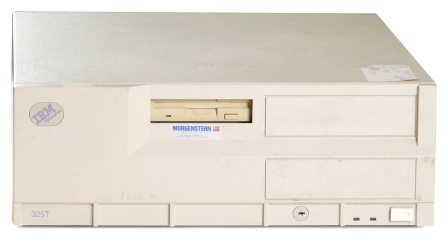 PS/ValuePoint 325T (IBM 386SLC-25)
 -
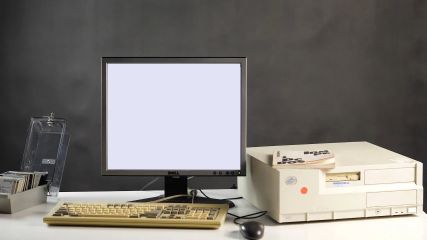 PS/ValuePoint 325T angle view
 -
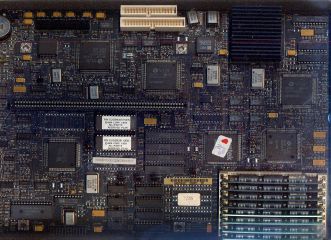 PS/ValuePoint i486SX planar (ca. 1992–1995)
 -
 PS/ValuePoint brand logo
Related Pages
[edit | edit source]- IBM PS/ValuePoint Maintenance Guide
- IBM PS/ValuePoint Troubleshooting Guide
- IBM PS/ValuePoint Capacitor Replacement Guide
- IBM PS/ValuePoint Video Mod Guide
- IBM PS/2 Model 30 — ISA-bus PS/2 ancestor
- IBM PC Series 300 — direct PS/ValuePoint successor
- Capacitor Failure Symptoms
References
[edit | edit source]- IBM PS/ValuePoint — Wikipedia. Launch and discontinuation dates, branding, lineage.
- IBM PSRef — PS/ValuePoint withdrawn-products book (1992–1995). Canonical source for SKUs, dates, IBM-Direct list prices.
- IBM Product Description — PS/ValuePoint, kev009 mirror. Form-factor map and per-submodel features.
- IBM PS/ValuePoint Tips & Tricks Section, kev009 mirror. Battery (lithium) confirmation, F1 setup, ICS/Chrontel chipset note.
- IBM PS/ValuePoint System Board layouts, kev009 mirror. B1/BT1 battery position, J2 external battery header, JP8 battery select jumper.
- IBM PS/ValuePoint 6381-Fxx product description. 100 W PSU, CR2032 battery on entry boards.
- IBM PS/ValuePoint 6382/S, 6384/D, 6387/T system info. 200 W PSU, OverDrive jumpers, Type 1 vs Type 2 distinction, IBMKBFIX.
- IBM PS/ValuePoint P60/D Pentium 60 system info. Pentium 60, PCI, 128 MB, ATI Mach32.
- IBM PS/ValuePoint 6387/T mini-tower system info. 8-slot tower, S3 86C805.
- IBM PS/ValuePoint Tips & Tricks Section continuation, kev009 mirror.
- IBM PS/ValuePoint and Model 64xx beep-code index.
- IBM Hardware Maintenance Manual S61G-1423-01 (September 1993). Authoritative HMM for 6381 / 6382 /S / 6384 / 6384 /D / 6384 P60/D / 6387 /T.
- IBM HMM S61G-1423-02 (August 1996). Updated HMM covering 638x and later 64xx machine types.
- IBM 6387/T Supplement S71G-1875-00 (May 1993). Tower-specific service supplement.
- The Retro Web — IBM PS/ValuePoint 6381-SX motherboard. SiS 85C461 chipset identification.
- zx.net.nz — IBM PS/ValuePoint 425SX/Si hands-on documentation. CR2032 leakage report, Alps floppy SMD cap note, Windows IBMKBFIX issue.
- ↑ https://en.wikipedia.org/wiki/IBM_PS/ValuePoint
- ↑ https://en.wikipedia.org/wiki/IBM_PS/ValuePoint
- ↑ http://ps-2.kev009.com/pcpartnerinfo/ctstips/d5ca.htm
- ↑ https://manualzz.com/doc/10390575/s61g_1423_02
- ↑ http://ps-2.kev009.com/pcpartnerinfo/ctstips/ad96.htm
- ↑ http://ps-2.kev009.com/pcpartnerinfo/ctstips/e1f6.htm
- ↑ https://theretroweb.com/motherboards/s/ibm-ps-valuepoint-6381-sx
- ↑ https://www.zx.net.nz/computers/ibm/psvaluepoint_425sxsi/
- ↑ http://ps-2.kev009.com/pcpartnerinfo/ctstips/5e9a.htm
- ↑ http://ps-2.kev009.com/pcpartnerinfo/ctstips/859e.htm
- ↑ http://ps-2.kev009.com/pcpartnerinfo/ctstips/859e.htm
- ↑ https://theretroweb.com/motherboards/s/ibm-ps-valuepoint-6381-sx
- ↑ http://ps-2.kev009.com/pcpartnerinfo/ctstips/27ae.htm
- ↑ http://ps-2.kev009.com/pcpartnerinfo/ctstips/e1f6.htm
- ↑ http://ps-2.kev009.com/pcpartnerinfo/ctstips/5e9a.htm
- ↑ http://ps-2.kev009.com/pcpartnerinfo/ctstips/27ae.htm
- ↑ http://ps-2.kev009.com/pcpartnerinfo/ctstips/ebaa.htm
- ↑ http://ps-2.kev009.com/pcpartnerinfo/ctstips/e1f6.htm
- ↑ http://ps-2.kev009.com/pcpartnerinfo/ctstips/859e.htm
- ↑ http://ps-2.kev009.com/pcpartnerinfo/ctstips/e1f6.htm
- ↑ http://ps-2.kev009.com/pcpartnerinfo/ctstips/27ae.htm
- ↑ http://ps-2.kev009.com/pcpartnerinfo/ctstips/a26e.htm
- ↑ https://www.zx.net.nz/computers/ibm/psvaluepoint_425sxsi/
- ↑ http://ps-2.kev009.com/pcpartnerinfo/ctstips/e1f6.htm
- ↑ http://ps-2.kev009.com/pcpartnerinfo/ctstips/859e.htm
- ↑ https://psref.lenovo.com/syspool/Sys/PDF/withdrawnbook/vpbook.pdf