
Amstrad CPC 664
The Amstrad CPC 664 (sold as the Schneider CPC 664 in West Germany, Austria and Switzerland) is the second machine in the CPC line. It replaced the CPC 464's cassette deck with a built-in 3-inch disc drive, moved the disc controller onto the main board instead of the external DDI-1, and shipped Locomotive BASIC 1.1 with AMSDOS in a separate 16 KB ROM.
 | |
 | |
| Amstrad CPC 664 with the CTM644 colour monitor | |
| Specifications | |
|---|---|
| Developer | Amstrad |
| Manufacturer | Amstrad Consumer Electronics plc |
| Type | Home computer |
| Released | 1985 |
| Discontinued | August 1985 |
| CPU | Zilog Z80A @ 4 MHz |
| Memory | 64 KB RAM (over 41 KB available to the user) |
| Storage | Built-in 3-inch single-sided disc drive, Matsushita EME-150A |
| Display | 160×200×16, 320×200×4 or 640×200×2 from a 27-colour palette |
| Sound | General Instrument AY-3-8912, three voices |
| ROM | 32 KB OS and Locomotive BASIC 1.1, plus a 16 KB AMSDOS ROM |
| Power | 5 V DC and a separate 12 V disc feed, both from the monitor |
| OS / Firmware | Amstrad firmware, Locomotive BASIC 1.1, AMSDOS, CP/M 2.2 |
| Predecessor | Amstrad CPC 464 |
| Model no. | CPC 664 |
It was on sale from May to August 1985 before the CPC 6128 replaced it, which is why it is scarcer than either the 464 or the 6128 and why the community knowledge base around it is thinner.[1] No production figure has ever been published, so none is given here.
The part numbers, designators and specification figures on this page are Amstrad's own, from the service manual hosted on this wiki.[2][3]
The monitor is the power supply
editLike the 464, the CPC 664 has no mains connection and no internal power supply — but it needs two DC feeds, not one. Amstrad's specification lists a socket for the 5 V supply from the monitor, and a plug and lead that goes out to the 12 V disc power socket on the monitor.[2] The CTM644 colour monitor and the GT65 green monitor provide both.
In the parts list these are J301 (DC jack, Amstrad part 170024 — the same part as the 464's J104) and CD301 (DC cord, part 170822).[2]
There is no five-pin DIN power connector on this machine. The 5-pin DIN on the back is J302 (part 170819), the external cassette recorder socket; the 3.5 mm socket is J103, stereo audio out.[2]
A drive that will not spin is very often a 12 V problem, not a drive problem. That rail comes down a separate lead from the monitor and that lead is a single point of failure. Check it before opening the drive.
Board
editThe CPC 664 main board is Z70205, 475 × 155 mm, in two variants:[3]
| Silkscreen | Notes |
|---|---|
| Z70205 MC0005A | 8-pin FDC data separator |
| Z70205 MC0005B | German Schneider boards. Usually carries a patch resistor R160 between pin 9 (A0) and pin 14 (/CASADDR) of IC105, which is not labelled on the PCB — do not mistake it for a previous owner's bodge |
Z70200 is a CPC 464 board, not a 664 board.[3] If your board is marked Z70200, you are looking at a 464.
Devices
editAmstrad's own parts list:[2]
| Ref | Device | Amstrad part no. | Role |
|---|---|---|---|
| IC103 | TMM-23256P-1952 | 40022 | 32 KB OS + Locomotive BASIC 1.1 ROM |
| IC204 | TMM-23128P-1951 | 40015 | 16 KB AMSDOS ROM |
| IC111 | Z8400APS | 40080 | Z80A CPU |
| IC116 | HSG3130 / HSG3170 | 40010 | Gate Array |
| IC108 | HD6845SP | 170106 | CRTC |
| IC107 | M5L8255AP-5 | 170105 | Parallel I/O |
| IC102 | AY-3-8912 | 40001 | Sound generator |
| IC117–IC124 | HM4864U-2 | 170110 | 64 KB DRAM, eight 64K × 1 devices |
| IC201 | µPD765AC | 40018 | Floppy disc controller |
| IC202 | FDC9216BT | 40020 | Data separator |
| IC301 | LA4140 | 170111 | Audio power amplifier |
| IC302 | LA63585 | 170814 | Cassette read chain |
Two corrections worth stating plainly, because both have circulated widely:
- The OS ROM is part 40022 at IC103. 40012 is IC211, a 74LS27 — a different device entirely.[2]
- The Gate Array is the 40010 at IC116. The heatsinked 40007 is the CPC 464's part, and the 40226 is the ASIC on the 464's late cost-down board. Neither belongs in a 664.[2][3]
The 664 keeps the whole cassette interface even though it has no cassette deck. IC301, IC302, the tape motor relay RY301, the speaker, the volume control and the entire 300-series population are present, feeding J302 for an external recorder.[2]
The disc drive
editAmstrad's specification describes it as "a 3" system, conforming to the Hitachi/Panasonic standard", configured in software for a 12 ms step rate and 30 ms settling time.[2] The mechanism actually fitted is the Matsushita EME-150A on PCB 30001 — the PCB number Amstrad's own manual refers to throughout.[2][4] Later machines in the family used the EME-155, EME-156 and EME-156V.
A 3-inch disc is physically double-sided, with a write-protect clip on each side, but the drive reads only the side facing it — you flip the disc by hand.[2]
Disc formats
editAmstrad's own figures. All are single-sided, double density, 512-byte sectors, 40 tracks, 2:1 interleave:[2]
| Format | Sectors per track | Reserved tracks | Capacity |
|---|---|---|---|
| SYSTEM | 9 | 2 | 169 KB |
| DATA | 9 | none | 178 KB |
| IBM | 8 | 1 | 154 KB |
The drive belt
editThe perished belt is the characteristic 664 fault. The motor runs, the disc does not, and the machine reports a read failure on a known-good disc.
Amstrad publishes no belt dimensions. The community specification for the CPC 664 / 6128 / FD-1 3-inch drive belt is 3 mm wide, 0.6 mm thick, 230 mm outer circumference — often advertised as "115 mm", which is the flat length.[5] Measure your own pulleys before ordering.
The spindle speed is adjustable at VR201 on the drive's own control PCB, to an index period of 200 ms — one revolution at 300 rpm.[2] Full procedure on Amstrad CPC 664 Maintenance Guide.
Amstrad's position on the mechanism
editPrinted twice in the manual, in a box: "Service Agents must not carry out any repair or adjustment to the Drive mechanism and its associated PCB 30001 during warranty. Faulty mechanism must be returned to AMSTRAD for exchange."[2] That was a 1985 warranty policy, not a statement that the drive is unserviceable — but it does mean the manual gives no component values for the drive PCB, and the parts list carries a matching note to that effect. The mechanical breakdown, the alignment checks and the replacement procedures are all there and all still usable.
Display
editThe same video subsystem as the 464: three modes, all 200 lines, from a 27-colour palette.
| Mode | Resolution | Colours | Text |
|---|---|---|---|
| 0 | 160 × 200 | 16 | 20 columns |
| 1 | 320 × 200 | 4 | 40 columns |
| 2 | 640 × 200 | 2 | 80 columns |
The CPC display is not interlaced and there is no 400-line mode. Both claims appeared on earlier versions of this page and neither is correct.
Amstrad's published specification
edit| Item | Figure |
|---|---|
| Processor | Z80A at 4 MHz |
| RAM / ROM | 64 KB RAM (over 41 KB available to the user) / 32 KB ROM for BASIC and OS |
| Video / sound / I/O | 6845 CRT controller · AY-3-8912, 3 voice, 8 octave · 8255 parallel I/O |
| Keyboard | 74 keys |
| Disc drive | 3 inch, 12 ms step rate, 30 ms settling time, maximum 2 drives |
| Expansion | Up to 252 additional 16 KB ROMs |
| Keyboard unit | 580 × 70 × 170 mm, 2.4 kg |
| CTM644 monitor | 375 × 340 × 365 mm, 10.6 kg |
| GT65 monitor | 305 × 315 × 335 mm, 6.3 kg |
| Mains | 240 V AC 50 Hz — at the monitor. Both the keyboard unit and the disc drive are powered from the screen system |
Servicing
edit- Amstrad CPC 664 Maintenance Guide — the drive, the belt, the VR201 spindle adjustment, cleaning
- Amstrad CPC 664 Troubleshooting Guide — Amstrad's diagnostic flow chart and alignment checks
- Amstrad CPC 664 Capacitor Replacement Guide — Amstrad's electrical parts list
- Amstrad CPC 664 Service Manual — the document itself
The keyboard, the audio chain and most of the main board are shared with the 464, so the Amstrad CPC 464 Maintenance Guide procedures apply to everything outside the disc subsystem.
Gallery
edit-
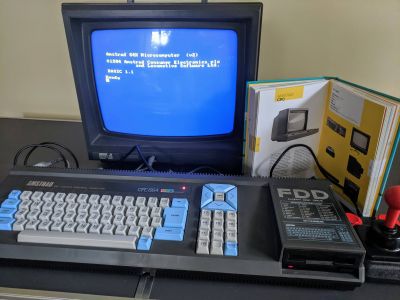 CPC 664 with the CTM644 colour monitor
 -
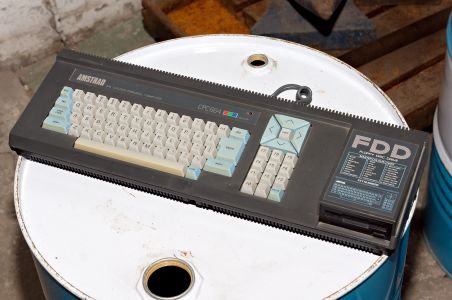 The disc drive bay
 -
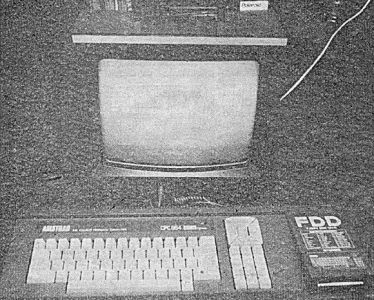 1985 catalogue photograph


Related pages
editReferences
edit- ↑ "CPC664", CPCWiki, citing Amstrad Action issue 1 (October 1985) page 8 for the May–August 1985 production window. CPCWiki gives no production figure for the 664, and none was found elsewhere. Secondary source.
- ↑ 2.00 2.01 2.02 2.03 2.04 2.05 2.06 2.07 2.08 2.09 2.10 2.11 2.12 2.13 2.14 Amstrad Consumer Electronics plc, CPC664 Micro Computer / CTM644 Colour Monitor / GT65 Green Monitor Service Manual. Hosted at Amstrad CPC 664 Service Manual. Source for the CPC664 Basic Hardware Analysis, the Diagnostic Flow Chart, the Alignment Checks including test points and the EME-CF2 test disk, the Electrical Parts List, the Mechanism drawing and Mechanical Replacements procedures, and the Technical Specification.
- ↑ 3.0 3.1 3.2 3.3 "Mainboard Versions", CPCWiki. Community catalogue of silkscreen markings, board dimensions and per-version differences across the CPC range. Gives the CPC664 board as Z70205 / MC0005A and MC0005B and notes the MC0005B's unlabelled patch resistor R160. Secondary source, compiled from observed boards.
- ↑ "Amstrad FDD part", CPCWiki — catalogue of the Matsushita EME-series 3-inch mechanisms Amstrad fitted: EME-150A (PCB 30001, CPC664, early DDI-1 and early 6128), EME-155 (PCB 30002), EME-156 (PCB Z70312), EME-156V (PCB Z80264) and the 5 V-only EME-157 (PCB Z80425). All single-sided, 40 track, 180 KB per side, 300 rpm. Secondary source.
- ↑ "Changing the drive belt", CPCWiki — gives the replacement belt as 3 mm wide, 0.6 mm thick and 230 mm outer circumference (commonly advertised as 115 mm), with the removal procedure. Secondary source; Amstrad published no belt dimensions.