

Professional 325
.png) | |
| DEC's drawing of a Professional 300 series system with VR201 monitor and LK201 keyboard (the 325 has no hard disk) | |
| Specifications | |
|---|---|
| Manufacturer | Digital Equipment Corporation |
| Type | Personal computer (PDP-11 architecture) |
| Released | 1982[1] |
| CPU | DEC F-11 chip set (PDP-11/23 instruction set) on the KDF11-CA system module[2][3] |
| Memory | RAM on system module daughterboards; addresses up to 3 MB[2][4] |
| Storage | RX50 dual 5.25-inch diskette drive, 819 KB formatted; no hard disk option[2][5] |
| Display | Bit-map video to a 12-inch VR201 monochrome monitor, 24 lines of 80 or 132 characters[2] |
| Sound | — |
| Expansion | One user-available CTI bus option slot[5][6] |
| Power | H7862 switching supply; 90–128 V or 174–256 V, 47–63 Hz, 320 W maximum[2][7] |
| Dimensions | 16.5 × 55.8 × 34.3 cm (system unit)[2] |
| Weight | 15.9 kg maximum (system unit)[2] |
| OS / Firmware | P/OS on diskette[5][1] |
The Professional 325 is the diskette-only member of Digital Equipment Corporation's Professional 300 series of PDP-11-based personal computers, introduced with the Professional 350 in 1982.[1] DEC's technical manual states that apart from a short list of differences the 325 and 350 are identical in configuration and operation: the 325 has no hard disk, cannot load its operating system over a network, and leaves only one CTI bus slot free for the user.[5] Both use the F-11 chip set of the LSI-11/23 on a single system module, the H7862 power supply, the RX50 dual diskette drive, the VR201 monitor and the LK201 keyboard shared with the Rainbow 100 and DECmate II.[2][3][1]
A Professional 325 that has been stored has two parts that need attention before use: the H7862 switching supply, whose input capacitors hold high voltage after power-off, and the three-cell nickel-cadmium battery pack on the system module.[7][8] See Professional 325 Capacitor Replacement Guide, Professional 325 General Maintenance and Professional 325 Troubleshooting Guide.
Specifications
[edit | edit source]| 325 | 350 | 380 | |
|---|---|---|---|
| RX diskette drive | Yes | Yes | Yes |
| User-available CTI bus slots (diskette-based monochrome system) | 1 | 3 | 5 |
| RD hard disk option | No | Yes | Yes |
| Operating system loaded over a network | No | Yes | Yes |
| Hard-disk-based operating system | No | Yes | Yes |
| Diskette-based operating system | Yes | Yes | Yes |
[5] DEC's pocket service guide tells the models apart by the logo beside the power switch, or inside the card cage, where a 350 has six slots and a 325 has four, two of them blocked.[6] An Italian DEC brochure of about 1983 lists both the 325 and 350 with 512 KB and standard floating point, and notes that an option converts a PC325 into a PC350; DEC's technical manual describes the floating point adapter as an option.[9][4]
Hardware
[edit | edit source]System module
[edit | edit source]The KDF11-CA system module carries the F-11 processor and memory management, a 16-bit ODT console emulator, the printer, communications and video/keyboard ports, the interrupt controllers, the power-up self-test and boot ROMs, the ID PROM and a battery-backed clock with 50 bytes of RAM. It is mounted on a metal plate that slides out of the bottom of the enclosure, and holds the six-slot CTI bus card cage with zero-insertion-force connectors.[4][2]
Clock battery
[edit | edit source]The clock is an MC146818 backed by a rechargeable nickel-cadmium pack on connector J3 of the system module (+3.6 V on pin 1). The pack is charged at 10 mA whenever the computer is on; 48 hours of running charge it fully, after which it keeps the clock going for at least ten days with the power off.[10][11] DEC's parts list for the system unit motherboard gives the pack as part 12-19245-00, "BATTERY, 3CELL 3.75V .18MA NICAD".[8]
Power supply
[edit | edit source]The H7862 is a 50 kHz switching supply rated at +5 V (5 to 20 A), +12 V (1 to 8 A) and −12 V (0.1 to 1 A), with a crowbar on the +5 V and +12 V outputs, overvoltage, overcurrent and start-up undervoltage shutdown, and DCOK and POK status signals to the CPU.[7] DEC's print set calls it the "PC300 system unit power supply, 210 watts".[3] Its fan pulls air through the whole system unit.[12]
Documentation
[edit | edit source]- Professional 300 Series Technical Manual, EK-PC350-TM-001, December 1982: File:Professional 300 Series Technical Manual (EK-PC350-TM-001, 1982).pdf
- Professional 300 Series Technical Manual, Volume 1, EK-PC300-V1-001, June 1985: File:Professional 300 Series Technical Manual Volume 1 (EK-PC300-V1-001).pdf
- PC350 Field Maintenance Print Set, MP-01394-00: File:Professional 350 PC350 Field Maintenance Print Set (MP-01394-00).pdf
- Professional 380 Pocket Service Guide, EK-PC380-PS-003: File:Professional 380 Pocket Service Guide (EK-PC380-PS-003).pdf
Gallery
[edit | edit source]-
 Rear panel with the four red self-test LEDs and the green DC LED
 -
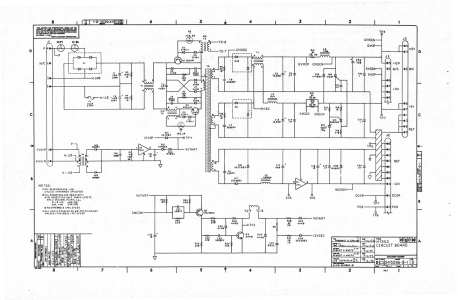 DEC schematic of the H7862 power supply, sheet 1
.png)
.png)
Related pages
[edit | edit source]- Professional 325 General Maintenance
- Professional 325 Troubleshooting Guide
- Professional 325 Capacitor Replacement Guide
- Professional 350
- Professional 380
- Professional 350 Documentation
References
[edit | edit source]- ↑ 1.0 1.1 1.2 1.3 "DEC Professional (computer)", Wikipedia, en.wikipedia.org. Introduction in 1982 with the PRO-350; F-11 chip set; the 325 has only floppies; P/OS; shared RX50 drives and LK201 keyboard with the Rainbow 100 and DECmate II.
- ↑ 2.0 2.1 2.2 2.3 2.4 2.5 2.6 2.7 2.8 Digital Equipment Corporation, Professional 300 Series Technical Manual, EK-PC350-TM-001, December 1982, pp. 1-2 to 1-4, "System Specifications" (File:Professional 300 Series Technical Manual (EK-PC350-TM-001, 1982).pdf).
- ↑ 3.0 3.1 3.2 Digital Equipment Corporation, PC350 Field Maintenance Print Set, MP-01394-00, 1982, PC350 unit assembly parts list, PDF p. 5 (File:Professional 350 PC350 Field Maintenance Print Set (MP-01394-00).pdf). KDF11-CA motherboard and H7862 "PC300 SYS UNIT POW SUP: 210WATTS".
- ↑ 4.0 4.1 4.2 DEC, EK-PC350-TM-001, pp. 5-4 to 5-5, sections 5.2.1 to 5.2.3, system module characteristics, memory management and floating point option.
- ↑ 5.0 5.1 5.2 5.3 5.4 Digital Equipment Corporation, Professional 300 Series Technical Manual, Volume 1: Kernel System, EK-PC300-V1-001, June 1985, pp. 1-2 to 1-3, section 1.1.4 and Table 1-1 (File:Professional 300 Series Technical Manual Volume 1 (EK-PC300-V1-001).pdf).
- ↑ 6.0 6.1 Digital Equipment Corporation, Professional 380 Pocket Service Guide, EK-PC380-PS-003, June 1986, pp. 1 to 2, section 1.1.2, physical differences between the Professional 380 and 325/350 (File:Professional 380 Pocket Service Guide (EK-PC380-PS-003).pdf).
- ↑ 7.0 7.1 7.2 DEC, EK-PC350-TM-001, pp. 13-1 to 13-11, chapter 13, H7862 power supply, including Table 13-2 and section 13.6.
- ↑ 8.0 8.1 DEC, MP-01394-00, KDF11-C large system unit motherboard parts list, PDF p. 11, item 8.
- ↑ Digital Equipment S.p.A., Personal computers Digital: una combinazione unica di qualità, prestazioni, servizio, undated brochure, p. 2, comparison table, archive.org/details/personalcomputersdigital.
- ↑ DEC, EK-PC350-TM-001, p. 5-9, section 5.2.12, battery backed-up system clock and RAM.
- ↑ DEC, EK-PC350-TM-001, pp. 5-54 and 5-130, section 5.3.13 and Table 5-23, battery charger and J3.
- ↑ DEC, EK-PC350-TM-001, p. 13-2, section 13.2, physical description of the power supply.