
Amstrad PPC512
The Amstrad PPC512 is a portable IBM PC compatible that Amstrad released in 1987 with the Amstrad PPC640. It has 512 KB of RAM, an 8 MHz V30-type processor, a non-backlit supertwist LCD, a full-size 102-key keyboard that folds up to form the lid, and one or two 720 KB 3.5-inch drives, and runs from ten C cells, a mains adaptor, a car adaptor or the supply in an Amstrad PC monitor.[1][2] Amstrad's specification describes it as the PPC640 with 512K of RAM and without the integral modem and the Mirror II communications software.[1] The two models share their boards, display and drives, so the repair guides for the PPC640 cover both.
 | |
| PPC512 with the keyboard lowered and the LCD raised | |
| Specifications | |
|---|---|
| Manufacturer | Amstrad plc |
| Type | Portable IBM PC compatible |
| Released | 1987 |
| CPU | Sony CXQ70116P-8 (NEC V30 type) at 8 MHz; socket for an 8087 |
| Memory | 512 KB, upgradeable to 640 KB |
| Storage | One (PPC512S) or two (PPC512D) 720 KB 3.5-inch drives |
| Display | 640 × 200 supertwist LCD, not backlit; MDA and CGA compatible; external monitor output |
| Sound | Speaker with volume control |
| Ports / interface | RS-232 serial, Centronics parallel, 9-pin video, two expansion connectors, DC input, 14-way DIN monitor power |
| Power | Ten alkaline C cells, AC adaptor, car adaptor or Amstrad PC monitor |
| Dimensions | 450 × 230 × 100 mm closed, excluding handle |
| Weight | 5.4 kg without batteries |
| OS / Firmware | MS-DOS 3.30, PPC Organiser |
| Model no. | PPC512S, PPC512D |
History
editThe PPC512 and PPC640 were Amstrad's first portable PC compatibles, developed from the desktop Amstrad PC1512 and Amstrad PC1640.[2] The PPC512 was supplied with MS-DOS 3.3 and PPC Organiser, a memory-resident diary, card file, calculator and telephone dialler; the PPC640 added Mirror II for its modem.[2] MCbx's notes on a PPC512 record that its German system discs were made by Clasma Software, which wrote PPC Organiser.[3]
PPC512 and PPC640
edit| Item | PPC512 | PPC640 |
|---|---|---|
| RAM | 512K | 640K |
| Modem | None; the bay is empty | Built in (modem board MC0053A) |
| Mirror II software | Not supplied | Supplied |
| Parallel port | Unidirectional | Bidirectional |
| Floppy drive part number | 177247 | 177248 |
| Keyboard switch assembly | 177318 | 177319 |
| Case | Lighter grey | Darker grey |
Amstrad's service manual gives the RAM, modem, software and part number differences; MCbx gives the parallel port and modem bay; Wikipedia gives the case colour.[1][3][2] Both come as S (one drive) and D (two drives) versions, and the cabinet parts list gives a separate bottom assembly for each.[1]
Hardware
editAmstrad's specification calls the processor an 8086 at 8 MHz, but the electrical parts list gives IC120 as a CXQ70116P-8 (part 177284), Sony's 8 MHz part of the NEC V30 family. There is a socket for an 8087.[1][4] The main boards are the CPU board MC0051A (PCB101) and the memory and power supply board MC0057A (PCB501), with small switch, LED, fuse, volume and control boards.[1] The real-time clock is an MC146818P (IC134). It has no backup cell of its own: the clock is powered by the main batteries, even with the power selector at BATT.OFF.[1][5]
The LCD is a 640 × 200 supertwist panel that tilts and has adjustable contrast; Amstrad treated it as an exchange unit (LCD101, part 177245).[1] A bank of DIP switches on the side sets the display: internal or external, MDA or CGA, and the default mode.[5][3] The drives are Amstrad's FD-5 720K 3.5-inch units; the drive nearest the keyboard is drive A.[1][5]
Power
editThe user instructions allow four power sources: ten C-size alkaline cells in two tubes of five, the AC adaptor, a 12 V car battery adaptor in a cigar lighter socket, or an Amstrad PC-MD, PC-CD or PC-ECD monitor.[5] Amstrad advises against zinc-carbon cells, which cannot supply the current, and NiCd cells, which give an early low-battery warning. An alarm sounds when the batteries are running low and when the keyboard is closed with the power on. Moving the power selector between external and battery power resets the machine.[5] The +5 V supply is set to 5 V ±5% with VR501, measured at the junction of L501 and C514.[1]
Memory
editMCbx describes the PPC512's memory board as having six empty, solder-filled positions for the 640K upgrade, filled with four 41464 (64K × 4) and two 4164 chips, after which the 512K/640K link LK4 on the memory board and a second link on the CPU board are moved.[3] Amstrad's parts list gives eighteen KM41256-15 (IC135–IC152) and six KM4164B-15 (IC153–IC158) for the 640K machine.[1] The Amstrad PPC512 Maintenance Guide has the procedure.
Repair guides
edit- Amstrad PPC512 Maintenance Guide: the 640K upgrade and opening the case.
- Amstrad PPC640 Maintenance Guide: batteries, external power, cleaning, the +5 V adjustment, drives, screen hinges and configuration switches, for both models.
- Amstrad PPC640 Troubleshooting Guide: power faults, self-test messages, display, disc and keyboard faults, for both models.
- Amstrad PPC640 Capacitor Replacement Guide: Amstrad's electrolytic list; the 26 positions not on the modem board are common to the PPC512.
Documentation
edit- Amstrad PPC 512 / PPC 640 Service Manual: specification, the FD-5 drive information, alignment, schematics and parts lists for both models.[1]
- Amstrad PPC 512 / PPC 640 User Instructions: Amstrad's US user manual for both models.[5]
Gallery
edit-
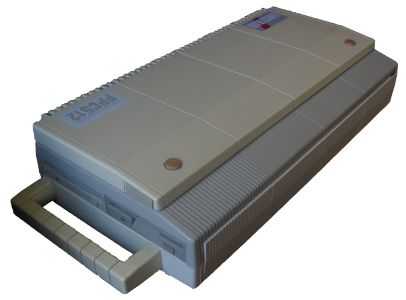 Closed for carrying, with the PPC512 badge on the lid
 -
 Memory and power supply board (service manual p. 18)


Related pages
editReferences
edit- ↑ 1.00 1.01 1.02 1.03 1.04 1.05 1.06 1.07 1.08 1.09 1.10 1.11 Amstrad plc, PPC 512S / 512D, PPC 640S / 640D Personal Portable Computer Service Manual. Hosted as File:Amstrad PPC 512 PPC 640 Service Manual.pdf, described at Amstrad PPC 512 / PPC 640 Service Manual. Technical specification and notes to service engineers p. 2; alignment p. 14; cabinet parts list p. 16; memory/fuse/volume boards pp. 18–19; electrical parts list pp. 29–31.
- ↑ 2.0 2.1 2.2 2.3 Wikipedia, "Amstrad PPC" (revision 1340053520). Retrieved 2026-10-02. Released in 1987 as Amstrad's first portable PC compatibles, developed from the PC1512 and PC1640; the PPC512 with an 8 MHz NEC V30, 512 KB, a 102-key keyboard and a non-backlit LCD; the PPC512S and PPC512D; the PPC640's darker case; the four power sources; the keyboard forming the lid.
- ↑ 3.0 3.1 3.2 3.3 MCbx, "Amstrad PPC512", oldcomputer.info. Retrieved 2026-10-02. A PPC512 described from a working machine: the 640K upgrade with four 41464 and two 4164 chips and the disassembly needed for it; the 512K/640K links LK4 and LK5; the DIP switches; option links LK1–LK3 and LK6–LK7; the monitor power and video pinouts; the unidirectional parallel port and empty modem bay of the PPC512; the Clasma Software system discs.
- ↑ CPU-World, "NEC V30 processor family". Retrieved 2026-10-01. Lists the Sony CXQ70116P-8 among V30 parts.
- ↑ 5.0 5.1 5.2 5.3 5.4 5.5 Amstrad plc, The Amstrad Portable PPC 512/640 User Instructions (US edition, first edition 1988). Hosted as File:Amstrad PPC 512 PPC 640 User Instructions.pdf, described at Amstrad PPC 512 / PPC 640 User Instructions. Power sources (introduction); inserting the batteries p. 9; configuration switches pp. 10–11; cleaning p. 50; the clock powered by the internal batteries p. 148; troubleshooting and hardware error messages pp. 327–339.