
PDP-11/20
The PDP-11/20 is the first model of Digital Equipment Corporation's 16-bit PDP-11 family. DEC announced the family in January 1970 and shipped the 11/20 that year.[1] Its KA11 processor is built from small-scale TTL on quad-height modules and has hard-wired control; every later PDP-11 is microprogrammed.[4] The 11/20 introduced the Unibus, the single bus that connects processor, memory and peripherals, and the first officially named version of Unix ran on an 11/20 in 1970.[3][1]
 | |
| PDP-11/20 table-top model at the Computer History Museum (Don DeBold, CC BY 2.0) | |
| Specifications | |
|---|---|
| Manufacturer | Digital Equipment Corporation |
| Type | 16-bit minicomputer |
| Released | 1970[1] |
| Intro price | US$10,800 with 4K words of core and an ASR-33 (November 1970)[2] |
| CPU | KA11, TTL logic with hard-wired control[3][4] |
| Memory | MM11-E core, 4K 16-bit words per unit, expandable to 28K words[3] |
| Storage | Paper tape on the basic system; DECtape, disk and magnetic tape as options[2] |
| Display | — |
| Sound | — |
| Power | H720 power supply; 120 V 6 A or 230 V 3 A single phase[5] |
| Dimensions | 10½ × 19 × 23 in (rack-mounting BA11-CS box)[5] |
| Weight | About 90 lb with processor, console and 4K of memory[5] |
| OS / Firmware | — |
| Successor | PDP-11/40 and PDP-11/05[1] |
A basic system fills one 10½-inch BA11-C box: the KA11 processor, the KY11-A programmer's console on the front, 4K words of MM11-E core memory, a KL11 Teletype control and the H720 switching power supply at the rear.[3] These machines are now more than fifty years old. The power supply, the core memory and the console lamps are the parts that need most attention; see PDP-11/20 General Maintenance, PDP-11/20 Power Supply Service and PDP-11/20 Troubleshooting Guide.
Models and prices
edit| Model | Mounting | Mains | Price (US$) |
|---|---|---|---|
| PDP-11/20-AA | Rack-mountable, slides included | 115 V 60 Hz | 10,800 |
| PDP-11/20-AB | Rack-mountable, slides included | 230 V 50 Hz | 10,800 |
| PDP-11/20-BA | Table-top, cover included | 115 V 60 Hz | 10,800 |
| PDP-11/20-BB | Table-top, cover included | 230 V 50 Hz | 10,800 |
| PDP-11/20-CA | Rack-mounted in a cabinet | 115 V 60 Hz | 11,450 |
| PDP-11/20-CB | Rack-mounted in a cabinet | 230 V 50 Hz | 11,450 |
[2] Each price covers a KA11 processor, 4K words of core memory, the programmer's console, the basic mounting box and power supply, and an ASR-33 Teletype with its control.[2] Wikipedia gives the 11/20's price as $11,800; DEC's own list gives the figures above.[1][2] DEC's H720 manual also lists twelve OEM configurations (codes D to K), physically the same as the standard systems but with the Teletype and front-panel logo optional and no documentation, training or maintenance included.[6]
Hardware
editProcessor and console
editThe KA11 has eight 16-bit general registers, R6 being the stack pointer and R7 the program counter. It addresses 32K words directly: 28,672 words of memory and 4,096 words of device registers at the top of the address space. It has four hardware bus-request priority levels with sub-levels and vectored interrupts; interrupt response takes 7.2 µs. The processor itself draws 8 A from +5 V.[3] Power-fail and automatic restart are standard: the processor traps when the mains falls below 105 V and needs 2 ms to save its state, using the AC LO and DC LO signals from the power supply.[3]
The KY11-A programmer's console has an 18-bit ADDRESS REGISTER display, a 16-bit DATA display, eight state lamps (FETCH, SOURCE, DESTINATION, two ADDRESS, EXEC, BUS, RUN), an 18-bit switch register, the key-operated OFF/POWER/PANEL LOCK switch and the LOAD ADDR, EXAM, CONT, ENABLE/HALT, S-INST/S-CYCLE, START and DEP keys.[3] Its lamps run from an unregulated, unfiltered +8 V supply.[3][7]
Options for the 11/20 included the KE11-A extended arithmetic element, which does multiply and divide as a separate device on the Unibus, programmed through its registers, and the rare KT11-B paging option.[4][8]
Memory
editThe MM11-E is a coincident-current, 3-wire planar core memory of 4,096 16-bit words with a 1.2 µs cycle and 500 ns access time. The basic box holds the first unit and has room for two more; more than that needs a BA11-E extension box. Memory expands to 28K words in 4K steps, and each 8K segment can be interleaved. The MM11-F (950 ns), MM11-FP with parity, MM11-H (1K) and MM11-J (2K) could be fitted instead.[3] Core memory keeps its contents with the power off. A DC OK signal inhibits the memory when the supply voltages are low, so that it does not write spuriously during power changes.[3]
Unibus
editThe Unibus carries 16 data lines, 18 address lines and control lines between all devices, with transfers of up to 2,500,000 words per second. Inside the box it runs from system unit to system unit on M920 jumper modules; a 120-conductor BC11 cable joins boxes, with a total Unibus length of no more than 50 ft.[3][6]
Power supply
editThe H720 gives +5 V at 16 A (models A and B) or 22 A (E and F) and −15 V at 10 A from switching regulators, plus unregulated supplies for the lamps and Teletype interface, a line-frequency clock signal and the AC LO and DC LO signals. Models A and C are 120 V, B and D 240 V; C and D are door-mounted versions, and E and F add a circuit breaker, remote power control and a thermal cut-out.[7] After the basic processor, console, 4K memory and Teletype control, an 11/20 box has 3.4 A at +5 V and 1.7 A at −15 V left for options.[3] See PDP-11/20 Power Supply Service.
Specifications
edit| Item | Specification |
|---|---|
| Word length | 16 bits, byte addressable |
| Core memory | 4K words basic, 28K words maximum; 1.2 µs cycle (MM11-E) |
| Unibus transfer rate | 2,500,000 words per second maximum |
| Mains | 120 V ±10%, 47–63 Hz, 6 A (H720-A); 218–240 V ±10%, 3 A (H720-B) |
| Heat | 400 W for the computer, 150 W for an ASR-33 |
| Operating environment | 10–50 °C, 20–95% relative humidity, non-condensing; DEC recommends 20–30 °C |
| Size and weight | BA11-CS rack box 10½ × 19 × 23 in, about 90 lb; BA11-CC table-top 11 × 20 × 23⅝ in, about 100 lb |
Known problems
edit- The H720's unregulated supplies rest on two 22,000 µF 50 V reservoir capacitors, and its regulator board carries a further seven electrolytics on the +5 V and −15 V outputs, all now about fifty years old.[9] The +5 V crowbar fires above about 6 V and holds the output down, which looks like a dead supply.[7] See PDP-11/20 Power Supply Service.
- The −15 V regulator is switched off whenever +5 V is below about 4.5 V, to protect the core memory, so a fault on +5 V also removes −15 V.[7]
- AC LO and DC LO from every H720 in a system are wired together on the Unibus. A fault in an expansion box's supply halts or hangs the whole machine.[7][10]
Documentation
edit- PDP-11/20 System Manual, DEC-11-HR1B-D: File:PDP-11-20 System Manual (DEC-11-HR1B-D).pdf
- KA11 Processor Manual, DEC-11-HR2B-D: File:KA11 Processor Manual (DEC-11-HR2B-D).pdf
- MM11-E Core Memory Manual, DEC-11-HR3A-D: File:MM11-E Core Memory Manual (DEC-11-HR3A-D).pdf
- H720 Power Supply and Mounting Box Manual, DEC-11-HR5B-D: File:H720 Power Supply and Mounting Box Manual (DEC-11-HR5B-D).pdf
- H720 Power Supply and Mounting Box Engineering Drawings: File:H720 Power Supply and Mounting Box Engineering Drawings (1971).pdf
- PDP-11/20 price list, 1 November 1970: File:PDP-11-20 Price List (1 November 1970).pdf
See PDP-11/20 Documentation for what each covers.
Gallery
edit-
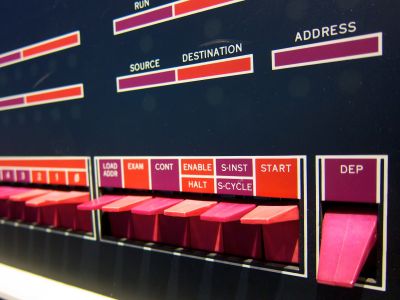 KY11-A console keys and state lamps (Don DeBold, CC BY 2.0)
 -
 DEC drawing D-CS-H720-0-1, the H720 power supply

.png)
Related pages
editReferences
edit- ↑ 1.0 1.1 1.2 1.3 1.4 "PDP-11", Wikipedia, en.wikipedia.org/wiki/PDP-11. Announcement in January 1970, the 11/20 as the first model, its $11,800 price, Unix on the 11/20, successors.
- ↑ 2.0 2.1 2.2 2.3 2.4 Digital Equipment Corporation, PDP-11/20 price list, 1 November 1970, p. 2 (File:PDP-11-20 Price List (1 November 1970).pdf).
- ↑ 3.00 3.01 3.02 3.03 3.04 3.05 3.06 3.07 3.08 3.09 3.10 3.11 3.12 Digital Equipment Corporation, PDP-11/20 System Manual, DEC-11-HR1B-D, sixth printing May 1973, chapter 2, pp. 2-1 to 2-6, Tables 2-2 to 2-8 (File:PDP-11-20 System Manual (DEC-11-HR1B-D).pdf).
- ↑ 4.0 4.1 4.2 "PDP-11/20", Computer History Wiki, gunkies.org/wiki/PDP-11/20. KA11 built without microcode, KE11-A and KT11-B options, RSTS-11.
- ↑ 5.0 5.1 5.2 5.3 DEC, DEC-11-HR5B-D, data sheets for models AA/AB and BA/BB (pp. 4-4 to 4-5).
- ↑ 6.0 6.1 6.2 DEC, DEC-11-HR5B-D, chapter 4, pp. 4-1 to 4-3. Configurations, environment, power requirements and cabling.
- ↑ 7.0 7.1 7.2 7.3 7.4 Digital Equipment Corporation, H720 Power Supply and Mounting Box Manual, DEC-11-HR5B-D, fifth printing November 1972, chapter 2, pp. 2-1 to 2-8 (File:H720 Power Supply and Mounting Box Manual (DEC-11-HR5B-D).pdf).
- ↑ Bitsavers directory bitsavers.org/pdf/dec/pdp11/1120/ (KE11-A extended arithmetic element and KT11-B paging option manuals), retrieved 2 October 2026.
- ↑ Digital Equipment Corporation, H720 Power Supply and Mounting Box Engineering Drawings, 1971, D-CS-H720-0-1 parts list and regulator board schematic D-CS-5408475-0-1 (PDF pp. 10–11) (File:H720 Power Supply and Mounting Box Engineering Drawings (1971).pdf).
- ↑ Digital Equipment Corporation, KA11 Processor Manual, DEC-11-HR2B-D, chapter 5, section 5.7, "Multiple Box Systems" (File:KA11 Processor Manual (DEC-11-HR2B-D).pdf).