

PDP-10
.jpg) | |
| KA10 PDP-10 systems at Bolt Beranek and Newman, around 1970 (public domain) | |
| Specifications | |
|---|---|
| Manufacturer | Digital Equipment Corporation |
| Type | 36-bit mainframe |
| Released | Made from 1966; first deliveries December 1967[1] |
| Discontinued | 1983 (cancellation announced)[1] |
| CPU | KA10, KI10, KL10, KS10[1] |
| Memory | Core memory, 256K words maximum on the KA10; 4096K words on the KI10[1][2] |
| Storage | — |
| Display | — |
| Sound | — |
| Power | KA10 processor: 115/200 V three-phase, 4300 W[3] |
| OS / Firmware | TOPS-10 (Monitor), TOPS-20, TENEX, ITS, WAITS[1] |
The PDP-10 is Digital Equipment Corporation's family of 36-bit time-sharing computers, made from 1966 and delivered from December 1967 until DEC announced the end of the line in 1983. Systems from the 1970s were sold under the name DECsystem-10, and the KL10 and KS10 also formed the DECSYSTEM-20 range.[1] The architecture is almost that of DEC's earlier PDP-6: 36-bit words, 18-bit addresses giving 256K words, sixteen general registers, and byte instructions that work on fields of any width from 1 to 36 bits.[1]
Four processors were built, from discrete-transistor FLIP CHIP logic to bit-slice microprocessors, and each needs different maintenance. The PDP-10 guides give most detail for the KA10, the original processor, and the KS10, the smallest; the KL10-based DECsystem-10 systems have their own pages starting at DECsystem-10. See PDP-10 General Maintenance, PDP-10 Power System Service and PDP-10 Troubleshooting Guide.
Processors
[edit | edit source]| Processor | Introduced | Technology | Notes |
|---|---|---|---|
| KA10 | 1968 | Discrete transistors on FLIP CHIP modules, wire-wrapped backplanes | 1 µs cycle, 2.1 µs add; base-and-bounds protection, no paging; 256K words |
| KI10 | 1973 | TTL small-scale ICs | Paging; 4096K words physical; DECsystem-1060, 1070, 1077 |
| KL10 | 1975 | ECL | DECsystem-1080 to 1099 and DECSYSTEM-20 models; see DECsystem-10 |
| KS10 | 1978 | TTL and Am2901 bit-slices, Intel 8080A console processor | DECSYSTEM-2020; Unibus peripherals |
[1][2] The KI10 runs the same monitor, software and most peripherals as the KA10, so a KA10 system could be upgraded without changing user programs.[2]
KA10
[edit | edit source]The KA10 processor fills three 31-inch cabinets. The right-hand bay holds the paper-tape reader and punch, the operator's console and, optionally, two TU55 DECtape drives; to the left of the reader and punch is the margin check and maintenance panel. Behind the hinged front doors are up to sixteen module panels (A to T, without G, I, O and Q), each holding 44 FLIP CHIP modules in the 31-inch cabinets. The power supplies are on a hinged frame inside the rear door, and fans or blowers cool the cabinets.[4] The KA10 processes 36-bit words and addresses up to 262,144 words of core memory. DEC sold five basic systems, the PDP-10/10 to 10/50.[4]
DEC's site guide gives the processor's installation data:[3]
| Item | Value |
|---|---|
| Mains | 115/200 V ±10%, 60 Hz ±2%, three-phase, 4-wire plus ground (230/400 V 50 Hz for 50 Hz systems) |
| Current at 115 V | 11 A phase 1 (16 A with the punch on), 11 A phase 2, 14 A phase 3; surge 25 A per phase |
| Power and heat | 4300 W, 14,720 Btu/h |
| Size | 69 × 96.5 × 49.5 in (1.75 × 2.45 × 1.26 m) |
| Weight | 1930 lb (875 kg) |
| Operating environment | 15–35 °C, 20–80% relative humidity |
KS10
[edit | edit source]The KS10, sold as the DECSYSTEM-2020, uses AMD 2901 bit-slice parts and an Intel 8080A as console and control processor. The 8080 loads the microcode from disk or tape, starts the main processor, and then runs the console and remote diagnostic ports. Peripherals are on the PDP-11 Unibus.[1] The machine boots itself 30 seconds after power-up.[5] Its logic is powered by H7130 supplies, and Unibus options sit in a BA11-K box with its own supply and adjustments.[6]
Operating systems
[edit | edit source]DEC's original operating system, called Monitor, became TOPS-10. BBN's TENEX was ported by DEC to the KL10 and became TOPS-20. MIT ran its own ITS, and Stanford's WAITS grew out of early TOPS-10.[1]
Documentation
[edit | edit source]- PDP-10 KA10 Central Processor Maintenance Manual, Volume I, DEC-10-HMAA-D: File:PDP-10 KA10 Central Processor Maintenance Manual Volume I (DEC-10-HMAA-D).pdf
- PDP-10 Site Preparation Guide, DEC-10-HAAB-D: File:PDP-10 Site Preparation Guide (DEC-10-HAAB-D).pdf
- KS10 Maintenance Guide, Volume I, EK-OKS10-MG-001: File:KS10 Maintenance Guide Volume 1 (EK-OKS10-MG-001).pdf
- DECsystem-10 Technical Summary (1971) and the KL10 documents: see DECsystem-10 Documentation.
See PDP-10 Documentation.
Gallery
[edit | edit source]-
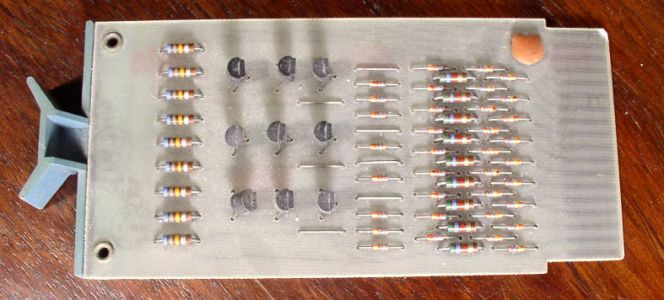 KA10 FLIP CHIP module (Jnc, CC BY-SA 2.5)
 -
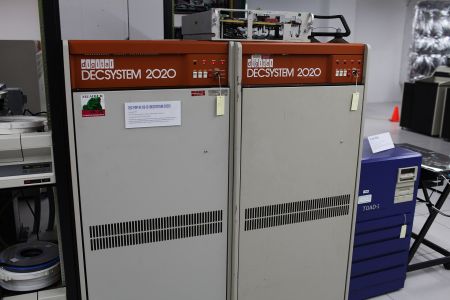 DECSYSTEM-2020 (KS10) (Jason Scott, CC BY 2.0)
 -
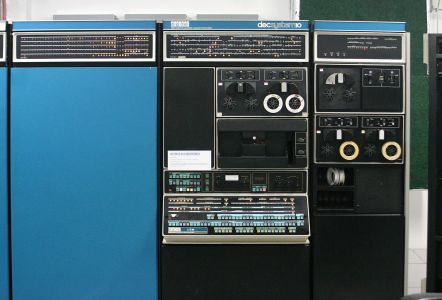 DECsystem-10 with KI10 processor (Gah4, CC BY-SA 4.0)

.jpg)

Related pages
[edit | edit source]- PDP-10 General Maintenance
- PDP-10 Troubleshooting Guide
- PDP-10 Power System Service
- PDP-10 Documentation
- DECsystem-10
- DECsystem-10 Power Supply Guide
- PDP-11/20
References
[edit | edit source]- ↑ 1.00 1.01 1.02 1.03 1.04 1.05 1.06 1.07 1.08 1.09 "PDP-10", Wikipedia, en.wikipedia.org/wiki/PDP-10. Dates, architecture, processors, KS10 design, operating systems.
- ↑ 2.0 2.1 2.2 Digital Equipment Corporation, DECsystem-10 Technical Summary, 1971, pp. 16 and 37 (File:DECsystem-10 Technical Summary (1971).pdf).
- ↑ 3.0 3.1 3.2 Digital Equipment Corporation, PDP-10 Site Preparation Guide, DEC-10-HAAB-D, May 1970, KA10 arithmetic processor data sheet and electrical requirements (File:PDP-10 Site Preparation Guide (DEC-10-HAAB-D).pdf).
- ↑ 4.0 4.1 Digital Equipment Corporation, PDP-10 KA10 Central Processor Maintenance Manual, Volume I, DEC-10-HMAA-D, December 1968, chapter 1, sections 1.1.1 and 1.1.2 (File:PDP-10 KA10 Central Processor Maintenance Manual Volume I (DEC-10-HMAA-D).pdf).
- ↑ Digital Equipment Corporation, KS10 Maintenance Guide, Volume I, EK-OKS10-MG-001, June 1979, system software section, standard boot procedure (File:KS10 Maintenance Guide Volume 1 (EK-OKS10-MG-001).pdf).
- ↑ DEC, EK-OKS10-MG-001, checks/adjustments section: KS10 backplane power adjustment, H7130 power supply, BA11-K backplane power adjustments.