

IBM 5120
 | |
| IBM 5120 Computing System (1980) — built-in 9-inch CRT and two 8-inch floppy drives | |
| Specifications | |
|---|---|
| Developer | IBM General Systems Division; industrial design by Tom Hardy |
| Manufacturer | IBM |
| Type | Desktop business computer (also designated IBM 5110 Model 3) |
| Released | February 1980 |
| Discontinued | 10 December 1982 |
| CPU | IBM PALM (Put All Logic in Microcode) — 16-bit board-level processor (same as IBM 5100 and IBM 5110). 1.9 MHz, 530 ns 2-byte cycle |
| Memory | 32 KB RAM standard; configurations 16–64 KB in 16 KB increments. 64 KB ROM holds the operating environment; both APL and BASIC interpreters are in ROM as standard; front-panel toggle selects the language |
| Storage | 2 × 8-inch 1.2 MB floppy drives built-in. Optional IBM 5114 Diskette Unit adds 2 more drives (4 × 1.2 MB total online). No tape drive option. No hard disk from IBM (Core International offered an aftermarket Winchester subsystem from 1981) |
| Display | Integrated 9-inch monochrome CRT (significantly larger than the 5100 / 5110's 5-inch tube — major usability improvement for accounting work) |
| Sound | None |
| Dimensions | Desktop form factor with detached keyboard |
| Weight | 45 kg (99 lb) |
| OS / Firmware | APL and BASIC interpreters as operating environment, both in ROM as standard, switched via front-panel toggle at power-on |
| Predecessor | IBM 5110 (1978); the 5120 is officially also designated IBM 5110 Model 3 |
| Successor | IBM Datamaster (System/23) (1981), then IBM PC (5150) (August 1981) |
| Model no. | 5120 |
The IBM 5120 Computing System is a desktop business computer announced and released in February 1980 by IBM General Systems Division, and discontinued on 10 December 1982.[1][2] The 5120 is officially also designated IBM 5110 Model 3 — it shares the IBM 5110's PALM processor and core architecture, but in a substantially redesigned desktop chassis with a much larger 9-inch CRT, a detached keyboard with palm rest, and two built-in 8-inch floppy drives.
The 5120 was IBM marketing's "lowest-priced IBM business computer to date", launched at a base US$13,500 (approximately $51,500 in 2024 dollars) with configured systems from US$9,340 to US$23,990.[3][4] Industrial designer Tom Hardy won the IDSA Gold IDEA award (1980) and an I.D. Magazine Product Design Award (1981) for the 5120's chassis.
The 5120 was effectively the last machine in the PALM / APL line; the IBM System/23 Datamaster followed in 1981, and the IBM PC (5150) arrived in August 1981 marking the architectural break to Intel 8088 and PC DOS.
Relationship to the IBM 5100 and 5110
The 5120 shares with the 5100 and 5110:
- The PALM board-level processor (same 16-bit, 1.9 MHz, 530 ns cycle).
- The APL and BASIC interpreters — but on the 5120 both are in ROM as standard.
- The PALM microcode emulators for IBM System/370 and System/3 instruction subsets.
The 5120 differs significantly:
- 9-inch CRT vs the 5100 / 5110's 5-inch CRT — usable for sustained accounting work.
- Detached keyboard with palm rest, vs the integrated keyboard on the 5100 / 5110.
- 2 × built-in 1.2 MB 8-inch floppy drives vs the 5100's DC300 tape and the 5110's external 5114.
- No tape drive — DC300 is dropped entirely.
- Desktop chassis (45 kg) vs the 5100 / 5110's "portable" suitcase.
- Both APL and BASIC in ROM as standard (no language-specific configurations).
Software Bundle
IBM released six accounting applications bundled with the 5120 launch in February 1980:
- Task Inventory
- Billing
- Payroll
- Accounts Payable
- Accounts Receivable
- General Ledger
This bundle was the heart of the 5120's small-business positioning.[5]
Architecture
The 5120 uses the same IBM PALM processor as the 5100 and 5110.[6] Memory:
- Executable ROS — microcode + monitor in PALM's directly addressable 64 KB.
- Language ROS — both APL and BASIC interpreters in ROM as standard; front-panel toggle selects at power-on.
- RWS (RAM) — 16 / 32 / 48 / 64 KB; 32 KB standard.
Form Factor and Physical Design
The 5120 chassis is a substantial desktop:
- Dimensions — desktop form factor with detached keyboard.
- Weight — 45 kg (99 lb).[7]
- Built-in 9-inch monochrome CRT — major usability improvement over the 5-inch tube of the 5100 / 5110.
- Detached keyboard with palm rest — IBM cited "reduced static loading in arms and shoulders" as a usability advantage.
- Recessed lift areas on the bottom for easier handling (industrial design).
- Reduced desktop footprint compared with the 5110 + 5114 combination.


Storage
- 2 × 8-inch 1.2 MB floppy drives built-in — the defining 5120 feature. The drives accept IBM Diskette 2D media (double-sided double-density, 1.2 MB formatted).
- Optional IBM 5114 Diskette Unit — adds 2 more 8-inch drives for a total of 4 × 1.2 MB online.
- No tape drive — the DC300 system from the 5100 / 5110 Model 1 is not available on the 5120.
- No hard disk from IBM — though Core International offered an aftermarket Winchester subsystem and the CoreNet LAN from 1981.[8]
I/O and Peripherals
- IBM 5103 Printer — matrix printer carried over from 5100 / 5110.
- IBM 5114 Diskette Unit — external 2-drive 8-inch floppy expansion.
- Communications — RS-232 and BSC / SDLC options carried over from the 5110.
Operating Languages
APL and BASIC are both in ROM as standard. The language is selected at power-on via a front-panel toggle (the same UX as the 5100 / 5110 dual-language models). The APL implementation is the same modified APLSV; the BASIC is the same System/3 port.
Service Documents
The IBM service documentation for the 5120 is preserved at Bitsavers:
- SY34-0192-0 — IBM 5120 Maintenance Information Manual (MIM), December 1979 — the CE service manual.
- SY34-0193-0 — IBM 5120 Computing System Logic Manual, December 1979 — gate-level logic diagrams.
- GH30-0232-1 — Joint 5110 / 5120 Bibliography, September 1980 — also lists 5120 publications.
The 5120 documentation set on Bitsavers is thinner than the 5110's — many user-facing manuals (APL, BASIC) for the 5120 are the 5110 manuals because the language ROMs are essentially the same. Use the 5110 references where applicable.
Common Faults
- PALM board — same gate-array risks as the 5100 / 5110; arrays are unobtainium.
- 8-inch floppy drives (×2 built-in) — drive belt aging is the dominant failure mode; head load solenoid fatigue; spindle motor brush wear; media (IBM Diskette 2D) oxide shedding. Drives are typically Shugart-class 8-inch FDDs.
- 9-inch CRT and deflection board — separate monitor sub-chassis inside the 5120 case; high-voltage flyback and deflection electrolytics are concerns.
- Linear PSU — beefier than the 5100 / 5110 to drive 2 floppies + 9-inch CRT; bulk filter caps after the bridge are the priority replacements. See IBM 5120 Capacitor Replacement Guide.
- Keyboard — Model F-class buckling-spring keyboards on some 5120s; very durable but key-cap removal needs the IBM tool to avoid damage.
- Industrial-design "carry handles" on the bottom — plastic fatigue reported by some collectors.
Pricing
- Base configuration: US$13,500 (≈$51,500 in 2024 dollars).
- Configured systems: US$9,340 to US$23,990 depending on RAM and peripherals.[9]
John Titor Connection
The 5120 is not part of the John Titor lore — by 1980 the System/370 emulator was no longer novel. The 5120 is the desktop sibling of the machine in the legend (the IBM 5100 / IBM 5110) but not the legendary machine itself. See the IBM 5100 page for full coverage.
Gallery
-
 IBM 5120 Computing System (1980)
 -
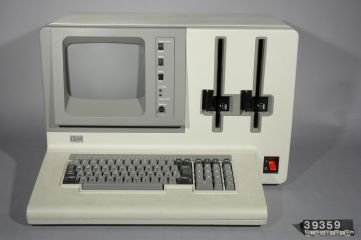 IBM 5120 — front view
 -
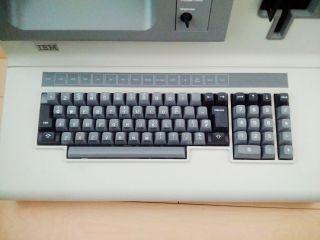 5120 detached keyboard with palm rest
 -
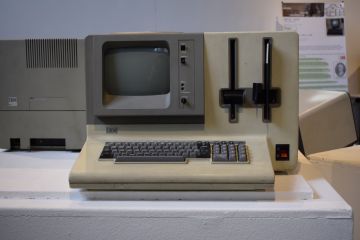 IBM 5120 full configuration

Related Pages
- IBM 5120 Maintenance Guide
- IBM 5120 Troubleshooting Guide
- IBM 5120 Capacitor Replacement Guide
- IBM 5100 — 1975 PALM-line origin
- IBM 5110 — 1978 predecessor (5120 is officially also designated 5110 Model 3)
- IBM 5114 Diskette Unit — external 8-inch floppy expansion
References
- IBM 5120 — Wikipedia. Authoritative reference.
- IBM PALM processor — Wikipedia.
- Bitsavers — IBM 5120 documents. MIM SY34-0192, Logic Manual SY34-0193.
- IBM Hursley Museum — Hardware Announcements to 1987. Withdrawal date.
- IBM Archives — IBM 5120 Computing System.
- Core International 1981 5110 / 5120 disk subsystem brochure.
- ↑ https://en.wikipedia.org/wiki/IBM_5120
- ↑ https://ibmhursleymuseum.info/docs/hardware_list_to_1987.pdf
- ↑ https://en.wikipedia.org/wiki/IBM_5120
- ↑ https://web.archive.org/web/20111110083525/http://www-03.ibm.com/ibm/history/exhibits/pc/pc_6.html
- ↑ https://en.wikipedia.org/wiki/IBM_5120
- ↑ https://en.wikipedia.org/wiki/IBM_PALM_processor
- ↑ https://en.wikipedia.org/wiki/IBM_5120
- ↑ https://web.archive.org/web/20110721193112/http://www.coreinternational.info/1981_5110_Disk_Brochure.pdf
- ↑ https://en.wikipedia.org/wiki/IBM_5120