

IBM 5110
 | |
| IBM 5110 at the Ridai Museum of Modern Science, Tokyo | |
| Specifications | |
|---|---|
| Developer | IBM General Systems Division, Rochester, Minnesota |
| Manufacturer | IBM |
| Type | Desktop business computer |
| Released | 1978 |
| CPU | IBM processor card (J2), 15.1 MHz oscillator; the same design as the IBM 5100's, known as PALM |
| Memory | 16, 32, 48 or 64 KB read/write storage |
| Storage | Model 1: built-in tape cartridge drive, about 204,000 bytes per cartridge. Model 2: no tape drive. Up to four 8-inch diskette drives in one or two IBM 5114 Diskette Units, 1.2 to 4.8 million bytes online |
| Display | Built-in CRT, 16 lines of 64 characters |
| Sound | Audible Alarm feature (optional) |
| Power | 0.4 kVA, 235 W |
| Dimensions | 17.5 × 24 × 8 in (445 × 610 × 203 mm), width × depth × height |
| Weight | Model 1: 50 lb (23 kg); Model 2: 43 lb (20 kg) |
| OS / Firmware | APL, BASIC or both, in ROS |
| Predecessor | IBM 5100 |
| Successor | IBM 5120 |
| Model no. | 5110 Model 1, Model 2; Model 3 is the base of the IBM 5120 |
The IBM 5110 Computing System is a desktop computer made by IBM's General Systems Division in Rochester, Minnesota, and introduced in 1978 as the successor to the IBM 5100.[1] IBM aimed it at small businesses and at departments of larger ones.[2] It keeps the 5100's case, built-in display, keyboard and processor design, and adds the IBM 5114 Diskette Unit, a parallel I/O adapter for IEEE 488 instruments, and binary synchronous communications.[2]
Models
[edit | edit source]IBM's general information manual describes two models.[3]
- Model 1 has a built-in tape unit and can take a 5106 Auxiliary Tape Unit and up to two 5114 Diskette Units.
- Model 2 has no built-in tape unit and uses the 5114 for storage.
The IBM 5110 Maintenance Analysis Procedures list the logic cards by model code (A1X, B1X, C1X, A2X, B2X, C2X), where the middle digit is the model.[4] The IBM 5120 is built on a third model: IBM's 5120 logic manual labels its power distribution and board net-list sheets "5110 Model 3".[5][1]
Hardware
[edit | edit source]Processor and cards
[edit | edit source]The processor uses a 15.1 MHz oscillator generating 66.2 ns clock pulses, as on the 5100.[6] IBM's manuals call it the processor; the name PALM does not appear in them. See IBM PALM processor.
The processor card sits in A1 board position J2 on the 5110, where the 5100 has its display card; on the 5100 the processor is in G2, which on the 5110 holds the display card.[7] The 5110 card positions are:[7][4]
| Position | Card |
|---|---|
| A2 | I/O cable driver |
| B2 | BSCA 1 |
| A4 | BSCA 2 |
| C2 | BSCA communications facility |
| D2 | Asynchronous communications / serial I/O |
| E4 | APL ROS |
| F2 | Common and language ROS |
| G2 | Display |
| H2 | Base I/O |
| J2 | Processor |
| K2 | Parallel I/O |
| K4 | Feature ROS |
| L2 | Executable ROS |
| M2, M4, N2, N4 | Read/write storage (0–16K, 16–32K, 32–48K, 48–64K) |
Storage
[edit | edit source]Main storage is 16, 32, 48 or 64K bytes.[8] The Model 1 tape unit holds about 204,000 bytes per cartridge, reads at 2,850 bytes per second, writes and verifies at 950 bytes per second, and searches at 40 inches per second, with an average access time of 30 seconds. A 5106 Auxiliary Tape Unit raises online tape storage to about 408K bytes.[9]
One or two IBM 5114 Diskette Units can be attached, each with one or two 8-inch drives, for 1.2 to 4.8 million bytes online.[10] The 5114 reads at 48,000 bytes per second with an average access time of 0.25 seconds, and exchanges data with the IBM 3741, System/32, System/34 and 3031/3032 on diskette types 1, 2 and 2D in the 128-byte basic exchange or 256-byte H-type exchange formats.[10] The 5114 weighs 116 lb (53 kg) with one drive and 132 lb (60 kg) with two, and has its own ferroresonant power supply.[11][12]
Display and keyboard
[edit | edit source]The built-in display shows 16 lines of 64 characters. The DISPLAY REGISTERS switch shows the first 512 bytes of storage in hexadecimal.[13]
Interfaces and features
[edit | edit source]IBM's optional features are:[14]
- Asynchronous communications.
- Binary synchronous communications, at up to 4,800 bits per second in EBCDIC or EBCDIC transparency, for connection to System/3, System/32, System/34, System/370, 3741 and other 5110 systems.[15]
- The Serial I/O Adapter.
- The Parallel I/O Adapter, which attaches IEEE 488-1975 devices with the 5110 as the only active controller on the bus.[16] IBM's logic manual draws it on the parallel I/O card (K2) and the 24-pin connector Y3, labelled "IEEE Bus".[17]
- The Audible Alarm, the Diskette Sort program, and the Expansion Feature.
- The IBM 5103 Printer, Model 11 at 80 characters per second or Model 12 at 120.[18]
Physical and electrical
[edit | edit source]The 5110 is 17.5 in (445 mm) wide, 24 in (610 mm) deep and 8 in (203 mm) high. The Model 1 weighs 50 lb and the Model 2, with no tape unit, 43 lb.[19][20] It draws at most 0.4 kVA (235 W) and gives off 800 BTU per hour; the 5114 draws 0.4 kVA (175 W). IBM required a grounded 15 A single-phase outlet.[21]
The DC supply is a transistor switching regulator producing +5, −5, +8.5, +12 and −12 V, with overvoltage, undervoltage and overcurrent shutdown.[22] Three supplies were offered, for 100–124 V 50/60 Hz, 200–235 V 50 Hz and 235 V 50 Hz (UK); the input connection does not change with voltage.[23]
Languages
[edit | edit source]A 5110 runs APL, BASIC or both, chosen when ordered.[14] On dual-language machines the BASIC-APL switch selects the language at power-on or RESTART.[24] When the bring up diagnostic completes, LOAD0 (BASIC) or CLEAR WS (APL) appears on the display within about 25 seconds.[13]
Faults and service
[edit | edit source]The bring up diagnostic runs at every power-on and RESTART and displays letters A to Q (skipping I and O) as each test passes; the last letter identifies the failing test and the cards to suspect.[25] The MIM's error-code section, the MAPs and the symptom tables are summarised in the IBM 5110 Troubleshooting Guide. Rail tolerances, the meter check and the tape service checks are in the IBM 5110 Maintenance Guide, and the power supply and 5114 capacitor information in the IBM 5110 Capacitor Replacement Guide.
Documentation
[edit | edit source]- IBM 5110 Maintenance Information Manual, SY31-0550-2, February 1979.
- IBM 5110 System Maintenance Analysis Procedures, SY31-0553-2, January 1979 (PDF).[4]
- IBM 5110 System Logic Manual, SY31-0552-3, February 1979.
- IBM 5110 General Information and Physical Planning Manual, GA21-9300-0, December 1977 (PDF).[2]
- IBM 5114 Diskette Unit Maintenance Information, SY31-0551-1, January 1979.
- IBM 5114 Diskette Unit Parts Catalog, S131-0626-1, September 1978.
The language manuals, the asynchronous communications maintenance manual (SY31-0557-0), the Customer Support Functions manual (SA21-9311-1) and the 5110/5120 bibliography (GH30-0232-1) are on bitsavers.
In popular culture
[edit | edit source]The first messages of the John Titor internet hoax, in 2000, named the IBM 5110 before the poster changed to the IBM 5100.[26]
Gallery
[edit | edit source]-
 IBM 5110 at the Ridai Museum of Modern Science, Tokyo
 -
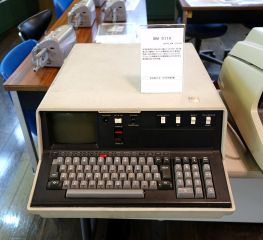 IBM 5110
.jpg)
Related pages
[edit | edit source]- IBM 5110 Maintenance Guide
- IBM 5110 Troubleshooting Guide
- IBM 5110 Capacitor Replacement Guide
- IBM 5100
- IBM 5120
- IBM PALM processor
References
[edit | edit source]- ↑ 1.0 1.1 Computermuseum der Stuttgarter Informatik, "Overview of the IBM 5110" (retrieved 2026-09-30). Introduction in 1978; Models 1 and 2; Model 3 as the base of the 5120.
- ↑ 2.0 2.1 2.2 IBM, IBM 5110 General Information and Physical Planning Manual, GA21-9300-0, first edition (December 1977). Hosted as File:IBM 5110 General Information and Physical Planning Manual GA21-9300-0.pdf. Page numbers are given at each use.
- ↑ IBM 5110 GIM, pp. 15–18.
- ↑ 4.0 4.1 4.2 IBM, IBM 5110 System Maintenance Analysis Procedures, SY31-0553-2 (January 1979), "Logic Card Part Numbers", pp. 050-1 and 050-2. Hosted as File:IBM 5110 System Maintenance Analysis Procedures SY31-0553-2.pdf.
- ↑ IBM, IBM 5120 Computing System Logic Manual, SY34-0193-0 (December 1979), contents and sheets 480A, 480B and 485. Hosted as IBM 5120 Computing System Logic Manual.
- ↑ IBM, IBM 5110 Computer Maintenance Information Manual, SY31-0550-2 (February 1979), p. 3-16, "Oscillators/Clocks". Hosted as IBM 5110 Maintenance Information Manual.
- ↑ 7.0 7.1 IBM 5110 MIM, p. 2-12, item 209 "A1 Board (Card Side)".
- ↑ IBM 5110 GIM, p. 16, "Main Storage Capacity".
- ↑ IBM 5110 GIM, p. 17, "Built-in Tape Unit" and "The 5106 Auxiliary Tape Unit".
- ↑ 10.0 10.1 IBM 5110 GIM, pp. 18–19, "The 5114 Diskette Unit" and "Diskette Storage".
- ↑ IBM 5110 GIM, p. 41, "IBM 5114 Diskette Unit".
- ↑ IBM, IBM 5114 Diskette Unit Maintenance Information, SY31-0551-1 (January 1979), p. 3-39, "Power". Hosted as IBM 5114 Diskette Unit Maintenance Information.
- ↑ 13.0 13.1 IBM 5110 MIM, p. 2-30, display switch service checks.
- ↑ 14.0 14.1 IBM 5110 GIM, pp. 29–34, "Optional Features".
- ↑ IBM 5110 GIM, p. 31, "Binary Synchronous Communications".
- ↑ IBM 5110 GIM, p. 34, "Parallel I/O Adapter".
- ↑ IBM, IBM 5110 System Logic Manual, SY31-0552-3 (February 1979), sheet 445 "Parallel I/O". Hosted as IBM 5110 System Logic Manual.
- ↑ IBM 5110 GIM, p. 20, "The 5103 Printer".
- ↑ IBM 5110 GIM, p. 39, "IBM 5110 Computer".
- ↑ IBM 5110 MIM, p. A-3, 5110 specifications.
- ↑ IBM 5110 GIM, p. 43, "Electrical Requirements".
- ↑ IBM 5110 MIM, p. 3-42, "Power Supply PC Board" and "Power Supply Protection".
- ↑ IBM 5110 System Logic Manual, sheet 480 "5110/5114 D.C. Power Distribution".
- ↑ IBM 5110 MIM, p. 3-8, "Switches and Controls".
- ↑ IBM 5110 MIM, p. 4-5, "Diagnostic Run Summary Chart".
- ↑ Wikipedia, "John Titor".
Further reading
[edit | edit source]- Computermuseum der Stuttgarter Informatik, "IBM 5110", including work on the processor card and ROS contents.