

IBM PS/2 Model 25
 | |
 | |
| IBM PS/2 Model 25 (8525) | |
| Specifications | |
|---|---|
| Manufacturer | IBM |
| Type | All-in-one personal computer |
| Released | 4 August 1987 (Model 25); 1 June 1990 (Model 25 286); 17 April 1992 (Model 25 SX) |
| Intro price | US$1,350 (8525-001) to US$1,740 (8525-G04) at launch |
| CPU | Intel 8086 at 8 MHz, no wait states; 80286 at 10 MHz (Model 25 286); 386SX at 16 MHz (Model 25 SX) |
| Memory | 512 KB, 640 KB maximum on the system board (8086); 0.5 to 4 MB on the board (286); 1 or 4 MB, 16 MB maximum (SX) |
| Storage | One or two 3.5-inch diskette drives (720 KB on the 8086, 1.44 MB on the 286 and SX); optional fixed disk |
| Display | Integrated 12-inch analogue display, monochrome or colour; MCGA (8086), VGA (286 and SX) |
| Sound | Beeper; earphone connector |
| Dimensions | 382 × 320 × 375 mm (H × W × D) |
| Weight | 14.1 kg monochrome, 16.3 kg colour (8086, IBM US); 16.0 to 17.7 kg (286 and SX) |
| OS / Firmware | IBM PC DOS 3.30 and later; DOS 5.0 shipped with the SX |
| Predecessor | IBM PC (5150), IBM PC XT (5160) |
| Model no. | 8525 |
The IBM Personal System/2 Model 25 (machine type 8525) is the all-in-one member of IBM's PS/2 range: the system board, drives and supply share one case with a 12-inch display. IBM announced it on 4 August 1987 as a low-priced machine running at about twice the speed of the 8088-based IBM PCs, with an 8086 at 8 MHz, MCGA graphics and two slots for existing PC and XT cards.[1] Like the Model 30 it has ISA slots; IBM kept Micro Channel for the higher models.[2] IBM later sold a Model 25 286 (1990) and a Model 25 SX for schools (1992).
History
[edit | edit source]The first four models, 001 and G01 (monochrome) and 004 and G04 (colour), were priced at US$1,350, $1,395, $1,695 and $1,740. The 001 and 004 were available on the day of announcement and the G models, with the Enhanced Keyboard instead of the Space Saving Keyboard, from 30 October 1987.[1] IBM Canada listed the 001 and 004 at $2,095 and $2,595.[3]
The Model 25 LS (8525-L01 monochrome and L04 colour), announced on 2 June 1988, came with 640 KB, the Enhanced Keyboard and an IBM Token-Ring Network PC Adapter, at US$2,139 and $2,484 through dealers.[4]
The Model 25 286 (8525-006, G06, 036, G36) was announced on 10 May 1990 for availability on 1 June 1990. It has an 80286 at 10 MHz with one wait state, 0.5 or 1 MB on the system board expandable to 4 MB, 1.44 MB diskette support and VGA, and the 036 and G36 have a 30 MB fixed disk. Prices ran from US$2,295 to $3,040. IBM noted that the new drive options announced with it do not fit earlier 8525 models.[5]
The Model 25 SX (8525-K00, K01, L02) was announced on 21 January 1992, available from 17 April 1992, and sold through IBM's K-12 education channels only. It has a 386SX at 16 MHz, 1 MB (K00) or 4 MB (K01, L02) of parity memory with a 16 MB maximum, VGA with 256-colour support, and DOS 5.0. The K01 adds an Ethernet adapter and the L02 a Token-Ring adapter, both with Remote Initial Program Load. Prices were US$2,082, $2,832 and $3,165.[6]
Models
[edit | edit source]| Model | Processor | Memory as shipped | Storage | Display | Notes |
|---|---|---|---|---|---|
| 8525-001, G01 | 8086, 8 MHz | 512 KB | One 720 KB diskette | Monochrome | G01 has the Enhanced Keyboard |
| 8525-004, G04 | 8086, 8 MHz | 512 KB | One 720 KB diskette | Colour | G04 has the Enhanced Keyboard |
| 8525-L01, L04 | 8086, 8 MHz | 640 KB | One 720 KB diskette | Monochrome / colour | Model 25 LS, Token-Ring adapter fitted |
| 8525-006, G06 | 80286, 10 MHz | 512 KB | One 1.44 MB diskette | Colour VGA | Model 25 286 |
| 8525-036, G36 | 80286, 10 MHz | 1 MB | 1.44 MB diskette, 30 MB fixed disk | Colour VGA | Model 25 286 |
| 8525-K00 | 386SX, 16 MHz | 1 MB | One 1.44 MB diskette | Colour VGA | Model 25 SX, education only |
| 8525-K01, L02 | 386SX, 16 MHz | 4 MB | One 1.44 MB diskette | Colour VGA | Ethernet (K01) or Token-Ring (L02) |
Sources: 187-148, 188-081, 190-082 and 192-019.[1][4][5][6]
Architecture
[edit | edit source]Model 25 (8086) system board
[edit | edit source]There are three system boards: Type 1 (P/N 00F2073), Type 2 (FRU P/N 96F7390, P/N 64F0738) and a Japanese board (P/N 78X8943) made by Panasonic/Matsushita. The layouts differ, but the reference designators are largely the same across all of them and across the 8086 Model 30 boards.[7] IBM's 1994 maintenance manual lists 96F7390 as the system board FRU.[8]
| Designator | Part |
|---|---|
| U10 | Intel 8086-2 CPU, 8 MHz |
| U13 | 8087 coprocessor socket |
| U8 | Intel P8253-5 timer |
| U9, U11, U12, U14, U15 | IBM gate arrays 72X8203, 72X8300 (MCGA memory controller), 72X8205 (MCGA video formatter), 72X8206, 72X8202 |
| U5 | IMSG171P RAMDAC |
| U6, U7 | HM53461P 64K × 4 DRAM (MCGA) |
| U38 | CXK5864BM-12L 8K × 8 SRAM (MCGA) |
| U16, U22, U34, U35 | NEC D4164C-10 DRAM |
| ZM1, ZM2 | MSM3764A-15 64K × 1 DRAM |
| U18 | µPD765AC-2 diskette controller |
| U19 | 8237A DMA controller |
| U27 | NS8250AV UART |
| F1, F2 | Fuses, probably mouse and keyboard (combined in F1 on the Type 2 board) |
| J7 | Power connector |
| J8 | Fan connector |
| J9 | Memory (dual 30-pin sockets) |
| J11 | 44-pin fixed-disk connector |
| J12 | 40-pin diskette connector |
| Y1, Y2, Y3 | 14.31818 MHz, 25.175 MHz and 48.0 MHz oscillators |
The 8086 Model 25 has no real-time clock: its BIOS system descriptor reports "No Real-time clock",[9] and it is the only PS/2 without a CMOS battery.[10] The riser card (P/N 78X9031) carries two 8-bit ISA slots and a resistor pack.[7] The Model 25 does not use the same power connector as the 8086 Model 30.[7]
Model 25 286 system board
[edit | edit source]The board (ardent-tool gives FRU P/N 64F0178, P/N 37F6675; IBM's 1994 manual lists FRU 96F7435) uses the VLSI VL82CPCAT chipset at ZM2 to ZM6, a 286-10 at ZM36 and a 287 socket at ZM1. Other parts: VL16C451 serial and parallel at ZM9, 27F4094 diskette gate array at ZM14, 15F6864 VGA controller at ZM18 with an IMSG171P-35 RAMDAC at ZM23, µPD765BC diskette controller at ZM19, 8042 keyboard controller at ZM33 and a Dallas DS1287 clock module at ZM35. Memory is 30-pin SIMMs with parity in J9 and J10. J13 is the password-override connector, and J7 and J14 are the power connectors.[11][8]
Model 25 SX system board
[edit | edit source]The board (ardent-tool gives FRU P/N 87F4769 in "K" and "L" versions; IBM's 1994 manual lists 42G2802 with 1 MB and 42G2803 with 4 MB) has an i386SX at U2, clocked at 16 MHz from a 32 MHz oscillator; many are 20 MHz parts run at 16 MHz. The chipset is a VLSI VL82C304 and VL82C305, with an 8042 keyboard controller at U10, an 82077AA diskette controller at U25, ROM BIOS 87F4794 at U26, and IBM's 84F7985 SVGA controller at U42 with its own video RAM. Memory is soldered 512K × 9 DRAM plus one 72-pin SIMM socket at J6; J4 is an unfitted second socket. J10 is a 40-pin IDE connector, J14 a 4-pin hard-disk power connector, J2 the power-on password clear, and B1 a CR2032 cell for the clock, with a 32.768 kHz crystal at Y1.[12][8] IBM's announcement mentions VGA only; the controller's SVGA modes work with IBM's VESA driver, though the built-in display cannot sync to 800 × 600.[6][12]
Storage
[edit | edit source]Each diskette drive takes power and data through one cable from the system board; there is no separate drive power lead.[2] PS/2 diskette drives were made mostly by Alps and Mitsubishi, with Sony and YE-Data less common.[2] The 8086 machine shipped with 720 KB drives but has undocumented 1.44 MB support that works reliably only with Sony drives, and later system boards accept more drives than early ones.[7]
Mitsubishi's MF355C specification describes a brushless DC motor turning the spindle directly at 300 rpm, so a drive of that design has no belt.[13]
The Model 25 has no hard-disk controller on the system board. IBM describes its 44-pin fixed-disk connector as "a dedicated I/O channel for the connection of the IBM Personal System/2 20MB Fixed Disk Drive and controller, or similar attachment", carrying ordinary I/O-channel signals, a −DISK CS select decoded at hex 032x, a −Disk Installed line and address lines A0 to A2 to pick a register in the drive's controller.[14] The Model 25 SX is the only Model 25 with a 40-pin IDE connector.[12]
Display
[edit | edit source]The 8086 Model 25 has MCGA on the system board with a 64 KB display buffer. It supports the CGA modes plus 640 × 480 in 2 colours, 320 × 200 in 256 colours, and 40- and 80-column text in 16 colours with an 8 × 16 character box, all from 262,144 colours. It does not support the 640 × 350 mode or mode 7 for the IBM 5151 monochrome display. On the monochrome models the MCGA converts colour to up to 64 shades of grey.[1] The palette has 256 18-bit registers driving three 6-bit DACs.[15] The Model 25 286 has VGA, and the Model 25 SX VGA with IBM's SVGA controller.[5][12]
Keyboard and mouse ports
[edit | edit source]On the 8086 machine the keyboard and pointing-device interfaces are the same, so either device can go in either 6-pin connector at the rear.[16] The 286 and SX boards use an 8042 keyboard controller.[11][12] The ports are fused on the system board: F1 and F2 on the Type 1 8086 board, a single F1 on the Type 2, 286 and SX boards.[7][11][12]
Power supply
[edit | edit source]The supply is inside the display assembly and powers the system unit, the display, options and keyboard.[17] IBM's parts list has no separate supply: the display assembly is the FRU, with different part numbers for monochrome and colour, for the 8086, 286 and SX machines, and for mains region.[8]
- Colour 8086 machines: 113 W, six voltage levels. System board: 7.0 A at +5 V, 1.7 A at +12 V, 100 mA at −5 V, 250 mA at −12 V. Display: 450 mA at 115 V DC and 220 mA at +12 V.
- Monochrome 8086 machines: 90 W, five voltage levels. The same system board outputs, plus 800 mA at +39 V DC for the display.[17]
- Model 25 286 and Model 25 SX: 124.5 W, dual voltage, switched on the rear.[5][6]
IBM Canada's quick reference gives 115 W for the colour 8086 machine; the Technical Reference gives 113 W.[3][17] The system board and drives take about 4 A of +5 V, leaving about 3 A for the two slots.[17]
| Rail | Load | Regulation | Ripple | Under-voltage sense |
|---|---|---|---|---|
| +5 V | 1.5 to 7.0 A | +5 % to −3 % | 100 mV p-p | +3.2 V |
| −5 V | 0.0 to 0.11 A | +10 % to −8 % | 50 mV | −2.4 V |
| +12 V | 0.12 to 1.7 A | +5 % to −3 % | 120 mV | +10.5 V |
| −12 V | 0.015 to 0.25 A | +10 % to −8 % | 120 mV | −8.6 V |
The Model 25 is an ISA machine and has a −5 V rail for adapters. The input is 115 V AC nominal (90 to 137 V, 2.0 A) or 230 V (180 to 265 V, 1.0 A), set by a switch on the rear, and is fused inside. The supply shuts down while an over-current or under-voltage condition exists. Power Good is 2.4 to 5.25 V when active, with a turn-on delay of 100 to 500 ms.[17] Power reaches the system board on the 12-pin J7: pin 1 Power Good, pins 2 and 5 to 8 ground, pin 3 +12 V, pin 4 −12 V, pin 9 −5 V, pins 10 to 12 +5 V.[17][8] A Model 30 supply does not fit.[2]
Reference Diskette
[edit | edit source]The Model 25 has no setup program in ROM. Configuration and diagnostics come from the model's own Reference or Starter Diskette; ardent-tool lists separate diskettes for the 8086, 286 and SX machines, and the SX has no Starter Disk and is configured with Advanced Diagnostics.[7][11][12] Power on with the diskette in the drive: soft-booting it can cause false errors and a false report that a power-on password is set.[18]
Documentation
[edit | edit source]- IBM PS2 Model 25 Technical Reference (June 1987): the 8086 machine's hardware and BIOS reference.
- IBM Personal System 2 Hardware Maintenance Manual (S52G-9971-02, October 1994): symptom-to-FRU index, system board locations and parts for the 8086, 286 and SX machines.
- IBM announcement letter 187-148, hosted as IBM Announcement Letter 187-148: PS/2 Model 25.
General maintenance
[edit | edit source]Opening the machine, the display assembly hazards, rail checks and batteries are in IBM PS/2 Model 25 Maintenance Guide.
Troubleshooting
[edit | edit source]IBM's symptom-to-FRU index, memory isolation, power checks and password removal are in IBM PS/2 Model 25 Troubleshooting Guide.
Capacitor replacement
[edit | edit source]The diskette drive boards, the system board and the display assembly are covered in IBM PS/2 Model 25 Capacitor Replacement Guide.
Gallery
[edit | edit source]-
 IBM PS/2 Model 25
 -
 Front view
 -
 Angled view
 -
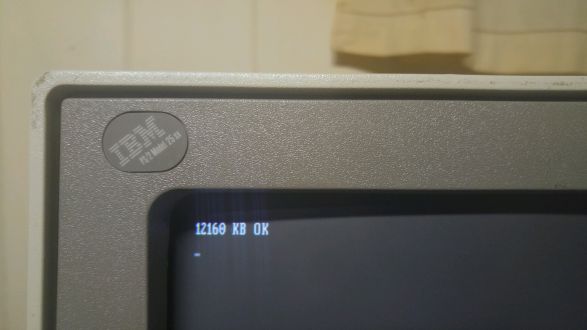 Model 25 SX
 -
 Model 25 badge
 -
 Model 25 286 badge


References
[edit | edit source]- ↑ 1.0 1.1 1.2 1.3 IBM, Announcement Letter 187-148, "IBM 8525, Personal System/2 Model 25", 4 August 1987, hosted as File:IBM Announcement Letter 187-148 PS2 Model 25 (August 1987).pdf. Description, standard features, prices, availability dates, physical specifications, universal power supply and compatibility notes.
- ↑ 2.0 2.1 2.2 2.3 DOS Days, "IBM PS/2 Model 25". Community reference: drive cabling, drive makers, dust shutters and capacitor leakage, 1.44 MB support with Sony drives, and the Model 30 supply not fitting.
- ↑ 3.0 3.1 IBM Canada Ltd, Quick Reference, "IBM Personal System/2 Model 25", transcribed at ardent-tool.com. Canadian prices, memory type, weights, supply ratings and MCGA summary.
- ↑ 4.0 4.1 IBM, Announcement Letter 188-081, "IBM Personal System/2 Model 25 LS", 2 June 1988, transcribed at ardent-tool.com.
- ↑ 5.0 5.1 5.2 5.3 IBM, Announcement Letter 190-082, "IBM Personal System/2 Model 25 286 (8525-006, G06, 036, G36)", 10 May 1990, transcribed at ardent-tool.com. Features, prices, 124.5 W supply, weights, BTU output and DOS support.
- ↑ 6.0 6.1 6.2 6.3 IBM, Announcement Letter 192-019, "IBM Personal System/2 Model 25 SX (8525-K00, K01, L02)", 21 January 1992, transcribed at ardent-tool.com. Features, prices, memory, LAN models, 124.5 W supply, dimensions and weight.
- ↑ 7.0 7.1 7.2 7.3 7.4 7.5 Ardent Tool of Capitalism, "8525 Planar", based on content by William R. Walsh. Designator lists for the Type 1, Type 2 and Japanese boards, ROM images, riser card, MCGA notes, power connector, diskette drive notes and ECA 023.
- ↑ 8.0 8.1 8.2 8.3 8.4 IBM, Personal System/2 Hardware Maintenance Manual, S52G-9971-02, October 1994, hosted as IBM Personal System 2 Hardware Maintenance Manual (S52G-9971-02, October 1994). General Checkout and Symptom-to-FRU Index (AT Bus), pp. 3 to 17; power supply connector, p. 138; system board locations, pp. 185 to 188; Model 25 parts, pp. 223 to 225.
- ↑ IBM, IBM Personal System/2 Model 25 Technical Reference, June 1987, p. 5-45, hosted as IBM PS2 Model 25 Technical Reference (June 1987).
- ↑ Ardent Tool of Capitalism, "PS/2 RTC/CMOS Batteries", based on content by Bob Eager and Peter H. Wendt. Battery type and FRU for each model, DS1287 replacements, CR2032 test limits.
- ↑ 11.0 11.1 11.2 11.3 Ardent Tool of Capitalism, "8525-286 Planar". Designator list, ROM images, memory, earphone connector board and memory expansion address table.
- ↑ 12.0 12.1 12.2 12.3 12.4 12.5 12.6 Ardent Tool of Capitalism, "8525 SX Planar", based on content by William R. Walsh. Designator lists for the K and L boards, ROM image, unpopulated memory positions, the riser slot for the LAN adapter, the SVGA controller and the CPU speed.
- ↑ Mitsubishi Electric, 3.5 inch Flexible Disk Drive Standard Specifications, MF355C, UGD-0527A, February 1987, section 1.1 (p. 3) and section 2.3, "Rotation Mechanism" (p. 9): brushless DC direct-drive spindle motor at 300 rpm. Hosted as File:Mitsubishi MF355C 3.5 inch Diskette Drive Specifications (UGD-0527A, Feb 1987).pdf.
- ↑ IBM, IBM Personal System/2 Model 25 Technical Reference, June 1987, "Fixed Disk Connector", p. 1-104, hosted as IBM PS2 Model 25 Technical Reference (June 1987).
- ↑ IBM, IBM Personal System/2 Model 25 Technical Reference, June 1987, video subsystem, pp. 1-36 and 1-57, hosted as IBM PS2 Model 25 Technical Reference (June 1987).
- ↑ IBM, IBM Personal System/2 Model 25 Technical Reference, June 1987, "Keyboard and Pointing Device Controller", p. 1-8, hosted as IBM PS2 Model 25 Technical Reference (June 1987).
- ↑ 17.0 17.1 17.2 17.3 17.4 17.5 IBM, IBM Personal System/2 Model 25 Technical Reference, June 1987, section 3, "Power Supply", pp. 3-3 to 3-6, hosted as IBM PS2 Model 25 Technical Reference (June 1987).
- ↑ Ardent Tool of Capitalism, "PS/2 Error Codes". Reference Diskette use, multiple-error order, dead-system procedure and line-cord advice.
Related pages
[edit | edit source]- IBM PS/2 Model 25 Maintenance Guide
- IBM PS/2 Model 25 Troubleshooting Guide
- IBM PS/2 Model 25 Capacitor Replacement Guide
- IBM PS/2 Model 30
- IBM PCjr