
Atari 130XE
The Atari 130XE is an 8-bit home computer introduced by Atari Corporation in 1985 as the flagship of the XE ("XL Enhanced") series. It is the most powerful standard-production model in the Atari 8-bit computer family, distinguished by its 128 KB of bank-switched RAM — double the memory of any previous model. The 130XE maintains full backward compatibility with earlier Atari 400/800, XL, and XE software while offering expanded capabilities for RAM disk usage and more demanding applications.
 | |
| Atari 130XE Home Computer | |
| Specifications | |
|---|---|
| Manufacturer | Atari Corporation |
| Type | Home Computer |
| Released | 1985 |
| Discontinued | 1992 |
| Intro price | US$150 (1985) |
| CPU | MOS Technology 6502C @ 1.79 MHz (NTSC) / 1.77 MHz (PAL) |
| Memory | 128 KB RAM (bank-switched), 24 KB ROM (OS + BASIC) |
| Storage | External cassette tape (410/1010), optional 5.25" floppy disk drive (1050/XF551) |
| Display | 320×192 pixels, 40×24 text, 16 colours (256 hue/luminance combinations via ANTIC/GTIA) |
| Sound | POKEY: 4 voices, 8-bit, noise, envelope, keyboard scan |
| Dimensions | 34 cm × 24 cm × 5 cm |
| Weight | 1.2 kg |
| OS / Firmware | Atari OS (Rev. 2/3 in ROM), Atari BASIC Rev. C |
| Predecessor | Atari 800XL |
| Successor | Atari XE Game System |
| Codename | — |
| Model no. | 130XE |
The 130XE shares the same compact, light-grey wedge case styling as the Atari 65XE, and was produced from 1985 until Atari Corporation officially dropped the 8-bit line on 1 January 1992. It was sold worldwide and became one of the most popular XE-series machines, particularly in European markets.
Architecture and Processor
editAt its core, the 130XE uses the MOS Technology 6502C (Sally) microprocessor, a custom variant of the 6502 with a HALT input for DMA operations. It runs at:
- 1.79 MHz (NTSC systems, derived from 3.58 MHz colour burst)
- 1.77 MHz (PAL systems, derived from 3.54 MHz colour burst)
The CPU coordinates with Atari's custom chipset:
- ANTIC (CO21697 NTSC / CO21698 PAL) — Display list processor, handles video DMA and generates display instructions
- GTIA (CO14805 NTSC / CO14889 PAL) — Graphics Television Interface Adaptor, produces final colour video output, handles player/missile (sprite) graphics and colour interpretation
- POKEY (CO12294) — Pot Keyboard Integrated Circuit, handles sound generation, serial I/O, keyboard scanning, and paddle input
- PIA (CO14795 / 6520) — Peripheral Interface Adaptor, manages joystick port I/O and memory bank selection
- FREDDIE (CO61991) — Memory controller, generates RAS/CAS signals for DRAM, handles bus arbitration between CPU and ANTIC
- MMU (CO61618) — Memory Management Unit PAL, handles address decoding and chip select generation
- EMMU (CO25953) — Extended MMU, enables bank-switching of the additional 64 KB RAM
Memory and Storage
editThe Atari 130XE is equipped with:
- 128 KB RAM — organised as 16 × 64Kbit (4164) DRAM chips on early boards (CO70065/CO70067) or 4 × 256Kbit (4464/41464) DRAM chips on later cost-reduced boards (C103579)
- 24 KB ROM, comprising:
- 16 KB for the operating system (Atari OS Rev. 2 or Rev. 3)
- 8 KB for Atari BASIC (Revision C)
The extra 64 KB of RAM beyond the base 64 KB is accessed via bank-switching controlled through PIA port B (address $D301). Four 16 KB banks can be mapped into the $4000–$7FFF window, accessible to either the CPU, ANTIC, or both. This extended memory is commonly used as a RAM disk under Atari DOS 2.5 and later DOS versions (e.g. SpartaDOS).
Storage options include:
- Cassette tape drive (Atari 410/1010)
- 5.25" floppy disk drive (Atari 1050, XF551, Indus GT)
- Cartridge slot for instant program loading (up to 16 KB standard, larger with bank-switching)
Display and Graphics
editVideo output is managed by the ANTIC and GTIA chips working in tandem:
- Resolution up to 320×192 pixels (Graphics mode 8) or 160×192 with 4 colours
- Text display: 40 columns × 24 rows (ANTIC mode 2)
- 16 colours simultaneously selectable from 256 possible hue/luminance combinations (16 hues × 16 luminances)
- GTIA extended modes provide 16-shade, 16-hue, and 9-colour modes at lower resolution
- Multiple graphics modes (ANTIC modes 2–F), with hardware vertical and horizontal fine scrolling
- Player/Missile Graphics (hardware sprites): 4 players (8 pixels wide) and 4 missiles (2 pixels wide), with priority control and collision detection
The XE series supports:
- Composite video output via 5-pin DIN monitor port (also carries separated luma/chroma for S-Video with adapter)
- RF modulated output via channel 2/3 switchable modulator
Sound Capabilities
editAudio is generated by the POKEY chip (CO12294), offering:
- 4 independent audio channels, each with 8-bit frequency divider
- Selectable clock base frequencies: 15 kHz, 64 kHz, or 1.79 MHz
- Channels can be linked in pairs for 16-bit resolution (two channels combined)
- Programmable polynomial counter noise generation (4-bit, 5-bit, 9-bit, 17-bit)
- Volume-only mode for digital audio playback (DAC)
- High-pass filter capability by clocking one channel with another
Input/Output and Expansion
editThe 130XE provides:
- Cartridge slot — standard Atari 8-bit cartridge interface for software and hardware expansion
- SIO (Serial Input/Output) port — Atari's proprietary daisy-chain serial bus (active accent), connects disk drives, printers, modems, cassette drives
- Two joystick ports — DE-9 connectors compatible with Atari-standard joysticks, paddles, and light guns
- ECI (Enhanced Cartridge Interface) — an edge connector on the back panel replacing the XL-series PBI (Parallel Bus Interface), providing active accent access to the system bus for expansion devices
- Composite/monitor port — 5-pin DIN connector carrying composite video, separate luminance, chrominance, and audio output
- RF output — via built-in modulator
PCB Revisions
editThe 130XE was produced on several motherboard revisions:
| Board Number | RAM Configuration | Notes |
|---|---|---|
| CO70065 / CO70067 Rev B/C | 16 × 4164 (64K×1) | Early production, same board as 65XE with all RAM slots populated |
| C103579-001 Rev 1 | 4 × 41464 (64K×4) | Later cost-reduced board, fewer chips, slightly different layout |
Gallery
edit-
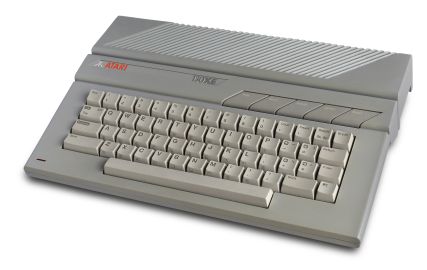 Atari 130XE front view
Related Pages
edit- Atari 130XE General Maintenance
- Atari 130XE Troubleshooting Guide
- Atari 130XE Capacitor Replacement Guide
- Atari 65XE
- Atari 800XE
- Atari XE Game System