

Atari XE Game System
.jpg) | |
| Atari XE Game System with its keyboard and XG-1 light gun | |
| Specifications | |
|---|---|
| Manufacturer | Atari Corporation |
| Type | Home computer in a games console case |
| Released | September 1987 (United States) |
| Discontinued | Christmas 1991 |
| Intro price | US$150 (1987, full package) |
| CPU | 6502C at 1.79 MHz |
| Memory | 64 KB RAM (two 64K × 4 DRAMs) |
| Storage | — |
| Display | 320 × 192 maximum; 40 × 24 text; 256 colours |
| Sound | POKEY, four voices |
| ROM | 32 KB: operating system, Atari BASIC and Missile Command |
| Input | Detachable keyboard; two controller ports |
| Ports / interface | Cartridge, SIO, two controller ports, keyboard (DB-15), RF, composite video and audio, power |
| Power | External adaptor, 5 V DC, 1 A |
| Dimensions | Console 325 × 205 × 60 mm; keyboard 350 × 162 × 45 mm |
| Weight | Console 1.02 kg; keyboard 1.04 kg |
| OS / Firmware | Atari XE operating system; Atari BASIC revision C |
| Model no. | Main board C100417 |
The Atari XE Game System (XEGS) is an Atari 8-bit computer in a games console case, released by Atari Corporation in 1987. It has 64 KB of RAM, a detachable keyboard, and Missile Command built into its ROM alongside the operating system and Atari BASIC. Without the keyboard it starts Missile Command; with the keyboard attached it starts Atari BASIC like an Atari 65XE, and it runs XL and XE software and peripherals.[1][2]
History
[edit | edit source]Antic reported that Atari executives asked the heads of several large toy store chains whether they would rather sell the 65XE as a computer for about $80 or a new game system for about $150, and were told to keep the computer.[2] According to Michael Current's Atari 8-bit FAQ, Atari previewed the XE Game System at the Winter Consumer Electronics Show on 8 January 1987, introduced it at the American International Toy Fair in New York in February, and shipped it in late September 1987, reaching most shops by mid-October at US$150.[3] The full package contained the console, keyboard, joystick, XG-1 light gun and the Bug Hunt and Flight Simulator II cartridges. The console with a joystick, the keyboard with Flight Simulator II and the light gun with Bug Hunt were also sold separately.[3] The FAQ names Ira Velinsky as the designer.[3]
Antic reported in May 1988 that Atari had sold 100,000 XE Game Systems in the United States at Christmas 1987, every unit it made that year.[4] The FAQ quotes AtariUser (July 1992) that Atari decided to discontinue the XEGS, 2600 and 7800 as of Christmas 1991.[3]
Hardware
[edit | edit source]The XEGS has 64 KB of RAM in two 64K × 4 DRAMs; Ratcliff's machine had Texas Instruments parts, and he counted 17 chips on the board in all.[2] The ROM is a single 32 KB part holding the 16 KB operating system, 8 KB of Atari BASIC and 8 KB of Missile Command, which is switched in and out of the memory map in the same way as BASIC.[3][2] Atari's specification lists the custom chips as GTIA (graphics display), POKEY (sound generator control), ANTIC (screen and input/output) and FREDDY (memory system control), with a 6502C at 1.79 MHz.[1]
The keyboard is the 65XE's mechanism in a separate case on a short cable ending in a standard DB15 plug; two brackets at the top of the keyboard case lock under the front of the console. Inside the keyboard a small board with two CD4051 multiplexers passes key codes to POKEY in the console, which does the scanning. START, SELECT, OPTION and RESET are on the console.[2]
Ports
[edit | edit source]| Connector | Notes |
|---|---|
| Power | 7-pin round socket: pins 1, 4 and 6 +5 V; 3, 5 and 7 ground; 2 shield |
| SIO | 13 pins; pin 10 is +5 V/ready, pin 12 is not connected |
| Controller ports (2) | 9-pin: directions on 1–4, paddle inputs on 5 and 9, trigger 6, +5 V on 7, ground 8 |
| Cartridge | Standard Atari 8-bit cartridge slot on top of the console |
| Keyboard | DB15 socket for the detachable keyboard |
| Video | RF output with channel selector; composite video and audio phono jacks |
Sources: Atari's owner's manual,[1] the keyboard connector from Ratcliff,[2] the phono jacks from the FAQ.[3] The XEGS has no 5-pin monitor socket of the XL/XE type.[3]
Power
[edit | edit source]Atari's specification gives the power supply as 1 A at 5 V DC, through the round power socket.[1] The FAQ lists Atari's 5 V 1 A adaptor C070042 as the one shipped with most XE Game Systems, and the 5 V 1.5 A C061982 as also used with it.[3] The board has no regulator for the logic supply: in JER/Eightbitter's redrawn schematic of the board, the +5 V input runs from the power socket J7 through the power switch SW1 and choke L3 to the 1000 µF filter capacitor C13.[5]
Start-up and self test
[edit | edit source]- With no keyboard attached and no cartridge, the console starts Missile Command.[1][2]
- With the keyboard attached, it starts Atari BASIC. Hold SELECT at power-on to start Missile Command instead.[2][3]
- Hold OPTION and press POWER to run the self test, which offers memory, audio-visual and keyboard tests. Typing BYE at the BASIC prompt also reaches it; BASIC then stays switched on, so the memory test shows 40 RAM squares instead of 48.[1][2]
- If the console fails its own check at power-on, it shows the message "Memory Test".[1]
XG-1 light gun
[edit | edit source]The XG-1 is a light pen in the shape of a gun, using the light-pen input built into the Atari 8-bit hardware. Its horizontal position can be read at memory location 564 and its vertical position at 565, with values from 0 to 227. The horizontal reading is offset: pointing at the far left of the display gives about 88, the value reaches 227 at about column 34, then wraps to 0 and rises to about 30 at column 39. The vertical reading is half the scan line number, from about 17 to 115. The gun gives no reliable readings if the display is too dim.[2] Atari's manual warns against exposing its lens to intense light.[1]
Documentation
[edit | edit source]- Atari XE System Owner's Manual, C100608-001 Rev. A, 1987: specifications and connector pinouts.
- Atari 130XE Field Service Manual: a 2016 reconstruction by JER/Eightbitter, not an Atari document, containing a redrawn schematic and PCB drawing of the XEGS board C100417.
- Atari 130XE Parts List and Production Test Instructions: Atari's 1985–86 parts list and XE/XL production test for the computers, which predate the XEGS.
Gallery
[edit | edit source]-
 XE Game System with its keyboard and XG-1 light gun
 -
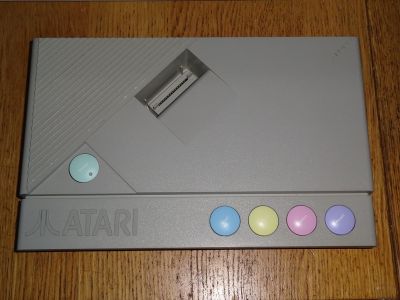 XE Game System console, with no keyboard attached

Related pages
[edit | edit source]- Atari XE Game System General Maintenance
- Atari XE Game System Troubleshooting Guide
- Atari XE Game System Capacitor Replacement Guide
- Atari 65XE
- Atari 130XE
References
[edit | edit source]- ↑ 1.0 1.1 1.2 1.3 1.4 1.5 1.6 1.7 Atari Corporation, Atari XE System Owner's Manual, C100608-001 Rev. A, 1987. Pp. 6–7, setting up and switching on; pp. 8–9, console keys; pp. 12–13, light gun; pp. 13–14, Missile Command and BASIC; pp. 15–18, self test; p. 19, care; p. 21, specifications; pp. 22–23, connector pinouts. Hosted as File:Atari XE Game System Owner's Manual C100608-001.pdf.
- ↑ 2.00 2.01 2.02 2.03 2.04 2.05 2.06 2.07 2.08 2.09 Matthew Ratcliff, "First Look Inside the XE Game System", Antic vol. 7 no. 4, August 1988, https://www.atarimagazines.com/v7n4/firstlook.php (retrieved 2026-10-01): keyboard, DB15 connector and CD4051 decoders; two 64K × 4 DRAMs and 17 chips; Missile Command bank switching; self-test behaviour; XG-1 light gun readings.
- ↑ 3.0 3.1 3.2 3.3 3.4 3.5 3.6 3.7 3.8 Michael D. Current, Atari 8-Bit Computers: Frequently Asked Questions, last modified 29 November 2009, http://www.faqs.org/faqs/atari-8-bit/faq/ (retrieved 2026-10-01). Section 1.10, XE video game system (package, separate components, boot options); external power supplies (C070042 5 V 1 A, "shipped with most XE Game Systems"; C061982 5 V 1.5 A); SIO port pinout (pin 10 +5 V/Ready); monitor port exceptions (the XEGS has phono video and audio jacks); OS ROM table (XEGS OS dated 7 May 1987, C101687, in a 32K ROM with BASIC and Missile Command); chronology for 1987 and 1991; Ira Velinsky as designer.
- ↑ Nat Friedland, "The Ever-Changing Atari Marketplace", Antic vol. 7 no. 1, May 1988, https://www.atarimagazines.com/v7n1/marketplace.html (retrieved 2026-10-01).
- ↑ JER/Eightbitter, 130XE Personal Computer Field Service Manual, a 2016 reconstruction (PDF author "Jurek", created 15 November 2016), not an Atari publication. Figure 2-13, "XE-System Assembly C100417", schematic redrawn by jer/eightbitter (PDF p. 32); figure 2-14, C100417 PCB (p. 33); figures 1-5 to 1-10, chip pin assignments (pp. 11–13). Hosted as Atari 130XE Field Service Manual (PDF).