

Atari 65XE
.jpg) | |
| Atari 65XE | |
| Specifications | |
|---|---|
| Manufacturer | Atari Corporation |
| Type | Home computer |
| Released | Announced January 1985 (Winter CES) |
| Intro price | US$99 (announced January 1985) |
| CPU | 6502C (SALLY) at 1.79 MHz (NTSC), 1.77 MHz (PAL) |
| Memory | 64 KB RAM; 24 KB ROM (16 KB operating system + 8 KB Atari BASIC Rev. C) |
| Storage | Cassette or floppy disk drive over SIO; ROM cartridge |
| Display | ANTIC and GTIA; RF and 5-pin DIN monitor output |
| Sound | POKEY, four channels |
| Power | External supply, +5 V DC (Atari C070042, 1 A, or C061982, 1.5 A), 7-pin DIN |
| OS / Firmware | Atari XL/XE operating system; Atari BASIC Rev. C built in |
| Predecessor | Atari 800XL |
| Model no. | 65XE |
The Atari 65XE is the 64 KB member of Atari Corporation's XE range, announced at the Winter Consumer Electronics Show in January 1985 as the replacement for the Atari 800XL. Compute! described it as "basically an 800XL without the rear parallel interface connector" and reported a retail price of US$99.[1] Atari's marketing manager Brian Kerr called the redesign "engineering optimization", saying that it made the machine cheaper and more reliable through the use of fewer parts, and said it would be compatible with all existing Atari software.[2] The 65XE was built in Taiwan and, late in production, in China.[3]
Versions
[edit | edit source]The comp.sys.atari.8bit FAQ lists these versions:[3]
| Version | Expansion (ECI) port | Notes |
|---|---|---|
| NTSC | No | Common production; TV channel switch 2–3 |
| NTSC | Yes | Uncommon late production on the NTSC 130XE board |
| PAL | No | Uncommon early production; no channel switch |
| PAL | Yes | Common later production on the PAL 130XE board, identical to the Atari 800XE; some machines are labelled 800XE and vice versa |
| PAL (Arabic) | Yes | "65XEN" board, Arabic operating system |
The XE range dropped the XL's 50-pin Parallel Bus Interface. Machines with the Enhanced Cartridge Interface (ECI) have a 14-contact extension behind the 30-pin cartridge slot, which is physically incompatible with the PBI.[3]
Hardware
[edit | edit source]The 65XE uses the SALLY 6502C, ANTIC, GTIA, POKEY and a 6520 PIA, with Atari's FREDDIE memory controller.[3] The master oscillator is 14.31818 MHz on NTSC machines and 14.187576 MHz on PAL machines; Atari's 130XE parts list gives both as alternatives at Y1 (C070032 and C070034) alongside a 14.31818 MHz oscillator module, and the redrawn 65XE schematics show the same values.[4][5] The CPU runs at 1.7897725 MHz (NTSC) or 1.7734470 MHz (PAL).[3]
RAM is 64 KB. The redrawn schematics in the 2016 reproduction of the 130XE service manual show eight 4164 (64K × 1) DRAMs on assemblies CO70025 and CA20097, and two 4464 (64K × 4) DRAMs on assembly CA200519, which is shared with the 800XE.[6] ROM is 24 KB: a 16K × 8 operating system ROM and 8 KB of Atari BASIC Rev. C.[6][3]
Ports
[edit | edit source]| Connector | Type | Pin notes |
|---|---|---|
| SIO | 13-pin | Pin 10 is +5 V/ready; pin 12 not connected[3] |
| Monitor | 5-pin DIN | 1 composite luminance, 2 ground, 3 audio out, 4 composite video, 5 composite chrominance[3] |
| Power | 7-pin DIN | 1, 4 and 6 +5 V; 2 shield; 3, 5 and 7 ground[3] |
| Controller jacks (two) | 9-pin D | Pin 7 +5 V, pin 8 ground[3] |
| Cartridge | 30-contact edge connector | Pin 13 +5 V; with the 14-contact ECI behind it on machines that have one[3] |
| RF output | Phono | With a channel 2/3 switch on NTSC machines[3] |
SIO pin 10 does carry +5 V. On Atari's 130XE schematic C070065 it is fed from the +5 V rail through ferrite bead L10, with C79 as its filter capacitor.[4]
Power
[edit | edit source]The 65XE runs from an external supply giving +5 V DC through the 7-pin DIN. The FAQ lists two Atari supplies for it: the 5 V DC 1 A unit C070042, whose "Logo" version shipped with most 65XEs, and the 5 V DC 1.5 A unit C061982/CA024814 shared with the 600XL, 800XL, 130XE and XE Game System. The sealed "Ingot" version of the 1.5 A unit came with some 65XEs, and the FAQ warns that if it fails it can damage the computer unless the machine is switched off quickly.[3] There is no regulator on the board; see Atari 65XE General Maintenance.
Keyboard and self test
[edit | edit source]Holding OPTION at power-on disables the built-in BASIC; with no cartridge and no powered disk drive the self test runs.[3] Atari's XE/XL production test cartridge (revision 3.4, May 1986) identifies the machine as "ATARI 65XE TESTS" and runs audio, video, port, keyboard, ROM and RAM tests with numbered error codes; these are on the Atari 65XE Troubleshooting Guide.[7]
Gallery
[edit | edit source]-
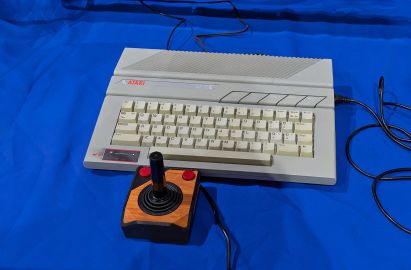 Atari 65XE
 -
 Rear panel of an NTSC 65XE: monitor, channel switch, television, power and power switch
 -
 65XE main board, assembly CO70025 Rev. C, with eight DRAMs on the left


Documentation
[edit | edit source]- Atari 130XE Parts List and Production Test Instructions: Atari's 130XE parts list (25 June 1985), the XE/XL production test instructions and error codes (Rev 3.4, 22 May 1986), and the 130XE schematic C070065 Rev B.[4]
- Atari 130XE Field Service Manual: the 2016 reproduction, with redrawn schematics of three 65XE assemblies (figures 2-7, 2-9 and 2-11).[6]
- Atari 65XE schematic: a nine-sheet redrawing of the 8 × 4164 board by Jerzy Sobola (2003, sheet 3 revised 2009).[5]
- Sams Computerfacts CC16 covers the 130XE board.
Atari's own documents for the XE range hosted here are the 130XE parts list, schematic and production test instructions. The "130XE Field Service Manual" is a 2016 retyped reproduction, not an Atari document, but its redrawn 65XE schematics are the only board-level drawings of all three 65XE assemblies.
Related pages
[edit | edit source]- Atari 65XE General Maintenance
- Atari 65XE Troubleshooting Guide
- Atari 65XE Capacitor Replacement Guide
- Atari 130XE
- Atari 800XE
- Atari 65XE (Poland)
- Atari 65XEM
- Atari 65XEP
References
[edit | edit source]- ↑ Tom R. Halfhill, "The Next Generation: New Computers at the Winter Consumer Electronics Show", Compute! issue 59, April 1985, p. 25. Report from the January 1985 show: the 65XE as an 800XL without the parallel connector, its US$99 price, and the 130XE, 65XEM and 65XEP.
- ↑ Tim Onosko and John J. Anderson, "Atari strikes back", Creative Computing Vol. 11 No. 3 (March 1985), p. 59. Written before the show from briefings by Atari marketing manager Brian Kerr.
- ↑ 3.00 3.01 3.02 3.03 3.04 3.05 3.06 3.07 3.08 3.09 3.10 3.11 3.12 3.13 Michael D. Current (ed.), comp.sys.atari.8bit Frequently Asked Questions, last modified 29 November 2009, faqs.org: sections 1.1 (clock rates), 1.7 ("What is the Atari 65XE?"), 1.11 (SALLY, FREDDIE and the PIA), 1.16 (port pinouts) and the power supply list. Community reference.
- ↑ 4.0 4.1 4.2 Atari (U.S.) Corp., 130XE Parts List (25 June 1985), XE/XL Production Test Operator's Instructions (Rev 3.4, 22 May 1986) and Atari (Japan) schematic C070065 Rev B (PDF page 14). Hosted on this wiki: Atari 130XE Parts List and Production Test Instructions (PDF).
- ↑ 5.0 5.1 Jerzy Sobola, Atari 65XE schematic, nine sheets, 23 September 2003 (sheet 3 revision D, 12 April 2009); sheet 1 shows the crystal as 14.18757 MHz (PAL) or 14.31818 MHz (NTSC). Community redrawing. Hosted on this wiki: File:ATARI65XE-SCHEMATIC.pdf.
- ↑ 6.0 6.1 6.2 Atari 130XE Personal Computer Field Service Manual, 2016 reproduction (PDF author "Jurek", created 15 November 2016), schematics "Drawn by jer/eightbitter", 2014: section 2, figures 2-7 (65XE, 8 × 4164, CO70025), 2-9 (65XEN, 8 × 4164, CA20097) and 2-11 (65XE/800XE, 2 × 4464, CA200519). Not an Atari publication. Hosted on this wiki: Atari 130XE Field Service Manual (PDF).
- ↑ Atari Corp., XE/XL Production Test Operator's Instructions and Diagnostic Error Codes, Rev 3.4, 22 May 1986, pages 1 to 4, in Atari 130XE Parts List and Production Test Instructions.