
Amstrad NC100
The Amstrad NC100 Notepad is an A4-sized, Z80-based portable computer that Amstrad released in 1992. It has a full-size keyboard, an eight-line by 80-column LCD, and its software in ROM: a word processor, address book, diary, calculator, a terminal program and BBC BASIC. It runs from four AA cells or a mains adaptor, with a lithium coin cell keeping the memory alive while the cells are changed.[1][2] The Centre for Computing History gives its price as £199 and dates its own unit to August 1992.[3]
 | |
| NC100 with a UK keyboard | |
| Specifications | |
|---|---|
| Manufacturer | Amstrad plc |
| Type | Notebook computer |
| Released | July 1992 |
| Intro price | £199 |
| CPU | Zilog Z84C00 (Z80-compatible CMOS), 4.606 MHz |
| Memory | 64 KB SRAM (two µPD43257A) |
| Storage | PCMCIA/JEIDA Type I SRAM card, up to 1 MB |
| Display | 480 × 64 pixel LCD, 80 × 8 characters, not backlit |
| Sound | — |
| ROM | 256 KB firmware EPROM (µPD27C2001) |
| Ports / interface | Centronics parallel (DB-25), RS-232 serial (DE-9) |
| Power | Four AA cells or mains adaptor; CR2032 lithium backup cell |
| Dimensions | 295 × 210 × 22 mm |
| Weight | 930 g |
| OS / Firmware | Built-in Protext-based word processor, diary, address book, calculator, terminal and BBC BASIC |
| Successor | Amstrad NC150 |
History
editWikipedia gives the release as July 1992, when Newsbytes reported the unveiling; Tim Surtell's NC users' site gives September 1992 for the launch.[4] Two related models followed: the Amstrad NC150, sold only in Italy and France in the same case from April 1993, and the NC200, a clamshell model with a backlit 80 × 16 screen and a 3.5-inch disc drive.[1] Both the NC100 and NC200 were also sold in North America as the Dreamwriter 325 and Dreamwriter 200.[1]
Hardware
editHans-Jürgen Böhling's teardown, A Surgical Guide To The Amstrad Notepad Computer, describes the board. His German NC100 board is marked Amstrad plc 4500-001P-1. Every IC is surface-mounted except the firmware EPROM, IC303, which sits under its own cover on the underside.[5]
| IC | Part | Function |
|---|---|---|
| IC301 | Zilog Z84C0006FEC | Z80-compatible CPU, 6 MHz part |
| IC302 | NEC µPD65034 | Custom ASIC: clocks, keyboard, printer and LCD interface, memory management, PCMCIA, sound |
| IC303 | NEC µPD27C2001 | 256K × 8 firmware EPROM |
| IC304, IC305 | NEC µPD43257A | 32K × 8 SRAM, on the lithium-backed supply |
| IC307 | Toshiba TC8521 | Real-time clock, on the lithium-backed supply |
| IC308 | NEC µPD71051 | UART |
| IC309 | NEC µPD4711 | RS-232 line driver |
| IC312 | LM339 | Comparators for battery level detection |
Böhling also tabulates zero-ohm links beside IC303 that select larger ROM types (27C4001, 23C2001, 23C4001 or 23C8001) and links that allow 43256 RAMs with the unfitted IC310.[5] The memory card slot takes 5 V PCMCIA/JEIDA Type I SRAM cards of up to 1 MB; flash cards do not work.[5] Amstrad's manual says cards must be formatted from the stored-documents menu before use.[2]
Böhling gives the clock as 4.606 MHz; Wikipedia gives 4 MHz.[5][1]
Power
edit| Source | Details |
|---|---|
| Four AA cells | Alkaline LR6, about 35 to 40 hours; NiCd rechargeables about 5 hours (Amstrad) |
| Mains adaptor | The supplied adaptor only; Böhling's power diagram marks the input as 6 V DC, with fuse F301 |
| CR2032 lithium cell | Keeps the memory and clock when no other power is present; Amstrad estimated its life at five years |
Amstrad's figures are from the user manual; Wikipedia gives up to 20 hours on four AA cells.[2][1] Böhling's power supply diagram shows a DC/DC converter producing +6 V, +5 V, a lithium-backed 5 V line for the RAM and clock, and −15 V for the LCD, with a battery-level detector that signals the custom chip.[5] The supplied adaptor gives 300 mA at 6 V DC and is not regulated.[6] The Amstrad NC100 Troubleshooting Guide gives the warning thresholds. If every power source is removed at once, the documents, addresses and diary entries in memory are lost.[2]
Repair guides
edit- Amstrad NC100 Maintenance Guide – batteries, the lithium cell, memory cards, opening the case
- Amstrad NC100 Troubleshooting Guide – power, low-battery warnings, lock-ups and resets, display and port faults
Documentation
edit- Amstrad Notepad Computer User Manual – Amstrad's user manual
- Amstrad NC100 Surgical Guide – Böhling's teardown and IC reference
- Robin Nixon and Chris Nixon, The Amstrad Notepad Advanced User Guide (Sigma Press, 1993), on archive.org
Gallery
edit-
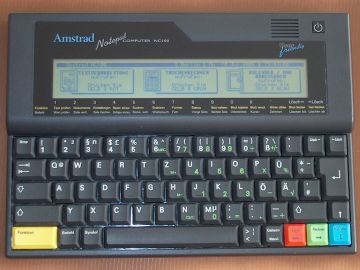 A German NC100 at its main menu
 -
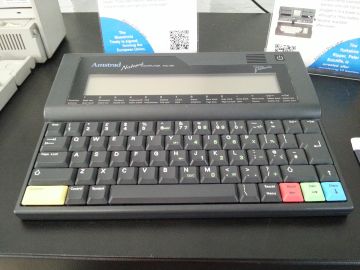 NC100 with a UK keyboard
.jpg)

Related pages
editReferences
edit- ↑ 1.0 1.1 1.2 1.3 1.4 Wikipedia, "Amstrad NC100", lead and section "Upgrades". Retrieved 2026-10-02. Release in July 1992, the built-in software, the 80 × 8 unlit screen, the serial, parallel and PC card ports, and the NC150 and NC200.
- ↑ 2.0 2.1 2.2 2.3 Amstrad plc, Amstrad Notepad Computer user manual. Hosted as File:Amstrad Notepad Computer User Manual.pdf, described at Amstrad Notepad Computer User Manual. Setting up pp. 1–2; mains adaptor p. 4; powering the Notepad p. 43; automatic power off p. 44; memory cards p. 47; resetting p. 60.
- ↑ Centre for Computing History, "Amstrad NC100", exhibit CH49463. Retrieved 2026-10-02. The £199 price and an August 1992 unit.
- ↑ Tim Surtell, Tim's Amstrad NC Users' Site, "Introduction" and "Specifications of the NC Computers". Retrieved 2026-10-02. Launch dates of the NC100 (September 1992), NC150 (April 1993) and NC200 (October 1993); the NC150's 128 KB RAM, French and Italian versions and optional external floppy drive; 4 × AA cells and a 6 V mains adaptor for the NC100 and NC150.
- ↑ 5.0 5.1 5.2 5.3 5.4 Hans-Jürgen Böhling, A Surgical Guide To The Amstrad Notepad Computer. Community document, hosted as File:Amstrad NC100 Surgical Guide.pdf, described at Amstrad NC100 Surgical Guide. Specification, opening the case, board and IC table, block and power supply diagrams, EPROM and RAM link tables, PCMCIA slot.
- ↑ Tim Surtell, Tim's Amstrad NC Users' Site, "Questions & Answers: Hardware". Retrieved 2026-10-02. Community answers: the blank-screen checklist from the NC200 manual, the internal surface-mount fuse (6 V 0.8 A on the NC100), adaptor rating and polarity, mains lead repair, case cracking, the NC100 display ribbon cable, serial port reliability, memory cards up to 1 MB, and Cliff Lawson on the NC150's Ranger disk hook.