
IBM PS/2 Model 50
The IBM Personal System/2 Model 50 (machine type 8550) is the mid-range desktop in IBM's PS/2 family, announced on April 2, 1987 alongside the IBM PS/2 Model 30, IBM PS/2 Model 60 and IBM PS/2 Model 80. The Model 50 was the entry-level MCA + VGA PS/2; the lower-priced Model 30 used ISA + MCGA. The Model 50 sold more than 1 million units (Model 50 and Model 50 Z combined), making it the best-selling PS/2 by several orders of magnitude and IBM's top-selling personal computer for several years.
 | |
| IBM PS/2 Model 50 (8550-021) MCA 286 desktop | |
| Specifications | |
|---|---|
| Developer | IBM Entry Systems Division, Boca Raton |
| Manufacturer | IBM |
| Type | Mid-range desktop personal computer |
| Released | April 2, 1987 (Model 50); June 2, 1988 (Model 50 Z) |
| Discontinued | Model 50 Z continued through c. 1992 |
| CPU | Intel 80286 @ 10 MHz, 1 wait state (Model 50); 0 wait states (Model 50 Z) |
| Memory | 1 MB on planar; 7 MB max via MCA memory cards |
| Storage | 1.44 MB 3.5" diskette + 20 MB ST-506 (Model 50) or 30 MB ST-506 / 60 MB ESDI (Model 50 Z) via MCA controller |
| Display | Integrated VGA on planar (15-pin DSUB) |
| Sound | PC speaker |
| Dimensions | 360 W × 420 D × 140 H mm |
| Weight | 9.55 kg (21 lb) |
| OS / Firmware | IBM PC DOS 3.3 and later; IBM OS/2 1.x; IBM AIX PS/2 |
| Predecessor | IBM PC AT (5170) |
| Successor | IBM PS/2 Model 70 (Model 50 / 50 Z family) |
| Model no. | 8550 |
A revised Model 50 Z (8550-031 / 061) shipped from June 2, 1988 with a redesigned planar carrying 85-ns DRAM (replacing the original 125-ns), enabling zero-wait-state memory access. The Z is roughly 20% faster than the original Model 50 in memory-bound work. The Model 50 Z also dropped the ST-506 Fixed Disk Adapter/A in favour of an ESDI controller for the 60 MB submodel, and replaced the dual 512 KB SIMM sockets with a single 1 MB or 2 MB SIMM socket.
History
The original Model 50 (8550-021) launched at US $3,595 alongside the Model 60 ($5,295 / $6,295) and the Model 80 (starting at $6,995). By mid-1987 IBM's Boca Raton factory was producing approximately 1,000 Model 50s per day at peak demand, and the Model 50 became the best-selling PS/2 throughout the late 1980s. Within the first year IBM sold over 440,000 units, with an additional 650,000 projected for 1988. By April 1988 the Model 50 was the top-selling personal computer worldwide; it occupied that position through at least late 1989, and in the UK it was still the best-selling PC in mid-1990.
The Model 50 received mixed press. Critics praised the tool-less industrial design (two thumbscrews at the rear cover, plastic captive push-pin tabs for drives, plastic thumbscrews for MCA cards) and the introduction of VGA + MCA as standard features. They criticised the slow 80286 + 1-wait-state memory (the Model 50 ran roughly the same speed as a contemporary Compaq Deskpro 286 despite the same clock) and the failure-prone Seagate ST-506 20 MB hard drive with its 85 ms access time. PC Magazine retrospectively named the Model 50 one of "The 20 Most Influential PCs of the Past 40 Years" for bringing VGA, 3.5-inch floppy drives, and tool-less construction to the personal computer market.
In June 1988 IBM introduced the Model 50 Z to address the performance criticisms. The Z planar replaced the 125-ns DRAM with 85-ns DRAM, eliminating the wait state. The dual-SIMM original was replaced with a single SIMM socket able to accept 1 MB or 2 MB modules (the original Model 50 only accepted 512 KB modules). The standard hard drive was upgraded to either a 30 MB ST-506 (-031) or a faster 60 MB ESDI (-061), with seek times rated twice as fast as the original 20 MB drive.
The Model 50 / 50 Z was discontinued in the catalogue around 1992 as IBM phased the 80286 PS/2 line out in favour of the Model 70 (80386 desktop) and PS/ValuePoint.
Submodels
| Submodel | Wait states | Stock RAM | Max RAM (planar) | HDD | Released | Notes |
|---|---|---|---|---|---|---|
| 8550-021 | 1 | 1 MB | 1 MB | 20 MB ST-506 | April 1987 | Original Model 50; 125-ns DRAM. US $3,595 |
| 8550-031 | 0 | 1 MB | 2 MB | 30 MB ST-506 | June 1988 | Model 50 Z; 85-ns DRAM |
| 8550-061 | 0 | 1 MB | 2 MB | 60 MB ESDI | June 1988 | Model 50 Z; ESDI drive |
Architecture
The Model 50 planar (Type 1, original 8550-021) and the Model 50 Z planar (Type 2, 8550-031 / 061) are distinct designs but share the chassis, the integrated VGA, the MCA slots and most I/O. Differences are concentrated around the memory subsystem.
Common architecture
- CPU: Intel 80286 in a 68-pin PGA socket, 10 MHz.
- Math coprocessor: Intel 80287 socket adjacent to the 80286. Optional, 8 MHz operation.
- MCA bus: Four 16-bit MCA expansion slots on the planar. Each slot has both the 16-bit MCA basic edge and is keyed to accept 16-bit and 8-bit MCA cards. No 32-bit MCA slots; no ISA compatibility.
- Integrated VGA on the planar with the IBM VGA gate-array implementation and an Inmos IMSG171P-style RAMDAC. Modes: 80×25 / 80×50 text, 640×480×16, 320×200×256, 720×400×16 text (8×16 character box). Output on 15-pin DSUB at rear. Analog monitors only.
- Integrated I/O:
- PS/2 keyboard (Mini-DIN-6).
- PS/2 pointing-device port (Mini-DIN-6) — the keyboard and mouse ports are functionally identical at the 8042 controller but the BIOS expects each device on its designated port.
- Asynchronous serial (DB-25 male).
- Centronics parallel (DB-25 female).
- Floppy controller: PS/2 single-cable interface integrated on the planar, 1.44 MB 3.5" half-height drive.
- Hard drive interface: None on the planar — the hard drive is supplied through an MCA controller card. The drive itself plugs directly into a connector on the rear edge of the controller card, eliminating a separate ribbon cable to the planar. The Model 50 (8550-021) uses the IBM Fixed Disk Adapter/A (ST-506); the Model 50 Z 30 MB (8550-031) uses the same ST-506 controller; the Model 50 Z 60 MB (8550-061) uses the IBM ESDI Fixed Disk Adapter/A.
- BIOS: 128 KB total, split between CBIOS (Compatible BIOS, for backward DOS compatibility) and ABIOS (Advanced BIOS, for protected-mode OS/2). Held in two 64 KB EPROM / mask-ROM chips at U-positions on the planar.
- CMOS / RTC: Battery-backed via the Dallas DS1287 / DS12887 integrated RTC + lithium-cell module. Stores SETUP configuration, date / time.
- Audio: PC speaker only.
Memory subsystem
- Model 50 (8550-021): Two 30-pin PS/2 SIMM sockets. Accept only 512 KB parity SIMMs. 1 MB on planar (2 × 512 KB). Maximum planar memory: 1 MB. Additional RAM via MCA memory cards up to a system maximum of 7 MB.
- Model 50 Z (8550-031 / 061): Single 30-pin PS/2 SIMM socket. Accepts 1 MB or 2 MB parity SIMMs. Maximum planar memory: 2 MB. Additional RAM via MCA memory cards up to a system maximum of 7 MB.
PS/2 SIMMs use an IBM-specific pinout that is similar to but not interchangeable with standard PC/AT 30-pin parity SIMMs. The originals on the Model 50 carried silver-cap "metal-can" DRAM chips; any PS/2-pinout SIMM with the right capacitance and speed (125-ns on Model 50, 85-ns on Model 50 Z) works as a replacement. The AST Advantage/2 16-bit MCA card with 4 MB pre-installed plus a SCSI controller is a documented aftermarket option that takes the Model 50 to its 7 MB ceiling.
Storage
- Floppy: 1.44 MB 3.5" half-height, PS/2 single-cable interface. Drives are typically ALPS, Mitsubishi, Sony or YE-Data.
- Hard drive (8550-021): Seagate ST-506 20 MB (the famously slow 85 ms-access-time drive PC Magazine reviewers criticised) on the IBM Fixed Disk Adapter/A MCA card.
- Hard drive (8550-031): Seagate ST-506 30 MB on the IBM Fixed Disk Adapter/A. Twice the seek-speed of the 20 MB drive.
- Hard drive (8550-061): 60 MB ESDI on the IBM ESDI Fixed Disk Adapter/A.
The ESDI Fixed Disk Adapter/A is the same MCA controller used in the Model 60 (70 MB), Model 80 (70 MB, 115 MB), and other ESDI-equipped PS/2 systems. The drive plugs directly into a rear-edge connector on the controller card.
Chassis
The Model 50 chassis is a low-profile desktop, 360 W × 420 D × 140 H mm, designed to sit under a monitor on a desk. Two thumbscrews at the rear release the cover, which slides back about 10 mm and lifts off. Inside, the planar mounts on the floor of the chassis; the MCA riser is at the rear; the drive cage runs across the front-right with the floppy and the hard drive controller card directly behind it. The PSU is on the left-front.
Drives are held by IBM's plastic captive push-pin tabs (the system shipped with a small plastic "crowbar" tool to release them). MCA cards are released by plastic thumbscrews on the rear bracket.
Power Supply
94 W switching power supply, 110/220 VAC auto-sensing. PS/2 single-cable drive power feed integrated on the planar — no Molex 4-pin connectors. The 94 W is borderline for a fully-populated Model 50 with multiple MCA cards plus an ESDI drive; the Model 50 Z PSU is electrically the same.
BIOS and Reference Diskette
The Model 50 has no built-in SETUP screen. All configuration is performed by booting the model-specific IBM PS/2 Reference Diskette that ships with the system. The Reference Diskette also reads each fitted MCA card's ADF (Adapter Definition File) and auto-configures interrupts, DMA channels and memory addresses.
- Model 50 Reference Diskette: version 1.07 final, supports both 8550-021 and 8550-031 / 061.
- Reference Diskettes are model-specific — a Model 30 or Model 60 Reference Diskette does not work on a Model 50.
ADF files for MCA cards are supplied on a separate "option diskette" that ships with each card. After fitting a new card, the ADF must be copied onto the working Reference Diskette before "Set Configuration → Run Auto Configuration" can complete; otherwise the system reports a 165 card-ID-mismatch error at POST.
The Reference Diskette also provides the Advanced Diagnostics menu (entered with Ctrl-A from the main menu) for FRU-level hardware testing.
General Maintenance
Chassis opening, MCA card handling, drive maintenance and Dallas DS12887 RTC replacement procedures are documented in IBM PS/2 Model 50 Maintenance Guide.
Troubleshooting
Audio beep codes, the full PS/2 numeric POST code reference, MCA-specific errors (165 card ID mismatch, 110 / 111 parity errors), the 161 / 162 / 163 RTC battery cluster and dead-system isolation are documented in IBM PS/2 Model 50 Troubleshooting Guide.
Capacitor Replacement
Planar tantalums (10 µF / 16 V), the 94 W PSU recap, the ESDI controller card capacitors and the drive logic board recap procedure are documented in IBM PS/2 Model 50 Capacitor Replacement Guide.
Gallery
-
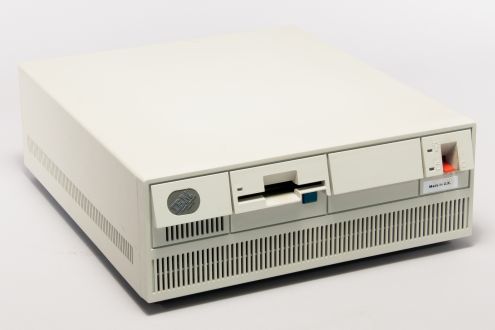 IBM PS/2 Model 50 (8550-021) desktop
 -
 IBM PS/2 Model 50 Z (8550-031 / 061)
 -
 Model 50 Z internals showing planar, drive cage and MCA riser
 -
 Model 50 front badge
 -
 Model 50 Z front badge


Related Pages
- IBM PS/2 Model 50 Maintenance Guide
- IBM PS/2 Model 50 Troubleshooting Guide
- IBM PS/2 Model 50 Capacitor Replacement Guide
- IBM PS/2 Model 60 — tower sibling
- IBM PS/2 Model 30 — ISA-bus entry-level
- IBM PS/2 Model 70 — 386 desktop successor
- IBM PS2 Model 50 Technical Reference (May 1988) — official IBM Technical Reference (PDF on the wiki)
- IBM PS2 Model 50 Technical Reference (October 1990) — updated Technical Reference (PDF on the wiki)
- IBM PS2 Model 50 Hardware Maintenance Reference — IBM HMR (PDF on the wiki)
References
- IBM PS/2 Model 50 — Wikipedia. Source for release dates, sales figures (1 million Model 50 / 50 Z units, 440,000 in first year), 125-ns vs 85-ns DRAM, tool-less construction, single-SIMM change on the Z, PC Magazine "20 Most Influential PCs" reference.
- IBM PS/2 Model 50 — DOS Days. Source for the 94 W PSU rating, integrated VGA modes, proprietary PS/2 SIMM pinout, ESDI controller architecture, and AST Advantage/2 option.
- IBM PS/2 Model 50 — Technical Specifications, Ardent Tool of Capitalism (IBM document GJAN-43VM6G).
- IBM PS/2 Model 50 Z — Technical Specifications, Ardent Tool of Capitalism (IBM document GJAN-43VMLQ).
- IBM, IBM Personal System/2 Hardware Maintenance Manual (S52G-9971-02, October 1994). Authoritative FRU listings and ECA recall data.