

BBC Micro Model A/B: Difference between revisions
Link the R. B. Coats BBC BASIC textbook and label it plainly as third-party with no hardware content |
|||
| (One intermediate revision by the same user not shown) | |||
| Line 1: | Line 1: | ||
{{Infobox computer | {{Infobox computer | ||
| name = BBC Micro Model A/B | | name = BBC Micro Model A/B | ||
| image = [[File: | | image = [[File:BBC Micro Model A-B (photo).jpg|250px]] | ||
| caption = BBC | | caption = BBC Microcomputer Model B | ||
| manufacturer = Acorn Computers Ltd | | manufacturer = Acorn Computers Ltd | ||
| type = Home | | type = Home and education computer | ||
| release date = 1 December 1981 | | release date = 1 December 1981; most of the initial run delivered during 1982 | ||
| discontinued = | | discontinued = Model A withdrawn after the Acorn Electron launch; Model B superseded by the Model B+ in 1985 | ||
| price = Model A | | price = Launch: Model A £235, Model B £335; raised to £299 and £399 | ||
| cpu = | | cpu = 6502A @ 2 MHz | ||
| memory = Model A | | memory = Model A 16 KB RAM, Model B 32 KB RAM | ||
| storage = Cassette | | storage = Cassette (300 or 1200 baud); 5.25" floppy via the optional disc interface | ||
| display = Teletext | | display = Teletext mode 7; up to 640×256 in 2 colours or 160×256 in 16 logical colours | ||
| sound = Texas Instruments SN76489: 3 | | sound = Texas Instruments SN76489: 3 tone channels + 1 noise channel, ADSR envelope control | ||
| os = Acorn MOS in ROM, with BBC BASIC in a separate 16 KB language ROM | |||
| os = Acorn MOS | |||
| predecessor = [[Acorn Atom]] | | predecessor = [[Acorn Atom]] | ||
| successor = [[BBC Micro Model B+]] | | successor = [[BBC Micro Model B+]] | ||
| codename = Proton | | codename = Proton | ||
| model = Model A | | model = ANA01, ANA02 (Model A); ANB01–ANB04 (Model B) | ||
| logo = [[File:BBC_Micro_Logo.svg|250px]] | | logo = [[File:BBC_Micro_Logo.svg|250px]] | ||
}} | }} | ||
<templatestyles src="Template:StyledTable/styles.css" /> | |||
The '''BBC Microcomputer''' — the "Beeb" — was designed and built by Acorn Computers for the BBC's Computer Literacy Project and launched on 1 December 1981, though production problems pushed most of the initial run into 1982. It became the standard computer in British schools and one of the defining British machines of the 1980s.<ref name="cchbbc">[https://www.computinghistory.org.uk/det/182/Acorn-BBC-Micro-Model-B/ "Acorn BBC Micro Model B"], The Centre for Computing History. Secondary source.</ref><ref name="beebwiki">[https://beebwiki.mdfs.net/Model_A "Model A"], BeebWiki (mdfs.net). Secondary source, used here for the launch prices and the price rise.</ref> | |||
Acorn supplied it at two levels of hardware provision, Model A and Model B, on the same circuit board: a Model A can be upgraded to a Model B.<ref name="bbcsm">Acorn Computers Limited, ''BBC Microcomputer Service Manual'', part number 0433,001, Issue 1, October 1985, Section 1 (Models A and B, ANA01–ANB04). Sections 1.2 Technical specification, 1.2.3 Expansion and 8 Component location tables. Hosted on this wiki: [[BBC Microcomputer Service Manual October 1985]].</ref> | |||
== Prices == | |||
The | The Model A launched at £235 and the Model B at £335. The prices rose almost immediately — the Model A to £299 and the Model B to £399 — because Acorn could not build the machine at the lower price.<ref name="beebwiki" /><ref name="cchbbc" /> | ||
== | == Models and variants == | ||
Acorn's own model codes, which appear on the machine and in the service manual:<ref name="bbcsm" /><ref name="beebwiki" /> | |||
== | {| class="wikitable styled-table" style="width:75%; text-align:left;" | ||
The | ! Code !! Machine | ||
|- | |||
| ANA01 || Model A, cassette only | |||
|- | |||
| ANA02 || Model A with the Econet interface fitted | |||
|- | |||
| ANB01 || Model B, cassette only | |||
|- | |||
| ANB02 || Model B with Econet | |||
|- | |||
| ANB03 || Model B with the 8271 floppy disc interface | |||
|- | |||
| ANB04 || Model B with both disc and Econet interfaces | |||
|} | |||
Early machines carried a "BBC Microcomputer" badge on the Perspex keyboard strip. A trademark dispute with Brown Boveri led to the badges being changed to read "British Broadcasting Corporation".<ref name="beebwiki" /> | |||
== Processor and memory == | |||
The machine uses a '''6502A at 2 MHz'''.<ref name="bbcsm" /> Model A has 16 KB of RAM and Model B 32 KB, in 4816 DRAMs at IC53–IC68.<ref name="bbcsm" /> | |||
ROM is not a single 32 KB block. There is a '''16 KB Machine Operating System ROM''' at IC51 and a separate '''16 KB language ROM''' holding BBC BASIC at IC52, and '''up to four 16 KB "sideways" ROMs''' can be paged in at any time at sockets IC52, IC88, IC100 and IC101. Those paged sockets hold Pascal, word processors, CAD software, the disc and Econet filing systems or teletext acquisition software.<ref name="bbcsm" /> | |||
The Model A/B has '''no cartridge slot'''. Sideways ROMs are fitted internally, in sockets on the main board. The only cartridge interface Acorn offered for this machine came with the optional speech synthesis upgrade.<ref name="bbcsm" /> | |||
== Custom chips == | |||
'''ULA''' stands for '''Uncommitted Logic Array''', and this machine has '''two''' of them, not one. Acorn's component location table gives:<ref name="bbcsm" /> | |||
{| class="wikitable styled-table" style="width:80%; text-align:center;" | |||
! Position !! Device !! Function | |||
|- | |||
| IC1 || 6502A || Processor | |||
|- | |||
| IC2 || 6845 || CRT controller | |||
|- | |||
| IC3 || 6522 || Internal (system) VIA | |||
|- | |||
| IC4 || 6850 || ACIA, serial and cassette | |||
|- | |||
| IC5 || SAA5050 || Teletext character generator | |||
|- | |||
| IC6 || 5C094 || '''Video ULA''' | |||
|- | |||
| IC7 || 2C199 || '''Serial ULA''' | |||
|- | |||
| IC18 || SN76489 || Sound generator | |||
|- | |||
| IC51 / IC52 || 27128 || Operating system ROM / BASIC ROM | |||
|- | |||
| IC69 || 6522 || User and printer VIA (Model B) | |||
|- | |||
| IC73 || µPD7002 || 4-channel analogue-to-digital converter (Model B) | |||
|- | |||
| IC78 || 8271 || Floppy disc controller (optional) | |||
|} | |||
Later machines could be fitted with a 1770 disc interface daughter board in place of the 8271; Acorn documented that upgrade, and a 64 KB sideways RAM upgrade, in Section 3 of the service manual.<ref name="bbcsm" /> | |||
== Display modes == | |||
The definitive mode list, from Acorn's own specification, with the screen memory each mode uses:<ref name="bbcsm" /> | |||
{| class="wikitable styled-table" style="width: | {| class="wikitable styled-table" style="width:85%; text-align:center;" | ||
! Mode !! Resolution !! Colours !! Text | ! Mode !! Resolution !! Colours !! Text !! Screen RAM !! Model A? | ||
|- | |- | ||
| 0 || | | 0 || 640 × 256 || 2 || 80 × 32 || 20K || no | ||
|- | |- | ||
| 1 || | | 1 || 320 × 256 || 4 || 40 × 32 || 20K || no | ||
|- | |- | ||
| 2 || | | 2 || 160 × 256 || 16 || 20 × 32 || 20K || no | ||
|- | |- | ||
| 3 || | | 3 || text only || 2 || 80 × 25 || 16K || no | ||
|- | |- | ||
| 4 || | | 4 || 320 × 256 || 2 || 40 × 32 || 10K || yes | ||
|- | |- | ||
| 5 || | | 5 || 160 × 256 || 4 || 20 × 32 || 10K || yes | ||
|- | |- | ||
| 6 || | | 6 || text only || 2 || 40 × 25 || 8K || yes | ||
|- | |- | ||
| 7 || | | 7 || teletext || teletext || 40 × 25 || 1K || yes | ||
|} | |} | ||
Two things are commonly got wrong here. '''Mode 2 has 16 logical colours''', not 8 — eight steady and eight flashing. '''Modes 3 and 6 are text-only'''; they are not reduced-memory graphics modes. A Model A has only 16 KB of RAM and so can use modes 4, 5, 6 and 7 only.<ref name="bbcsm" /> | |||
Mode 7 is a hardware teletext display to the UK broadcast standard, with character rounding, double height, flashing and coloured backgrounds, and it costs only 1 KB of RAM. In the non-teletext modes, characters are user-definable and can be positioned anywhere, not only on the character grid, and text and graphics windows can overlap.<ref name="bbcsm" /> | |||
== Sound == | |||
The SN76489 at IC18 gives '''three tone channels and one noise channel''' with full ADSR envelope control, driving the internal loudspeaker through IC19 (an LM386).<ref name="bbcsm" /> | |||
== Video outputs == | |||
* '''UHF''' on a phono connector: 625-line, 50 Hz, interlaced, fully encoded PAL, modulated on '''channel 36'''.<ref name="bbcsm" /> | |||
* '''Composite video''' on a '''BNC''' connector, for a monochrome or PAL colour monitor.<ref name="bbcsm" /> | |||
* '''RGB''' on a 6-pin DIN: separate RGB and sync at TTL levels, RGB high true, sync link-selectable high or low true, pulse duration 4.7 µs.<ref name="bbcsm" /> | |||
== | == Interfaces == | ||
The BBC | |||
Model A has the cassette interface and, optionally, Econet. Everything else below is Model B — the Model A board is missing the connectors and some of the components.<ref name="bbcsm" /><ref name="beebwiki" /> | |||
* '''Cassette''': 7-pin DIN, '''300 or 1200 baud''' to the Computer Users Tape Standard, with full automatic motor control.<ref name="bbcsm" /> | |||
* '''RS423 serial''': software-selectable between 75 and 9600 baud, with two-way RTS/CTS handshaking. The software to drive it is only present from MOS 1.2 onwards.<ref name="bbcsm" /> | |||
* '''Parallel printer''' (Centronics).<ref name="bbcsm" /> | |||
* '''User port''': 8-bit input/output with 2 control bits, on the IC69 VIA.<ref name="bbcsm" /> | |||
* '''Analogue port''': four channels, input range '''0 to 1.8 V''', 10 ms conversion time per channel. The µPD7002 is a 12-bit converter but only 9 or 10 bits are significant; with averaging the full 12 bits can be approached.<ref name="bbcsm" /> | |||
* '''1 MHz bus''': buffered extension bus for a teletext acquisition unit, IEEE-488 interface, Winchester disc and similar.<ref name="bbcsm" /> | |||
* '''Tube''': high-speed connection to a second processor. Acorn's own list at the time was a 3 MHz 6502 with 64 KB and a Z80 with 64 KB running CP/M; a 32016 second processor followed, and the ARM1 first appeared in the ARM Evaluation System, itself a BBC second processor in the standard "cheese box".<ref name="bbcsm" /><ref name="arch">Whytehead, Chris. [https://chrisacorns.computinghistory.org.uk/Computers/Archimedes.html "Archimedes"], Chris's Acorns / The Centre for Computing History. Source for the ARM1 appearing in the ARM Evaluation System, a BBC second processor.</ref> | |||
* '''Econet''': optional network interface.<ref name="bbcsm" /> | |||
* '''Floppy disc interface''': optional; drives ranged from single-sided single-density 100 KB to dual double-sided double-track-density 800 KB.<ref name="bbcsm" /> | |||
== Keyboard == | |||
73 full-travel QWERTY keys including '''10 user-definable function keys''', with two-key rollover and auto-repeat, and a clear plastic strip above the function keys for a legend card.<ref name="bbcsm" /> | |||
== Power supply == | |||
Most production machines have a switch-mode supply; a small number of early machines have a linear supply with a conventional mains transformer and regulators. On the linear unit the three outputs come from separate regulators, so it is possible for power to appear on two of the three output pairs and not the third — a useful diagnostic. The internal supply is built to BS 415 Class 1 and the mains fuse specified is 3 A to BS 1362.<ref name="bbcsm" /> | |||
Mains voltage is present on the primary side and the bulk capacitors hold a charge after switch-off. See [[Capacitor Failure Symptoms]] before working on either type. | |||
== Board issues == | |||
The main board went through issues 1 to 7, and Acorn's service manual documents the circuit changes between issue 3 and 4, and between issue 4 and 7, alongside a full link list with each link's X-Y position in millimetres from the south-west corner of the board. Links 18 and 19 control fast or slow access to the paged ROM sockets — worth checking when a sideways ROM behaves oddly.<ref name="bbcsm" /> | |||
== Documentation == | |||
{| class="wikitable styled-table" style="width:80%; text-align:center;" | {| class="wikitable styled-table" style="width:80%; text-align:center;" | ||
! Logic | ! Logic board !! Logic board schematic | ||
! Logic | |||
|- | |- | ||
| [[File:BBC Micro Motherboard.jpg|center|thumb|321x321px|BBC Micro Model B | | [[File:BBC Micro Motherboard.jpg|center|thumb|321x321px|BBC Micro Model B logic board]] | ||
| [[File:BBC Micro Schematic.png|center|thumb|350x350px|BBC Micro Model B | | [[File:BBC Micro Schematic.png|center|thumb|350x350px|BBC Micro Model B schematic]] | ||
|} | |} | ||
The full service manual — Acorn part 0433,001, Issue 1, October 1985 — is hosted here as [[BBC Microcomputer Service Manual October 1985]], covering the technical specification, general circuit description, upgrading the PCB, the link list, servicing and fault-finding, the interfacing survey, the component location tables and the circuit diagrams. | |||
The user documentation hosted on this wiki includes the [[BBC User Guide]], the [[BBC Micro Advanced User Guide]], the [[BBC Micro BASIC ROM User Guide]] and [[BBC Micro Assembly Language Programming]]. | |||
== Gallery == | == Gallery == | ||
<gallery mode="packed" heights="200"> | <gallery mode="packed" heights="200"> | ||
File: | File:BBC Micro Model A-B (photo).jpg|BBC Microcomputer Model B | ||
File:BBC Micro Motherboard.jpg|BBC Micro Model B main board | |||
File:BBC Micro Motherboard.jpg|BBC Micro Model B | |||
</gallery> | </gallery> | ||
== Related | == Related pages == | ||
* [[BBC Micro Model A/B General Maintenance]] | * [[BBC Micro Model A/B General Maintenance]] | ||
* [[BBC Micro Model A/B Troubleshooting Guide]] | * [[BBC Micro Model A/B Troubleshooting Guide]] | ||
* [[BBC Micro Model A/B Capacitor Replacement Guide]] | * [[BBC Micro Model A/B Capacitor Replacement Guide]] | ||
* [[BBC Micro | * [[BBC Micro Model B+]] | ||
* [[BBC | * [[BBC BASIC]] — R. B. Coats, Edward Arnold, 1983. A '''third-party textbook''' that states on its own title page that it "is in no way connected with either the BBC or the manufacturers of the computer, Acorn". No hardware content at all — not a source for any figure on this wiki. | ||
* [[Acorn Electron]] | |||
* [[Recommended Tools]] | |||
== References == | |||
<references /> | |||
{{Navbox-AcornComputers|state=collapsed}} | |||
[[Category:Acorn Computers]] | [[Category:Acorn Computers]] | ||
[[Category:BBC Micro]] | [[Category:BBC Micro]] | ||
Latest revision as of 02:31, 25 September 2026
 | |
.jpg) | |
| BBC Microcomputer Model B | |
| Specifications | |
|---|---|
| Manufacturer | Acorn Computers Ltd |
| Type | Home and education computer |
| Released | 1 December 1981; most of the initial run delivered during 1982 |
| Discontinued | Model A withdrawn after the Acorn Electron launch; Model B superseded by the Model B+ in 1985 |
| Intro price | Launch: Model A £235, Model B £335; raised to £299 and £399 |
| CPU | 6502A @ 2 MHz |
| Memory | Model A 16 KB RAM, Model B 32 KB RAM |
| Storage | Cassette (300 or 1200 baud); 5.25" floppy via the optional disc interface |
| Display | Teletext mode 7; up to 640×256 in 2 colours or 160×256 in 16 logical colours |
| Sound | Texas Instruments SN76489: 3 tone channels + 1 noise channel, ADSR envelope control |
| OS / Firmware | Acorn MOS in ROM, with BBC BASIC in a separate 16 KB language ROM |
| Predecessor | Acorn Atom |
| Successor | BBC Micro Model B+ |
| Codename | Proton |
| Model no. | ANA01, ANA02 (Model A); ANB01–ANB04 (Model B) |
The BBC Microcomputer — the "Beeb" — was designed and built by Acorn Computers for the BBC's Computer Literacy Project and launched on 1 December 1981, though production problems pushed most of the initial run into 1982. It became the standard computer in British schools and one of the defining British machines of the 1980s.[1][2]
Acorn supplied it at two levels of hardware provision, Model A and Model B, on the same circuit board: a Model A can be upgraded to a Model B.[3]
Prices
[edit | edit source]The Model A launched at £235 and the Model B at £335. The prices rose almost immediately — the Model A to £299 and the Model B to £399 — because Acorn could not build the machine at the lower price.[2][1]
Models and variants
[edit | edit source]Acorn's own model codes, which appear on the machine and in the service manual:[3][2]
| Code | Machine |
|---|---|
| ANA01 | Model A, cassette only |
| ANA02 | Model A with the Econet interface fitted |
| ANB01 | Model B, cassette only |
| ANB02 | Model B with Econet |
| ANB03 | Model B with the 8271 floppy disc interface |
| ANB04 | Model B with both disc and Econet interfaces |
Early machines carried a "BBC Microcomputer" badge on the Perspex keyboard strip. A trademark dispute with Brown Boveri led to the badges being changed to read "British Broadcasting Corporation".[2]
Processor and memory
[edit | edit source]The machine uses a 6502A at 2 MHz.[3] Model A has 16 KB of RAM and Model B 32 KB, in 4816 DRAMs at IC53–IC68.[3]
ROM is not a single 32 KB block. There is a 16 KB Machine Operating System ROM at IC51 and a separate 16 KB language ROM holding BBC BASIC at IC52, and up to four 16 KB "sideways" ROMs can be paged in at any time at sockets IC52, IC88, IC100 and IC101. Those paged sockets hold Pascal, word processors, CAD software, the disc and Econet filing systems or teletext acquisition software.[3]
The Model A/B has no cartridge slot. Sideways ROMs are fitted internally, in sockets on the main board. The only cartridge interface Acorn offered for this machine came with the optional speech synthesis upgrade.[3]
Custom chips
[edit | edit source]ULA stands for Uncommitted Logic Array, and this machine has two of them, not one. Acorn's component location table gives:[3]
| Position | Device | Function |
|---|---|---|
| IC1 | 6502A | Processor |
| IC2 | 6845 | CRT controller |
| IC3 | 6522 | Internal (system) VIA |
| IC4 | 6850 | ACIA, serial and cassette |
| IC5 | SAA5050 | Teletext character generator |
| IC6 | 5C094 | Video ULA |
| IC7 | 2C199 | Serial ULA |
| IC18 | SN76489 | Sound generator |
| IC51 / IC52 | 27128 | Operating system ROM / BASIC ROM |
| IC69 | 6522 | User and printer VIA (Model B) |
| IC73 | µPD7002 | 4-channel analogue-to-digital converter (Model B) |
| IC78 | 8271 | Floppy disc controller (optional) |
Later machines could be fitted with a 1770 disc interface daughter board in place of the 8271; Acorn documented that upgrade, and a 64 KB sideways RAM upgrade, in Section 3 of the service manual.[3]
Display modes
[edit | edit source]The definitive mode list, from Acorn's own specification, with the screen memory each mode uses:[3]
| Mode | Resolution | Colours | Text | Screen RAM | Model A? |
|---|---|---|---|---|---|
| 0 | 640 × 256 | 2 | 80 × 32 | 20K | no |
| 1 | 320 × 256 | 4 | 40 × 32 | 20K | no |
| 2 | 160 × 256 | 16 | 20 × 32 | 20K | no |
| 3 | text only | 2 | 80 × 25 | 16K | no |
| 4 | 320 × 256 | 2 | 40 × 32 | 10K | yes |
| 5 | 160 × 256 | 4 | 20 × 32 | 10K | yes |
| 6 | text only | 2 | 40 × 25 | 8K | yes |
| 7 | teletext | teletext | 40 × 25 | 1K | yes |
Two things are commonly got wrong here. Mode 2 has 16 logical colours, not 8 — eight steady and eight flashing. Modes 3 and 6 are text-only; they are not reduced-memory graphics modes. A Model A has only 16 KB of RAM and so can use modes 4, 5, 6 and 7 only.[3]
Mode 7 is a hardware teletext display to the UK broadcast standard, with character rounding, double height, flashing and coloured backgrounds, and it costs only 1 KB of RAM. In the non-teletext modes, characters are user-definable and can be positioned anywhere, not only on the character grid, and text and graphics windows can overlap.[3]
Sound
[edit | edit source]The SN76489 at IC18 gives three tone channels and one noise channel with full ADSR envelope control, driving the internal loudspeaker through IC19 (an LM386).[3]
Video outputs
[edit | edit source]- UHF on a phono connector: 625-line, 50 Hz, interlaced, fully encoded PAL, modulated on channel 36.[3]
- Composite video on a BNC connector, for a monochrome or PAL colour monitor.[3]
- RGB on a 6-pin DIN: separate RGB and sync at TTL levels, RGB high true, sync link-selectable high or low true, pulse duration 4.7 µs.[3]
Interfaces
[edit | edit source]Model A has the cassette interface and, optionally, Econet. Everything else below is Model B — the Model A board is missing the connectors and some of the components.[3][2]
- Cassette: 7-pin DIN, 300 or 1200 baud to the Computer Users Tape Standard, with full automatic motor control.[3]
- RS423 serial: software-selectable between 75 and 9600 baud, with two-way RTS/CTS handshaking. The software to drive it is only present from MOS 1.2 onwards.[3]
- Parallel printer (Centronics).[3]
- User port: 8-bit input/output with 2 control bits, on the IC69 VIA.[3]
- Analogue port: four channels, input range 0 to 1.8 V, 10 ms conversion time per channel. The µPD7002 is a 12-bit converter but only 9 or 10 bits are significant; with averaging the full 12 bits can be approached.[3]
- 1 MHz bus: buffered extension bus for a teletext acquisition unit, IEEE-488 interface, Winchester disc and similar.[3]
- Tube: high-speed connection to a second processor. Acorn's own list at the time was a 3 MHz 6502 with 64 KB and a Z80 with 64 KB running CP/M; a 32016 second processor followed, and the ARM1 first appeared in the ARM Evaluation System, itself a BBC second processor in the standard "cheese box".[3][4]
- Econet: optional network interface.[3]
- Floppy disc interface: optional; drives ranged from single-sided single-density 100 KB to dual double-sided double-track-density 800 KB.[3]
Keyboard
[edit | edit source]73 full-travel QWERTY keys including 10 user-definable function keys, with two-key rollover and auto-repeat, and a clear plastic strip above the function keys for a legend card.[3]
Power supply
[edit | edit source]Most production machines have a switch-mode supply; a small number of early machines have a linear supply with a conventional mains transformer and regulators. On the linear unit the three outputs come from separate regulators, so it is possible for power to appear on two of the three output pairs and not the third — a useful diagnostic. The internal supply is built to BS 415 Class 1 and the mains fuse specified is 3 A to BS 1362.[3]
Mains voltage is present on the primary side and the bulk capacitors hold a charge after switch-off. See Capacitor Failure Symptoms before working on either type.
Board issues
[edit | edit source]The main board went through issues 1 to 7, and Acorn's service manual documents the circuit changes between issue 3 and 4, and between issue 4 and 7, alongside a full link list with each link's X-Y position in millimetres from the south-west corner of the board. Links 18 and 19 control fast or slow access to the paged ROM sockets — worth checking when a sideways ROM behaves oddly.[3]
Documentation
[edit | edit source]| Logic board | Logic board schematic |
|---|---|
 |
 |
The full service manual — Acorn part 0433,001, Issue 1, October 1985 — is hosted here as BBC Microcomputer Service Manual October 1985, covering the technical specification, general circuit description, upgrading the PCB, the link list, servicing and fault-finding, the interfacing survey, the component location tables and the circuit diagrams.
The user documentation hosted on this wiki includes the BBC User Guide, the BBC Micro Advanced User Guide, the BBC Micro BASIC ROM User Guide and BBC Micro Assembly Language Programming.
Gallery
[edit | edit source]-
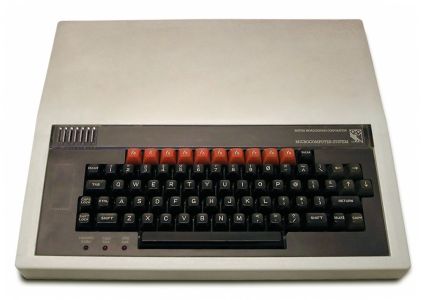 BBC Microcomputer Model B
 -
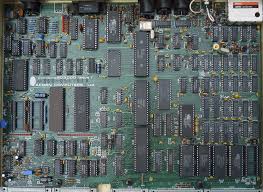 BBC Micro Model B main board
Related pages
[edit | edit source]- BBC Micro Model A/B General Maintenance
- BBC Micro Model A/B Troubleshooting Guide
- BBC Micro Model A/B Capacitor Replacement Guide
- BBC Micro Model B+
- BBC BASIC — R. B. Coats, Edward Arnold, 1983. A third-party textbook that states on its own title page that it "is in no way connected with either the BBC or the manufacturers of the computer, Acorn". No hardware content at all — not a source for any figure on this wiki.
- Acorn Electron
- Recommended Tools
References
[edit | edit source]- ↑ 1.0 1.1 "Acorn BBC Micro Model B", The Centre for Computing History. Secondary source.
- ↑ 2.0 2.1 2.2 2.3 2.4 "Model A", BeebWiki (mdfs.net). Secondary source, used here for the launch prices and the price rise.
- ↑ 3.00 3.01 3.02 3.03 3.04 3.05 3.06 3.07 3.08 3.09 3.10 3.11 3.12 3.13 3.14 3.15 3.16 3.17 3.18 3.19 3.20 3.21 3.22 3.23 3.24 3.25 3.26 3.27 Acorn Computers Limited, BBC Microcomputer Service Manual, part number 0433,001, Issue 1, October 1985, Section 1 (Models A and B, ANA01–ANB04). Sections 1.2 Technical specification, 1.2.3 Expansion and 8 Component location tables. Hosted on this wiki: BBC Microcomputer Service Manual October 1985.
- ↑ Whytehead, Chris. "Archimedes", Chris's Acorns / The Centre for Computing History. Source for the ARM1 appearing in the ARM Evaluation System, a BBC second processor.