

Amstrad NC200
 | |
| NC200 open, with the backlit screen showing text | |
| Specifications | |
|---|---|
| Manufacturer | Amstrad plc |
| Type | Notebook computer |
| Released | 1993 |
| CPU | Zilog Z80-compatible |
| Memory | 128 KB RAM |
| Storage | 3.5-inch 720 KB floppy drive (MS-DOS format); PCMCIA SRAM card up to 1 MB |
| Display | Backlit LCD, 480 × 128 pixels, 80 × 16 characters |
| Sound | — |
| Ports / interface | Centronics parallel, RS-232 serial, PCMCIA slot |
| Power | Five C cells or 7.5 V mains adaptor; CR2032 lithium backup cell |
| Dimensions | 295 × 215 × 35 mm |
| OS / Firmware | Built-in word processor, spreadsheet, diary, address book, calculator, terminal, games and BBC BASIC |
| Predecessor | Amstrad NC150 |
The Amstrad NC200 Notebook is the last of Amstrad's Z80-based Notepad computers, following the Amstrad NC100 and Amstrad NC150. It has a clamshell case with a hinged, backlit 16-line screen, 128 KB of RAM, a 3.5-inch floppy drive that reads and writes 720 KB MS-DOS discs, and its software in ROM: a word processor, a spreadsheet, the diary, address book and calculator, a serial terminal, three falling-block games and BBC BASIC. It runs from five C cells or a 7.5 V adaptor.[1][2]
History
[edit | edit source]Tim Surtell's NC users' site gives the launch as October 1993, and the Centre for Computing History dates the NC200's introduction to the same month; Wikipedia has "late 1993".[1][3][4] Its extra software had already appeared on the NC150, sold only in France and Italy. Cliff Lawson, Amstrad's NC project manager, explains that Ranger, who had written the NC150's improved terminal program, also wrote the NC200's disc routines.[5] The NC200 was also licensed to NTS Computer Systems and sold in North America as the Dreamwriter 200, which has a 1.44 MB drive.[4]
Hardware
[edit | edit source]The Centre for Computing History describes the processor as a Z80 with a custom all-in-one chip for the I/O and memory management.[3] David Given, who ported CP/M to the NC200, describes the memory management as able to map any 16 KB bank of RAM anywhere in the address space; he expanded his machine to 1128 KB with a memory card.[6] The PCMCIA slot takes SRAM memory cards of up to 1 MB; the case opening admits only Type I cards.[1][6]
The floppy drive formats 720 KB discs that a PC can read; the NC200 puts files in a directory called NOTEBOOK.[5] Given found that discs formatted on the NC200 itself use a non-standard sector skew, which more than doubles disc speed under his CP/M port compared with discs formatted on a PC.[6]
| Item | NC100 | NC150 | NC200 |
|---|---|---|---|
| Screen | 480 × 64, 80 × 8 | 480 × 64, 80 × 8 | Backlit 480 × 128, 80 × 16 |
| RAM | 64 KB | 128 KB | 128 KB |
| Discs | – | Optional Ranger drive | Built-in 3.5-inch 720 KB drive |
| Power | 4 × AA, 6 V adaptor | 4 × AA, 6 V adaptor | 5 × C, 7.5 V adaptor |
| Games and spreadsheet | No | Yes | Yes |
Power
[edit | edit source]Five alkaline C cells give about 35 to 40 hours according to Amstrad, depending on how much the backlight and floppy drive are used; the backlight triples the consumption and the floppy drive raises it to about twelve times normal. NiCad cells give about 10 hours and are not charged in the machine. A CR2032 lithium cell keeps the memory when no other power is present.[2] Given reports up to ten hours from five C cells.[6] The adaptor gives 1 A at 7.5 V and is not regulated; Tim Surtell's site says the barrel of its plug is positive, against convention.[5] The Centre for Computing History describes the adaptor as 7.5 V AC.[3] Measure an adaptor's polarity before using it.
Repair guides
[edit | edit source]- Amstrad NC200 Maintenance Guide – cells, the lithium backup cell, memory cards, the floppy drive, opening the case
- Amstrad NC200 Troubleshooting Guide – blank screen, screen bars, disc and power faults, resets
The NC100 guides cover the related machine: Amstrad NC100 Maintenance Guide and Amstrad NC100 Troubleshooting Guide.
Documentation
[edit | edit source]- Amstrad NC200 Notebook Computer User Manual – Amstrad's user manual
Gallery
[edit | edit source]-
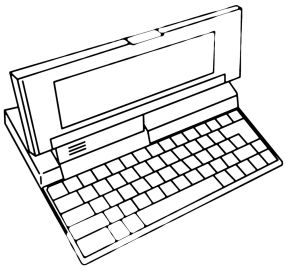 The clamshell case, with the floppy drive in the side

Related pages
[edit | edit source]- Amstrad NC100 · Amstrad NC150 · Amstrad NC100 Surgical Guide
- Battery Explosion, Capacitor or Corrosion Damage · Floppy Drive Repair
References
[edit | edit source]- ↑ 1.0 1.1 1.2 Tim Surtell, Tim's Amstrad NC Users' Site, "Specifications of the NC Computers" and "Introduction". Retrieved 2026-10-02. The NC200's backlit 480 × 128 screen, 128 KB of RAM, PCMCIA slot up to 1 MB, 3.5-inch 720K MS-DOS disc drive, parallel and serial ports, five C cells and 7.5 V adaptor, software including the spreadsheet and the games Blockade, Super Blockade and Trikade; the October 1993 launch.
- ↑ 2.0 2.1 Amstrad plc, Amstrad NC200 Notebook Computer user manual, 1993. Hosted as File:Amstrad NC200 Notebook Computer User Manual.pdf, described at Amstrad NC200 Notebook Computer User Manual. Powering the Notebook p. 62; backlight p. 64; disc drive on batteries p. 65; troubleshooting pp. 453–459; soft and hard reset p. 458.
- ↑ 3.0 3.1 3.2 Centre for Computing History, "Amstrad NC200", exhibit CH18431. Retrieved 2026-10-02. Introduced October 1993; Z80 with a custom chip for I/O and memory management; 80 × 16 text and 480 × 128 graphics; 29.5 × 21.5 × 3.5 cm and 1.280 kg; 720 KB drive and 1 MB PCMCIA slot; an external 7.5 V adaptor or five C cells; Control and Caps Lock to toggle the backlight.
- ↑ 4.0 4.1 Wikipedia, "Amstrad NC100" (revision 1370100358), sections on the NC200 and variants. Retrieved 2026-10-02. The NC200 of late 1993, its clamshell form, 80 × 16 backlit screen, 720 KB MS-DOS drive, 128 KB, extra games and spreadsheet, five C cells, the disc drive's need for near-full cells, Control and Caps Lock for the backlight; the Dreamwriter 200 with a 1.44 MB drive.
- ↑ 5.0 5.1 5.2 Tim Surtell, Tim's Amstrad NC Users' Site, "Questions & Answers: Hardware". Retrieved 2026-10-02. Cliff Lawson on Ranger's disc software in the NC200; the blank-screen checklist from the NC200 manual; the internal fuse; the NC200 adaptor rating and polarity; battery life and the backlight; the screen ribbon cable fault; NC200 thickness and weight; the 720K disc format and NOTEBOOK directory.
- ↑ 6.0 6.1 6.2 6.3 David Given, "Platform: the Amstrad NC200", cpmish project documentation, and "Running native programs on the Amstrad NC200", cowlark.com, 4 December 2017. Retrieved 2026-10-02. The NC200's 16 KB bank mapping, the PCMCIA slot's Type I-only opening, ATA cards on PCMCIA adaptors under CP/M, the undocumented Function+R boot from floppy, a first NC200 ruined when its C cells burst over the main board, battery life of up to ten hours on five C cells.