

Amstrad PenPad PDA600
 | |
| PDA600 opened, with its stylus | |
| Specifications | |
|---|---|
| Developer | Eden Group |
| Manufacturer | Amstrad plc |
| Type | Personal digital assistant |
| Released | 1993 |
| CPU | Three Z80-compatible 8-bit microcontrollers; main processor Zilog Z8S180 at 20 MHz |
| Memory | 128 KB battery-backed RAM |
| Storage | PCMCIA Type I slot for memory cards of 32 KB to 2 MB |
| Display | 240 × 320 reflective LCD under a pen digitiser |
| Sound | — |
| Input | Stylus, boxed handwriting recognition |
| Ports / interface | 8-pin mini serial connector |
| Power | Three AA alkaline cells; CR2032 lithium backup cell |
| Dimensions | 4.5 × 6.3 × 1 in (about 114 × 160 × 25 mm) |
| Weight | 14 oz (about 400 g) |
| OS / Firmware | Built-in organiser software |
| Model no. | PDA600 |
The Amstrad PenPad PDA600 is a pocket pen-based organiser that Amstrad sold from 1993. It has no keyboard: a stylus picks icons printed around a 240 × 320 LCD and writes characters into boxes for recognition. The built-in software is an address book, diary, to-do list, notepad and unit converter, laid out like a ring-bound paper organiser. It runs from three AA cells with a CR2032 lithium cell backing up the memory, and has a PCMCIA memory card slot and a small serial connector.[1][2]
History
[edit | edit source]The PenPad was designed for Amstrad by the Eden Group in the UK, using character-recognition algorithms licensed from Texas Instruments, and was made in China. Byte reviewed it in August 1993 as the first of the announced PDAs to actually ship, priced at about US$450 (the review's product box gives $460).[1] Wikipedia dates the launch to March 1993, citing PC Magazine.[3] The French manual credits the software design to Cliff Lawson and the recognition method to Texas Instruments (copyright 1992).[2]
Hardware
[edit | edit source]Byte describes a proprietary multiprocessor design built on three Z80-equivalent 8-bit microcontrollers: one for normal processing, one for character recognition and one for power management.[1] PC Magazine identified the main processor as a Zilog Z8S180, a low-power Z180, running at 20 MHz.[3]
The case opens like a book. The screen is a 240 × 320 LCD under a digitiser film; Byte found the contrast poor in dim light and blamed partly the thick, highly reflective film.[1] The border round the screen is printed with the section tabs, binder rings and icons, which are live areas for the pen. The first icon at the top left adjusts the contrast.[1][2] The on/off button is recessed, at the bottom left, and is pressed with the stylus; the stylus lives in a groove in the back of the case.[1][2]
Everything entered is held in 128 KB of battery-backed RAM; there are no files and no user-accessible operating system.[1][2] A PCMCIA Type I slot on the bottom edge takes memory cards of 32 KB to 2 MB, and the PenPad ships with a dummy card in the slot.[1][2] The PenPad recognises a card used in an Amstrad NC100 Notepad but overwrites the Notepad's data if the user carries on; the two machines cannot exchange address book or diary data.[2]
Serial connector
[edit | edit source]A small non-standard connector at the top of the case connects to a PC, a serial printer or a fax modem through Amstrad's cable.[1] Amstrad's manual gives its pinout for making a cable. Printing is fixed at 9600 baud, 8 data bits, no parity and 1 stop bit.[2]
| Pin | 1 | 2 | 3 | 4 | 5 | 6 | 7 | 8 |
|---|---|---|---|---|---|---|---|---|
| Signal | +5 V DC | TxD | RTS | RxD | CTS | Ground | n/c | n/c |
The manual's null-modem cable joins PenPad TxD to the PC's RxD, PenPad RxD to the PC's TxD, PenPad RTS to the PC's CTS and DSR together, PenPad CTS to the PC's RTS, and ground to ground, with pin numbers given for both 25-pin and 9-pin D sockets.[2]
Power
[edit | edit source]| Cell | Use | Notes |
|---|---|---|
| Three AA alkaline (MN1500/LR6) | Main supply | Amstrad claimed 40 hours. Gauge levels BON, JUSTE, FAIBLE and REMPLACER! |
| CR2032 lithium | Keeps the memory while the AA cells are changed | Under a round screw-on cover; positive side facing you. A message asks for it to be replaced. |
The PenPad switches itself off after five minutes without use. Amstrad warns that taking the cells out with the machine switched on risks losing all the data, and that the AA cells and the lithium cell must never be removed at the same time.[2]
Software
[edit | edit source]The five section tabs open the address and phone book, the diary, the to-do list, the notepad and the unit converter. A desk icon gives a clock, world times, alarms, anniversaries, battery and memory gauges, a search, the memory card functions and serial input and output, and another icon opens a calculator.[1][2] Text is entered one character at a time into a grid of boxes. Recognition is trained on first use and retrained whenever a character is misread; the trained library cannot be saved outside the machine.[1] Tapping the binder rings removes the current page, which can then be dragged off the screen to delete it.[1][2]
Repair guides
[edit | edit source]- Amstrad PenPad PDA600 Maintenance Guide – cells, the lithium backup cell, cleaning the screen, the stylus, pen calibration, memory cards
- Amstrad PenPad PDA600 Troubleshooting Guide – power and memory loss, an unresponsive or misaligned pen, recognition faults, display contrast, card messages
- Amstrad PenPad PDA600 Capacitor Replacement Guide – the board's chip map and recording your own capacitors
Documentation
[edit | edit source]- Amstrad PenPad PDA600 User Manual (French) – Amstrad's French user manual
- Dick Pountain, "Amstrad's Modest PDA", Byte, August 1993, on archive.org
Gallery
[edit | edit source]-
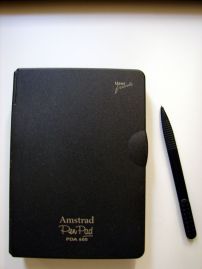 Closed
-
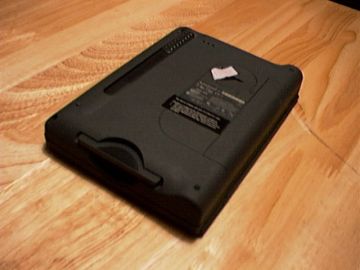 The back, with the stylus groove


Related pages
[edit | edit source]References
[edit | edit source]- ↑ 1.00 1.01 1.02 1.03 1.04 1.05 1.06 1.07 1.08 1.09 1.10 1.11 1.12 Dick Pountain, "Amstrad's Modest PDA", Byte, August 1993, pp. 161–162, 164. Scan at archive.org. Retrieved 2026-10-02. UK design by the Eden Group with Texas Instruments recognition algorithms, Chinese manufacture, price, three Z80-equivalent microcontrollers and their roles, size and weight, 40 hours on three AA cells, lithium backup cell, 240 × 320 screen and reflective digitiser film, serial connector, 128 KB of memory, PCMCIA Type I slot up to 2 MB, first-use language choice, pen calibration and handwriting training.
- ↑ 2.00 2.01 2.02 2.03 2.04 2.05 2.06 2.07 2.08 2.09 2.10 2.11 2.12 2.13 Amstrad, PenPad PDA 600 user manual (French, 1993). Hosted as File:Amstrad PenPad PDA600 User Manual (French).pdf, described at Amstrad PenPad PDA600 User Manual (French). Box contents and AA cells p. 5; replacing the AA and lithium cells p. 6; switching on, automatic switch-off and contrast pp. 7–8; first-time set-up pp. 9–12; gauges p. 33; memory cards pp. 34–35, 45–46; serial printing p. 36; configuration p. 40; troubleshooting pp. 41–42; messages pp. 43–44; care p. 44; serial connector p. 46.
- ↑ 3.0 3.1 Wikipedia, "PenPad", section "PDA600". Retrieved 2026-10-02. March 1993 launch and the Z8S180 at 20 MHz, both cited there to Jeff Greenberg, "Amstrad Pen Pad PDA600", PC Magazine, 12 October 1993, pp. 143, 148.