

Atari Super Pong
 | |
| Atari Super Pong, model C-140, with its two built-in paddle knobs and the four-position game selector | |
| Specifications | |
|---|---|
| Manufacturer | Atari, Inc. |
| Type | Dedicated home video game console |
| Released | 1976[1] |
| CPU | None; a custom Atari game chip[2] |
| Memory | None |
| Storage | — |
| Display | RF output to a television, colour, on-screen scoring[2] |
| Sound | Built-in speaker[2] |
| Power | Four D cells[3] |
| OS / Firmware | — |
| Predecessor | Atari Home Pong |
| Model no. | C-140 (Atari); 99736 (Sears Tele-Games Super Pong)[1] |
Atari Super Pong (model C-140) is Atari's second home Pong console, released in 1976. It plays four ball-and-paddle games for two players on a television, with on-screen scoring and the game sound coming from a speaker in the console.[1][2] Sears sold the same game under its Tele-Games name as Super Pong, model 99736, with detachable controllers in place of the built-in knobs.[1]
History
[edit | edit source]The Atari Museum records that Harold Lee, who had designed the chip for Atari Home Pong, began work on Super Pong as soon as that chip was finished, and added two new games of his own design.[4] Atari released Super Pong in 1976 as the follow-up to its own-brand Pong (C-100).[1] Pong-Story lists the models that followed under the Atari name: Super Pong Ten (C-180), Super Pong Pro-Am (C-200), Super Pong Pro-Am Ten (C-202) and Atari Ultra Pong (C-402). Sears also sold a four-player Super Pong IV (model 99737), which had no Atari-branded equivalent.[1]

Games and controls
[edit | edit source]| Game | Play |
|---|---|
| Pong | The standard two-player Pong game. |
| Super Pong | Each player controls two paddles instead of one. |
| Catch | Each knob moves a goal instead of a paddle; the ball stays in play until a player catches it through the goal, which scores a point. |
| Solitaire | Squash for one player. |
The console has two built-in paddle knobs, a start button, a power switch, a game selector and a channel 3/4 switch for the television output.[2] The game selector on the front of the base is marked "Select Game" with positions 1 to 4.[5] arcade-history.com, a community database, names the game chip as Atari's C010073-01.[2]
Power and care
[edit | edit source]DigiBarn's curator notes that the console runs on four D cells and gets through them quickly.[3] No Super Pong manual has turned up online, so the rating of Atari's adaptor for this model is not confirmed. Its siblings need low voltages: the Sears Pong manual gives 6 V at 125 mA, and the Ultra Pong manual 5.5 V DC at 100 mA.[6][7] Atari's 9 V DC adaptor for the 2600 and the Stunt Cycle uses a similar plug, so measure any adaptor, including its polarity, before plugging it into a Super Pong.[8][9]
Leaking cells are the main hazard to the circuit board of a battery-powered console. Atari's Ultra Pong manual tells owners to remove the batteries if the game will not be used for more than a month.[7] Battery Explosion, Capacitor or Corrosion Damage covers cleaning up after a leak.
For picture faults, the troubleshooting checklists in the hosted Sears Pong and Ultra Pong manuals (see Atari Home Pong and Atari Ultra Pong) work through the television connection: the TV/game switch box, the twin-lead wiring, the channel and the set's fine tuning.[7][6]
Gallery
[edit | edit source]-
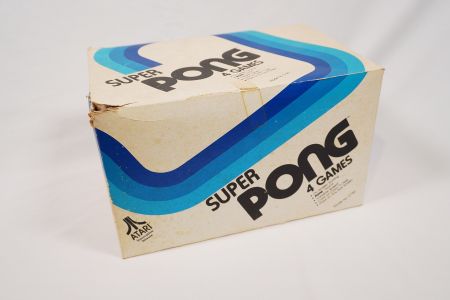 The Super Pong retail box, "4 games"

Related pages
[edit | edit source]References
[edit | edit source]- ↑ 1.0 1.1 1.2 1.3 1.4 1.5 David Winter, Pong-Story, "Atari home PONG systems": model numbers, years, numbers of games and players, the Sears versions and their model numbers. pong-story.com.
- ↑ 2.0 2.1 2.2 2.3 2.4 2.5 2.6 arcade-history.com, "Super Pong [Model C-140]": the four games, controls, switches, colour, sound, on-screen scoring and the game chip number. arcade-history.com. Community database.
- ↑ 3.0 3.1 DigiBarn Computer Museum, "Super PONG C-140 (1976) and Super PONG IV from ATARI", curator's note on batteries. digibarn.com.
- ↑ Curt Vendel, Atari Museum, "The Atari Super Pong Dedicated Console": Harold Lee and the two new games. atarimuseum.ctrl-alt-rees.com.
- ↑ Photograph of a C-140 by Jeff Keyzer, File:Atari Super Pong C-140 console.jpg.
- ↑ 6.0 6.1 Sears, Roebuck and Co., Pong Tele-Games Electronic Games Owner's Manual, model 637.25796, 1975, power requirements (p. 3) and troubleshooting checklist (p. 7). Hosted as File:Sears Tele-Games Pong Owner's Manual 637.25796.pdf.
- ↑ 7.0 7.1 7.2 Atari, Inc., Ultra Pong and Ultra Pong Doubles owner's manual, C010930, 1977: battery eliminator and power requirement (p. 5), care (p. 9), troubleshooting checklist (p. 10). Hosted as File:Atari Ultra Pong and Ultra Pong Doubles Owner's Manual C010930.pdf.
- ↑ Atari, Inc., Stunt Cycle owner's manual, C010931, 1977: AC power supply C010472 and the 9 V DC 500 mA requirement (pp. 5, 10). Hosted as File:Atari Stunt Cycle Owner's Manual C010931.pdf.
- ↑ Ctrl-Alt-Rees, "A Curious Atari Video Game Machine Restoration", 28 December 2023: the Pong consoles need 6 V while the 2600 and two of the other consoles use 9 V on the same type of plug, and replacement adaptors found wired tip-negative. ctrl-alt-rees.com. Restoration report.