

Acorn System 5
 | |
| Acorn System 5 (front): Eurocards on the left, two 5.25-inch drives on the right | |
| Specifications | |
|---|---|
| Manufacturer | Acorn Computers Ltd |
| Type | Rack-mounted modular microcomputer (Eurocard) |
| Released | 1983[1] |
| CPU | 6502A, 1, 2 or 3 MHz by link, from a 24 MHz crystal |
| Memory | 32 KB DRAM card as standard; further 16 KB or 32 KB DRAM cards |
| Storage | One or two 5.25-inch floppy drives; Intel 8271 controller card |
| Display | 80 × 25 VDU card or 40 × 25 Teletext VDU card |
| Sound | — |
| Power | AC9231 switch-mode supply: +5 V 6 A, −5 V 0.5 A, +12 V 2.5 A, −12 V 0.5 A |
| Dimensions | Rack 480 × 177 × 240 mm; cabinet 490 × 214 × 350 mm |
| Weight | About 16 kg with one drive |
| OS / Firmware | Acorn DOS (resident), with a utilities disc |
| Predecessor | Acorn System 4 |
The Acorn System 5 is the last of Acorn's rack-mounted Eurocard computers. It is a 19-inch rack with a card frame for up to ten 100 × 160 mm Eurocards, room for one or two 5.25-inch floppy drives and a switch-mode power supply mounted behind the card frame. It could be rack-mounted or housed in an optional instrument case with feet, louvres and two carrying handles.[2] Acorn's handbook for it is dated 1 March 1983, and the Centre for Computing History dates the machine to 1983.[2][1]
Configuration
[edit | edit source]Acorn supplied the System 5 built to the customer's order. The handbook lists the minimum as the rack, power supply and backplane, a 6502A processor board, a 32K dynamic RAM board, an 80 × 25 VDU board or a Teletext VDU board, a floppy disc controller board and one floppy drive, with the Disc Operating System resident and a DOS utilities disc. A different version of DOS was needed for each VDU type and for each make of disc drive.[3] Six card positions remain free in the basic configuration for further Acorn Bus boards.[2]
Acorn's earlier sales catalogue describes a different machine: a 4U frame with seven Eurocard slots, a switch-mode power supply Eurocard giving 5 and 12 V (two of them in a two-drive system), a 6502 CPU card, and says that 2 MHz versions "will be available soon".[4] The handbook's ten-slot rack with a single AC9231 supply matches the surviving machine described by Chris Whytehead.[5]
Boards
[edit | edit source]The handbook has a unit description, parts list and circuit diagram for each of the boards below. The supply currents are Acorn's.[2][6]
| Board | Main devices | +5 V supply |
|---|---|---|
| 6502A CPU | 6502A (IC8), 6522A VIA, 24 MHz crystal, 2K static RAM socket (6116) | ±5 %, 520 mA typical |
| 32K DRAM | Sixteen 4816 DRAMs (IC1–IC16; 4816-7 for 1 MHz, 4816-3 for 2 MHz) in two 16K × 8 banks; can be half-populated for 16K | 280 mA |
| 80 × 25 VDU | HD46505SP-2 CRTC (IC3), four 2114-2 RAMs (IC8–IC11), Acorn-programmed MM52116 character ROM (IC13) | ±5 %, 450 mA typical |
| Floppy disc controller | Intel 8271 (IC1) | 150 mA |
| Keyboard | AY-3-4592 encoder (IC1), 13 × 8 matrix | 100 mA maximum |
| Econet | 68B54 ADLC (IC6), 75159 line driver, LM319 comparators | ±5 %, 250 mA typical |
The 6502A board runs at 1, 2 or 3 MHz, selected by links LK2, LK3 and LK1, from dividers on a 24 MHz crystal; it also puts an 8 MHz clock on the Acorn Bus. The 32K DRAM board is supplied set to run at 2 MHz from the bus clocks.[7] The Acorn Bus runs over two backplanes: the large one carries the ten 64-way DIN 41612 sockets and all A-side connections, the small one carries the B-side clock and interrupt lines, and the remaining B-side connections are wired by hand where needed.[2]
Power supply
[edit | edit source]The supply is a switch-mode unit, type AC9231, mounted behind the card frame. It gives +5 V at 6 A, −5 V at 0.5 A, +12 V at 2.5 A and −12 V at 0.5 A from 90–135 V or 180–270 V AC at 47–400 Hz, with a typical hold-up time of 24 ms, and Acorn states that open or short-circuit loads can be tolerated indefinitely. The machine draws 0.6 A at 230 V or 1 A at 115 V.[2] The parts list names it "Aztec AC9231"; AC9231 is an Astec part number, sold by spares dealers with the same output ratings.[8] Acorn gives no component data for the supply.
Acorn's typical load figures for the drives Acorn fitted are 750 mA at +5 V and 1.15 A at +12 V for an Olivetti drive, 500 mA and 900 mA for a Shugart, and 600 mA and 900 mA for a Tandon.[2]
Maintenance and repair
[edit | edit source]- Acorn System 5 Maintenance Guide
- Acorn System 5 Troubleshooting Guide
- Acorn System 5 Capacitor Replacement Guide
Documentation
[edit | edit source]- Acorn System 5 Handbook: Acorn's handbook, with the DOS manual and a unit description, parts list and circuit diagram for each standard board.
- Acorn System Catalogue: Acorn's catalogue of the System range and Eurocards; its System 5 entry describes the earlier seven-slot configuration.
Gallery
[edit | edit source]-
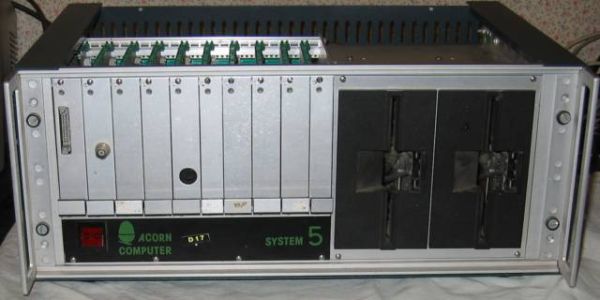 System 5 front, with the cards on the left and the drives on the right
 -
 Card cage and 10-slot backplane with the cards removed

Related pages
[edit | edit source]References
[edit | edit source]- ↑ 1.0 1.1 "Acorn System 5", The Centre for Computing History, exhibit CH44173 (retrieved 2026-10-01). Date 1983; card cage for 10 cards and 2 floppy disc drives.
- ↑ 2.0 2.1 2.2 2.3 2.4 2.5 2.6 Acorn Computers, Acorn System 5 Handbook, 400,056/1, 1 March 1983, hosted on this wiki. Part 2 Section 1, Rack, PSU and Backplane, pp. 1–4: rack and cabinet, leading particulars, power supply unit, Table 1 (supply connections), Table 2 (typical loads), backplane and Table 3 (Acorn Bus), parts list.
- ↑ Acorn Computers, Acorn System 5 Handbook, Part 1 Section 1, Disc Operating System, para. 1.2, "What is supplied in the System 5", p. 1.
- ↑ Acorn Computers, Acorn System Computers and Eurocards catalogue, p. 8, "System 5", hosted on this wiki.
- ↑ Whytehead, Chris. "Acorn System 5", Chris's Acorns, archived by The Centre for Computing History (retrieved 2026-10-01). Card cage for 10 cards and 2 drives; an ex-school Econet server with a 2 MHz 6502A card, 80 × 25 VDU card, one full and one part-populated 32K DRAM card (48 KB), Econet card, Intel 8271 FDC card and two Tandon TM101 80-track double-sided drives; the System keyboard plugs into the 6502A card; handbook pages 13 and 14 of the 6502A CPU section are missing.
- ↑ Acorn Computers, Acorn System 5 Handbook, Part 2 Sections 2–7, leading particulars of each board: 6502A CPU (400,005) p. 1; 32K DRAM (400,010) p. 1 and parts list p. 8; 80 × 25 VDU (400,019) p. 2 and parts list p. 15; floppy disc controller (400,004) p. 3; keyboard (400,013) p. 2; Econet p. 1.
- ↑ Acorn Computers, Acorn System 5 Handbook, 6502A CPU Board (400,005) pp. 1 and 7, para. 2.3 "System Clock"; 32K Dynamic RAM Board (400,010) p. 5, para. 2.3.1 "Acorn Bus Clock Operation".
- ↑ "AC9231-01", ABC Industrial Parts (retrieved 2026-10-01). Astec AC9231-01, 115/230 V, 50 W, +12 V 2.5 A and +5 V 6 A outputs plus two 0.5 A outputs.