

BBC Master Compact
 | |
 | |
| Master Compact keyboard unit, disc unit and monitor (photo: Chris Whytehead, CC BY-SA 3.0) | |
| Specifications | |
|---|---|
| Manufacturer | Acorn Computers Ltd |
| Type | Home and education computer |
| Released | September 1986[1] |
| Discontinued | 1989[2] |
| Intro price | £451.25 including VAT[1] |
| CPU | 65SC12 at 2 MHz (IC28) |
| Memory | 128 KB DRAM (four 4464, IC35, IC36, IC41, IC47) |
| Storage | 3.5-inch disc drive in the disc unit (WD1772 controller, ADFS) |
| Display | 6845 CRTC and VIDPROC; SAA5050 Teletext; RGB and composite video |
| Sound | SN76489 (IC30), LM386 amplifier, internal speaker |
| ROM | 64 KB system ROM (IC49), with sockets for more |
| Power | 5 V DC from the supply in the disc unit |
| OS / Firmware | MOS 5.10 with BBC BASIC IV and ADFS 2.10 |
| Predecessor | BBC Master 128 |
| Model no. | ADB20 |
The BBC Master Compact is Acorn's 1986 low-cost member of the Master series. It is a separate design from the BBC Master 128: the main board sits inside the keyboard unit, and a second box, the disc unit or monitor stand, holds a 3.5-inch floppy drive and the power supply, which feeds the keyboard unit with 5 V through a lead.[1][3] It was launched in September 1986 at £451.25 including VAT and discontinued in 1989.[1][2] The Compact keeps the Master's custom chips and memory map, but drops the cartridge slots, cassette, 1 MHz bus, analogue port, Tube and internal co-processor sockets, and replaces the battery-backed clock with an EEPROM.[2][3]
Hardware
[edit | edit source]The main board is Acorn 0258,000 issue 1.[4]
| Position | Device | Function |
|---|---|---|
| IC28 | 65SC12 | Processor, 2 MHz CMOS |
| IC48 | CF30058 | Memory controller |
| IC22 | CF30050 | I/O controller |
| IC26 | CF30049 | Peripheral bus controller |
| IC46 | CF30048 | CRTC multiplexer |
| IC16 | Acorn ULA | VIDPROC, video processor |
| IC34 | 6845 | CRT controller |
| IC15 | SAA5050 | Teletext character generator |
| IC7, IC25 | 6522 | User VIA and system VIA |
| IC24 | PCD8572 | 128-byte EEPROM for configuration (socketed) |
| IC6 | WD1772 | Floppy disc controller |
| IC30 | 76489 | Sound generator |
| IC42 | LM386 | Audio amplifier |
| IC35, IC36, IC41, IC47 | 4464 | 64K × 4 DRAM, 120 ns |
| IC49 | System ROM | MOS, BASIC and ADFS (socketed) |
Most ICs are soldered to the board. The parts list shows sockets only for the EEPROM IC24, for IC5, IC9 and IC13, and six 28-pin sockets, IC14, IC17, IC23, IC29, IC38 and IC49, for ROMs.[4] Acorn says the RS232 upgrade is fitted by plugging ICs into sockets already on the board.[3] Repairers on stardot point out that the soldered chips make swapping parts harder than on the BBC Micro.[5]
Connectors
[edit | edit source]The rear of the keyboard unit carries, from left to right, RGB, composite video, RS232 (usable only after the internal upgrade), Econet (usable only with the module), the mouse and joystick port, the printer port, the disc drive connector and the DC power input.[1] The power input is a 2 mm centre-pin socket, PL2, with +5 V on the centre pin and 0 V on the outer.[6] The disc drive connects through a 25-way D-type socket and the printer through a 24-way connector; the joystick port is a nine-way D-type plug for Atari-type joysticks, read by the operating system so that software written for the analogue joysticks of earlier machines still works.[6][3] A 50-way edge connector on the right of the keyboard unit carries the system buses for expansion.[3] Third-party adaptors such as the Mertec Compact Companion added user, analogue and 1 MHz bus ports through it.[1][2]
Configuration memory
[edit | edit source]There is no battery. The 128 bytes of configuration are kept in a PCD8572 serial EEPROM, IC24, on an I²C bus emulated by the system VIA. Acorn socketed it because of its finite life and guaranteed it only as working on delivery.[7] Without a clock chip the Compact returns a fixed date of 31 December 1999 unless the time is supplied over Econet.[8]
Disc unit and power supply
[edit | edit source]The disc unit holds a 3.5-inch drive, a mains power supply board and space for a second drive. Its back carries the mains switch, a mains outlet for the monitor, the fuse and the mains input, and the 5 V lead to the keyboard unit comes out through a strain-relief grommet.[1][9] Acorn's manual says the supply can come in more than one type with the same voltages; repairers on stardot report at least two.[9][10] The supply is marked 5 V 2 A, and owners run the keyboard unit from any regulated 5 V supply of 2 A or more with a centre-positive plug.[11]
Software
[edit | edit source]The ROM holds MOS 5.10, the UTILS ROM and ADFS 2.10; DFS is not in ROM, and View, Logo and the other applications came on the Welcome disc.[1] The Compact's BASIC is selected with *CONFIGURE LANG 14.[8]
Faults and maintenance
[edit | edit source]- The disc unit supply's RIFA X2 capacitor and start-up electrolytic fail as in other Acorn supplies; a weak start-up capacitor makes the supply slow to start. See BBC Master Compact Capacitor Guide.
- A continuous tone with a blank screen has been traced to failed DRAMs on several Compacts. See BBC Master Compact Troubleshooting.
- The membrane keyboard cannot be repaired key by key; Acorn's manual says to replace the whole keyboard if no track fault can be found.[12]
- Routine care is in BBC Master Compact Maintenance.
Documentation
[edit | edit source]- BBC Master Compact Service Manual: Acorn's service manual 0458,002, covering the keyboard unit and the monitor stand.
Gallery
[edit | edit source]-
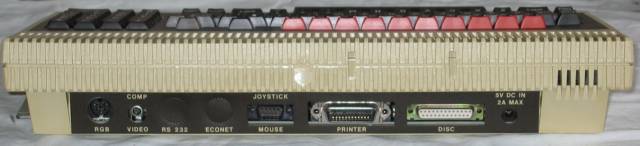 Rear of the keyboard unit
 -
 Main board inside the keyboard unit
 -
 Disc unit opened: drive at bottom left, supply behind it


Photographs: Chris Whytehead, Chris's Acorns (CC BY-SA 3.0).
Related pages
[edit | edit source]- BBC Master Compact Maintenance
- BBC Master Compact Troubleshooting
- BBC Master Compact Capacitor Guide
- BBC Master 128
References
[edit | edit source]- ↑ 1.0 1.1 1.2 1.3 1.4 1.5 1.6 1.7 Whytehead, Chris. "Master Compact", Chris's Acorns (retrieved 2026-10-02). Launched September 1986 at £451.25 including VAT; the main board is under the keyboard and the disc unit holds only the 3.5-inch drive and the power supply, with room for a second drive; no cartridge slots; MOS 5.10, BASIC IV and ADFS in ROM, with View and other software on the Welcome disc; *HELP showing MOS 5.10, UTILS 1.10 and ADFS 2.10; the rear connectors of the keyboard unit (RGB, composite video, RS232 needing an internal upgrade, Econet needing a module, joystick, printer, disc and power in); the disc unit's rear (switch, power out, fuse, power in, lead to the keyboard unit); photographs.
- ↑ 2.0 2.1 2.2 2.3 "BBC Master", Wikipedia (retrieved 2026-10-02). Section "Master Compact": the three-box arrangement with the main board in the keyboard unit and the 3.5-inch drive and power supply under the monitor; no cartridge, cassette, 1 MHz bus, analogue or co-processor connections; RS-232 not populated as standard; a nine-pin mouse and joystick port; a 50-way expansion edge connector; EEPROM configuration storage and no real-time clock; ADFS 2 on a WD1772; a membrane keyboard; built by Rank Xerox; price cut in late 1987 to £344 without monitor with the Mertec Compact Companion bundled; discontinued in 1989 after more than 80,000 Compacts and Olivetti Prodest PC 128 S machines.
- ↑ 3.0 3.1 3.2 3.3 3.4 Acorn Computers, British Broadcasting Corporation Master Series Compact Microcomputer Service Manual, part no. 0458,002, issue 1, October 1986, hosted as File:Acorn BBC Master Compact Service Manual 0458,002.pdf. Section 1, keyboard and processor: 5 "Hardware description", printed pp. 11–25 (128 KB DRAM; 64 KB ROM as standard, possibly 128 KB in later issues, with provision for 80 KB more on the board; 93-contact keyboard; 6845, RGB and composite video; 3.5-inch MFM disc drive; Econet on the same daughter board as the Master 128; Centronics printer port; RS232 as a plug-in upgrade; Atari-type joystick port; 50-way expansion connector; 128 bytes of non-volatile memory in a PCD8572 EEPROM, so no battery).
- ↑ 4.0 4.1 Acorn Computers, Master Series Compact Microcomputer Service Manual, 0458,002, parts list, printed pp. 43–47 (OCR text): bare PCB 0258,000 issue 1; the gate arrays, ICs, capacitors and connectors with Acorn part numbers; spares marked with an asterisk; keyboard PCB assembly 0158,0001/T; speaker 16 Ω 0.2 W 40 mm.
- ↑ stardot.org.uk, "Master Compact Repair Help/Continuous Tone of Death" (January 2014, retrieved 2026-10-02). AndyGarton: most Compact ICs are soldered, unlike the socketed chips of the BBC Micro; continuous tone with no display, later display and BASIC prompt but a dead keyboard apart from BREAK. 1024MAK: BREAK is only a reset, not part of the keyboard interface. hoglet: the system VIA IC25 is not socketed. Secondary source.
- ↑ 6.0 6.1 Acorn Computers, Master Series Compact Microcomputer Service Manual, 0458,002, connector pinouts, printed pp. 41–42: SKT8 composite video phono; PL2 power input, outer 0 V, inner +5 V; SKT9 RGB six-pin DIN (pin 6 +5 V); SKT7 RS232 five-pin domino DIN; SKT6 Econet; PL8 joystick nine-way D (pin 7 +5 V, pin 8 0 V); SKT1 disc drive 25-way D; SK2 printer 24-way; PL13 expansion connector.
- ↑ Acorn Computers, Master Series Compact Microcomputer Service Manual, 0458,002, "Non volatile memory", printed pp. 19–20 (PCD8572 IC24, 128 bytes, I²C bus emulated by PB4 and PB5 of the system VIA, write cycle time set by R1 and C2, socketed because of its finite life, no battery needed), and 6.11 "Non Volatile Memory", p. 38.
- ↑ 8.0 8.1 Sprow, "The most common beeb power on problems", Sprow's webpages, updated 9 November 2010 (retrieved 2026-10-02). Community source: the Compact's time fixed at "Fri,31 Dec 1999.23:59:59" unless on Econet or fitted with clock hardware; *CONFIGURE LANG 14 for BASIC on the Compact; *CONFIGURE FILE 13 and *INSERT 13 for its disc filing system; the ADFS mount hang.
- ↑ 9.0 9.1 Acorn Computers, Master Series Compact Microcomputer Service Manual, 0458,002, section 2, Master Compact monitor stand service guide, PDF pp. 50–58: safety tests (earth continuity under 0.1 Ω, 1.5 kV AC insulation test for ten seconds); first-line servicing only, with Acorn telling users and dealers not to fault-find on the power supply; dismantling; the 5 A plug fuse; mains switch, auxiliary output and input; mains fuse anti-surge 3.15 A HBC 250 V (type T); changing the supply board (four screws, mains input, DC output and earth tag); a second supply type with different cable layout; the +5 V lead, part of the DC cable assembly, under 100 mΩ per wire at full load; the disc data cable; replacing the drive (Sony F6 3W, set as drive 0); the second-drive upgrade.
- ↑ stardot.org.uk, "Refurb process for Master Compact Base Unit PSU" (February–March 2025, retrieved 2026-10-02). egel: at least two types of Compact base unit supply. 1024MAK: renew the RIFA X2 capacitor and the small primary-side start-up electrolytic; on his supply C1 is 0.1 µF 275 V AC class X2 and C10 is 220 µF 10 V (he fitted 220 µF 16 V 105 °C). 1980s_john: a cracked RIFA and a bulging output electrolytic replaced on his Compact. Secondary source.
- ↑ stardot.org.uk, "BBC Master Compact Power Supply?" (February–March 2023, retrieved 2026-10-02). 1024MAK: a 2 A regulated 5 V supply is enough; egel: the original supply is printed 5V 2A; jgharston: he uses a mains adaptor rated 5 V 2.5 A, body 0 V and tip +5 V. Secondary source.
- ↑ Acorn Computers, Master Series Compact Microcomputer Service Manual, 0458,002, 6 "Fault finding", printed pp. 26–38 (6.1.8: individual keys cannot be replaced on this keyboard).