

IBM RS/6000
 | |
| IBM RS/6000 POWERstation 320 (machine type 7012-320, 1990 POWER1 desktop) | |
| Specifications | |
|---|---|
| Developer | IBM Austin Research Lab |
| Manufacturer | IBM |
| Type | RISC UNIX workstation and server family |
| Released | February 15, 1990 (initial 7012-320, 7013-530, 7015-920 launch) |
| Discontinued | Brand retired October 2000 (replaced by IBM eServer pSeries) |
| CPU | IBM POWER1 (multi-chip RIOS); POWER1 single-chip RSC; POWER2 8-chip MCM; POWER2 Super Chip (P2SC); PowerPC 601, 604, 604e; IBM POWER3, POWER3-II; RS64-II, RS64-III |
| Memory | Proprietary IBM ECC SIMMs / DIMMs depending on submodel (8 MB to 16 GB, machine-type dependent) |
| Storage | SCSI-2 / Fast/Wide SCSI / UltraSCSI / Ultra2 / Ultra3; SSA (Serial Storage Architecture); IDE on 7248 PReP boxes only |
| Display | IBM POWER GXT graphics adapter family (GXT110P, GXT250P, GXT255P, GXT500P, GXT800P, GXT2000P, GXT3000P); integrated S3 Vision864 on 7248 |
| Sound | Crystal CS4232 audio on 7248; no audio on most other RS/6000s (server-class) |
| OS / Firmware | IBM AIX 3.x / 4.x / 5L; Linux on PowerPC RS/6000 (Yellow Dog Linux, Debian PowerPC); OS/400 not supported |
| Predecessor | IBM RT PC (RT, PC/RT) |
| Successor | IBM eServer pSeries (later IBM Power Systems) |
| Model no. | 7011, 7012, 7013, 7015, 7020, 7024, 7025, 7026, 7043, 7044, 7046, 7248 |
The IBM RISC System/6000 (almost always written RS/6000) is a family of RISC-based UNIX workstations, servers and high-end supercomputing systems introduced by IBM on February 15, 1990. The RS/6000 was the first computer line to use IBM's POWER architecture and later its successor PowerPC, and replaced the earlier IBM RT PC platform.[1][2] The RS/6000 brand was retired in October 2000 in favour of the new IBM eServer pSeries name; the underlying machine-type numbers continued in service for years afterward.[3]
The initial February 1990 launch included three machines: the desktop 7012-320 POWERstation, the deskside 7013-530 POWERserver and the rack 7015-920 enterprise system, all running a multi-chip POWER1 implementation (codenamed "RIOS") at 20 MHz under AIX 3.x.[4] The RS/6000 line grew rapidly to encompass over a dozen machine-type families, ranging from the 9-kg notebook (7020-N40) to the multi-frame 7015 R50 supercomputers, and pioneered the use of out-of-order, super-scalar RISC microarchitecture in commercial computing.
The internal name for the POWER1 chip research was "America"; the systems built around that chip were collectively "RIOS".[5] POWER stands for Performance Optimization With Enhanced RISC.
Architecture Eras
The RS/6000 family spans three quite distinct hardware generations:
- POWER1 / POWER2 Micro Channel era (1990–1996) — multi-chip POWER1 and POWER2 modules on a Micro Channel bus inherited from the IBM PS/2 Model 80. Machine types 7011, 7012, 7013, 7015. AIX 3.x and 4.x.
- PReP / early PCI era (1995–1997) — PowerPC 601 / 604 / 604e on a PReP-compliant ISA + PCI motherboard ("Carolina" board). Machine type 7248. Bridges Micro Channel and pure-PCI families.
- CHRP / PCI era (1996–2000) — PowerPC 604e, POWER3, RS64-II / RS64-III on pure PCI / PCI-X with Open Firmware and the Common Hardware Reference Platform (CHRP) firmware. Machine types 7025, 7026, 7043, 7044. AIX 4.3.x and AIX 5L.
The Micro Channel and PReP eras both use proprietary IBM expansion buses and proprietary IBM memory. CHRP-era RS/6000s use standard PCI / PCI-X cards but still use IBM-specific (and rather scarce) ECC SDRAM DIMMs.

CPU Families
| CPU | Implementation | Years | RS/6000 use |
|---|---|---|---|
| POWER1 (RIOS) | 7–9 chip MCM | 1990– | 7012-320 / 340; 7013-520 / 530 / 540 / 550; 7015-930 / 950 |
| POWER1 (RSC) | Single chip | 1992– | 7011-220 / 230 |
| POWER2 | 8-chip MCM, CMOS-5 | Sep 1993– | 7012-380 / 390 / 39H; 7013-58H / 580 / 590 / 591; 7015-R10 / R20 / R24 |
| P2SC (POWER2 Super Chip) | Single die, CMOS-6S, 15 M transistors | Oct 1996– | 7012-397 (160 MHz); 7013-595 (135 MHz) |
| PowerPC 601 | Single chip, 0.6 µm CMOS | Sep 1993– | 7011-250 (66 MHz); 7020 / 7007-N40 notebook (50 MHz) |
| PowerPC 604 | Single chip | 1995– | 7248-100 (100 MHz) |
| PowerPC 604e | Single chip | 1996– | 7043-140 / 150; 7025-F30 / F40 / F50; 7248-120 / 133 |
| IBM POWER3 | 64-bit, CMOS 7S | 1998– | 7043-260 (200 MHz) |
| POWER3-II | 64-bit, CMOS 7S copper interconnect | 1999– | 7044-170 / 270 (333 / 375 / 450 MHz) |
| RS64-II "Northstar" | 64-bit, CMOS 6S | 1998– | 7026-H50 (340 MHz) |
| RS64-III "Pulsar" | 64-bit, CMOS 7S copper | 1999– | 7025-F80; 7026-H70 / H80 (450 / 500 MHz) |
The MCM-based POWER1 and POWER2 use one large ceramic module with several dies for the integer unit, floating-point unit, instruction cache, data cache, and storage control. The P2SC of 1996 collapses the POWER2 MCM into a single die.[6][7]
-
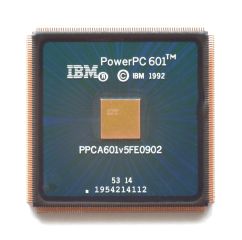 PowerPC 601 — 7011-250 and N40 notebook
 -
 PowerPC 604e — 7043-140 / 150, 7025-F50, 7248-120 / 133


Machine Type Families
7011 (entry desktop)
| Submodel | CPU | Speed | Year | Notes |
|---|---|---|---|---|
| 7011-220 | POWER1 (RSC) | 33 MHz | Jan 1992 | Entry desktop, single-chip RSC, max 64 MB RAM, up to 2 GB SCSI |
| 7011-230 | POWER1 (RSC) | 45 MHz | 1993 | Faster 220-class desktop |
| 7011-250 | PowerPC 601 | 66 MHz | Sep 1993 | First RS/6000 with PowerPC 601 — single-chip 0.6 µm RISC |
The 7011 chassis is a low-profile "pizza-box" desktop, 84 × 406 × 419 mm, 9.0–11.5 kg.[8][9]
7012 (POWERstation / POWERserver deskside)
The 7012 is the deskside POWER1 / POWER2 mainstream. Key submodels:
| Submodel | CPU | Speed | Notes |
|---|---|---|---|
| 7012-320 / 320H | POWER1 (RIOS) | 20 / 25 MHz | February 1990 launch desktop; 16 MB std, 128 MB max |
| 7012-340 / 340H | POWER1 (RIOS) | 33 MHz | Desktop counterpart to 7013-530H |
| 7012-350 / 360 / 370 / 380 / 390 | POWER1 / POWER2 | 41–67 MHz | September 1993 POWER2 upgrade |
| 7012-39H | POWER2 8-chip MCM | 67 MHz | Feb 17 1995 – Jan 30 1998; 32 KB I-cache, 128 KB D-cache, optional 1/2 MB L2; 64 MB – 512 MB ECC RAM in pairs; four Micro Channel slots; integrated SCSI-2 Fast/Wide and Ethernet |
| 7012-397 | P2SC | 160 MHz | 32 KB L1-I + 64/128 KB L1-D; 128 MB base, 1 GB max; 2.56 GB/s memory bandwidth; 80 MB/s MCA data streaming |
7013 (POWERserver deskside / mid-rack)
The 7013 is the larger deskside (and small rack) family. The 7013-530 launched alongside the 7012-320 in February 1990.
| Submodel | CPU | Speed | Notes |
|---|---|---|---|
| 7013-530 | POWER1 (RIOS) | 20 MHz | February 1990 launch deskside |
| 7013-540 | POWER1 (RIOS) | 30 MHz | 1991 deskside |
| 7013-580 / 58H | POWER2 | 55–67 MHz | POWER2 deskside, service guide SA38-0531 |
| 7013-590 | POWER2 | 66 MHz | GA Sep 21 1993, EOM Sep 24 1997; first RS/6000 on 32-bit POWER2; 610 × 360 × 675 mm, 36.7–53.1 kg |
| 7013-591 | POWER2 | 77 MHz | Faster 590-class |
| 7013-595 | P2SC | 135 MHz | Announced October 1996; first system using P2SC, the 32-bit POWER2 Super Chip — 15 million transistors, single-die CMOS-6S |

7015 (large rack)
The 7015 is the large rack enterprise family — full-frame servers with up to 32 GB ECC RAM and multiple CPU drawers.
Lineup includes 930, 950, 970, 980, 990, R10, R20, R21, R24, R30, R40, R50.[15] R10 uses POWER1; R20 / R24 use POWER2 (introduced September 1993). R10 / R20 / R21 CPU drawer is 267 × 446 × 610 mm, ≥30.3 kg, 0.29 kVA typical, 200–240 V. R24 is 446 × 446 × 710 mm, ≥51.3 kg, 0.685 kVA, 200–240 V or −48 V DC. R30 / R40 / R50 are 267 × 446 × 925 mm, ≥59.7 kg.
7020 / N40 (notebook)
The 7020 / 7007-N40 is the first PowerPC notebook released by IBM, co-developed with Tadpole Computer. Announced March 1994; sales started October 1994; discontinued 1995.[16][17] Specifications: 50 MHz PowerPC 601, 32 KB unified L1 cache, 16–64 MB RAM, 9.4″ TFT, PCMCIA. Runs a special "AIX for N40" 3.2.5 build with custom modem, SCSI, PCMCIA and Token Ring drivers.[18]

7025 (PCI midrange tower)
The 7025 family — F30, F40, F50, F80 — is the early CHRP/PCI midrange tower.
- 7025-F50 — PowerPC 604e, 1–4-way SMP at 166 / 332 MHz; X5 cache system; 128 MB ECC SDRAM std, 3 GB max; 256 KB per-CPU 8-way associative ECC L2.[19][20]
- 7025-F80 — 64-bit RS64-III at 450 / 500 MHz (copper CMOS 7S), 1–6 way SMP, up to 16 GB ECC RAM, 128 KB L1-I + 128 KB L1-D, DDR SRAM L2. F50 owners can serial-upgrade to F80 by replacing processor cards.[21]
7026 (PCI rack midrange)
- 7026-H50 — 64-bit RS64-II at 340 MHz, 1–4 way; chassis 350 × 443 × 844 mm.[22]
- 7026-H70 — 64-bit RS64-III, 1/2/4-way at 450 MHz, 6-way at 500 MHz; 8 EIA U rack; 750 W PSU (FC 6290).[23]
- 7026-H80 — RS64-III, 1/2/4-way at 450 MHz, 6-way at 500 MHz; CEC drawer 218 × 445 mm, 5 EIA U; hot-swap 9.1/18.2/36.4 GB Ultra3 SCSI/SSA drives; 10 PCI buses with 10 × 64-bit slots.

7043 (43P desktop / deskside, PCI)
The 7043 "43P" is the most common RS/6000 in collector hands. PowerPC 604e and POWER3 era, all-PCI.
- 7043-140 — PowerPC 604e at 160 / 200 / 233 / 332 MHz; 128 MB std, 1 GB max; 64-bit ECC DIMMs.
- 7043-150 — PowerPC 604e at 375 MHz (some 250 MHz units exist), 1 MB L2; 512 MB SDRAM std (1 GB max); 9 GB SCSI std; 10/100 Ethernet; GXT 2000P video; ships with AIX 5L. Most common RS/6000 ever made.[24][25][26]
- 7043-240 — service guide SA38-0512 covers this and the rest of the 7043 family.[27]
- 7043-260 — 200 MHz POWER3, 64 KB L1-D / 32 KB L1-I, 4 MB L2; 256 MB SDRAM base, 4 GB max via two memory cards × 16 DIMMs; five PCI slots (three 32-bit, two 64-bit); deskside tower.[28][29]
7044 (POWER3-II workstation)
- 7044-170 — POWER3 (single-CPU), 200 MHz; PCI workstation.
- 7044-270 — up to two 64-bit POWER3-II at 333 / 375 / 450 MHz; copper CMOS 7S; private 32-byte L2 bus at 250 MHz; 256 MB std SDRAM, 8 GB max; Ultra SCSI internal, Ultra2 SCSI external; integrated 10/100 Ethernet (AUI + RJ45); deskside 340 × 713 × 610 mm, 45 kg max.[30][31]
-
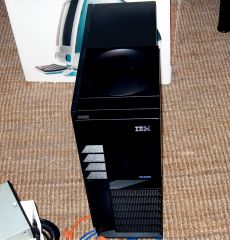 7044-170 workstation (POWER3, 200 MHz)
 -
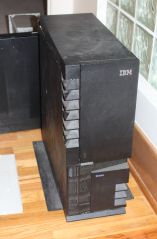 7044-270 workstation (POWER3-II, dual-CPU up to 450 MHz)


7248 (PReP "Carolina" workstation)
The 7248 is the small PReP-compliant 43P workstation — a transitional design bridging Micro Channel POWER1/POWER2 and pure-PCI CHRP RS/6000s.
- 7248-100 — 100 MHz PowerPC 604, 256 KB L2 cache; PReP architecture, "Carolina" motherboard; integrated NCR 53c810 SCSI-2, IDE controller, AMD PCnet32 Ethernet, IBM E15 2 MB graphics (S3 Vision864 chip), Crystal CS4232 audio; 16 MB – 192 MB RAM; three ISA and two PCI slots; SPECint92 128.1, SPECfp92 120.2.[32][33]
- 7248-120 / 133 — same chassis with 120 MHz and 133 MHz PowerPC 604.[34]
-
 7248-100 in IBM Austin labs (PReP / Carolina board)
 -
 7248-100 front panel
 -
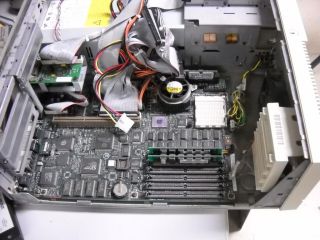 Carolina board — PowerPC 604, PCI + ISA, NCR 53c810 SCSI


Memory
Most RS/6000 systems use proprietary IBM memory that is not interchangeable with PC SIMMs/DIMMs:
- Early MCA RS/6000s (7011, 7012, 7013, 7015) use proprietary IBM 40-bit ECC SIMM cards (not PC parity SIMMs).
- POWER2 systems (7012-39H, 7013-590, 7012-397) require memory installed in pairs due to the MCM memory subsystem.[35]
- 7025-F50 / F80 use ECC SDRAM DIMMs on proprietary memory carrier cards.
- 7043-150 uses high-density ECC SDRAM up to 1 GB; 7044-270 expandable to 8 GB SDRAM ECC.[36]
All RS/6000 memory is ECC (single-bit correct, double-bit detect) — IBM did not ship parity-only memory in the RS/6000 line.
Storage
- Early MCA (7011 / 7012 / 7013 / 7015): SCSI-2 on the planar; SSA (Serial Storage Architecture) on later POWER2 deskside / rack systems.
- PReP (7248): NCR 53c810 SCSI-2 on the Carolina board, plus an IDE controller — IDE/ATA was rare on RS/6000 and appeared only on these small PReP boxes.[37]
- CHRP / PCI (7025 / 7026 / 7043 / 7044): SCSI-2 → UltraSCSI → Ultra2 → Ultra3; SSA on H-series and F-series; SCSI CD-ROM and 1.44 MB floppy stock on 7043-150.[38]
Graphics
The IBM POWER GXT family is the dominant RS/6000 graphics line. Most are PCI on the 7043/7025/7026/7044 generation; earlier RS/6000s use Micro Channel variants.
- GXT110P (FC 2839) — 2D/3D entry PCI.
- GXT250P / GXT255P — 2D single-card PCI.
- GXT800P (FC 2853/2859) — high-end 3D PCI.
- GXT2000P — mid-range 3D, double-wide PCI.
- GXT3000P (FC 008E, IBM P/N 41L5754) — mid-range 3D, double-wide, 64-bit or 32-bit PCI; supported on AIX 4.3.2.[39]
- 7248-100 has integrated IBM E15 2 MB graphics (S3 Vision864 chip) — only RS/6000 with integrated planar VGA.[40]
Comprehensive reference: IBM RS/6000 Graphics Handbook SG24-5130.[41]
Firmware
- Pre-PReP MCA RS/6000s (7011 / 7012 / 7013 / 7015): proprietary IBM RS/6000 boot ROM.
- 7248-100 / 120 / 133: PReP (PowerPC Reference Platform) firmware on the Carolina board.[42]
- 7043 / 7025 / 7026 / 7044: CHRP-compliant Open Firmware.[43]
SMS (System Management Services) is the user-facing setup utility on CHRP RS/6000s. Entry keys at POST:
- F1 — graphical SMS (at the keyboard icon).
- F4 — text-mode SMS (English).
- F5 — boot from the default boot list (or 5 on an ASCII terminal). Applies to machine types 7017, 7024, 7025, 7026, 7043, 7137.[44][45]
Many RS/6000 / pSeries machines carry a separate service processor that boots on power application and runs independently of AIX — it is responsible for the LED diagnostic display and for emergency dump on a kernel halt.
AIX Support
- AIX 3.x — original OS for 1990 launch machines (7012-320, 7013-530, 7015-920).
- AIX 4.x (introduced 1994) — adds SMP; runs on PowerPC 601 / 604 / 604e RS/6000s; final AIX 4.3.3 (1999).
- AIX 4.3.2 — first 64-bit AIX, required for POWER3 7043-260.[46]
- AIX 5L (2001+) — runs on most PCI RS/6000s. 7043-150 is documented as a good 5L platform.[47]
- AIX for N40 3.2.5 — special build for the 7020 / 7007-N40 notebook.[48]
IBM publishes per-machine "System software map" pages giving the exact AIX levels supported per submodel — useful when restoring a specific RS/6000.
Common Faults
The dominant restoration faults are:
- NVRAM module battery dead — Dallas TimeKeeper modules (DS1287 / DS1385 / DS1387 / DS1644 / DS1742 / DS1746) on the planar lose their internal lithium cell after 10–20 years. Symptoms: lost SMS / NVRAM configuration, boot list reset, clock at epoch.
- Capacitor leakage — particularly on POWER1 / POWER2 era 7012 / 7013 planars (surface-mount aluminium electrolytics, similar generation to the IBM PS/2 Model 70 / 80 PS/2 plague).
- PSU electrolytics aged — particularly on the 7013 500-series PSU, which will refuse to stay on if it doesn't sense fan rotation (fan failure presents as PSU failure).[49]
- SCSI drive stiction — original IBM SCSI drives in long-stored systems will not spin up.
- Memory card failure — POWER2 MCMs are intolerant of single-bit ECC errors after extended operation; ECC scrubbing eventually fails.
Pricing
Launch pricing (1990, all USD):
- 7012-320 POWERstation: from $13,000 (entry workstation config).
- 7013-530 POWERserver: from $43,000.
- 7015-930 enterprise: from $144,000.
These were enterprise-class prices reflecting the RISC workstation market of the early 1990s. By the late 1990s, 7043-150 desktops sold for ~$5,000–$8,000 USD as base workstations.
Related Pages
- IBM RS/6000 Maintenance Guide
- IBM RS/6000 Troubleshooting Guide
- IBM RS/6000 Capacitor Replacement Guide
- IBM RS/6000 Firmware Update Guide
- IBM Personal System/2 — Micro Channel architecture predecessor
- Open Firmware
- Common Hardware Reference Platform (CHRP)
References
- IBM RS/6000 — Wikipedia. Family overview, machine-type lineage, brand retirement October 2000.
- Ardent Tool of Capitalism — RS/6000 section. The most thorough community reference, including planar photos, CPU card detail, and IBM Announcement Letter mirrors.
- 27 years of IBM RISC, kev009.com. February 1990 launch, "America" / "RIOS" codenames, POWER architecture history.
- RS/6000 Machine Type Models — kev009.com. Submodel index across 7011 / 7012 / 7013 / 7015 / 7025 / 7026 / 7043 / 7044.
- RS/6000 architecture overview, kev009.com. CPU implementation detail per submodel.
- IBM Sales Manual — 7012-397. P2SC specifications.
- IBM Sales Manual — 7012-39H. POWER2 67 MHz workstation.
- IBM RS/6000 F80 white paper. F50 / F80 spec.
- IBM RS/6000 44P Model 270 white paper. 7044-270 POWER3-II spec.
- IBM Redbook SG24-5144 — RS/6000 43P Models 150 and 260 Handbook. 7043 family deep dive.
- IBM Redbook SG24-5143 — RS/6000 Models E30, F40, F50, H50 Handbook. 7025 / 7026 family deep dive.
- IBM SA38-0531-00 — RS/6000 7013 500-series Installation and Service Guide. PSU + planar service.
- IBM SA38-0512-03 — RS/6000 7043 / 7248 Service Guide. 43P and Carolina service.
- IBM Redbook SG24-5130 — RS/6000 Graphics Handbook (March 1999). POWER GXT card reference.
- IBM 7248 HOWTO, TLDP. PReP / Carolina detail.
- IBM RS/6000 N40 page, ibmfiles.com. Notebook detail.
- IBM RS/6000 7044 family page, ibmfiles.com. POWER3 / POWER3-II workstation detail.
- ↑ https://en.wikipedia.org/wiki/IBM_RS/6000
- ↑ http://ps-2.kev009.com/rootvg/column_risc.htm
- ↑ https://en.wikipedia.org/wiki/IBM_RS/6000
- ↑ http://ps-2.kev009.com/rootvg/column_risc.htm
- ↑ http://ps-2.kev009.com/rootvg/column_risc.htm
- ↑ http://ps-2.kev009.com/jasper/ibm/RS6K.arch.html
- ↑ https://ardent-tool.com/RS6000/ENUS197-267.pdf
- ↑ https://web-docs.gsi.de/~kraemer/COLLECTION/IBM/RISC_System-6000_POWERstation-POWERserver_250_series_upgrades_from_220_or_230_series_and_POWER.html
- ↑ https://blog.pizzabox.computer/pizzaboxes/powerstation250/
- ↑ https://www-01.ibm.com/common/ssi/printableversion.wss?docURL=/common/ssi/rep_sm/h/897/ENUS7012-39H/index.html
- ↑ https://ardent-tool.com/RS6000/ENUS197-267.pdf
- ↑ https://www.ibm.com/common/ssi/ShowDoc.wss?docURL=/common/ssi/rep_sm/7/877/ENUS7012-397/index.html
- ↑ https://www.ibm.com/support/pages/node/7093162
- ↑ https://www.ardent-tool.com/RS6000/docs/pdf/38053100.pdf
- ↑ http://ps-2.kev009.com/rootvg/RSmodels.htm
- ↑ http://www.ibmfiles.com/pages/rs6000n40.htm
- ↑ https://en.wikipedia.org/wiki/ThinkPad_Power_Series
- ↑ https://www.openpa.net/risc/ibm_powerpc_rs6000_n40_800_850_860.html
- ↑ https://public.dhe.ibm.com/software/mktsupport/techdocs/f80whitepaper.pdf
- ↑ https://theretroweb.com/motherboards/s/ibm-rs-6000-type-7025-f50
- ↑ https://public.dhe.ibm.com/software/mktsupport/techdocs/f80whitepaper.pdf
- ↑ http://ps-2.kev009.com/rs6000/redbook-cd/sg245143.pdf
- ↑ https://www.amazon.com/IBM-6000-7026-H70-POWER-SUPPLY/dp/B000MRECHI
- ↑ https://www.worthpoint.com/worthopedia/ibm-rs-6000-43p-150-type-7043-150-1786561961
- ↑ https://unixhq.com/systems/ibm-7043-150/
- ↑ http://www.ibmfiles.com/pages/rs6000type7043150.htm
- ↑ https://sharktastica.co.uk/resources/docs/IBM_SA38-0512-03_RS6000_98_4.pdf
- ↑ https://www.drdobbs.com/ibms-rs6000-43p-model-260/199200782
- ↑ http://ps-2.kev009.com/rs6000/redbook-cd/sg245144.pdf
- ↑ https://public.dhe.ibm.com/software/mktsupport/techdocs/44p270wp.pdf
- ↑ http://www.ibmfiles.com/pages/rs6000type7044.htm
- ↑ https://web-docs.gsi.de/~kraemer/COLLECTION/IBM/rs6k43p7248.html
- ↑ https://tldp.org/HOWTO/IBM7248-HOWTO/overview.html
- ↑ https://www.memorystock.com/memory/IBMRS6000Model43P7248100120133.html
- ↑ https://www-01.ibm.com/common/ssi/printableversion.wss?docURL=/common/ssi/rep_sm/h/897/ENUS7012-39H/index.html
- ↑ https://public.dhe.ibm.com/software/mktsupport/techdocs/44p270wp.pdf
- ↑ https://web-docs.gsi.de/~kraemer/COLLECTION/IBM/rs6k43p7248.html
- ↑ https://www.worthpoint.com/worthopedia/ibm-rs-6000-43p-150-type-7043-150-1786561961
- ↑ http://ps-2.kev009.com/rs6000/rs6000_ps_pdf/Graphics/GXT3000P.pdf
- ↑ https://web-docs.gsi.de/~kraemer/COLLECTION/IBM/rs6k43p7248.html
- ↑ http://bitsavers.informatik.uni-stuttgart.de/pdf/ibm/rs6000/SG24-5130-00_RS6000_Graphics_Handbook_199903.pdf
- ↑ https://tldp.org/HOWTO/IBM7248-HOWTO/overview.html
- ↑ https://en.wikipedia.org/wiki/Common_Hardware_Reference_Platform
- ↑ https://www.infania.net/misc/rs6000-firmware/7043140I.html
- ↑ http://ps-2.kev009.com/tl/techlib/qna/faxes/html/krn/krn4.htm
- ↑ https://www.drdobbs.com/ibms-rs6000-43p-model-260/199200782
- ↑ https://unixhq.com/systems/ibm-7043-150/
- ↑ http://www.ibmfiles.com/pages/rs6000n40.htm
- ↑ https://www.ardent-tool.com/RS6000/docs/pdf/38053100.pdf