

IBM System/23 Datamaster
 | |
| IBM System/23 Datamaster (Model 5322) — all-in-one desktop launched 28 July 1981 | |
| Specifications | |
|---|---|
| Developer | IBM Entry Level Systems, Boca Raton — engineering lead Bill Sydnes (hardware), Jack Sams (software); programme led by Bill Lowe |
| Manufacturer | IBM |
| Type | Small-business desktop computer |
| Released | 28 July 1981 |
| Discontinued | c. 1985 |
| CPU | Intel 8085A at 18.432 MHz crystal divided to 3.07 MHz internal machine-cycle clock; IBM internal part number 4178015. No math coprocessor |
| Memory | 9-bit parity DRAM (TMS4132 stacked-die). Official configs: 32 / 64 / 96 / 128 KB on one or two daughter cards. ROM (ROS): 14 × 8 KB then 16 × 8 KB (Mostek MK36000 / Motorola 68366 / Motorola 68766 EPROM early units) |
| Storage | 0, 1 or 2 × built-in 8-inch floppy drives ("31SD" single-sided or "51TD" double-sided); ~1.1 MB single, 2.2 MB double. Optional external IBM 5246 Diskette Unit (up to 4.4 MB aggregate) and IBM 5247 Winchester Disk Unit (15.4 / 30.8 MB; first shipped November 1982; up to 4 hosts shared per 5247) |
| Display | Built-in green-phosphor CRT (80 × 24 character cells). NEC-equivalent Intel 8275 CRTC + Intel 8257 DMA channel feeding the frame buffer at 0x8200 |
| Sound | None |
| Dimensions | Not published in surviving secondary sources; refer to SY34-0171-0 front matter |
| Weight | 95 lb (43 kg) |
| OS / Firmware | No separate OS — the boot ROM IPLs directly into IBM's own BASIC interpreter (closely related to System/34 BASIC). EBCDIC character set throughout |
| Predecessor | IBM 5120 |
| Successor | IBM PC (5150) — the Datamaster team transferred to the IBM PC's "Project Chess" task force at Boca Raton, applying lessons from the Datamaster's slipped schedule |
| Model no. | 5322 (all-in-one), 5324 (tower without integrated CRT/keyboard) |
The IBM System/23 Datamaster is an all-in-one desktop business computer announced by IBM on 28 July 1981 — just two weeks before the IBM PC (5150) of 12 August 1981. The Datamaster occupies a unique place in IBM history: it is both the direct successor to the IBM 5120 in IBM's small-business computer line, and the direct architectural ancestor of the IBM PC, sharing chipset, peripheral wiring, 9-bit parity RAM, the 62-pin expansion bus (with only five signals changed between Datamaster and PC), the keyboard mechanism, the power-good signal and the POST diagnostic system.[1][2]
The Datamaster was a commercial failure — three causes are cited repeatedly: a high US$9,000 base price, a one-year development slip caused by IBM's late decision to make the Datamaster's BASIC compatible with System/34 BASIC, and the IBM PC being announced one month after the Datamaster shipped and immediately upstaging it.[3][4]
But the Datamaster is far more historically significant than its sales suggest: the IBM PC project's defining design decisions — off-the-shelf parts, no NIH, one-year schedule, Intel 8088 because the team knew the 8085, Microsoft BASIC because IBM's own BASIC was the Datamaster schedule killer — were direct reactions to the Datamaster experience. The Datamaster's hardware engineer Bill Sydnes, software lead Jack Sams and POST author David Bradley all moved to the IBM PC "dirty dozen" task force in 1980, and brought the Datamaster's architecture with them.[5][6]
Development History
Development began at IBM's Entry Level Systems unit in Boca Raton, Florida in February 1978 under Bill Lowe. The hardware was ready by mid-1980.[7] The project then stalled approximately one year because IBM decided late in development to make the Datamaster's BASIC compatible with the BASIC on the much larger IBM System/34 minicomputer, requiring substantial rework of the interpreter.
By the time the Datamaster shipped in July 1981, the IBM PC's "Project Chess" task force — led by Bill Lowe and then by Don Estridge — was already nine months into a one-year mandate to ship a competing 16-bit personal computer. The PC's launch on 12 August 1981 immediately overshadowed the Datamaster.
Models
| Machine type | Name | Form factor | Notes |
|---|---|---|---|
| 5322 | System/23 Datamaster | All-in-one desktop | Integrated CRT, integrated 8-inch floppy bays, detached keyboard |
| 5324 | System/23 Datamaster | Tower (file-cabinet style) | No integrated CRT or keyboard — uses separate terminal; same motherboard as 5322; marketed as "ergonomic" |

Architecture
CPU
The Datamaster uses an Intel 8085A processor relabelled with IBM internal part number 4178015 (community-confirmed by swap-testing against an Alphatronic P2's 8085).[8] The clock topology is:
- 18.432 MHz crystal on the motherboard
- ÷3 to give a 6.144 MHz clock at the 8085 input pin
- ÷2 internally by the 8085 to give a 3.07 MHz machine cycle
Wikipedia and most secondary sources cite the figure as "3.07 MHz".
The 8085 was chosen because it was the cost-effective, in-production Intel 8-bit in 1978; the team's familiarity with the 8085 was a deciding factor in IBM's later choice of the 8088 (a 16-bit family member with 8-bit external bus) for the IBM PC.[9]

Peripheral Chipset (all Intel, relabelled with IBM part numbers)
- 8257 DMA — with a dedicated channel for floppy transfers (the 8275 CRTC has no internal address generator and uses DMA for every frame).
- 8275 CRTC — 80 × 24 character display.
- 8253 PIT — programmable interval timer.
- 3 × 8255 PPI — general-purpose parallel I/O (one of them drives the diagnostic probe port at the rear).
- 8251 USART — single async/sync serial channel.
- 8259 PIC — programmable interrupt controller.
- 8048 in the keyboard — with Datamaster-specific firmware.
- NEC 765 FDC on the floppy controller card.
Memory Map
The 64 KB 8085 address space is split into four 16 KB segments. Even segments (0x0000, 0x8000) are fixed; odd segments (0x4000, 0xC000) are paged through a 74LS670 page register (4 bits wide, giving 16 pages of 16 KB). Lower half of the map is ROM; upper half is RAM; video memory begins at 0x8200.[10] Theoretical maximum 272 KB ROM + 128 KB RAM addressable through banking; the firmware caps RAM at 128 KB.
ROM (Read-Only Store)
The motherboard carries either 14 × 8 KB ROS modules (= 112 KB) on early-production boards or 16 × 8 KB (= 128 KB) on later boards. Each module is numbered for diagnostic identification. ROMs are supplied as:
- Mostek MK36000 (most common, now a leading failure mode — see IBM System/23 Datamaster Troubleshooting Guide)
- Motorola 68366
- Motorola 68766 EPROM (early-production units, used because of supply shortages)
RAM
RAM is 9 bits wide (8 data + 1 parity). A parity error on read triggers the 8085's TRAP input and halts the system. RAM is not on the motherboard — it lives on one or two memory daughter cards connected via 36-pin card-edge connectors.
The DRAMs are Texas Instruments TMS4132 — a factory-piggybacked variant of the TMS4116 that stacks two TMS4116-class dies in a single package. This is often mistaken for IBM-soldered redundancy; in fact, it is a TI factory part. Each TMS4132 contains two stacked dies and failure of either die kills the byte.[11]
Official RAM configurations: 32 / 64 / 96 / 128 KB. Memory boards came in 32 KB and 64 KB sizes; combinations are 32 (32+none), 64 (32+32 or 64+none), 96 (64+32), 128 (64+64). The system will not boot without a board in the "base" socket.
Interrupts
- TRAP — memory parity error.
- RST 7.5 — 8253 PIT timer 2.
- RST 6.5 — expansion-slot B4.
- RST 5.5 — 8275 IRQ (only if jumper J1 is bridged).
- General-purpose IRQ via the 8259 PIC: IRQ0 = keyboard, IRQ1 = USART, IRQ2 = USART.
Expansion Bus
The Datamaster has four internal expansion slots at the rear. The bus is the direct architectural ancestor of the IBM PC's 62-pin XT / ISA bus — David Bradley (lead PC POST author) confirms "only five signals being changed" between the Datamaster bus and the PC bus.[12] A persistent myth that the Datamaster bus is mirrored compared to the PC bus is refuted by hands-on community examination — the mirroring impression is an artifact of how the SY34-0171-0 service manual draws the connector.[13]
Character Encoding
The Datamaster uses EBCDIC character encoding throughout — one of very few microcomputers ever to do so. This is inherited from IBM's mainframe / midrange systems and made interoperability with non-IBM hardware significantly more difficult.
Storage
- Internal — 0, 1 or 2 × built-in 8-inch floppy drives. Drive types:
- 31SD — single-sided variant (~1.1 MB single drive)
- 51TD — double-sided variant (~2.2 MB internal with two drives)
- IBM 5246 Diskette Unit (external 8-inch floppy):
- Models 11 / 12 — dedicated to one computer, 1.1 / 2.2 MB
- Models 21 / 22 — shared between two computers, 1.1 / 2.2 MB
- Aggregate diskette storage up to 4.4 MB across internal + external[14]
- IBM 5247 Winchester Disk Unit — 8-inch hard drive, first shipped November 1982. Capacities 15.4 MB and 30.8 MB. Up to four 5322/5324 hosts could share a single 5247, effectively giving the Datamaster a multi-user file-share mode. File-format-compatible with the floppy media.[15]
I/O and Peripherals
- Printers — up to two of the IBM 5217, 5241 or 5242 in any combination. The motherboard has one integrated printer port; an optional Printer Control Adapter card adds a second (diagnostic test 3A confirms its presence).[16]
- Communications — single Intel 8251 USART on the motherboard providing one async/sync serial channel. Often described as a "current-loop serial port". BSC (Binary Synchronous Communications) is supported as an optional feature.[17]
- Keyboard — 83-key pre-Model F, capacitive matrix, Intel 8048 microcontroller, parallel interface to the motherboard's 8255 PPI. Often cited as the earliest production Model F design (the IBM PC moved the keyboard to a serial interface but kept the same capacitive Model F mechanism). The 8048's firmware is unique to the Datamaster — replacement requires a known-good Datamaster keyboard; PC firmware is not interchangeable.
- Diagnostics probe port at the rear (driven by an 8255 in mode 0) — 8-bit data plus probe power, used by a service-engineer probe with LEDs to display the current POST test ID even when the CRT has not yet initialised.

Operating Environment
The Datamaster has no separate operating system in the modern sense. The boot ROM (designated PID-1200 firmware) IPLs directly into the BASIC interpreter from ROM. System commands are accessed via the keyboard's Cmd-key templates.
BASIC on the Datamaster is IBM's own BASIC, closely related to System/34 BASIC — not Microsoft BASIC. It is a closed environment by design: no PEEK / POKE / direct hardware access is provided. Up to 8-character variable names and 5-digit line numbers, a major step up from the IBM 5110 / IBM 5120 BASIC.[18]
IBM later cited the Datamaster BASIC's closed-environment philosophy as one of the reasons the IBM PC chose Microsoft BASIC instead — IBM wanted the PC to allow third-party hardware access and BASIC extension, which the Datamaster's BASIC did not permit.
Application Bundle
IBM supplied a small-business application suite:
- Accounts Payable
- Accounts Receivable
- General Ledger
- Payroll
- Inventory
- Word Processor (rated "extremely good" by contemporary reviewers)
Submodels with a dedicated Word Processing Feature Card (Bits Passats catalogues these as the 4xx series) required a minimum 64 KB RAM.
Service Documents
The IBM service documentation set for the System/23 is preserved at Bitsavers:
- SY34-0171-0 — IBM 5322 Computer Service Manual, December 1980. Primary CE document; covers diagnostics, power supply, drives, board layouts.
- SY34-0241-1 — IBM 5324 Computer Service Manual, May 1982.
- 6841631 — System/23 Diagnostic User Guide, April 1982 — contains the full PID-1200 test ID list.
- SA34-0107-3 — System/23 Setup Instructions (5322), June 1982.
- SA34-0109-1 — System/23 BASIC Language Reference, July 1981.
- ZA38-0016-0 — Commonly Used Systems Parts Handbook, July 1988 (p. 119 lists 5322 / 5324 motherboard parts).
- Datapro M11-491-35 — Management Summary, multiple editions: September 1981, November 1982, August 1984.
Connection to the IBM PC
The Datamaster's historical importance is its direct architectural lineage to the IBM PC. The following design elements were carried forward essentially unchanged:
| Element | Datamaster | IBM PC |
|---|---|---|
| Expansion bus | 62-pin slots on backplane | Same 62-pin slots; only 5 signals changed |
| 8253 PIT, 8259 PIC | Same chips, same wiring | Identical |
| DMA | 8257 | 8237 (upgraded replacement) |
| RAM width | 9 bits (8 data + 1 parity) | Same |
| PSU "Power Good" signal | Present | Same signal, same pinout |
| PSU rail set | +5, +12, +24, −5, −12 V | +5, +12, −5, −12 V (24 V dropped because no built-in 8-inch drives) |
| Keyboard mechanism | 83-key capacitive Model F + 8048 | Same mechanism; serial interface instead of parallel |
| Character ROM and video format | 80 × 24 character cells | Same 80 × 24 character mode (MDA / CGA both inherit) |
| POST diagnostic | PID-1200, 2-digit hex codes via probe port | Ported and simplified to "POST" |
| Project home | Boca Raton ELS | Boca Raton "Project Chess" |
| Engineering team | Bill Sydnes (HW), Jack Sams (SW), David Bradley (POST) | Same Sydnes / Sams / Bradley |
Bradley's 1990 BYTE retrospective is explicit: "the diagnostics system was ported to the PC and simplified, and was renamed to POST." The Bits Passats community summary captures the broader point: "the early life of the IBM PC started as modifications on the Datamaster."
Pricing
- Introductory price — US$9,000 baseline; ~US$9,830 with printer.[19] Equivalent to approximately $27,000–$31,000 in 2024 dollars.
- Discontinued — c. 1985. Datapro reports continued through August 1984.
Common Faults
- Mostek MK36000 ROS modules degrade with age — primary cause of "computer halts mid-IPL" complaints. ROM-adapter replacements with re-burned firmware are a known workaround.
- TMS4132 stacked-die DRAMs — failure of either die in the package kills the byte. To bench-test, the upper die must be physically separated from the lower die.
- Linear PSU electrolytic failures — particularly on the RAM supply rails. See IBM System/23 Datamaster Capacitor Replacement Guide.
- Keyboard 8048 firmware is Datamaster-specific; firmware failure makes the keyboard unrecoverable without a donor.
- Relabelled-IC problem — every IC on the Datamaster has an IBM internal part number (e.g. 4178015 = 8085, 4178629 = 8275 variant) which makes parts identification a major repair barrier. No IBM-published cross-reference table exists; the community has assembled a partial mapping.
Gallery
-
 Datamaster 5322 front
 -
 Datamaster 5322 angle view
 -
 5322 computer
 -
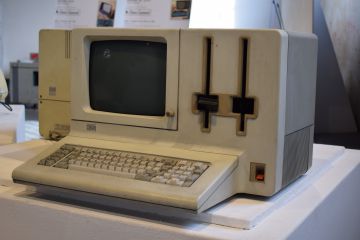 5322 full configuration
 -
 5322 alternate angle
 -
 5322 with keyboard detached
 -
 5322 keyboard close-up (Model F precursor)
 -
 Motherboard (1982 revision)
 -
 Motherboard (1983 revision)
 -
 5324 tower variant


Related Pages
- IBM System/23 Datamaster Maintenance Guide
- IBM System/23 Datamaster Troubleshooting Guide
- IBM System/23 Datamaster Capacitor Replacement Guide
- IBM 5120 — direct predecessor in IBM's small-business line
- IBM PC (5150) — direct architectural successor; the Datamaster team became the IBM PC team
References
- IBM System/23 Datamaster — Wikipedia.
- Bits Passats — IBM System/23 Datamaster. The most thorough community technical reference, including the chipset breakdown, memory map, ROS module details, and PID-1200 test ID list.
- oldcomputers.net — IBM 5322 System/23 Datamaster. Pricing and configuration reference.
- Wavablog — TSI's IBM System/23 Datamaster experience. Field reseller account.
- IBM 5322 Service Manual SY34-0171-0 (December 1980). Primary CE document.
- IBM 5324 Service Manual SY34-0241-1 (May 1982).
- System/23 Diagnostic User Guide 6841631 (April 1982). Full PID-1200 test ID list.
- System/23 BASIC Language Reference SA34-0109-1 (July 1981).
- Bradley, D. J., "The Creation of the IBM PC", BYTE September 1990, pp. 414–420. Datamaster → IBM PC lineage from a member of both teams.
- Pollack, A., "Big I.B.M.'s Little Computer", NYT, 13 August 1981.
- Trifunovic, N., "Why IBM Turned to Microsoft for BASIC". Cited for the Datamaster-BASIC-as-PC-design-driver argument.
- EDN, "Whence Came the IBM PC?". Architectural lineage detail.
- Mark Blair (NF6X), "IBM 5322 System/23 Datamaster Internals". Restorer's hands-on photographs.
- ↑ Wikipedia, "IBM System/23 Datamaster".
- ↑ Bradley, D. J. "The Creation of the IBM PC", BYTE September 1990, pp. 414–420.
- ↑ Bits Passats, "IBM System/23 Datamaster".
- ↑ Pollack, A., "Big I.B.M.'s Little Computer", New York Times, 13 August 1981.
- ↑ Trifunovic, N., "Why IBM Turned to Microsoft for BASIC".
- ↑ Bradley 1990, BYTE.
- ↑ Bradley 1990, BYTE.
- ↑ Bits Passats, "IBM System/23 Datamaster".
- ↑ Bradley 1990, BYTE.
- ↑ Bits Passats.
- ↑ TMS4132 datasheet, minuszerodegrees.net mirror.
- ↑ Bradley 1990, BYTE.
- ↑ Bits Passats.
- ↑ Datapro M11-491-35, "IBM System/23 — Management Summary".
- ↑ Datapro M11-491-35.
- ↑ Datapro M11-491-35.
- ↑ oldcomputers.net, "IBM 5322 System/23 Datamaster".
- ↑ IBM, System/23 BASIC Language Reference SA34-0109-1, July 1981.
- ↑ oldcomputers.net.