

IBM PS/2 Model 70
 | |
 | |
| IBM PS/2 Model 70 (8570) low-profile desktop | |
| Specifications | |
|---|---|
| Developer | IBM Entry Systems Division, Boca Raton |
| Manufacturer | IBM |
| Type | Desktop personal computer |
| Released | June 2, 1988 |
| Discontinued | c. 1992 |
| CPU | Intel 80386DX @ 16 MHz (8570-E61); 20 MHz (8570-121); 25 MHz (8570-A21 / A61); Intel 80486DX @ 25 MHz via Power Platform daughtercard (8570-B21 / B61). Optional Intel 80387DX coprocessor on 386-based submodels (built into 80486 on Power Platform) |
| Memory | 2 MB stock (E61); 4 MB stock (121 / A21 / B21); 4 × 72-pin proprietary PS/2 SIMM sockets on planar; 16 MB max on planar, expandable further via MCA Memory Adapter cards |
| Storage | 1.44 MB 3.5" diskette + 60 MB ESDI (E61 / A61 / B61) or 120 MB ESDI (121 / A21 / B21) via IBM ESDI Fixed Disk Adapter/A |
| Display | Integrated VGA on planar (256 KB VRAM, 15-pin DSUB); supports IBM 8503 / 8512 / 8513 / 8514 displays |
| Sound | PC speaker |
| Dimensions | 421 W × 421 D × 144 H mm |
| Weight | ~9.5 kg |
| OS / Firmware | IBM PC DOS 3.30 / 4.00 / 5.00; IBM OS/2 1.x / 2.x / Warp 3; IBM AIX PS/2; Windows 3.0 / 3.1 |
| Predecessor | IBM PS/2 Model 50 (286-class desktop sibling) |
| Successor | IBM PS/2 Model 90 XP 486 (32-bit MCA 486 desktop) |
| Model no. | 8570 |
The IBM PS/2 Model 70 (IBM machine type 8570) was a 32-bit, 80386DX-based desktop introduced in June 1988 as the high-end desktop member of the IBM Personal System/2 family. The Model 70 paired the planar architecture of the Model 60 with a 32-bit Micro Channel implementation and a full 80386DX with paging, protected mode and 32-bit data path, in the same desk-friendly low-profile chassis as the Model 50.
The Model 70 is the desktop counterpart to the IBM PS/2 Model 80 tower. The two share the 32-bit MCA bus, the 80386DX-family processor, and (in 16 / 20 MHz submodels) most of the planar topology — but the Model 70 has only three MCA slots and a single 5.25" / two 3.5" drive cage in the low-profile desktop chassis, while the Model 80 is the eight-slot tower.
The Model 70 is well known for two engineering features: the optional Power Platform 486 upgrade module (a daughtercard that replaced the 80386DX socket on the planar with an Intel 80486-based daughtercard), and the on-planar VGA (no separate display adapter card needed). It is equally well known to restorers for the surface-mount aluminium electrolyte leakage on the 8570 planar, which is now considered the classic PS/2 failure mode and is documented in IBM PS/2 Model 70 Capacitor Replacement Guide.
Submodels
[edit | edit source]| Submodel | CPU | Speed | HDD | Notes |
|---|---|---|---|---|
| 8570-E61 | 80386DX | 16 MHz | 60 MB ESDI | Entry submodel, June 1988 |
| 8570-121 | 80386DX | 20 MHz | 120 MB ESDI | 20 MHz, larger ESDI |
| 8570-A21 | 80386DX | 25 MHz | 120 MB ESDI | 25 MHz top-end; planar revisions differ from E61/121 |
| 8570-A61 | 80386DX | 25 MHz | 60 MB ESDI | 25 MHz with smaller HDD |
| 8570-B21 | 80486-DX (via Power Platform) | 25 MHz | 120 MB ESDI | Power Platform-equipped Model 70 — 80486 daughtercard replaces 80386DX socket |
| 8570-B61 | 80486-DX (via Power Platform) | 25 MHz | 60 MB ESDI | As B21 with smaller HDD |
The 80386DX in the Model 70 includes paging and full protected mode; the planar exposes the full 32-bit MCA data path. The 16/20/25 MHz submodels boot OS/2 1.x and 2.x, AIX PS/2 and PC DOS 3.30 / 4.00 / 5.00.
Chassis and Layout
[edit | edit source]The Model 70 chassis is the same low-profile desktop as the Model 50:
- Width × depth × height (chassis): approx 421 × 421 × 144 mm.
- Weight (without HDD): approx 9.5 kg.
- Two thumbscrews at the rear top corners hold the cover. Cover slides back 10 mm and lifts off.
- Three MCA slots (all 32-bit) on a vertical riser at the rear.
- One 5.25" half-height bay at the top (often empty or used for tape backup).
- Two 3.5" half-height bays below it (one for floppy, one for the ESDI hard drive).
- PSU on the left-front: 132 W on the Model 70.
- Planar on the chassis floor, with the 80386DX socket near the front-right.
- Power switch on the front-right.
- Onboard VGA (15-pin Mini-D-Sub on the rear bracket of the planar).
- PS/2 keyboard and mouse (Mini-DIN-6).
- Serial port (DB-25 male) and parallel port (DB-25 female).
Planar
[edit | edit source]The Model 70 planar carries:
- CPU: 80386DX, PGA-132, socketed. The socket is shared between the discrete 80386 (in E61 / 121 / A21 / A61) and the Power Platform daughtercard (in B21 / B61).
- Optional 80387DX coprocessor in a socket adjacent to the 80386DX.
- Memory: 4 × 72-pin SIMM sockets accepting 1, 2 or 4 MB modules. Maximum 16 MB (4 × 4 MB) on planar. PS/2 72-pin SIMMs are proprietary to IBM PS/2 — they have a different pinout and parity convention from later PC 72-pin SIMMs.
- RTC: Dallas DS1287 / DS12887 (24-pin DIP marked "DALLAS") with integrated lithium cell.
- Onboard VGA: IBM VGA implementation with 256 KB of dedicated VRAM. VGA controller chip and VRAM are on the planar.
- MCA bus controller: 32-bit MCA implementation, providing three 32-bit MCA slots.
- Floppy controller integrated on the planar with single-cable interface.
- Surface-mount aluminium electrolytic capacitors for IC bypassing throughout the planar. These are the famous PS/2 SMD caps that leak after 30+ years and cause the Model 70 to die slowly.
SMD Electrolyte Leakage — The Famous PS/2 Plague
[edit | edit source]The Model 70 (and the Model 80) planar uses surface-mount aluminium electrolytic capacitors (SMD electrolytics) — typically 10 µF / 16 V or 47 µF / 16 V — scattered across both sides of the planar for IC supply rail bypassing. The aluminium electrolyte inside these caps is corrosive and the rubber bung seal degrades over decades, allowing the electrolyte to leak onto the planar.
Symptoms of SMD electrolyte leakage:
- Brown / green residue near a SMD cap base.
- Crusty deposits on nearby PCB traces.
- Intermittent POST faults; system passes POST cold but fails when warm.
- Random reboots.
- Specific functional area (e.g., onboard VGA, RTC, serial port) becomes intermittent before failing.
- Eventually, planar dies completely.
The leak is cumulative. Once electrolyte is on the planar surface, it continues to corrode traces and ICs even after the PSU is unplugged. Restoration requires complete SMD cap removal, planar wash (IPA or laboratory cleaning), trace repair where necessary, and recap with modern equivalents.
The Model 70 SMD leak is the single most common cause of an apparently-dead 8570. See IBM PS/2 Model 70 Capacitor Replacement Guide for the full recap procedure.
Power Platform
[edit | edit source]The IBM Power Platform is an upgrade daughtercard that replaces the 80386DX socket on the Model 70 planar with an Intel 80486-based daughterboard. The Power Platform was offered as both a factory-fitted option (the 8570-B21 / B61) and as a field upgrade kit (FRU 64F8011).
Power Platform key characteristics:
- CPU: Intel 80486DX (or 80486SX on some Power Platform variants).
- Cache: 8 KB on-die in the 80486; no L2 cache on the Power Platform.
- Speed: 25 MHz internal, with the planar MCA bus running at the same speed it did under the 80386DX.
- Compatibility: Power Platform requires planar BIOS update; the BIOS update is on the Reference Diskette for the B21 / B61 submodels.
The Power Platform is a sought-after period upgrade for Model 70 restorers because it brings the desktop chassis up to 80486-class performance without resorting to MCA accelerator cards.
Display
[edit | edit source]Like the Model 50 and Model 60 (but unlike earlier PS/2 models), the Model 70 has VGA on the planar. The VGA chip and 256 KB of dedicated VRAM are on the planar; no display adapter card is required.
Supported monitors:
- IBM 8503 — 12" monochrome VGA.
- IBM 8512 — 14" colour VGA, 640 × 480 max.
- IBM 8513 — 12" colour VGA.
- IBM 8514 — 16" high-resolution display (1024 × 768 with the matching IBM 8514/A MCA card; standard VGA without it).
The on-planar VGA cannot do 1024 × 768 — that requires an IBM 8514/A or compatible MCA display adapter.
Drive Architecture
[edit | edit source]The Model 70 uses the PS/2 single-cable drive interface for the floppy drive (1.44 MB DSHD 3.5" half-height) and the IBM ESDI Fixed Disk Adapter/A for the hard drive. The 8570 ESDI controller is on an MCA card; the drive's data and power cables connect directly to the rear of the controller card, not to the planar.
ESDI drives in the 8570 are 60 MB (E61 / A61) or 120 MB (121 / A21 / B21).
Reference Diskette
[edit | edit source]The Model 70 requires a Model 70-specific Reference Diskette. The Reference Diskette is used for:
- SETUP (drive types, date, time, memory size).
- MCA Auto Configuration.
- Advanced Diagnostics (Ctrl-A from Reference Diskette menu).
- Reading and writing CMOS configuration.
The Reference Diskette is not interchangeable with the Model 50 / 60 / 80 Reference Diskette. The Power Platform-equipped Model 70 (B21 / B61) uses a different Reference Diskette image with BIOS extensions for the 80486 daughtercard.
Software
[edit | edit source]- PC DOS 3.30 was the launch OS in 1988.
- PC DOS 4.00 followed shortly after.
- PC DOS 5.00 (1991) was the contemporary final DOS.
- OS/2 1.x (and IBM's later OS/2 2.0 / 2.1 / Warp 3) — the Model 70 is one of the best 80386-class platforms for OS/2 2.x.
- AIX PS/2 — IBM's Unix for PS/2.
- Windows 3.0 / 3.1 run on DOS on the Model 70.
Common Faults
[edit | edit source]- SMD electrolytic leakage on the planar. Most common Model 70 failure. See IBM PS/2 Model 70 Capacitor Replacement Guide.
- Dead DS1287 / DS12887 RTC battery producing the 161 / 162 / 163 POST cluster. See IBM PS/2 Model 70 Maintenance Guide.
- ESDI controller cap failure producing 10455 / 10463 errors. See IBM PS/2 Model 70 Capacitor Replacement Guide.
- Drive stiction on long-stored ESDI drives.
- 165 card-ID-mismatch after MCA card change without Auto Configuration. See IBM PS/2 Model 70 Troubleshooting Guide.
- Failed PSU electrolytics (132 W PSU). See IBM PS/2 Model 70 Capacitor Replacement Guide.
Specifications Summary
[edit | edit source]| Spec | E61 | 121 | A21 | B21 |
|---|---|---|---|---|
| CPU | 80386DX-16 | 80386DX-20 | 80386DX-25 | 80486DX-25 (Power Platform) |
| RAM stock | 2 MB | 4 MB | 4 MB | 4 MB |
| RAM max | 16 MB | 16 MB | 16 MB | 16 MB |
| FDD | 1.44 MB 3.5" | 1.44 MB 3.5" | 1.44 MB 3.5" | 1.44 MB 3.5" |
| HDD | 60 MB ESDI | 120 MB ESDI | 120 MB ESDI | 120 MB ESDI |
| Coprocessor | 80387DX (opt.) | 80387DX (opt.) | 80387DX (opt.) | Built into 80486DX |
| Video | Onboard VGA | Onboard VGA | Onboard VGA | Onboard VGA |
| PSU | 132 W | 132 W | 132 W | 132 W |
| MCA slots | 3 (all 32-bit) | 3 (all 32-bit) | 3 (all 32-bit) | 3 (all 32-bit) |
| Bays | 1 × 5.25", 2 × 3.5" | 1 × 5.25", 2 × 3.5" | 1 × 5.25", 2 × 3.5" | 1 × 5.25", 2 × 3.5" |
Pricing
[edit | edit source]Launch pricing (1988):
- 8570-E61: $7,995 USD.
- 8570-121: $9,995 USD.
These are 1988 prices for high-end IBM business desktops. The Model 70 was sold primarily to corporate customers running OS/2, AIX PS/2 or DOS-based business applications.
Gallery
[edit | edit source]-
 Model 70 with 80386DX (8570-E61 / 121 / A21 / A61)
 -
 Front view showing the 5.25" / 3.5" drive bays
 -
 8570-121 planar (20 MHz, Type 1) — note the SMD electrolytics
 -
 Bare Model 70 planar, recap candidate
 -
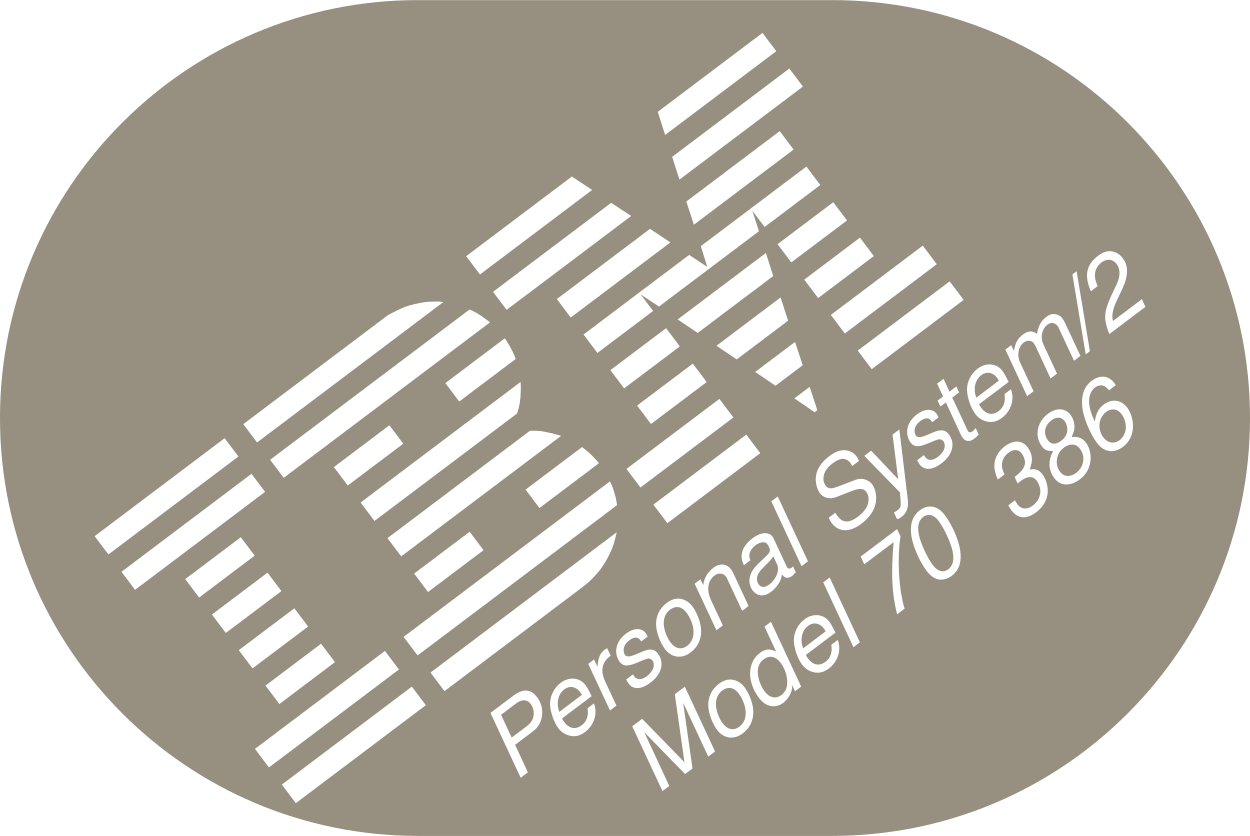 Front-bezel "Model 70 386" badge
 -
 "Model 70 486" badge (Power Platform / 8570-B21 / B61)


Related Pages
[edit | edit source]- IBM PS/2 Model 70 Maintenance Guide
- IBM PS/2 Model 70 Troubleshooting Guide
- IBM PS/2 Model 70 Capacitor Replacement Guide
- IBM PS/2 Model 50 — desktop predecessor (286-class)
- IBM PS/2 Model 60 — tower sibling (286-class)
- IBM PS/2 Model 80 — tower sibling (386-class)
- IBM Personal System/2
References
[edit | edit source]- IBM PS/2 Model 70 — Ardent Tool Quick Reference. FRU breakdown, submodel matrix.
- IBM PS/2 Model 70 — Wikipedia. Source for release date (June 1988), Power Platform existence, submodel matrix.
- IBM PS/2 Model 70 — DOS Days. Source for the 132 W PSU rating, ESDI controller, on-planar VGA, RAM SIMM topology.
- Commonly Failing Electronic Components, minuszerodegrees.net. Reference for SMD electrolytic leakage.
- IBM, IBM Personal System/2 Hardware Maintenance Manual (S52G-9971-02, October 1994).