

Atari Transputer Workstation
 | |
| Atari ATW800 tower with key switch, control panel and floppy drive | |
| Specifications | |
|---|---|
| Developer | Perihelion Hardware (Jack Lang)[1] |
| Manufacturer | Atari Corporation |
| Type | Transputer workstation |
| Released | Shown as the Abaq at COMDEX, November 1987; prototypes May 1988; production May 1989[1] |
| Intro price | £4,950 with 40 MB hard disk, 4 MB RAM, Helios and X Window (Perihelion, September 1989)[2] |
| Units sold | About 350 made, of which 50 to 100 were prototypes[1][3] |
| CPU | Inmos T800-20 transputer; Motorola 68000 at 8 MHz for I/O[4] |
| Memory | 4 MB DRAM for the T800, expandable to 16 MB; 1 MB dual-port video RAM; 512 KB for the 68000[4] |
| Storage | 40 MB SCSI hard disk; 3.5-inch floppy[4] |
| Display | — |
| Sound | — |
| Graphics | Blossom raster-op co-processor; up to 1280 × 960[5] |
| OS / Firmware | Helios[4] |
| Model no. | ATW800 (first shown as the Abaq)[1] |
The Atari Transputer Workstation (ATW800, first shown as the Abaq) is a parallel-processing workstation built around the Inmos T800 transputer, built in small numbers by Atari Corporation in 1988 and 1989 and designed with Perihelion in England. It runs Perihelion's Helios operating system with the X Window System, has a custom graphics co-processor called Blossom, and uses a complete Mega ST on a board as its input/output processor.[1][4] Further transputers fit on farm cards inside the case, and the host transputer's links come out to the back panel so that several machines can be joined.[1] About 350 were made.[3]
History
[edit | edit source]Tim King left MetaComCo in 1986 to start Perihelion Software, which wrote Helios, and his colleague Jack Lang started Perihelion Hardware to build a transputer workstation to run it. Atari showed the machine at the November 1987 COMDEX as the Abaq, in two forms: a card for the Mega ST's expansion slot and a stand-alone tower containing a miniaturised Mega ST. The card version was dropped, and the name was changed to ATW800 because "Abaq" was already in use in Europe.[1]
Atari Corp (UK) wrote the hardware manual for the Issue 3 Abaq in 1988, the development system sold to software developers. That version is a separate box connected to an external Mega ST through a SCSI and link interface card fitted inside the Mega ST, and its blitter, Charity I, ran at 17.6 MHz pending a Charity II at 20 MHz. The manual states that the final design would be a single tower with the 68000 front end built in, and gives production units as due in December 1988.[6] Wikipedia records a first run of prototypes in May 1988 and a production run in May 1989.[1] Perihelion was the exclusive distributor in England; its price list of September 1989 gives £4,950 for the base system and £4,300 for a four-transputer farm card.[1][2] Dave Dunfield's records and Wikipedia give the total as about 350 machines, 50 to 100 of them prototypes.[3][1]
Hardware
[edit | edit source]The machine has three main parts:[1][4]
- The main board, with the T800-20 host transputer, its 4 MB of DRAM (120 ns, expandable to 16 MB) and 1 MB of dual-port video RAM (100 ns).
- The Blossom video board, which plugs onto the main board.
- The I/O subsystem: a Mega ST on one board with a 68000 at 8 MHz and 512 KB of RAM, connected to the host transputer by a transputer link.
The Atari Museum describes the I/O subsystem as a compact Mega ST running TOS 1.4 that can work as a stand-alone Mega ST, with every standard ST port except the joystick ports.[7] Ram Meenakshisundaram's data sheet lists RS-232, DMA (ACSI), parallel, MIDI in and out, SCSI and mouse/joystick ports, four expansion slots on the T800 bus and one on the 68000 bus.[4] Atari's Model 4.3 specification gives the 68000 1 MB of DRAM and lists buffered ECL and TTL Inmos links, a floppy port and an ST video output for terminal or diagnostic use.[5]
The blitter does more than graphics. In the Issue 3 Abaq the Charity chip performs all the memory control for main, expansion and video memory, and the main memory refresh has to be started by software: if the refresh enable bit is not set, no refresh cycles take place.[6] This is the reason Wikipedia notes that Blossom appears to be responsible for DRAM refresh in the ATW.[1]
| Mode | Resolution | Bits per pixel | Colours | Pixel rate | Line rate |
|---|---|---|---|---|---|
| 0 | 1280 × 960 | 4 | 16 grey levels (monochrome) | 107.5 MHz | 65.0 kHz |
| 1 | 1024 × 768 | 8 | 256 from 16 million | 64.0 MHz | 50.0 kHz |
| 2 | 640 × 480 | 8 | 256 from 16 million | 26.87 MHz | 31.5 kHz |
| 3 | 512 × 480 | 32 | True colour | 25.0 MHz | See note |
| 4 | 1280 × 960 | 4 | 16 from 4,096 | 107.5 MHz | 65.0 kHz |
Atari's Model 4.3 sheet prints the mode 3 line rate as 1.5 kHz; the 1988 Issue 3 manual gives 31.5 kHz, and also gives 66 MHz for mode 1 where the later sheet gives 64.0 MHz. The Issue 3 manual gives a 60 Hz frame rate for every mode; the later sheet says mode 0 is supported only for non-interactive displays.[6][5] The Issue 3 manual names the NEC MultiSync Plus or XL for modes 1 to 3 and a Hitachi 4615-D-BB-3 for mode 0, with output on four 75 Ω BNC sockets (RGB, with sync on green or composite sync). Ram Meenakshisundaram's data sheet lists the NEC MultiSync Plus/XL, the Hitachi 4616-D-BB-3 and the Philips M1964.[6][4]
Blossom draws lines, fills trapezoids and blocks and applies a 32 × 32 pixel mask. The data sheet quotes square fills at up to 128 megapixels per second, and line drawing and trapezoid fills at up to 32 megapixels per second.[4]
Expansion
[edit | edit source]Perihelion's F104 farm card carries up to four Inmos transputers (T800, T425 or T414, at 20 MHz), each with 1 MB of its own DRAM, and draws 12 W typically and 20 W at most from the 5 V supply. Its manual says the Issue 3 ATW takes farm cards on a vertical expansion plane plugged into the main board, while the Issue 4 ATW has three slots on the main board for them.[8] Sources differ on how many processors fit inside. Wikipedia gives three farm-card slots and 13 transputers in a full machine; Dunfield's page and Ram Meenakshisundaram's data sheet say up to 16 more T800s can be added internally, for 17 in all; and Atari's Model 4.3 specification describes a Tram12 motherboard, with twelve TRAM sites and an Inmos C004 link switch, that allows up to 36 additional processors.[1][3][4][5] Every transputer, including those on third-party TRAMs, can be reset and analysed individually over the ATW's diagnostics bus.[5]
Power supply
[edit | edit source]The Issue 3 Abaq manual describes an internal, fan-cooled 200 W power supply with a switch for 100/120 V or 220/240 V input. Check the selector before connecting the machine to the mains.[6]
| Rail | Rated current |
|---|---|
| +5 V DC | 15.00 A |
| +12 V DC | 4.20 A |
| -5 V DC | 0.30 A |
| -12 V DC | 0.25 A |
These are the figures for the 1988 development system. They have not been checked against the supply in a production ATW800; read the label on the supply in your machine before testing it against this table.
Maintenance and repair
[edit | edit source]
The Internet Archive, bitsavers and the ATW800 sites cited here hold no Atari service manual, schematic or parts list for the production ATW800. The surviving technical documents are the Issue 3 Abaq hardware manual, Atari's product specifications and Perihelion's farm card manual.[8] The I/O subsystem is a Mega ST on a board of its own with its own connector bracket (see the gallery), so check designators on the board itself before working from Mega ST documentation.[7]
- Opening the Issue 3 Abaq takes four screws in the side of the case. Its start-up instructions check that the video board under the supply is seated, that the supply's voltage selector is right, and that the power connector J11 is fitted.[6]
- The Issue 3 manual's diagnostic program, run from the Mega ST, sets bits to choose its tests: main RAM, video RAM, scope loops on each for an oscilloscope, a transputer bit test, a Charity blit test and test patterns.[6]
- Each processor on a farm card has three LEDs: RESET (red) lights when its reset line is held high, ANALYSE (yellow) when analyse is set over the diagnostic bus, and ACTIVITY (green) whenever it reads or writes its external memory, including refresh cycles. A reset switch on the card resets every processor on it and on any other cards.[8]
- The Helios 1.1 formatting utility corrupts the hard disk through data wraparound, according to the restorer of a working ATW800. Format with the Helios 1.2 utility instead, or format the disk in a TT, in which case there is no Helios partition.[9]
- The ATW boot disk, version 1.1, is a 720 KB TOS-format floppy whose host.con file is edited to suit the machine. Perihelion has stated that Helios may be distributed freely as long as nothing is charged for it.[10]
Documentation
[edit | edit source]- Atari Transputer Workstation Documentation: the Issue 3 Abaq hardware manual and Atari's ATW technical documentation.
- Atari ABAQ Issue 3 Hardware Manual (Atari Corp (UK) Ltd, 1988, draft)
- ATW Technical Documentation (Atari Corporation UK, Model 4.3 specification)
- Transputer FarmCard Technical Manual (Perihelion, F104, Issue 2, July 1989)
Gallery
[edit | edit source]-
 The Mega ST I/O subsystem removed from the machine
 -
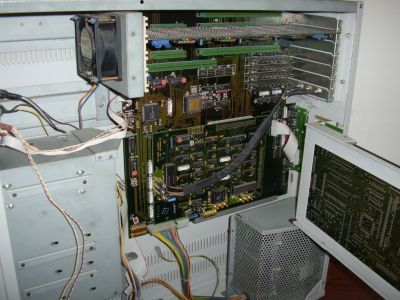 I/O subsystem swung out, showing the Blossom video board
 -
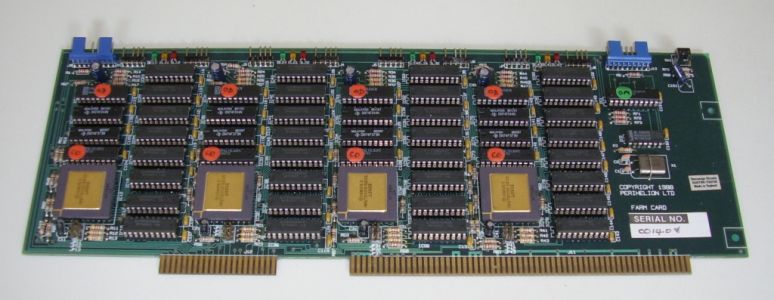 Perihelion farm card with four T800 transputers


Related pages
[edit | edit source]References
[edit | edit source]- ↑ 1.00 1.01 1.02 1.03 1.04 1.05 1.06 1.07 1.08 1.09 1.10 1.11 1.12 Wikipedia, "Atari Transputer Workstation", revision 1348474284: history, the Abaq name, Perihelion, prototype and production runs, number made, the three main parts, farm card slots, Blossom video modes and the DRAM refresh note. en.wikipedia.org.
- ↑ 2.0 2.1 "Atari ATW800 Price List (1989)", atw800.complicated.net, copied from a Perihelion price list dated September 1989. atw800.complicated.net.
- ↑ 3.0 3.1 3.2 3.3 Dave Dunfield, "Daves Old Computers: Atari Transputer Workstation", classiccmp.org, 2004-2005: number made, number of processors, photographs and manuals. classiccmp.org.
- ↑ 4.00 4.01 4.02 4.03 4.04 4.05 4.06 4.07 4.08 4.09 Ram Meenakshisundaram, "Atari Transputer Workstation 800 Data Sheet", transputer pages at classiccmp.org: processors, graphics processor rates, memory, monitors, I/O ports, storage, expansion slots and processors. classiccmp.org.
- ↑ 5.0 5.1 5.2 5.3 5.4 5.5 Atari Corporation UK, ATW Technical Documentation (The Atari Transputer Workstation Model 4.3 specification), undated: memory (p. 2), video modes and rates (p. 3), I/O and processor expansion, Tram12 and the diagnostics bus (pp. 4-5), storage and software (pp. 5-7). Hosted as File:Atari Transputer Workstation Technical Documentation (Atari UK).pdf.
- ↑ 6.0 6.1 6.2 6.3 6.4 6.5 6.6 6.7 Atari Corp (UK) Ltd, Atari ABAQ Issue 3 hardware manual, draft, 1988: overview (section 1, PDF p. 7); physical layout and set-up (section 2.1, PDF p. 9); power supply (section 2.3, PDF p. 10); refresh enable bit (PDF p. 51); appendix 1, specification and monitors (PDF pp. 47-48); appendix A, start-up (PDF pp. 83-85); appendix B, development system notes (PDF p. 87); appendix D, diagnostics (PDF p. 89). Hosted as File:Atari ABAQ Issue 3 Hardware Manual (draft, 1988).pdf.
- ↑ 7.0 7.1 Curt Vendel, Atari Museum, "The Atari ABAQ/ATW800 Transputer": the I/O subsystem (TOS 1.4, stand-alone Mega ST, ports). atarimuseum.ctrl-alt-rees.com.
- ↑ 8.0 8.1 8.2 Perihelion Ltd, Transputer FarmCard Technical Manual: Handbook for the Perihelion FarmCard F104, Issue 2, July 1989: installation in the ATW (p. 2, PDF p. 3); key features, processors and diagnostic LEDs (pp. 3-5, PDF pp. 3-4); specification including power consumption (PDF p. 5). Hosted as File:Perihelion Transputer FarmCard Technical Manual F104 Issue 2 (1989).pdf.
- ↑ "Atari ATW800 software installation", atw800.complicated.net: note on the Helios 1.1 formatting utility, from the owner who restored an ATW800 to working order. atw800.complicated.net. Restorer's report.
- ↑ "Atari ATW800 downloads", atw800.complicated.net: boot disk, Helios distribution and Perihelion's statement on free distribution. atw800.complicated.net.