

Atari SLM804
| Atari SLM804 | |
|---|---|
.jpg) |
|
| An SLM804 (photograph: atari-computermuseum.de) | |
| Manufacturer | Tokyo Electric Co. (TEC) for Atari Corp.[1][2] |
| Type | 300 dpi laser page printer |
| Release date | 23 September 1987 (United Kingdom); 27 January 1988 (United States)[2] |
| Discontinued | October 1990[2] |
| Price | £1,299 (UK, September 1987); US$1,495 (March 1989)[2] |
| Interface | Atari DMA (ACSI) port, through the SLMC804 controller[3][2] |
| Compatible | Atari ST and TT computers with at least 2 MB of RAM[2] |
| Dimensions | 411 × 517 × 310 mm (16.2 × 20.3 × 12.2 in), W × D × H[4] |
| Weight | Under 23 kg (50.7 lb)[4] |
| Successor | Atari SLM605 |
| Power | 90 to 132 V 50/60 Hz or 198 to 264 V 50 Hz (two versions)[5]; 700 W printing, 400 W standby[2] |
The Atari SLM804 is a desktop laser printer that Atari Corp. sold for the Atari ST from 1987. It prints at 300 × 300 dots per inch and 8 pages per minute on Letter paper, and was built by Tokyo Electric Co. (TEC).[5][1] The printer holds only the print engine. Its companion, the SLMC804 controller, connects to the computer's DMA hard disk port and passes complete bit-mapped page images, rendered in the computer's own memory, to the engine's video interface.[3][6] atari-computermuseum.de describes it as the bare print mechanism, with the computer doing all the work and supplying the memory, which kept the printer cheap and is why it needs a machine with at least 2 MB of RAM.[2]
History
[edit | edit source]atari-computermuseum.de records that the printer was first shown, without a name, at the Winter CES in Las Vegas on 8 January 1987. It appeared at CeBIT in Hannover on 4 March 1987 as the "Atari SLM" and at the Atari Computer Show in London on 24 April 1987 as the SLM804. It went on sale in the United Kingdom on 23 September 1987 at £1,299 and in the United States on 27 January 1988. Production ended in October 1990, and the Atari SLM605 replaced it that year.[2] The museum gives TEC as the maker and Canon as the maker of the print mechanism. TEC's own manual does not name a mechanism supplier.[2][1]
Antic watched the printer at work in Atari's engineering department shortly before its December 1987 issue went to press. Neil Harris, Atari's marketing communications director, told the magazine that the Atari Mega ST and the laser printer would be launched together in October at regional dealer meetings, where final prices would be set.[7]
Specifications
[edit | edit source]| Item | Value |
|---|---|
| Print method | Laser beam scanning with dry electrophotography: semiconductor laser and polygon mirror scanner, OPC drum, corona charging and transfer, dry dual-component developer, heat roll fixing |
| Resolution | 300 × 300 dots per inch |
| Speed | 8 pages per minute (Letter, continuous, from the cassette); first page in under 22 seconds; warm-up under 2 minutes |
| Cassette paper | A4, B5, Letter or Legal, 16 to 21.3 lb; the cassette is made in three versions (Letter/Legal, A4, B5) and holds up to 250 sheets of 17 lb paper |
| Manual feed | 3.9 to 8.5 in wide, 5.8 to 14 in long, 16 to 21.3 lb; post cards, envelopes and transparencies |
| Output tray | Up to 50 sheets of 17 lb paper |
| Printable area | Letter 8 × 10.6 in, Legal 8 × 13.6 in, A4 198 × 287 mm, B5 170 × 247 mm |
| Noise | Under 55 dB(A) printing, under 45 dB(A) standby |
| Mains supply | 90 to 132 V 50/60 Hz or 198 to 264 V 50 Hz, two versions |
| Safety approvals | UL, CSA, FCC class A, TÜV, FTZ |
The engine's operation panel consists of five indicators: READY, WAIT, ADD PAPER, CHECK PAPER PATH and REPLACE TONER.[8] The power switch is on the side of the case, and the interface connector and mains inlet are at the back.[4] The HomeComputerMuseum in Helmond notes that the power switch is the printer's only control.[9]
The SLMC804 controller
[edit | edit source].jpg)
Atari's The Atari Page Printer Interface (April 1988) describes the SLMC804 as a translator between the ST's parallel DMA bus, which Atari calls the Atari Computer System Interface (ACSI), and the serial video interface of the printer engine. It takes six-byte command blocks on the DMA bus and supports six commands: Request Sense, Print, Inquiry, Mode Select, Mode Sense and Stop Print. Page images arrive from the computer as bit-mapped data, and the controller returns a status byte at the end of each page.[3][10][6] Its Inquiry reply identifies it with a string such as "PAGE PRINTER:SLMC804v1.1:ATARI".[11] Atari's example driver addresses it as controller number 7 and sends a Letter page as 954,000 bytes, 300 bytes by 3,180 lines.[12]
The SLMC804 schematic (Atari (Japan) Corporation drawing C026455, three sheets, July 1987) shows a 6801 microcontroller (U1) with a 4.0 MHz crystal, a three-way switch (U4), and 74LS14 and 7408 buffers between the microcontroller's ports and the engine signals. The controller takes its +5 V supply from the printer through pins 16, 17, 35 and 36 of its 37-way connector J3.[13] Those are the pins on which the engine's video interface provides +5 V at up to 3 A for a controller.[14] The front of the case carries BUSY and POWER lamps.[15]
The engine itself has its own controller board, TEC's "MCON-T" (drawing JRE52-05101), and a power supply board giving +5 V, +12 V, −12 V and +24 V (drawing SLE52-00301 for the 200 V version).[16][17] The MCON-T drawing in the hosted scan has the article name "LB-1301" crossed out and "SLM-804" written in by hand.[16]
The Atari SLM605 uses the same SLMC804 controller.[18]
Software
[edit | edit source]The SLMC804 accepts pages only as bit maps, so text has to be rendered by the computer: programs use an SLM driver, or an emulator that builds the page in memory.[6][19] Atari supplied driver disks and a Diablo 630 emulator for it, both listed in the Atari Document Archive.[20] START (October 1990) distributed Laserbrain 1.31, an Epson FX emulator from Design Marketing Communications (the makers of Calamus) that installs as a desk accessory, free to users but the property of Atari Corp. The article noted that the lack of Epson compatibility had been the printer's main shortcoming, that Diablo and PostScript emulations were already available, and that 2 MB is the practical minimum for anything beyond simple ASCII printing.[19]
Repair
[edit | edit source]See Atari SLM804 General Maintenance for placement, paper, the drum and toner, and the two adjustment controls, and Atari SLM804 Troubleshooting Guide for the panel lamps, the SLMC804 status codes and the power supply outputs.
Documentation
[edit | edit source]- Atari SLM804 Documentation: the scanned SLM804 service compilation (TEC specification pages, engine and power supply schematics, SLMC804 schematic and board drawings) and The Atari Page Printer Interface (April 1988).
Gallery
[edit | edit source]-
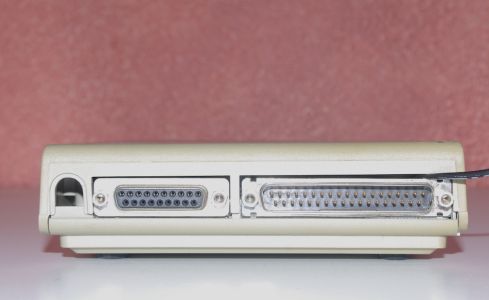 Back of the SLMC804 controller (atari-computermuseum.de)
 -
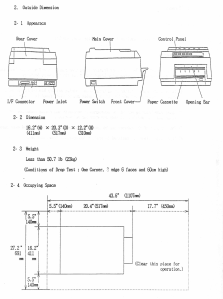 Views, dimensions and floor space (TEC service manual, p. 2)
 -
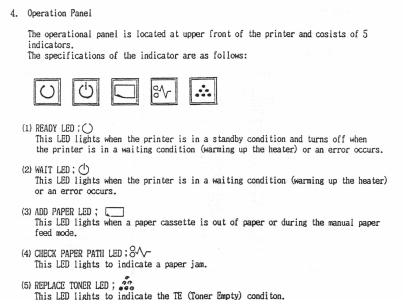 The five panel indicators (TEC service manual, p. 5)
.jpg)
.png)
.png)
Related pages
[edit | edit source]- Atari SLM804 General Maintenance
- Atari SLM804 Troubleshooting Guide
- Atari SLM804 Documentation
- Atari SLM605
- Atari Mega ST, Atari SM124, Atari SMM804
References
[edit | edit source]- ↑ 1.0 1.1 1.2 Tokyo Electric Co., Ltd., Service Manual Model SLM-804, document E0-16172A, original June 1987, revised September 1987, cover (PDF p. 31). File:Atari SLM804 Service Manual and SLMC804 Schematics (1987).pdf.
- ↑ 2.00 2.01 2.02 2.03 2.04 2.05 2.06 2.07 2.08 2.09 atari-computermuseum.de, "Atari SLM804 Laser Printer", in "Atari ST-Peripheriegeräte". https://www.atari-computermuseum.de/st_peri.htm#slm804 (retrieved 2026-10-06).
- ↑ 3.0 3.1 3.2 Atari Corp., The Atari Page Printer Interface, 13 April 1988, section 1, Introduction, p. 2 (PDF p. 4). File:The Atari Page Printer Interface (April 1988).pdf.
- ↑ 4.0 4.1 4.2 TEC, Service Manual Model SLM-804, section 2, Outside Dimension, p. 2 (PDF p. 18).
- ↑ 5.0 5.1 5.2 TEC, Service Manual Model SLM-804, section 3, Basic Specification, pp. 3-4 (PDF pp. 19-20).
- ↑ 6.0 6.1 6.2 The Atari Page Printer Interface, section 2.2, Print, p. 5 (PDF p. 7).
- ↑ Nat Friedland, "Latest Mega, PC, Laser timetable", Antic vol. 6 no. 8, December 1987. https://www.atarimagazines.com/v6n8/newhardware.php
- ↑ TEC, Service Manual Model SLM-804, section 4, Operation Panel, p. 5 (PDF p. 21).
- ↑ HomeComputerMuseum, "Atari SLMC804". https://www.homecomputermuseum.nl/en/collectie/atari/atari-slmc804/ (retrieved 2026-10-06).
- ↑ The Atari Page Printer Interface, section 2, Command Definitions, p. 3 (PDF p. 5).
- ↑ The Atari Page Printer Interface, section 2.3, Inquiry, p. 6 (PDF p. 8).
- ↑ The Atari Page Printer Interface, Appendix, Driver Example, p. 19 (PDF p. 21).
- ↑ Atari (Japan) Corporation, "Schematic Diagram SLMC 804", drawing C026455 Rev. 2, sheets 1-3, drawn 28 July 1987 (PDF pp. 8-12 of the same file).
- ↑ TEC, Service Manual Model SLM-804, section 6-1, Video Interface, pp. 6-7 (PDF pp. 22-23).
- ↑ Photograph of the SLMC804 controller, atari-computermuseum.de. File:Atari SLMC804 controller (Atari Computermuseum).jpg.
- ↑ 16.0 16.1 TEC, "MCON-T CCT", drawing JRE52-05101, January 1987, revised April 1987 (PDF pp. 4-7 of the same file).
- ↑ TEC, "Laser Printer Power Supply 200V", drawing SLE52-00301, for board SLE61-0081, April 1987 (PDF pp. 2-3 of the same file).
- ↑ atari-computermuseum.de, "Atari SLM605 Laser Printer", in "Atari ST-Peripheriegeräte". https://www.atari-computermuseum.de/st_peri.htm#slm605 (retrieved 2026-10-06).
- ↑ 19.0 19.1 Gregg Anderson, "Laserbrain", START vol. 5 no. 2, October 1990. https://www.atarimagazines.com/startv5n2/laserbrain.php
- ↑ Atari Document Archive, search results for "slm804" (catalogue listing: driver disks; owner's manual C033517-001 Rev. A; parts list E5-16168, May 1987; service manual E0-16172A; Diablo 630 emulator manual). https://docs.dev-docs.org/htm/search.php?find=slm804 (retrieved 2026-10-06).