

Atari XG-1
| Atari XG-1 Light Gun | |
|---|---|
 |
|
| Atari XG-1 light gun | |
| Manufacturer | Atari Corporation; electronics by Newtronics (1987) and Whitways (1989)[1] |
| Type | Light gun |
| Release date | Introduced February 1987; on sale September 1987 with the XE Game System[2][1] |
| Price | US$34.95 with Bug Hunt (XES2001)[3] |
| Interface | DE-9 joystick port[1] |
| Compatible | Atari 800, XL and XE computers, Atari XE Game System, Atari 7800, Atari 2600[1][3] |
| Dimensions | 47 × 150 × 323 mm[1] |
| Weight | 340 g[1] |
The Atari XG-1 is a light gun for the Atari 8-bit computers and consoles, introduced by Atari Corporation in February 1987 and packed with the Atari XE Game System from September 1987.[2][1] Electrically it is a light pen in the shape of a gun: a photosensor picks up the lines scanned by the cathode ray tube, and the computer's light pen hardware turns that into a screen position.[4][1] It also works with the Atari 7800 and Atari 2600.[3]
History
[edit | edit source]Atari previewed the light gun in January 1987 and introduced it at the American International Toy Fair in February 1987, as part of the XE Game System bundle.[2] It was supplied with the XE Game System packages and kits, and in November 1988 Atari announced the XES2001 package, the XG-1 with the Bug Hunt cartridge, for separate sale in the United States.[2] Wikipedia gives its price as US$34.95.[3]
The Atari Computermuseum describes two versions. The 1987 gun has a lower rear sight and electronics made by Newtronics in Japan. From 1989 the rear sight was raised, to match a red G-1 gun planned for the 2600 and 7800, and the electronics came from Whitways in Hong Kong. The red G-1 was shown in 1989 but not released.[1]
Games
[edit | edit source]The museum counts seven Atari 8-bit games with light gun support.[1] On the 7800, Atari released Alien Brigade, Barnyard Blaster, Crossbow, Meltdown and Sentinel; Sentinel is the only 2600 game for it.[3]
How it works
[edit | edit source]| Pin | Light gun use |
|---|---|
| 1 | Light pen button / light gun trigger |
| 6 | Light pen / light gun detect (ANTIC); not on the 400 |
| 7 | +5 V |
| 8 | Ground |
The pin functions are from the FAQ's controller port pinout.[2] The horizontal position can be read at memory location 564 and the vertical position at 565, with values from 0 to 227. The horizontal reading is offset by the delay between the beam lighting a pixel and the computer latching its scan counter: at the far left of the screen it reads about 88, reaches 227 at about column 34, then wraps to 0 and rises to about 30 at column 39. The vertical reading is half the scan line number, from about 17 to 115. Atari's Bug Hunt and Barnyard Blaster use different fixed correction values.[4]
Using the XG-1
[edit | edit source]- Use a cathode ray tube television or monitor; a light gun or light pen needs one. Only one light gun or light pen can be used at a time, and controller jacks 1 to 3 of the Atari 400 do not support one.[2]
- Atari recommends shooting from three to five feet (about 1 to 1.5 m) from the screen, and turning up brightness and contrast.[5]
- Aim with the front sight between the two arms of the rear sight.[5]
- Do not expose the lens to intense light other than the screen.[5]
Faults and limitations
[edit | edit source]- No reading, or erratic readings: the display is too dim. Light gun games flash the screen white when the trigger is pressed for this reason.[4] Turn up brightness and contrast.[5]
- Shots land left or right of the target: the horizontal offset described above. Matthew Ratcliff found Bug Hunt shooting slightly left and Barnyard Blaster slightly right, and the XG-1 less accurate than Nintendo's light gun.[4]
- Jitter in the readings when the gun is held still. Ratcliff's drawing program in the same article shows it.[4]
- Gun not detected after swapping between joystick and gun: Ratcliff later complained that the XE Game System does not detect which controller is plugged in, so switching between light gun and joystick games means replugging and switching the system off and on.[3]
Ratcliff also described wiring a Sega light gun to an Atari joystick port as an alternative. Its trigger switch has to be rewired to the normally closed contacts, because the Sega gun fires on release when wired straight across.[4]
Documentation
[edit | edit source]- Atari XE Game System Owner's Manual, pp. 12–13: using the light gun. Hosted as File:Atari XE Game System Owner's Manual C100608-001.pdf.[5]
Gallery
[edit | edit source]-
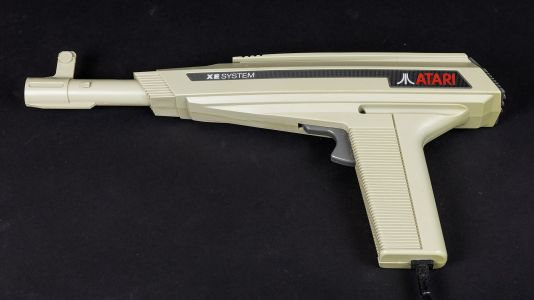 XG-1 marked "XE System", right-hand side
.jpg)
Related pages
[edit | edit source]References
[edit | edit source]- ↑ 1.00 1.01 1.02 1.03 1.04 1.05 1.06 1.07 1.08 1.09 Atari Computermuseum, "XE-Peripherie: Atari XG-1 Light Gun", atari-computermuseum.de (retrieved 2026-10-06), in German. Versions and makers, dates, compatibility, connector, dimensions and weight, number of 8-bit games.
- ↑ 2.0 2.1 2.2 2.3 2.4 2.5 Michael D. Current (ed.), Atari 8-Bit Computers: Frequently Asked Questions, last modified 2 August 2026, mcurrent.name (retrieved 2026-10-06). Section 1.15 (controller port pinout), section 6.3 (XG-1 light gun: preview, introduction, packages), section 6.7 (light guns: CRT, one at a time, 400 controller jacks) and the 1987 and 1988 chronology in section 11.1. Community reference.
- ↑ 3.0 3.1 3.2 3.3 3.4 3.5 Wikipedia, "Atari XG-1 light gun", en.wikipedia.org (retrieved 2026-10-06). XES2001 price, 7800 and 2600 games, Ratcliff's December 1988 comments.
- ↑ 4.0 4.1 4.2 4.3 4.4 4.5 Matthew Ratcliff, "First Look Inside the XE Game System", Antic vol. 7 no. 4, August 1988, section "Light gun", atarimagazines.com (retrieved 2026-10-06).
- ↑ 5.0 5.1 5.2 5.3 5.4 Atari Corporation, Atari XE System Owner's Manual, C100608-001 Rev. A, 1987, pp. 12–13 (light gun). Hosted as File:Atari XE Game System Owner's Manual C100608-001.pdf.