

Atari XM301
| Atari XM301 Modem | |
|---|---|
 |
|
| Atari XM301 Modem | |
| Manufacturer | Atari Corp.; made in Taiwan[1][2] |
| Type | 300 bit/s direct-connect modem |
| Release date | Introduced January 1985; shipped December 1985[1] |
| Discontinued | September 1987[3] |
| Interface | Atari SIO, built-in cable; RJ11C telephone jack[2] |
| Compatible | Atari 130XE, 65XE, 800XL and 800 with at least 48 KB; 1200XL only if modified[2] |
| Dimensions | 140 × 40 × 75 mm[3] |
| Weight | 250 g[3] |
| Predecessor | Atari 1030[3] |
| Successor | Atari SX212[3] |
| Power | 5 V, 60 mA from the computer's SIO port[2] |
The Atari XM301 is a 300 bit/s, Bell 103 direct-connect modem for the Atari 8-bit computers, introduced with the XE range in January 1985 and shipped in December 1985.[1] It needs no power adaptor: it takes 5 V at 60 mA from the computer through its built-in SIO cable. It has no SIO socket of its own, so it must be the last device on the chain. It came with the XE Term communications program on disk.[2][1]
History
[edit | edit source]Atari announced the XM301 at the Winter CES in January 1985 at "under $50", showed it again at the Summer CES that June and shipped it in December 1985.[1] The Atari Computermuseum says it followed the Atari 835 and Atari 1030 once their stocks had nearly sold out, was replaced by the 1200 bit/s Atari SX212 in 1987, and was never approved by the West German Bundespost, so it was not sold there.[3] Jose Valdes was the key engineer, and Russ Wetmore wrote XE Term for Atari.[1] The XM301 is software-compatible with the 1030.[1]
Specifications
[edit | edit source]| Item | Value |
|---|---|
| Modulation | Frequency shift keying, Bell 103 |
| Data rate | 300 bit/s |
| Line interface | Direct connect, FCC part 68; USOC RJ11C jack |
| Dialling | Tone (DTMF) or pulse; auto-dial and auto-answer |
| Transmit frequencies | Originate: mark 1270 Hz, space 1070 Hz; answer: mark 2225 Hz, space 2025 Hz (±0.5 %) |
| Transmit level | −9.0 to −16 dBm |
| Receive sensitivity | −13 to −46 dBm |
| Carrier detect | On at −44 dBm, off at −47 dBm |
| Indicator | Carrier LED |
| Audio | Through the television or monitor speaker |
| Power | 5 V at 60 mA from the computer |
| Operating temperature | 1 to 50 °C |
The values are from Atari's manual.[2] The FAQ's list gives the carrier-off threshold as −45 dBm.[1]
Hardware
[edit | edit source]The FAQ lists an Intel 8048 microcontroller (Atari part C060549) and a National Semiconductor MM74HC943 300 baud modem chip.[1] The modem has no speaker; the telephone line's sound is routed to the computer's audio output.[1]
Connecting and using
[edit | edit source]- Switch off every part of the system.
- Plug the modem's cable into a free SIO socket on the disk drive or printer. The modem must be the last device in the chain.
- Plug the telephone cord into the modem's jack and the wall socket.[2]
XE Term needs an Atari 130XE, 65XE, 800XL or 800 with at least 48 KB and a disk drive.[2]
Atari 1200XL
[edit | edit source]Atari's manual says the XM301 cannot be used with a 1200XL unless the computer has been modified.[2] The 1200XL has only a Ready signal on SIO pin 10 where other Atari computers supply +5 V; the FAQ's fix is to replace the 100 Ω resistor R63 in the 1200XL with a 0 to 1 Ω resistor or a wire link.[1] Curt Vendel's Atari Museum puts the incompatibility down to a missing 12 V line on the 1200XL's SIO port instead.[4]
Faults
[edit | edit source]| Symptom | Probable cause | Action |
|---|---|---|
| Dead on a 1200XL, working elsewhere | No +5 V on SIO pin 10[1] | Modify the 1200XL (R63) or use another computer. |
| XE Term does not load; only READY appears | A language cartridge is plugged in, a connection is loose or the drive is off[2] | Remove the cartridge, check the connections, switch the drive on first. |
| Carrier tone heard but the modem's light does not come on | Bad line or weak carrier[2] | Hang up with RESET and redial. |
| "Connection lost!" message | Telephone line disconnected[2] | Redial from the Functions Menu. |
| Nothing appears as you type | The remote system does not echo characters[2] | Set Duplex to Half in the Options Menu. |
| Each character appears twice | Both ends echo characters[2] | Set Duplex to Full. |
| Garbled data | An extension telephone picked up, or a call-waiting tone[2] | Disconnect extensions; disable call waiting. |
Documentation
[edit | edit source]- Atari XM301 Modem with XE Term Communications Program: Owner's Manual, C026119 Rev. A (1985), 61-page scan. It covers connecting the modem and using XE Term, with the modem specifications and SIO pinout in appendix B and a troubleshooting guide in appendix C. It contains no circuit description or service information.
Gallery
[edit | edit source]-
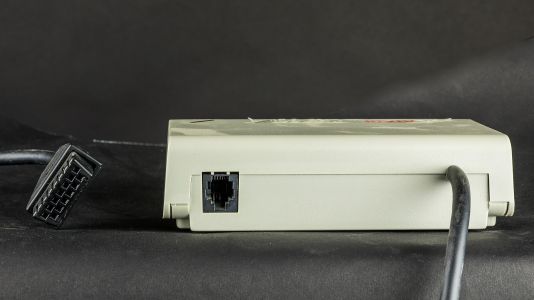 Rear: telephone jack and the built-in SIO cable
.jpg)
Related pages
[edit | edit source]References
[edit | edit source]- ↑ 1.00 1.01 1.02 1.03 1.04 1.05 1.06 1.07 1.08 1.09 1.10 1.11 Michael D. Current (ed.), Atari 8-Bit Computers: Frequently Asked Questions, last modified 2 August 2026, mcurrent.name (retrieved 2026-10-06). Section 1.4 (1200XL SIO pin 10 and resistor R63), section 5.1.1 (the XM301: standard, connectivity, chips, designer, frequencies, power, manual) and the 1985 chronology in section 11.1. Community reference.
- ↑ 2.00 2.01 2.02 2.03 2.04 2.05 2.06 2.07 2.08 2.09 2.10 2.11 2.12 2.13 2.14 Atari Corp., Atari XM301 Modem with XE Term Communications Program: Owner's Manual, C026119 Rev. A, 1985. Chapter 1, pp. 1–2 (requirements, 1200XL note, hooking up); appendix B, pp. 37–38 (specifications and SIO pinout); appendix C, pp. 39–40 (troubleshooting guide). Hosted as File:Atari XM301 Modem Owner's Manual C026119.pdf.
- ↑ 3.0 3.1 3.2 3.3 3.4 3.5 Atari Computermuseum, "XE-Peripherie: Atari XM301 Modem", atari-computermuseum.de (retrieved 2026-10-06), in German. Predecessors and successor, end of production, Bundespost approval, dimensions and weight.
- ↑ Curt Vendel, "The Atari XM301", Atari Museum, XE peripherals section, updated 24 March 2020, atarimuseum.ctrl-alt-rees.com (retrieved 2026-10-06).