

Atari XMM801
| Atari XMM801 Dot-Matrix Graphics Printer | |
|---|---|
 |
|
| Atari XMM801 with its top cover and paper rack fitted | |
| Manufacturer | Shinwa Printing International for Atari Corp.[1] |
| Type | 80-column impact dot-matrix printer |
| Release date | 1986[1] |
| Discontinued | 1989[1] |
| Price | US$219.95 (December 1986)[2] |
| Interface | Atari SIO, two 13-pin connectors[3] |
| Compatible | Atari 8-bit computers: Atari 400, Atari 800, 1200XL, 600XL, 800XL and the XE models[3] |
| Dimensions | 394 × 284 × 113 mm (15.5 × 11.1 × 4.5 in)[3] |
| Weight | About 4.6 kg (10.1 lb)[3] |
| Model | XMM801 |
| Power | Internal transformer; 100, 115, 220 or 240 V AC versions[4] |
The Atari XMM801 is an 80-column impact dot-matrix printer for the Atari 8-bit computers, styled to match the XE series.[5] It plugs straight into the SIO bus and has its own mains transformer, so it needs no interface module or external power supply.[3] Antic found it identical in most respects to the SMM804, which has a parallel interface for the ST. Both were designed to be as Epson-compatible as possible and fully compatible with the old Atari 825 printer, as "a new, improved 825".[2]
History
[edit | edit source]Atari showed the XMM801 at the Winter CES in Las Vegas on 5 January 1985. atari-computermuseum.de says Atari ordered it once its US stocks of the 825 and 1025 printers were nearly used up, that it reached the shops in the second quarter of 1986 and that production ended in 1989. It names the maker as Shinwa Printing International of Kowloon, Hong Kong, and gives a 1988 price of US$185.[1] The rating plate of a surviving 240 V unit says "Made in Japan", and the FAQ also gives Japan.[6][5]
Atari's owner's manual and field service manual are both dated 1985.[3][4] Antic was answering readers' questions about "the new Atari XMM801 printer" in October 1986, and reviewed it in December 1986 at a suggested price of US$219.95, with street prices as low as US$199.97.[7][2]
Specifications
[edit | edit source]| Item | Value |
|---|---|
| Print method | Impact dot matrix, bidirectional and logic-seeking; unidirectional on command |
| Speed | 80 characters per second at 10 characters per inch |
| Print head | 8 pins; life 30 million characters |
| Character matrix | 8 dots high by 9 dots wide |
| Character sets | 96 ASCII; international mode with 91 ASCII and 36 international characters |
| Graphics | 8 dots high; 480 dots per line at normal density, 960 at high density |
| Pitch and line length | Pica 10 cpi (80 columns), elite 12 cpi (96), condensed 16.5 cpi (132), and double width of each |
| Line spacing | 1/6 inch unless programmed; line feed at up to 5 lines per second |
| Paper | Fanfold pin-feed and single sheets, 4 to 10 inches wide, 0.05 to 0.15 mm thick; one original and one copy; rear entry |
| Ribbon | Cartridge with a multistrike carbon-film ribbon, about 1 million characters |
| Buffer | 80 bytes |
| Current drawn at 115 V | 100 mA standing, 300 to 600 mA printing |
| Operating environment | 5 to 35 °C, 10 to 80 % relative humidity, non-condensing |
At switch-on the printer goes on-line unless it is out of paper, returns the head to the far left, and sets pica pitch, six lines per inch, a 66-line page, bidirectional printing, the non-international character set and the paper-out sensor active. The top of the page is wherever the print head is when the printer is switched on.[3]
Hardware
[edit | edit source]Atari's XMM801 Field Service Manual (CO 70435, October 1985) gives the circuit diagrams, board layouts and parts list.[4] The printer is built from a printer mechanism unit, a main control board, an Atari serial I/O interface board that plugs onto the main board, a switch board for the control panel, a mains filter board and the power transformer.[4]

| Location | Part | Notes |
|---|---|---|
| LSI1 | NEC µPD7811 | CPU, with a 7.37 MHz ceramic resonator |
| ROM1 | 2764 EPROM (X801.1D) | Printer firmware |
| IC1 | 74LS373 | Address latch |
| IC2 | 74LS14 (or 74HC14) | |
| IC3, IC4, IC6 | M54567P or M5248P | Print head and carriage motor drivers |
| IC5 | M54523P | Paper feed motor driver |
| IC7 | 7805 | +5 V regulator, on the heat sink |
| T1, T3 | 2SD1392 (2SD1595) | Fitted with a Mylar insulating sheet |
| T2 | 2SB794 | |
| T4, T7 | 2SA844 | |
| T5, T6 | 2SC2308 |
The functions in the notes column are taken from the circuit diagram, where IC3 and IC4 drive the head needles, IC6 the carriage stepper motor and IC5 the paper feed motor.[4] The interface board, XMM8-B04AA, carries the two 13-pin SIO connectors wired pin for pin to each other, and joins the main board through a 14-pin connector.[4]
Power supply
[edit | edit source]The transformer is chosen at the factory for 100, 115, 220 or 240 V mains, and four transformer types exist.[4] One secondary, about 23 V AC, feeds the bridge rectifier BD1 (S2VB20) and the 3,300 µF reservoir C2; the pass transistor T1 (2SD1392), referenced to the zener ZD1, produces the 19 V supply for the print head and the two motors. The other secondary, about 10 V AC, feeds the bridge D1-D4 (1N4002) and the 2,200 µF capacitor C1, and the 7805 regulator IC7 makes +5 V for the logic.[4]
| Mains | Transformer | Fuse F1 |
|---|---|---|
| 100 V | XMM8-T05J | 1.0 A (UL) |
| 115 V (UL and CSA) | XMM8-T01UC | 1.0 A (UL or CSA) |
| 220 V | XMM8-T03E | T 400 mA |
| 240 V | XMM8-T04E | T 400 mA |
The fuse sits on the filter board in the mains input. The 220 V version has a single-pole power switch and the 240 V version a double-pole one.[4] The rating plate of a 240 V example reads "240V~ 50/60Hz 0.5A".[6]
Mechanism
[edit | edit source]The parts list gives the printer unit as a needle printer model CE-80S-G(8) or CE-80S-G(9), and its ribbon cartridge as IK-SP80RC.[4] The owner's manual and atari-computermuseum.de give an 8-pin head.[3][1] The field service manual's wiring diagram for the head connector CON4 shows eight coils and a ninth drawn dashed, while Antic described both the XMM801 and SMM804 as 9-pin printers.[4][2] The unit also carries the carriage stepper motor and toothed belt, the paper feed motor and tractor, the ribbon drive, a home position switch, a paper end sensor and a strobe sensor on the carriage motor.[4] Atari's service policy was to replace the print head on its own but to change the rest of the mechanism as a complete unit.[4]
Controls
[edit | edit source]The control panel has three keys, On Line, Line Feed (LF) and Form Feed (FF), and three lights, Power, No Paper and On Line; the power switch is on the right-hand side. LF and FF work only when the printer is off-line. When the paper is about to run out, the No Paper light comes on, a buzzer sounds and the printer goes off-line.[3]
Using the printer
[edit | edit source]The XMM801 answers as P: from BASIC (LPRINT, LIST "P:" and PRINT #).[3] The FAQ notes that it ignores the device number under the 400/800 operating system, and responds to P:, P1: and P7: under the XL operating system.[5] For AtariWriter, the owner's manual names the ATARI 825 printer option as the most compatible.[3]
Graphics work through standard Epson printer drivers, but Antic could not get the printer to work with Broderbund's Print Shop or with Lister Plus in 1986.[2] In 1988 Antic reported that XLEnt Software sold a translator disk for Print Shop which, according to Atari, made it "98% compatible" with the XMM801.[8] In Antic's timing test, copying a 20,000-character file from DOS 2.5, the XMM801 averaged 51 characters per second, against the 80 cps rating.[2][3]
Antic found that the XMM801 ribbon cartridge is interchangeable with ribbons for the Commodore 1526 and the Mannesmann Tally Spirit 80.[2] The FAQ lists Mannesmann Tally MT-80, MT-80 Plus, MT-81, SP-80 and Spirit 80, Commodore 1526, MPS802 and 4023, and Shinwa CP80 ribbons as compatible.[5]
Known problems
[edit | edit source]- Faint or patchy print from a worn ribbon. The printer has no ribbon sensor.[3]
- Paper jams, most often from paper loaded wrongly or from friction feed being used with pin-feed paper.[3]
- The printer stops and goes off-line about an inch before the end of a single sheet. This is the paper-out sensor working normally.[3]
- Software that does not support the printer's control codes, as above.[2]
Diagnosis is on the Atari XMM801 Troubleshooting page, care and adjustments on the Atari XMM801 Maintenance Guide, and the electrolytic capacitors on the Atari XMM801 Capacitor Replacement Guide.
Documentation
[edit | edit source]- Atari XMM801 Documentation: both manuals, with contents and the points where the field service manual disagrees with itself.
- XMM801 Field Service Manual, CO 70435 (October 1985).
- Atari XMM801 Dot-Matrix Graphics Printer Owner's Manual, C025959-001 Rev. A (1985).
Gallery
[edit | edit source]-
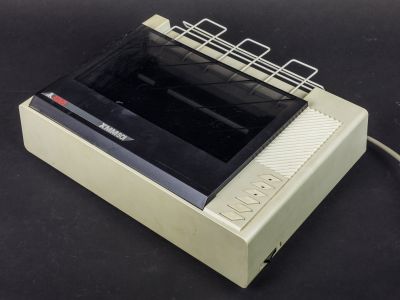 Front right, with the control panel keys
-
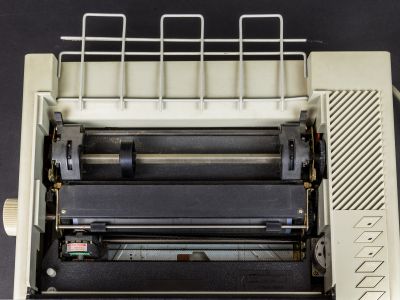 Top cover removed, head parked at the left
-
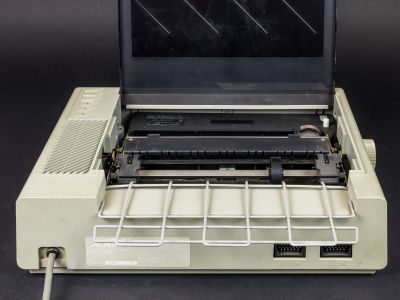 Rear panel with the two SIO connectors and the rating plate


Related pages
[edit | edit source]- Atari XMM801 Maintenance Guide
- Atari XMM801 Troubleshooting
- Atari XMM801 Capacitor Replacement Guide
- Atari XMM801 Documentation
- Atari 1025
- Atari 1029
- Atari 850
References
[edit | edit source]- ↑ 1.0 1.1 1.2 1.3 1.4 "Atari XMM801 Dot Matrix Printer", in "Atari XE System" peripherals, atari-computermuseum.de. atari-computermuseum.de, retrieved 6 October 2026. Secondary source: maker, first showing, sales and production dates, 1988 price, 8-pin head, identical to the SMM804 apart from the interface.
- ↑ 2.0 2.1 2.2 2.3 2.4 2.5 2.6 2.7 Gregg Pearlman, "Two New Atari Printers", Antic vol. 5 no. 8, December 1986. atarimagazines.com. Review of the XMM801 and SMM804: price, Epson and 825 compatibility, ribbon substitutes, software tests and a print speed test.
- ↑ 3.00 3.01 3.02 3.03 3.04 3.05 3.06 3.07 3.08 3.09 3.10 3.11 3.12 3.13 3.14 3.15 Atari Corp., Atari XMM801 Dot-Matrix Graphics Printer Owner's Manual, C025959-001 Rev. A, 1985: unpacking and connecting (pp. 1-2), ribbon (p. 4), loading paper and top of page (pp. 4-7), control panel and self test (pp. 8-9), printing from BASIC (pp. 11-14), AtariWriter (p. 16), power-up defaults (p. 17), paper-out sensor codes (pp. 39-40), troubleshooting and preventive maintenance (pp. 55-57), specifications (pp. 71-72), serial interface (p. 73). Hosted here as File:Atari XMM801 Owner's Manual C025959-001.pdf.
- ↑ 4.00 4.01 4.02 4.03 4.04 4.05 4.06 4.07 4.08 4.09 4.10 4.11 4.12 Atari Corp., XMM801 Field Service Manual, CO 70435, October 1985: basic structure (p. 3), connections and interface (p. 4), power supply circuits and fuse table (p. 8), switch board (p. 9), main control board circuit and layout (pp. 10-11), SIO interface board (p. 12), mechanism wiring (p. 13), check points (pp. 19-22), parts list (pp. 27-40), mechanism services (separately numbered pp. 1-8). Hosted here as File:Atari XMM801 Field Service Manual C070435.pdf.
- ↑ 5.0 5.1 5.2 5.3 Michael D. Current (ed.), Atari 8-Bit Computers: Frequently Asked Questions, section 4.3, "What are the Atari XMM801 and XDM121 printers?", as mirrored by Atarimania. atarimania.com, retrieved 6 October 2026. Community reference: XE styling, device names, contents of the box, manual part numbers, compatible ribbons, made in Japan.
- ↑ 6.0 6.1 Raimond Spekking, photograph of the rear of an Atari XMM801, 17 June 2022, Wikimedia Commons, CC BY-SA 4.0. Hosted here as File:Atari XMM801 rear panel.jpg. Rating plate: "Atari Corp. Model XMM801, Made in Japan, 240V~ 50/60Hz 0.5A".
- ↑ "Not yet", I/O Board, Antic vol. 5 no. 6, October 1986. atarimagazines.com. Reader's question on Print Shop and the new XMM801.
- ↑ "XMM801 woes", I/O Board, Antic vol. 6 no. 10, February 1988. atarimagazines.com. Reply on screen dumps and the XLEnt Print Shop translator.