

IBM PCjr: Difference between revisions
Cite TR page numbers, SA38 ch. 2, PCjr HMS (uploaded) and NMAH; add prices, maker, units, dimensions, weights, models; fix memory aliasing (only without expansion), keyboard-replacement and TR-edition claim, PSU fuse/trip values; remove uncited Tandy, 'PCjr cliff', developer; copyedit |
|||
| (5 intermediate revisions by the same user not shown) | |||
| Line 1: | Line 1: | ||
{{Infobox computer | {{Infobox computer | ||
| name = IBM PCjr | | name = IBM PCjr | ||
| image = [[File:IBM PCjr with display.jpg|260px]] | | logo = [[File:IBM PCjr wordmark.svg|150px]] | ||
| caption = IBM PCjr (4860) with | | image = [[File:IBM PCjr with display.jpg|260px|frameless]] | ||
| caption = IBM PCjr (4860) with the IBM PCjr Color Display (4863) and the 62-key cordless keyboard | |||
| manufacturer = IBM | | manufacturer = IBM (built by Teledyne in Lewisburg, Tennessee) | ||
| type = Home | | type = Home personal computer | ||
| release date = March | | release date = March 1984 (announced November 1983) | ||
| discontinued = March | | discontinued = March 1985 | ||
| cpu = Intel 8088 | | price = US$669 (64 KB); US$1,269 (128 KB with diskette drive) | ||
| memory = 64 KB on | | units_sold = About 270,000 | ||
| storage = | | cpu = Intel 8088 at 4.77 MHz | ||
| display = Built-in | | memory = 64 KB on the system board; 128 KB with the 64KB Memory and Display Expansion; IBM lists expansion to 512 KB | ||
| sound = Texas Instruments | | storage = Optional 5.25-inch 360 KB diskette drive (one only); cassette interface; two ROM cartridge slots | ||
| dimensions = | | display = Built-in video: Motorola 6845 CRT controller and IBM Video Gate Array; RGB direct drive, composite video and TV connector | ||
| weight = | | sound = Texas Instruments SN76496N (three tone channels and noise), 8253 timer, cassette audio | ||
| os = Cassette BASIC in ROM; Cartridge BASIC; PC DOS 2.1 | |||
| dimensions = 97 × 354 × 290 mm (3.8 × 13.9 × 11.4 in) | |||
| weight = 3.71 kg with diskette drive; 2.61 kg without | |||
| model = 4860 | | model = 4860 Model 04, 4860 Model 67 | ||
}} | }} | ||
The '''IBM PCjr''' ( | The '''IBM PCjr''' (type 4860) is IBM's home computer of 1984. It uses the same 8088 processor as the [[IBM PC (5150)]] but is a different design: its video is built into the system board and uses main memory as the display buffer, it has a three-voice sound chip, ROM cartridge slots and an infrared keyboard, and it expands through side-mounted "sidecar" modules instead of PC expansion slots. IBM announced the PCjr in November 1983, shipped it from March 1984 and discontinued it in March 1985 after selling about 270,000.<ref name="nmah">National Museum of American History, [https://americanhistory.si.edu/collections/object/nmah_905913 "IBM PCjr Microcomputer"], object 2002.0090.01. Announcement and availability dates, prices, manufacture by Teledyne in Lewisburg, Tennessee, discontinuation and units sold.</ref> | ||
The PCjr | == History == | ||
The PCjr was sold at US$669 with 64 KB of memory and US$1,269 with 128 KB and a diskette drive. Teledyne built it for IBM in Lewisburg, Tennessee.<ref name="nmah" /> Criticism of the machine centred on the original keyboard, which had small calculator-style keys.<ref name="nmah" /> IBM replaced it with a version that is electronically identical but has bigger keys with the legends on the key tops.<ref name="sim2">IBM, ''Personal Computer Family Service Information Manual'', SA38-0037-00, July 1989, chapter 2, "4860 PCjr", pp. 2-1 to 2-3, hosted as [[IBM Personal Computer Family Service Information Manual]]. Models 04 and 67, unit specifications, interface locations, the power supply, both keyboard versions, and the keyboard as a non-repairable FRU.</ref><ref name="brutman">Mike Brutman, [https://www.brutman.com/PCjr/pcjr_hardware.html "PCjr Hardware Notes"], 2000, updated 2010. Community reference. Graphics modes, cartridge address regions, the missing DMA controller and its effects, the diskette drive and fan, DOS 2.1, the COM port numbering, the replacement keyboard, and the short (33 W) and long (45 W) Power Board versions.</ref> | |||
== Models == | == Models == | ||
<templatestyles src="Template:StyledTable/styles.css" /> | |||
{| class="wikitable styled-table" style="width:70%; text-align:center;" | {| class="wikitable styled-table" style="width:70%; text-align:center;" | ||
|+'''IBM PCjr | |+'''IBM PCjr models''' | ||
! | ! Model !! Memory !! Diskette drive !! Launch price | ||
|- | |- | ||
| 4860- | | 4860-04 || 64 KB || None || US$669 | ||
|- | |- | ||
| 4860- | | 4860-67 || 128 KB || 360 KB 5.25-inch || US$1,269 | ||
|} | |} | ||
IBM's service manual names the two models 04 and 67.<ref name="sim2" /> The 128 KB machine has the 64KB Memory and Display Expansion card fitted.<ref name="nmah" /><ref name="trjr217">IBM, ''IBM PCjr Technical Reference'', revised edition, November 1983, "64K RAM", p. 2-17, hosted as [[:File:IBM PCjr Technical Reference.pdf]].</ref> | |||
== Architecture == | == Architecture == | ||
=== Processor and memory === | |||
The PCjr uses an Intel 8088 at 4.77 MHz.<ref name="nmah" /> Early boards have the 8088 in a socket; later boards have it soldered in, and some use an AMD D8088.<ref name="brutman" /> The PCjr has no DMA controller, so the processor handles diskette transfers itself.<ref name="brutman" /><ref name="trjr413">IBM, ''IBM PCjr Technical Reference'', November 1983, "Hardware Differences", pp. 4-12 to 4-13, hosted as [[:File:IBM PCjr Technical Reference.pdf]].</ref> | |||
The | The system board's 64 KB of RAM uses eight 64K × 1, 150 ns dynamic RAMs (Motorola MCM6665AL15, Texas Instruments TMS4164-15 or equivalent) and has no parity.<ref name="trjr217" /> It sits at the bottom of the address space. Without the 64KB Memory and Display Expansion, the same 64 KB also appears in the next 64 KB of address space. With the expansion fitted, the expansion card takes the odd addresses and the system board the even addresses across the bottom 128 KB. The 6845 and the gate array refresh the RAM and arbitrate between display and processor cycles.<ref name="trjr217" /> | ||
== | This RAM is both the display buffer and the 8088's main memory. The processor reaches it either directly from address 00000 or through a 16 KB window at B8000, with a page register choosing which part of RAM the window points at.<ref name="trjr247">IBM, ''IBM PCjr Technical Reference'', November 1983, "Video Color/Graphics Subsystem", pp. 2-44 to 2-50 and 2-64 to 2-65, hosted as [[:File:IBM PCjr Technical Reference.pdf]].</ref> Brutman gives the practical cost: a 128 KB PCjr in a standard CGA mode leaves 112 KB for programs, and 96 KB in the 16-colour modes.<ref name="brutman" /> | ||
=== ROM and cartridges === | |||
The system ROM is 64 KB at the top of the address space, built from 32K × 8 modules (Mostek MK38000, TMM23256P or equivalent) with no parity, 250 ns access and 375 ns cycle time. It holds the BIOS, the diagnostics and Cassette BASIC from F0000 to FFFFF. The two standard application cartridge areas are E0000 and E8000, and D0000 and D8000 are reserved for further cartridges.<ref name="trjr219">IBM, ''IBM PCjr Technical Reference'', November 1983, "ROM Subsystem", p. 2-19, hosted as [[:File:IBM PCjr Technical Reference.pdf]].</ref> Each cartridge is wired for a fixed region, and two cartridges that use the same region usually lock the machine up. Inserting or removing a cartridge resets the machine.<ref name="brutman" /> | |||
= | Cassette BASIC is in the system ROM, and Cartridge BASIC supplies the Advanced BASIC features from ROM, so neither takes user memory.<ref name="trjr413" /> | ||
Video | === Video === | ||
The colour/graphics subsystem uses a Motorola 6845 CRT controller and IBM's Video Gate Array (LSI5220), a CMOS gate array that generates the memory timing (RAS, CAS, WE), the direct-drive and composite-colour outputs and the status signals.<ref name="trjr247" /> The gate array has a 16-entry palette. The ROM character generator is an MCM68A316E or equivalent, 2 KB, 350 ns, pin-compatible with 2716 and 2732 EPROMs.<ref name="trjr247" /> Outputs are RGB direct drive, composite video and the connector for the optional IBM Connector for Television.<ref name="trjr247" /> | |||
== | The PCjr has the CGA modes plus 320 × 200 in 16 colours and 640 × 200 in 4 colours, and a 160 × 200 16-colour mode.<ref name="brutman" /> IBM classes 80-column text, 640 × 200 4-colour and 320 × 200 16-colour as high-bandwidth modes that need the 64KB Memory and Display Expansion, so a machine without the expansion cannot use them.<ref name="trjr247" /> | ||
Sound | === Sound === | ||
An analogue multiplexer, controlled by bits PB5 and PB6 of the 8255, selects one of four sources: the Texas Instruments SN76496N complex sound generator, the 8253 timer, cassette audio and audio from the I/O channel. The SN76496N has three tone channels and a noise generator, each with its own attenuation. The output is 1 V peak to peak through a 4.8 kHz low-pass filter, and goes to the external-amplifier connector and the television connector; an external speaker needs its own amplifier.<ref name="trjr287">IBM, ''IBM PCjr Technical Reference'', November 1983, "Sound Subsystem", pp. 2-87 to 2-88, hosted as [[:File:IBM PCjr Technical Reference.pdf]].</ref> | |||
== Keyboard == | == Keyboard == | ||
IBM describes the cordless keyboard as a low-profile, 62-key detached keyboard with full-travel keys in a typewriter layout, plus a function key and cursor keys. On the original keyboard the keys are unmarked for their alternate functions and an overlay carries the descriptions.<ref name="trjr2101">IBM, ''IBM PCjr Technical Reference'', November 1983, "IBM PCjr Cordless Keyboard", pp. 2-101 to 2-105, hosted as [[:File:IBM PCjr Technical Reference.pdf]].</ref> It runs on four AA batteries. An 80C48 microcontroller stays in a power-down standby mode until a key is pressed, then scans, sends the scan code and goes back to standby, so the keyboard has no on/off switch.<ref name="trjr2101" /><ref name="sim2" /> | |||
The link to the system unit is infrared: 11-bit words with odd parity, biphase-encoded with a 440 µs bit cell, each logical 1 sent as a 40 kHz burst.<ref name="trjr2101" /> The optional keyboard cord carries the same data. Plugging it in disconnects the batteries and the infrared transmitter, and its −CABLE CONNECT signal disables the system unit's infrared receiver, so other infrared devices no longer interfere.<ref name="trjr2101" /> | |||
Unlike other IBM PC keyboards, the PCjr keyboard has phantom-key detection. When three or more keys are pressed together in an invalid combination, it generates a hex 55 code and ignores all the keys pressed at that moment; BIOS ignores the code.<ref name="trjr2101" /> Scan codes match the PC and XT at BIOS level, and each break code is the make code plus hex 80.<ref name="trjr2101" /> | |||
== Expansion == | |||
== | The system board has internal connectors for the 64KB Memory and Display Expansion, the internal modem and the diskette-drive adapter.<ref name="sim2" /> Only one diskette drive is supported.<ref name="brutman" /> On the right-hand side is the I/O expansion bus for sidecars, which is not the PC's I/O channel, so PC and XT cards do not fit.<ref name="sim2" /><ref name="brutman" /> IBM's launch options include the Parallel Printer Attachment, which is a sidecar, and the internal modem, which fits inside.<ref name="brutman" /><ref name="hms">IBM, ''Personal Computer PCjr Hardware Maintenance and Service'', first edition, September 1983, hosted as [[:File:IBM PCjr Hardware Maintenance and Service (September 1983).pdf]]. Options list, p. 1-4; parts catalogue, pp. 6-7 to 6-13.</ref> | ||
With no internal modem, the external serial port is COM1 but uses the COM2 address and interrupt (2F8h, IRQ 3); with the modem fitted, the modem becomes COM1 and the serial port COM2.<ref name="brutman" /> | |||
== Power == | |||
IBM's supply is a 33 W, three-voltage, two-stage design. The first stage is an external transformer with a single-fuse-protected, extra-low-voltage AC output. The second stage is the Power Board, a card mounted vertically in the system board, which converts that AC into three DC levels. The power switch is on the Power Board at the rear.<ref name="trjr2135">IBM, ''IBM PCjr Technical Reference'', November 1983, "System Power Supply", pp. 2-135 to 2-137, hosted as [[:File:IBM PCjr Technical Reference.pdf]].</ref> Brutman reports a short 33 W Power Board and a later long 45 W version.<ref name="brutman" /> | |||
{| class="wikitable styled-table" style="width:85%; text-align:center;" | |||
|+'''IBM PCjr DC outputs (Technical Reference p. 2-136)''' | |||
! Rail !! Minimum load !! Maximum load !! Regulation | |||
|- | |||
| +5 V || 1.5 A || 3.6 A || ±5 % | |||
|- | |||
| +12 V || 0.04 A || 1.2 A || ±5 % | |||
|- | |||
| −6 V || 0.0 A || 0.025 A || ±16 % | |||
|} | |||
The | The −6 V output is present only when +5 V carries at least 1.5 A.<ref name="trjr2135" /> The input is 120 V AC nominal (104 to 127 V), 60 Hz, 0.65 A maximum at 104 V.<ref name="trjr2135" /> | ||
{| class="wikitable styled-table" style="width:85%; text-align:center;" | |||
|+'''IBM PCjr protection (Technical Reference p. 2-137)''' | |||
! Where !! Protection !! Rating or trip point | |||
|- | |||
| Transformer input || Non-resettable fuse; thermal / over-current || 5 A slow-blow | |||
|- | |||
| Power Board, +5 V || Over-voltage, by fuse F1 || 6.3 ± 0.7 V | |||
|- | |||
| Power Board, +12 V || Over-voltage, by fuse F1 || 14.4 ± 1.4 V | |||
|- | |||
| Power Board, +5 V || Over-current, resettable || 3.9 ± 0.25 A | |||
|- | |||
| Power Board, +12 V || Over-current, resettable || 2.2 ± 0.9 A | |||
|} | |||
To reset the over-current protection, remove the fault and keep the power off for at least 5 seconds before switching on again.<ref name="trjr2135" /> | |||
A machine fitted with all the internal features has 400 mA of +5 V and nothing on +12 V or −6 V left for the I/O connector.<ref name="trjr2135" /> Brutman reports that heavy or numerous sidecars stretch the supply and cause erratic operation, and that IBM's power sidecar uses the same external transformer.<ref name="brutman" /> The system unit has no fan; the only fan is on the diskette drive.<ref name="brutman" /> | |||
== | == Documentation == | ||
* [[IBM PCjr Technical Reference]]: the November 1983 hardware and BIOS reference. | |||
* [[:File:IBM PCjr Hardware Maintenance and Service (September 1983).pdf|IBM PCjr Hardware Maintenance and Service]] (September 1983): advanced POST, the Problem Isolation Charts, removal and replacement procedures and the parts catalogue.<ref name="hms" /> | |||
* [[IBM Personal Computer Family Service Information Manual]] (SA38-0037-00, 1989): chapter 2 covers the PCjr.<ref name="sim2" /> | |||
* [[IBM PCjr BASIC Reference (June 1983)]]. | |||
== General | == General maintenance == | ||
Cleaning, keyboard batteries, the diskette drive and Power Board checks are in [[IBM PCjr Maintenance Guide]]. | |||
== Troubleshooting == | == Troubleshooting == | ||
POST | IBM's advanced POST, the POST error table, the Power Board voltage checks and the customer error codes are in [[IBM PCjr Troubleshooting Guide]]. | ||
== Capacitor | == Capacitor replacement == | ||
What IBM documents about the PCjr's capacitors, and what it does not, is in [[IBM PCjr Capacitor Replacement Guide]]. | |||
== Gallery == | == Gallery == | ||
<gallery mode="packed" heights="220"> | <gallery mode="packed" heights="220"> | ||
File:IBM PCjr with display.jpg|IBM PCjr with the IBM | File:IBM PCjr with display.jpg|IBM PCjr with the IBM PCjr Color Display | ||
File:IBM PCjr keyboard.png|62-key | File:IBM PCjr keyboard.png|The 62-key cordless keyboard | ||
File:IBM PCjr motherboard.jpg|IBM PCjr | File:IBM PCjr motherboard.jpg|IBM PCjr system board | ||
File:IBM PCjr expanded with sidecars.jpg|IBM PCjr with several sidecars attached | File:IBM PCjr expanded with sidecars.jpg|IBM PCjr with several sidecars attached | ||
File:IBM PCjr internal teardown.jpg| | File:IBM PCjr internal teardown.jpg|PCjr system unit: diskette drive and the two cartridge slots | ||
</gallery> | </gallery> | ||
== Related | == References == | ||
<references /> | |||
== Related pages == | |||
* [[IBM PCjr Maintenance Guide]] | * [[IBM PCjr Maintenance Guide]] | ||
* [[IBM PCjr Troubleshooting Guide]] | * [[IBM PCjr Troubleshooting Guide]] | ||
* [[IBM PCjr Capacitor Replacement Guide]] | * [[IBM PCjr Capacitor Replacement Guide]] | ||
* [[IBM PC (5150)]] | * [[IBM PC (5150)]] | ||
* [[IBM Cassette BASIC]] | |||
* [ | |||
{{Navbox-IBMComputers|state= | {{Navbox-IBMComputers|state=collapsed}} | ||
[[Category:IBM]] | [[Category:IBM]] | ||
Latest revision as of 20:39, 30 September 2026
 | |
 | |
| IBM PCjr (4860) with the IBM PCjr Color Display (4863) and the 62-key cordless keyboard | |
| Specifications | |
|---|---|
| Manufacturer | IBM (built by Teledyne in Lewisburg, Tennessee) |
| Type | Home personal computer |
| Released | March 1984 (announced November 1983) |
| Discontinued | March 1985 |
| Intro price | US$669 (64 KB); US$1,269 (128 KB with diskette drive) |
| Units sold | About 270,000 |
| CPU | Intel 8088 at 4.77 MHz |
| Memory | 64 KB on the system board; 128 KB with the 64KB Memory and Display Expansion; IBM lists expansion to 512 KB |
| Storage | Optional 5.25-inch 360 KB diskette drive (one only); cassette interface; two ROM cartridge slots |
| Display | Built-in video: Motorola 6845 CRT controller and IBM Video Gate Array; RGB direct drive, composite video and TV connector |
| Sound | Texas Instruments SN76496N (three tone channels and noise), 8253 timer, cassette audio |
| Dimensions | 97 × 354 × 290 mm (3.8 × 13.9 × 11.4 in) |
| Weight | 3.71 kg with diskette drive; 2.61 kg without |
| OS / Firmware | Cassette BASIC in ROM; Cartridge BASIC; PC DOS 2.1 |
| Model no. | 4860 Model 04, 4860 Model 67 |
The IBM PCjr (type 4860) is IBM's home computer of 1984. It uses the same 8088 processor as the IBM PC (5150) but is a different design: its video is built into the system board and uses main memory as the display buffer, it has a three-voice sound chip, ROM cartridge slots and an infrared keyboard, and it expands through side-mounted "sidecar" modules instead of PC expansion slots. IBM announced the PCjr in November 1983, shipped it from March 1984 and discontinued it in March 1985 after selling about 270,000.[1]
History
[edit | edit source]The PCjr was sold at US$669 with 64 KB of memory and US$1,269 with 128 KB and a diskette drive. Teledyne built it for IBM in Lewisburg, Tennessee.[1] Criticism of the machine centred on the original keyboard, which had small calculator-style keys.[1] IBM replaced it with a version that is electronically identical but has bigger keys with the legends on the key tops.[2][3]
Models
[edit | edit source]| Model | Memory | Diskette drive | Launch price |
|---|---|---|---|
| 4860-04 | 64 KB | None | US$669 |
| 4860-67 | 128 KB | 360 KB 5.25-inch | US$1,269 |
IBM's service manual names the two models 04 and 67.[2] The 128 KB machine has the 64KB Memory and Display Expansion card fitted.[1][4]
Architecture
[edit | edit source]Processor and memory
[edit | edit source]The PCjr uses an Intel 8088 at 4.77 MHz.[1] Early boards have the 8088 in a socket; later boards have it soldered in, and some use an AMD D8088.[3] The PCjr has no DMA controller, so the processor handles diskette transfers itself.[3][5]
The system board's 64 KB of RAM uses eight 64K × 1, 150 ns dynamic RAMs (Motorola MCM6665AL15, Texas Instruments TMS4164-15 or equivalent) and has no parity.[4] It sits at the bottom of the address space. Without the 64KB Memory and Display Expansion, the same 64 KB also appears in the next 64 KB of address space. With the expansion fitted, the expansion card takes the odd addresses and the system board the even addresses across the bottom 128 KB. The 6845 and the gate array refresh the RAM and arbitrate between display and processor cycles.[4]
This RAM is both the display buffer and the 8088's main memory. The processor reaches it either directly from address 00000 or through a 16 KB window at B8000, with a page register choosing which part of RAM the window points at.[6] Brutman gives the practical cost: a 128 KB PCjr in a standard CGA mode leaves 112 KB for programs, and 96 KB in the 16-colour modes.[3]
ROM and cartridges
[edit | edit source]The system ROM is 64 KB at the top of the address space, built from 32K × 8 modules (Mostek MK38000, TMM23256P or equivalent) with no parity, 250 ns access and 375 ns cycle time. It holds the BIOS, the diagnostics and Cassette BASIC from F0000 to FFFFF. The two standard application cartridge areas are E0000 and E8000, and D0000 and D8000 are reserved for further cartridges.[7] Each cartridge is wired for a fixed region, and two cartridges that use the same region usually lock the machine up. Inserting or removing a cartridge resets the machine.[3]
Cassette BASIC is in the system ROM, and Cartridge BASIC supplies the Advanced BASIC features from ROM, so neither takes user memory.[5]
Video
[edit | edit source]The colour/graphics subsystem uses a Motorola 6845 CRT controller and IBM's Video Gate Array (LSI5220), a CMOS gate array that generates the memory timing (RAS, CAS, WE), the direct-drive and composite-colour outputs and the status signals.[6] The gate array has a 16-entry palette. The ROM character generator is an MCM68A316E or equivalent, 2 KB, 350 ns, pin-compatible with 2716 and 2732 EPROMs.[6] Outputs are RGB direct drive, composite video and the connector for the optional IBM Connector for Television.[6]
The PCjr has the CGA modes plus 320 × 200 in 16 colours and 640 × 200 in 4 colours, and a 160 × 200 16-colour mode.[3] IBM classes 80-column text, 640 × 200 4-colour and 320 × 200 16-colour as high-bandwidth modes that need the 64KB Memory and Display Expansion, so a machine without the expansion cannot use them.[6]
Sound
[edit | edit source]An analogue multiplexer, controlled by bits PB5 and PB6 of the 8255, selects one of four sources: the Texas Instruments SN76496N complex sound generator, the 8253 timer, cassette audio and audio from the I/O channel. The SN76496N has three tone channels and a noise generator, each with its own attenuation. The output is 1 V peak to peak through a 4.8 kHz low-pass filter, and goes to the external-amplifier connector and the television connector; an external speaker needs its own amplifier.[8]
Keyboard
[edit | edit source]IBM describes the cordless keyboard as a low-profile, 62-key detached keyboard with full-travel keys in a typewriter layout, plus a function key and cursor keys. On the original keyboard the keys are unmarked for their alternate functions and an overlay carries the descriptions.[9] It runs on four AA batteries. An 80C48 microcontroller stays in a power-down standby mode until a key is pressed, then scans, sends the scan code and goes back to standby, so the keyboard has no on/off switch.[9][2]
The link to the system unit is infrared: 11-bit words with odd parity, biphase-encoded with a 440 µs bit cell, each logical 1 sent as a 40 kHz burst.[9] The optional keyboard cord carries the same data. Plugging it in disconnects the batteries and the infrared transmitter, and its −CABLE CONNECT signal disables the system unit's infrared receiver, so other infrared devices no longer interfere.[9]
Unlike other IBM PC keyboards, the PCjr keyboard has phantom-key detection. When three or more keys are pressed together in an invalid combination, it generates a hex 55 code and ignores all the keys pressed at that moment; BIOS ignores the code.[9] Scan codes match the PC and XT at BIOS level, and each break code is the make code plus hex 80.[9]
Expansion
[edit | edit source]The system board has internal connectors for the 64KB Memory and Display Expansion, the internal modem and the diskette-drive adapter.[2] Only one diskette drive is supported.[3] On the right-hand side is the I/O expansion bus for sidecars, which is not the PC's I/O channel, so PC and XT cards do not fit.[2][3] IBM's launch options include the Parallel Printer Attachment, which is a sidecar, and the internal modem, which fits inside.[3][10]
With no internal modem, the external serial port is COM1 but uses the COM2 address and interrupt (2F8h, IRQ 3); with the modem fitted, the modem becomes COM1 and the serial port COM2.[3]
Power
[edit | edit source]IBM's supply is a 33 W, three-voltage, two-stage design. The first stage is an external transformer with a single-fuse-protected, extra-low-voltage AC output. The second stage is the Power Board, a card mounted vertically in the system board, which converts that AC into three DC levels. The power switch is on the Power Board at the rear.[11] Brutman reports a short 33 W Power Board and a later long 45 W version.[3]
| Rail | Minimum load | Maximum load | Regulation |
|---|---|---|---|
| +5 V | 1.5 A | 3.6 A | ±5 % |
| +12 V | 0.04 A | 1.2 A | ±5 % |
| −6 V | 0.0 A | 0.025 A | ±16 % |
The −6 V output is present only when +5 V carries at least 1.5 A.[11] The input is 120 V AC nominal (104 to 127 V), 60 Hz, 0.65 A maximum at 104 V.[11]
| Where | Protection | Rating or trip point |
|---|---|---|
| Transformer input | Non-resettable fuse; thermal / over-current | 5 A slow-blow |
| Power Board, +5 V | Over-voltage, by fuse F1 | 6.3 ± 0.7 V |
| Power Board, +12 V | Over-voltage, by fuse F1 | 14.4 ± 1.4 V |
| Power Board, +5 V | Over-current, resettable | 3.9 ± 0.25 A |
| Power Board, +12 V | Over-current, resettable | 2.2 ± 0.9 A |
To reset the over-current protection, remove the fault and keep the power off for at least 5 seconds before switching on again.[11]
A machine fitted with all the internal features has 400 mA of +5 V and nothing on +12 V or −6 V left for the I/O connector.[11] Brutman reports that heavy or numerous sidecars stretch the supply and cause erratic operation, and that IBM's power sidecar uses the same external transformer.[3] The system unit has no fan; the only fan is on the diskette drive.[3]
Documentation
[edit | edit source]- IBM PCjr Technical Reference: the November 1983 hardware and BIOS reference.
- IBM PCjr Hardware Maintenance and Service (September 1983): advanced POST, the Problem Isolation Charts, removal and replacement procedures and the parts catalogue.[10]
- IBM Personal Computer Family Service Information Manual (SA38-0037-00, 1989): chapter 2 covers the PCjr.[2]
- IBM PCjr BASIC Reference (June 1983).
General maintenance
[edit | edit source]Cleaning, keyboard batteries, the diskette drive and Power Board checks are in IBM PCjr Maintenance Guide.
Troubleshooting
[edit | edit source]IBM's advanced POST, the POST error table, the Power Board voltage checks and the customer error codes are in IBM PCjr Troubleshooting Guide.
Capacitor replacement
[edit | edit source]What IBM documents about the PCjr's capacitors, and what it does not, is in IBM PCjr Capacitor Replacement Guide.
Gallery
[edit | edit source]-
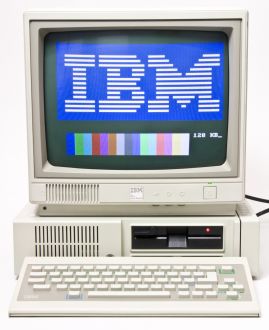 IBM PCjr with the IBM PCjr Color Display
 -
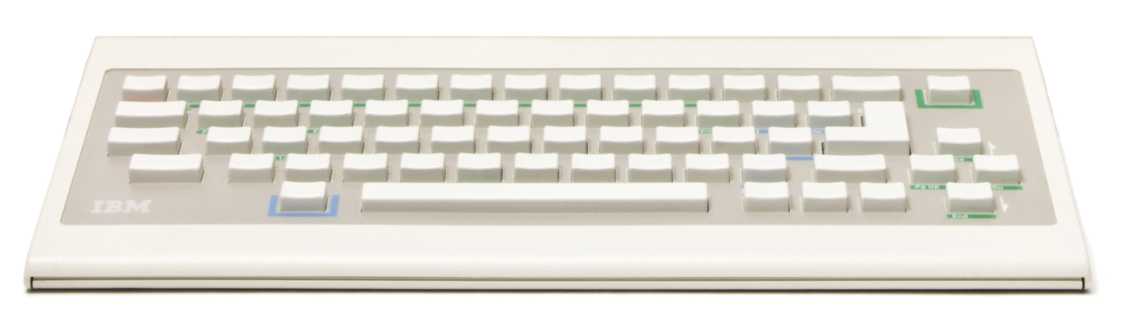 The 62-key cordless keyboard
 -
 IBM PCjr system board
 -
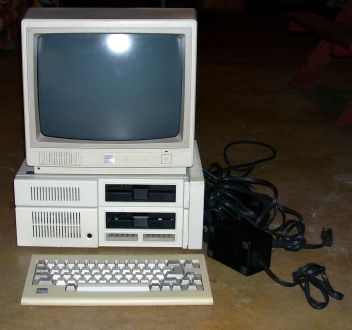 IBM PCjr with several sidecars attached
 -
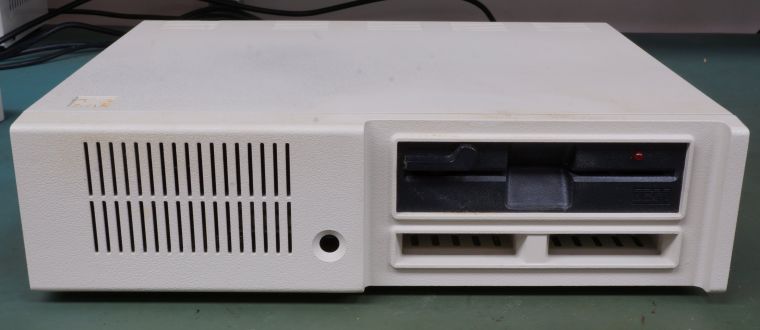 PCjr system unit: diskette drive and the two cartridge slots


References
[edit | edit source]- ↑ 1.0 1.1 1.2 1.3 1.4 National Museum of American History, "IBM PCjr Microcomputer", object 2002.0090.01. Announcement and availability dates, prices, manufacture by Teledyne in Lewisburg, Tennessee, discontinuation and units sold.
- ↑ 2.0 2.1 2.2 2.3 2.4 2.5 IBM, Personal Computer Family Service Information Manual, SA38-0037-00, July 1989, chapter 2, "4860 PCjr", pp. 2-1 to 2-3, hosted as IBM Personal Computer Family Service Information Manual. Models 04 and 67, unit specifications, interface locations, the power supply, both keyboard versions, and the keyboard as a non-repairable FRU.
- ↑ 3.00 3.01 3.02 3.03 3.04 3.05 3.06 3.07 3.08 3.09 3.10 3.11 3.12 Mike Brutman, "PCjr Hardware Notes", 2000, updated 2010. Community reference. Graphics modes, cartridge address regions, the missing DMA controller and its effects, the diskette drive and fan, DOS 2.1, the COM port numbering, the replacement keyboard, and the short (33 W) and long (45 W) Power Board versions.
- ↑ 4.0 4.1 4.2 IBM, IBM PCjr Technical Reference, revised edition, November 1983, "64K RAM", p. 2-17, hosted as File:IBM PCjr Technical Reference.pdf.
- ↑ 5.0 5.1 IBM, IBM PCjr Technical Reference, November 1983, "Hardware Differences", pp. 4-12 to 4-13, hosted as File:IBM PCjr Technical Reference.pdf.
- ↑ 6.0 6.1 6.2 6.3 6.4 IBM, IBM PCjr Technical Reference, November 1983, "Video Color/Graphics Subsystem", pp. 2-44 to 2-50 and 2-64 to 2-65, hosted as File:IBM PCjr Technical Reference.pdf.
- ↑ IBM, IBM PCjr Technical Reference, November 1983, "ROM Subsystem", p. 2-19, hosted as File:IBM PCjr Technical Reference.pdf.
- ↑ IBM, IBM PCjr Technical Reference, November 1983, "Sound Subsystem", pp. 2-87 to 2-88, hosted as File:IBM PCjr Technical Reference.pdf.
- ↑ 9.0 9.1 9.2 9.3 9.4 9.5 IBM, IBM PCjr Technical Reference, November 1983, "IBM PCjr Cordless Keyboard", pp. 2-101 to 2-105, hosted as File:IBM PCjr Technical Reference.pdf.
- ↑ 10.0 10.1 IBM, Personal Computer PCjr Hardware Maintenance and Service, first edition, September 1983, hosted as File:IBM PCjr Hardware Maintenance and Service (September 1983).pdf. Options list, p. 1-4; parts catalogue, pp. 6-7 to 6-13.
- ↑ 11.0 11.1 11.2 11.3 11.4 IBM, IBM PCjr Technical Reference, November 1983, "System Power Supply", pp. 2-135 to 2-137, hosted as File:IBM PCjr Technical Reference.pdf.
Related pages
[edit | edit source]- IBM PCjr Maintenance Guide
- IBM PCjr Troubleshooting Guide
- IBM PCjr Capacitor Replacement Guide
- IBM PC (5150)
- IBM Cassette BASIC