

IBM PS/2 Model 80
 | |
 | |
| IBM PS/2 Model 80 (8580) floor-standing system unit | |
| Specifications | |
|---|---|
| Manufacturer | IBM |
| Type | Floor-standing personal computer |
| Released | 2 April 1987 (8580-041, -071, -111) |
| Intro price | US$6,995 (8580-041, 1987) |
| CPU | Intel 80386DX at 16 MHz (-041, -071), 20 MHz (-081, -111, -121, -161, -311, -321) or 25 MHz with a 64 KB cache (-A16, -A21, -A31) |
| Memory | 1 or 2 MB (16 MHz), 2 or 4 MB (20 MHz), 4 or 8 MB (25 MHz) on the system board; 16 MB with memory adapters |
| Storage | 1.44 MB 3.5-inch diskette drive; 44 MB ST-506, 70, 115 or 314 MB ESDI, or 80, 120, 160 or 320 MB SCSI fixed disk |
| Display | VGA on the system board |
| Sound | Speaker |
| FPU / coprocessor | Socket for an 80387 at the processor's speed |
| Expansion | Eight Micro Channel slots |
| Power | 225 W or 242 W, automatic range selection |
| Dimensions | 165 mm wide (318 mm with the feet out) × 483 mm deep × 597 mm high |
| Weight | 21 kg to 26 kg |
| OS / Firmware | IBM DOS 3.3 and later, OS/2, AIX PS/2 |
| Model no. | 8580 |
The IBM Personal System/2 Model 80 386 (machine type 8580) is IBM's floor-standing 80386 Micro Channel computer, announced on 2 April 1987 with the first PS/2 range. It uses the same tower case, side cover, battery/speaker assembly and power-supply form factor as the IBM PS/2 Model 60, with a 32-bit Micro Channel system board.[1] IBM built it on three different system boards, at 16 MHz, 20 MHz and 25 MHz, and announced the last submodels in October 1990.[2][3]
History
[edit | edit source]| Submodel | Processor | Fixed disk | Announced | US price at announcement |
|---|---|---|---|---|
| 8580-041 | 386DX-16 | 44 MB ST-506 | 2 April 1987 | $6,995 |
| 8580-071 | 386DX-16 | 70 MB ESDI | 2 April 1987 | $8,495 |
| 8580-111 | 386DX-20 | 115 MB ESDI | 2 April 1987 | $10,995 |
| 8580-311 | 386DX-20 | 314 MB ESDI | 4 August 1987 | $13,995 |
| 8580-121 | 386DX-20 | 120 MB SCSI | 20 March 1990 | $7,495 |
| 8580-321 | 386DX-20 | 320 MB SCSI | 20 March 1990 | $9,895 |
| 8580-A21 | 386DX-25, 64 KB cache | 120 MB SCSI | 20 March 1990 | $10,695 |
| 8580-A31 | 386DX-25, 64 KB cache | 320 MB SCSI | 20 March 1990 | $13,195 |
| 8580-081 | 386DX-20 | 80 MB SCSI | 30 October 1990 | $6,845 |
| 8580-161 | 386DX-20 | 160 MB SCSI | 30 October 1990 | $7,495 |
| 8580-A16 | 386DX-25, 64 KB cache | 160 MB SCSI | 30 October 1990 | $10,195 |
The first three models used ST-506 and ESDI drives on a disk adapter card. In March 1990 IBM announced the SCSI models (-121, -321, -A21, -A31) with its Micro Channel SCSI adapter as the standard disk controller; IBM's letter for the A21 and A31 says that with them it "introduces Small Computer System Interface (SCSI) as a standard feature to the PS/2 product line". IBM listed OS/2 Standard and Extended Edition 1.1 and 1.2, DOS 3.3 and 4.0, and AIX PS/2 1.2 as supported on the -121 and -321.[6][7]
System boards
[edit | edit source]IBM's technical reference describes three system boards, told apart by clock speed, layout and memory, and by the model and submodel bytes returned by interrupt 15h function C0h: F8/00 for Type 1 (16 MHz), F8/01 for Type 2 (20 MHz) and F8/80 for Type 3 (25 MHz). The Type 3 board adds a two-way set-associative 64 KB cache.[9]
| Type | Speed and models | FRU | Memory connectors | Clock chip |
|---|---|---|---|---|
| 1 | 16 MHz: -041, -071 | 33F8416 | J15, J16 | MC146818A at U187 |
| 2 | 20 MHz: -081, -111, -121, -161, -311, -321 | 33F8415 (1990 HMS); 10G4148 (1994 HMM); Ardent lists 33F8506, 92F0756 and 92F0767, with P/N 90X7390 | J15, J16 | MC146818A at U186 |
| 3 | 25 MHz: -A16, -A21, -A31 | 34F0022 (1990 HMS); 85F0046 (1994 HMM) | J8, J9 | MC146818AFN at U132 |
The Type 3 board shares its core logic with the 25 MHz IBM PS/2 Model 70 planar and the PS/55 5551-V board. Ardent Tool's contributor Major Tom points to its silkscreen style as evidence that it was designed by IBM Japan, and notes that the same board was fitted to the Japanese PS/55 Model 5570-Vxx.[13]
Micro Channel slots
[edit | edit source]Every Model 80 has eight slots. The Type 1 and Type 2 boards have three 32-bit slots with the matched-memory extension (J1, J2, J4) and five 16-bit slots (J3, J5, J6, J7, J8), J6 carrying the auxiliary video extension; one 16-bit slot holds the disk adapter. The Type 3 board has four 32-bit slots (J10-J13) and four 16-bit slots, two of them (J6, J7) with the video extension; the SCSI adapter occupies one 16-bit slot, leaving seven for the owner.[9][11][13][7] The on-board VGA supplies the base video, so there is no base video extension slot, only auxiliary video extension slots.[3]
Memory
[edit | edit source]System-board memory is on IBM's own memory cards, which plug into two memory connectors on the board; they are not SIMMs. IBM gives the board capacity as 1 or 2 MB on the Type 1, 2 or 4 MB on the Type 2 and 4 or 8 MB on the Type 3, and a system total of 16 MB with 80386 memory expansion adapters in the 32-bit slots.[9][14] The IBM kits listed in the 1990 HMS are 1 MB (72X6670) for the 16 MHz board, 2 MB (90X7391) for the 20 MHz board and 4 MB (34F0023) for the 25 MHz board.[10] Fred Spencer's tests, published on Ardent Tool, found that 4 MB cards also work on the 20 MHz board, that the 16 MHz board uses only 2 MB of a 4 MB card, and that 1 MB and 2 MB cards give a 225 error on the 25 MHz board.[15]
Clock, battery and video
[edit | edit source]The real-time clock is a Motorola MC146818A with a 32.768 kHz crystal, backed up by a separate 6 V two-cell lithium pack (FRU 72X8498) in the battery/speaker assembly. The clock chip holds 64 bytes of CMOS RAM; a separate 2 KB CMOS RAM extension stores further configuration and status information.[14][11][12][13][16]
The system-board VGA gives up to 720 × 400 in text modes and 640 × 480 in graphics modes, with 256 colours or 64 shades of grey at one time, and 256 KB of video memory. Composite video is not supported. IBM warns that some non-IBM graphics adapters drive the VGA signals instead of receiving them, and that fitting two adapters that both drive VGA damages both.[14][9]
The Type 3 board carries three fuses (F2 1 A, F3 1.5 A, F4 2 A); IBM's parts lists give a 3 A system board fuse, FRU 72X8561, for the 8560 and 8580.[13][1] The Type 3 board's parallel port supports DMA transfers.[7]
Power supply
[edit | edit source]The supply converts the mains to three DC outputs, +5 V, +12 V and −12 V; there is no −5 V rail. It selects its input range automatically and connects to the system board through a 15-pin connector, with two 4-pin connectors for the fixed-disk positions.[9][17] IBM fitted three ratings, and the October 1990 technical reference gives a heat output for each: 350 W per hour for the 225 W supply, 375 W for the 242 W supply and 390 W for the 250 W supply.[9] The earlier 8580s have the 225 W supply and the later ones the 242 W; the 250 W unit, FRU 57F1600, is the replacement part in IBM's 1990 and 1994 parts lists.[18][10][1]
The 225 W supply P/N 72X6665 is rated on its label at 4.5 A on 100-125 V or 2.5 A on 200-240 V, and delivers +5 V at 27.25 A, +12 V at 7 A and −12 V at 0.39 A.[18] Eric Schlaepfer ("Tube Time") has published a reverse-engineered schematic of that unit, and his notes describe it as an LLC resonant converter with a separate bias supply for its SG3524 controller.[19][20] Repair and capacitor details are on the capacitor replacement guide.
Storage
[edit | edit source]IBM describes five storage positions, six with an option: four 3.5-inch half-height bays, two of them reached from the front, and one 5.25-inch full-height bay, which the SCSI Fixed Disk Drive Kit A converts to two 3.5-inch half-height bays.[21][7] The 44 MB ST-506 and the 70, 115 and 314 MB ESDI drives are 5.25-inch full-height units on an adapter card; the SCSI drives are 3.5-inch half-height. All of them park their heads when the power is switched off.[21][14]
| Capacity | Interface | Average access | FRU (1990 HMS) |
|---|---|---|---|
| 44 MB | ST-506 | 40 ms | 72X8541 |
| 70 MB | ESDI | 30 ms | 72X8519 |
| 115 MB | ESDI | 28 ms | 90X7392 |
| 314 MB | ESDI | 23 ms | 90X8745 |
| 80 MB | SCSI | 56F8854 | |
| 120 MB | SCSI | 23 ms | 6128298 |
| 160 MB | SCSI | 56F8851 | |
| 320 MB | SCSI | 12.5 ms | 33F8453 |
The diskette drives take their power through the interface and have no separate power connector. The -Axx machines use a pin-connector drive and the earlier models a card-edge drive, and Ardent Tool reports electrical differences that could damage a 20 MHz board if a pin-style drive is fitted to it.[22] IBM's 1990 parts list gives FRU 72X8523 for the half-height 1.44 MB drive and 33F8211 for the one-third-height drive.[10]
Configuration
[edit | edit source]Configuration, the date and time, the power-on password and the diagnostics are run from the Reference Diskette; Ardent Tool hosts the Model 70/80 Reference Diskette image for all three boards.[11][14] Two limits recorded on Ardent Tool: the 8580's Set Configuration program handles only 64 MB, and the IBM SCSI-2 Fast/Wide adapter is not supported by the 8570 and 8580 BIOS (retain tip H125078).[23]
Specifications
[edit | edit source]| Item | Value |
|---|---|
| Width × depth × height | 165 mm (318 mm with the feet out) × 483 mm × 597 mm |
| Weight | 21 kg minimum, 26 kg maximum configuration (HMR); 20.6 kg with one fixed disk (technical reference) |
| Heat output | 350, 375 or 390 W per hour with the 225, 242 or 250 W supply |
| Mains input | 90-137 V or 180-265 V AC, range selected automatically |
| Operating temperature and humidity | 15.6 to 32.2 °C, 8 to 80 % RH |
| Keyboard port, maximum current | 275 mA at +5 V |
| Auxiliary (mouse) port, maximum current | 300 mA at +5 V |
| Each fixed-disk power connector, maximum current | 1.5 A at +5 V, 2.5 A at +12 V |
| 16-bit Micro Channel connector, maximum load | 1.6 A at +5 V, 0.175 A at +12 V, 0.040 A at −12 V |
| 32-bit Micro Channel connector, maximum load | 2.0 A at +5 V, 0.175 A at +12 V, 0.040 A at −12 V |
Known faults
[edit | edit source]- Dust drawn in by the supply fan settles on the part of the system board under it, which holds the 8042, the MC146818A, the diskette controller, the NS16550 UART and the RTC crystal. Peter Wendt reports that it causes lost configuration, a wrong clock after long power-offs and diskette or disk read/write errors that survive a new battery.[3][23]
- Peter Wendt reports that about half of the failed Model 80 supplies he saw had a broken power switch, the red ones more often than the white.[18]
- Diskette drives fail with surface-mount electrolytics on their logic boards going open or high-ESR, and with mechanical faults that give a 162 at POST.[22]
- The 6 V lithium pack wears out; IBM retain tip H024809 sets the replacement point at 5.5 V.[3]
- A 1780 on an 8580-041: IBM retain tip H064300 says to check the fixed-disk cables first.[3]
The IBM PS/2 Model 80 Troubleshooting Guide covers the error codes, and the IBM PS/2 Model 80 Maintenance Guide the battery, supply checks and cleaning.
Engineering changes
[edit | edit source]Peter Wendt's summary of the Model 80 ECAs, from an older IBM parts reference, and the text of ECA 051 on Ardent Tool:[23][13]
| ECA | Applies to | Subject |
|---|---|---|
| 008 | -111 below S/N 6019000 and -311 below S/N 6502022 with planar FRU 90X7390 and an 80387 | Speaker noise |
| 011 | -111 and -311 with board FRU 33F8415 at EC A79694 or REA 18600149 and lower | 386/387 conflict |
| 031 | Planar FRU 90X7390 below EC C00835 | Bus-master adapters; usually a 110 parity error |
| 035 | Down-level 8514/A adapters | 8514/A in the 8580 |
| 040 | -311 with a second 314 MB ESDI drive | Drive not coming ready; fault in the drive logic board |
| 048 | Planars 90X7390 and 33F8415 | Second bus-master ECA, naming adapters known to cause trouble |
| 051 | -A16, -A21, -A31 with 8 MB on the system board | Intermittent OS/2 Trap 0002 or NMI errors; board replaced if the modules at U24 and U34 are marked FCT841 |
| 069 | Early PS/2 machines including the 8580, with down-level diskette drives | 162 with 601 at POST |
Documentation
[edit | edit source]IBM's service and technical documents for the Model 80, and two third-party drawings:
- Hardware Maintenance Reference, S64F-3995-01, September 1990: File:IBM PS2 Model 80 HMR.pdf
- Hardware Maintenance Service, S15F-2199-01, September 1990: File:IBM PS2 Model 80 HMS.pdf
- PS/2 Hardware Maintenance Manual, S52G-9971-02, October 1994: IBM Personal System 2 Hardware Maintenance Manual (S52G-9971-02, October 1994)
- Technical Reference, April 1987: IBM PS2 Model 80 Technical Reference (April 1987)
- Technical Reference, May 1988: IBM PS2 Model 80 Technical Reference (May 1988)
- Technical Reference, October 1990: IBM PS2 Model 80 Technical Reference (October 1990)
- System board schematics for planar 90X9152-01, drawn by Maintenance Information Technologies (not IBM): IBM PS2 Model 80 Schematics
- Reverse-engineered schematic of the 225 W supply 72X6665: File:IBM PS2 225W Power Supply 72X6665 Reverse-Engineered Schematic (Tube Time 2024).pdf
Gallery
[edit | edit source]-
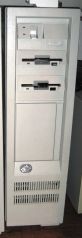 IBM PS/2 Model 80 (8580)
 -
 Front-bezel "Model 80 386" badge
Related pages
[edit | edit source]- IBM PS/2 Model 80 Maintenance Guide
- IBM PS/2 Model 80 Troubleshooting Guide
- IBM PS/2 Model 80 Capacitor Replacement Guide
- IBM PS/2 Model 60 (same case)
- IBM PS/2 Model 70
- Hard Drive Maintenance and Repair
- Floppy Drive Repair
References
[edit | edit source]- ↑ 1.0 1.1 1.2 1.3 IBM, IBM Personal System/2 Hardware Maintenance Manual, S52G-9971-02, October 1994. Hosted on this wiki as IBM Personal System 2 Hardware Maintenance Manual (S52G-9971-02, October 1994) (PDF). Models 60, 65 and 80 power-supply voltages, p. 142; Model 80 system board locations, pp. 207-208; Models 60, 65 and 80 parts list, pp. 251-253.
- ↑ 2.0 2.1 IBM Announcement Letter 187-051, IBM Personal System/2 Model 80 (8580-041/071), 2 April 1987, text at ardent-tool.com. Prices of the -041 (US$6,995) and -071 (US$8,495); the -041 with 1 MB and a 44 MB disk, the -071 with 2 MB and a 70 MB disk; "eight I/O bus slots with five 16-bit and three 16/32-bit (one 16-bit slot is occupied by the disk controller adapter)"; the 225-watt universal power supply; 80 ns memory; physical specifications.
- ↑ 3.0 3.1 3.2 3.3 3.4 "60, 65 SX, and 80 – Common Devices", Ardent Tool of Capitalism. Side-cover and front-bezel removal, the locked-case method, retain tips H064300 (1780 on the -041) and H024809 (battery minimum 5.5 V), Peter Wendt on dust under the supply fan and the ICs it affects, Alfred Arnold on the RTC oscillator stopping first, the Mitsubishi and ALPS drive comparison, Alan Douglas's capacitor replacement notes, and the VGA-driving adapter warning.
- ↑ IBM Announcement Letter 187-052, IBM Personal System/2 Model 80 (8580-111), 2 April 1987, text at ardent-tool.com. Price US$10,995.
- ↑ IBM Announcement Letter 187-150, IBM Personal System/2 Model 80 (8580-311), 4 August 1987, text at ardent-tool.com. Price US$13,995; the 314 MB fixed disk feature at US$6,495.
- ↑ 6.0 6.1 IBM Announcement Letter 190-054, IBM Personal System/2 Model 80 (8580-121, -321), 20 March 1990, text at ardent-tool.com. Prices US$7,495 and US$9,895; supported by OS/2 SE and EE 1.1 and 1.2, DOS 3.3 and 4.0, and AIX PS/2 1.2.
- ↑ 7.0 7.1 7.2 7.3 7.4 IBM Announcement Letter 190-055, IBM Personal System/2 Model 80 (8580-A21, -A31), 20 March 1990, text at ardent-tool.com. 25 MHz 80386 with a 64 KB cache; "With these systems, IBM introduces Small Computer System Interface (SCSI) as a standard feature to the PS/2 product line"; 4 MB of 80 ns memory; DMA parallel port; four 32-bit and four 16-bit slots with the SCSI adapter in one 16-bit slot; seven available slots; five internal storage devices, six with an option; 242-watt supply; prices US$10,695 and US$13,195; physical specifications.
- ↑ IBM Announcement Letter 190-177, IBM Personal System/2 Model 80 (8580-081, 161 and A16), 30 October 1990, text at ardent-tool.com. The 80 MB SCSI drive in the -081 and the 160 MB in the -161 and -A16; 4 MB standard on the A16 system board, expandable to 8 MB; prices US$6,845, US$7,495 and US$10,195.
- ↑ 9.0 9.1 9.2 9.3 9.4 9.5 9.6 IBM, IBM Personal System/2 Model 80 386 Technical Reference, October 1990. Hosted on this wiki as IBM PS2 Model 80 Technical Reference (October 1990) (PDF). System description, model bytes and system board features for Types 1 to 3, section 1; physical specifications and heat output, power supply outputs, component maximum current and channel load current, pp. 1-10 to 1-12; output protection and voltage sequencing, p. 1-13; drive power connectors, p. 1-14.
- ↑ 10.0 10.1 10.2 10.3 10.4 IBM, IBM PS/2 Model 80 Hardware Maintenance Service, S15F-2199-01, September 1990. Hosted on this wiki as File:IBM PS2 Model 80 HMS.pdf. Power-on password (3.0), undetermined problem (4.0), power supply voltages and fan (5.0), memory (11.0), symptom-to-FRU index (12.0), parts (15.0): system boards 33F8416, 33F8415 and 34F0022, memory kits 72X6670, 90X7391 and 34F0023, coprocessors 72X6673, 90X7393 and 15F7661, battery/speaker assembly 72X8511 or 33F5950, battery 72X8498, 250 W power supply 57F1600, diskette drives 72X8523 and 33F8211, fixed disks.
- ↑ 11.0 11.1 11.2 11.3 "8580 Type 1 Planar", Ardent Tool of Capitalism. 16 MHz planar, FRU 33F8416, P/N 72X7492: J1, J2, J4 32-bit slots with matched-memory extension; J3, J5, J7, J8 16-bit; J6 16-bit with the auxiliary video extension; J14 power connector; J15, J16 memory connectors; J18 battery/speaker connector; U13 386DX-16; U72 72X8287 VGA with eight OKI M41464-12 video DRAMs; U186 2 K × 8 SRAM; U187 MC146818A; U188 8042; Reference Diskette image rf7080a (Model 70/80).
- ↑ 12.0 12.1 "8580 Type 2 Planar", Ardent Tool of Capitalism. 20 MHz planar, FRU 33F8506, 92F0756 or 92F0767: same slot layout as Type 1; J15, J16 memory connectors; J18 battery/speaker connector; U87 72X8287 VGA with eight TI TMS4464 video DRAMs; U131 386DX-20; U146 2 K × 8 SRAM; U186 MC146818A; BIOS of 7 October 1987.
- ↑ 13.0 13.1 13.2 13.3 13.4 13.5 "8580 Type 3 Planar", Ardent Tool of Capitalism. 25 MHz planar, FRU 34F0022 (P/N 33F5571) or 85F0046 (P/N 91F7513): F2 1 A, F3 1.5 A and F4 2.0 A fuses; J6, J7 16-bit slots with the auxiliary video extension; J8, J9 memory connectors; J10-J13 32-bit slots with matched-memory extension; J14, J15 16-bit slots; J16 power connector; J19 battery/speaker connector; U16 90X8941 VGA; U54 82385-25 cache controller with eight M5M5178P-33 SRAMs; U59 socketed 8042; U96 386DX-25; U132 MC146818AFN; U152 8 K × 8 SRAM; DMA parallel port; up to 8 MB on the planar with 4 MB boards; Major Tom's note on the board's IBM Japan origin and its use in the PS/55 5570-Vxx; the text of ECA 051.
- ↑ 14.0 14.1 14.2 14.3 14.4 14.5 IBM, IBM PS/2 Model 80 Hardware Maintenance Reference, S64F-3995-01, 25 September 1990. Hosted on this wiki as File:IBM PS2 Model 80 HMR.pdf. Product description (1.0), cover lock (1.1.1), power-on password (1.1.2), CMOS RAM and extension (1.2.2), VGA and the VGA-driving adapter warning (1.2.4), keyboard and pointing-device connectors (1.2.8), fixed disks park their heads (2.2), power supply and under-voltage sense levels (3.1), system memory and memory errors (4.1), specifications (5.0), special tools (6.0), service position (7.0), removals and replacements (8.0, including the battery caution at 8.7 and the coprocessor orientation at 8.6), locations (9.0).
- ↑ "8580 Planar Memory", Ardent Tool of Capitalism. IBM and third-party planar memory cards for the 8580 with part numbers; kit numbers by planar; Fred Spencer's table of which card sizes work on which planar.
- ↑ "PS/2 Batteries", Ardent Tool of Capitalism, based on content by Bob Eager and Peter H. Wendt. The Model 80 takes the 6 V pack 72X8498, sold as CR-P2, DL223A, EL223AP, K223LA or PC223.
- ↑ IBM, IBM Personal System/2 Model 80 Technical Reference, April 1987. Hosted on this wiki as IBM PS2 Model 80 Technical Reference (April 1987) (PDF). Section 5, "Power Supply", pp. 5-3 to 5-6: input ranges and currents, internal fuse, outputs, output protection (restart after the switch has been off for one second), voltage sequencing, no-load operation, auto restart, the power good signal and its 100-500 ms turn-on delay, sense levels, and the 15-pin and 4-pin connector assignments.
- ↑ 18.0 18.1 18.2 "60, 65 SX, and 80 – Power Supply", Ardent Tool of Capitalism. Removal, the 15-pin connector pinout, IBM's test voltages, the supply variants (225 W FRU 15F6548; 242 W; 250 W FRU 57F1600) and the 72X6665 label ratings, Peter Wendt on power switch failures, the crackling-noise discussion, and Fred Spencer's fixed-disk power figures.
- ↑ Eric Schlaepfer ("Tube Time"), PS/2 Model 80 Power Supply, schematic of the 225 W supply IBM P/N 72X6665, PEC 3978, 2024, CC BY-SA 4.0. Hosted on this wiki as File:IBM PS2 225W Power Supply 72X6665 Reverse-Engineered Schematic (Tube Time 2024).pdf.
- ↑ Eric Schlaepfer, "IBM PS/2 Model 80 Power Supply Schematics", GitHub repository README. Notes on the 72X6665: LLC resonant converter; auxiliary bias supply with a triac preregulator; series reservoir capacitors with balancing resistors and inrush limiting by RT1/RT2 and R117/R118; SG3524 controller; output trim R77; over- and under-voltage monitoring on all three outputs, over-voltage latching the supply off and under-voltage removing Power Good; the power LED driven by Power Good.
- ↑ 21.0 21.1 21.2 IBM product information document GJAN-43WKBR, IBM PS/2 (Model 80) – Technical specifications, 2000, mirrored at ardent-tool.com. Clock speeds by model, slots, 80 ns parity memory in two sockets, 64 KB cache on the Axx, 225 W (242 W on the Axx) supply, drive bays, and the capacity, interface and average access time of the 44, 70, 115, 314, 120 and 320 MB drives.
- ↑ 22.0 22.1 "8580 Diskette Drives", Ardent Tool of Capitalism, content by Fred Spencer and Al Savage. Card-edge and pin-style 8580 drives and their part numbers, Peter Wendt on the causes of a 162 at POST, dirt on the diskette controller under the supply fan, and Al Savage's replacement of failed surface-mount electrolytics on a Mitsubishi MF355W-99M3.
- ↑ 23.0 23.1 23.2 "8580 Common Devices", Ardent Tool of Capitalism. Fred Spencer's submodel table; dust on the diskette controller; retain tip H104756 (draining CMOS by grounding the CMOS modules); Peter Wendt's 161/163 notes; memory error procedures; memory activation; Peter Wendt's summary of ECAs 008, 011, 031, 035, 040, 048, 051 and 069; retain tip H006554 (intermittent 110); Linux DMA above 16 MB; the 64 MB configuration limit; retain tip H125078 (no SCSI-2 Fast/Wide support); retain tip H021673 (base frames).