

Grandstand Colour Programmable SD070
.jpg) | |
| The Colour Programmable SD070 with its two joystick controllers and the Supersportic PC-501 cartridge in the slot | |
| Specifications | |
|---|---|
| Manufacturer | Made in Hong Kong on Soundic's SD-070 design; sold in the UK by Adam Imports Ltd under the Grandstand name |
| Type | Cartridge-based TV game console (PC-50x family) |
| Released | 1978 to 1980 (sources conflict; see History) |
| CPU | None in the console; each cartridge holds one General Instrument game chip (an AY-3-8610 in the Supersportic PC-501) |
| Memory | None |
| Storage | PC-50x plug-in cartridges |
| Display | RF to a television on UHF channel 36; 625-line PAL System I; colour |
| Sound | Speaker in the console with a volume control |
| Power | Six 1.5 V UM-2 (C) cells, or a 9 V DC 200 mA adaptor with the tip positive |
| OS / Firmware | None |
| Model no. | SD 070 (box: "MODEL SD 070") |
The Grandstand Colour Programmable SD070 is a cartridge-based TV game that Adam Imports sold in the UK under its Grandstand name, boxed as the "Cartridge Loading Video Sports Centre" and endorsed by the footballer Kevin Keegan.[1][2] It belongs to the PC-50x family of consoles made in Hong Kong: the console itself has no game chip, and each plug-in cartridge holds one General Instrument chip that contains the games.[3][4] The set came with the Supersportic cartridge (PC-501), which plays ten ball-and-paddle and target games on a General Instrument AY-3-8610.[1][2]
History
[edit | edit source]Wikipedia gives the letters SD in the names of many PC-50x consoles as standing for Soundic of Hong Kong, the real maker; Pong-Story shows the same designs sold under many other names.[3][5] Pong-Story describes the SD 70 and SD 90 types as sold from the end of the 1970s until around 1984, all made in Asia and all taking PC-50x cartridges.[5]
The date of Grandstand's SD070 is uncertain, and the sources conflict:
- Wikipedia's list of PC-50x consoles dates the Grandstand Colour Programmable SD070 to 1978, without a citation for that row.[3] The Pixel Museum's display card for its example also says 1978.[6]
- The photographed set carries the sticker "BATCH NO. 08-80-02", and the AY-3-8610 in its cartridge has the date code 8034, which in the usual year-and-week form reads as 1980, week 34.[1] Its owner dates it to 1980 and describes it as a late version of Soundic's SD 070C with a newer main board, revision F.[2]
- A Spanish sales leaflet packed with that set lists the console for 1980-1981, alongside the TV Game 3600 Mk II and the Video Entertainment Computer.[2]
The SD070 may therefore have been on sale from 1978, with the photographed unit a 1980 production. That set was also sold in Spain, with a Spanish instruction book.[2]
Hardware
[edit | edit source]| Item | Detail |
|---|---|
| Main board | Marked SD-070, REV F, 11-00110-13; the same board number as the Hanimex TVG 070C[1][2][7] |
| Game chip | None in the console; one GI chip per cartridge[4] |
| Cartridge supplied | Supersportic PC-501, with a GI AY-3-8610[1] |
| Video | RF lead, UHF channel 36, 625-line PAL System I[1][2] |
| Sound | Speaker in the lower case, volume slider on the panel[1][2] |
| Controllers | Two detachable joysticks on DIN sockets in the sides of the case[2] |
| Other sockets | DIN socket for a light gun and the DC-9V power socket at the rear[1][2] |
| Power | Six 1.5 V UM-2 cells, or 9 V DC 200 mA, tip positive[1] |
The cartridge chip does most of the work. Pong-Story describes a PC-50x console as "more an interface than a real videogame system": the chip in the cartridge generates the games, and the console provides the controls, the power and the connection to the television.[4] The AY-3-8610 in the Supersportic cartridge plays tennis, hockey, soccer, squash, practice, gridball, basketball, basketball practice and two target games, with bats that move both up and down and across the screen.[8][1]
Controls
[edit | edit source].jpg)
- Cartridge slot with an exposed edge connector at the left of the panel.
- SERVE (AUTO/MANU); TEAM L, TEAM R and SPEED, each switching between PROFESSIONAL and AMATEUR; POWER (OFF/ON).
- A VOLUME slider, a RESET button and ten numbered game buttons.[1]
- Two joysticks that move in all directions and plug into DIN sockets in the sides of the case, each with an orange SERVE/FIRE button.[2][1]
The Supersportic cartridge label numbers its ten games 1 to 10, as the game buttons are numbered: Squash, Hockey, Tennis, Target II, Target I, Basketball, Soccer, Gridball, Basketball Practice and Practice.[1]
Video and sound
[edit | edit source]The base label gives "UHF CH-36" and "625-I PAL System".[1] System I is the UK television standard. The owner reports that on continental televisions working to PAL G the picture appears but the sound through the television does not.[2] The console also has its own speaker with a volume control. A "SOUND CARRIER ADJ" label on the base covers a hole through which the sound carrier can be adjusted; on earlier versions, the owner says, the access hole was in the battery compartment.[1][2]
Power
[edit | edit source]The base label asks for six 1.5 V UM-2 cells or an AC adaptor giving 9 V DC at 200 mA, and its drawing of the plug marks the tip positive and the sleeve negative.[1] The owner gives the socket as centre positive.[2] Grandstand's Grandstand Universal Mains Adaptor has a polarity switch, and Grandstand's tabletop game leaflets tell owners to set it to negative.[9] An adaptor left on that setting would feed the SD070 the wrong way round. The labels are not consistent across the family either: the Hanimex TVG 070C, built on the same main board, has a label whose plug drawing marks the tip negative.[7] Check the label on the console in hand; see the maintenance guide.
Cartridges
[edit | edit source]The SD070 takes PC-50x cartridges, numbered PC-501 to PC-508, each built around one GI chip.[4][5] The cartridges and their chips are listed on Grandstand Programmable Cartridges.
The photographed Supersportic cartridge carries no Grandstand name on its label; it reads "SUPERSPORTIC PC-501" and "10 exciting programmable home video games".[1] Two holes in the label, marked "Left bat adjust" and "Right bat adjust", give access to two trimmers on the cartridge board.[1][2]
Related models
[edit | edit source]Wikipedia's PC-50x list gives two other Grandstand consoles in the same family. No photograph of either with a Grandstand badge has been found.
Grandstand SD-050
[edit | edit source]Listed by Wikipedia as a colour model sold in the UK.[3] The owner of the photographed SD070 also names an SD-050 among the consoles Adam Imports sold.[2] The SD-050 was a common Soundic design sold under many names; Pong-Story's description of a typical one (the ITMC SD 050S) gives six UM2 cells or a 9 V DC 200 mA supply, detachable joysticks and a DIN socket for a gun, but does not describe a Grandstand example.[10]
Grandstand Programmable (SD 90 type)
[edit | edit source]Pong-Story shows a "Grandstand Programmable game (UK)" and calls it the colour version of the ITMC SD 90.[5] Wikipedia lists it as the Grandstand "Programmable game".[3]
Both models take the same PC-50x cartridges as the SD070.[5][10]
Maintenance and repair
[edit | edit source]No service manual or schematic for the SD070 or any other SD-070 console has been found. The console has its own repair guides:
- Grandstand Colour Programmable SD070 General Maintenance: opening the case, the board layout (read from photographs of a Hanimex TVG 070C with the same main board), adaptor polarity, cartridges, joysticks, switches and the RF output.
- Grandstand Colour Programmable SD070 Troubleshooting Guide: what should happen at power-on, symptom tables for power, picture, game selection and sound, and reference values from General Instrument's data for the AY-3-8610.
There is no capacitor replacement guide for the SD070. No capacitor values have been published, the Grandstand board's component side has not been photographed, and the capacitor markings in the Hanimex photographs are too small to read.[7]
Gallery
[edit | edit source]-
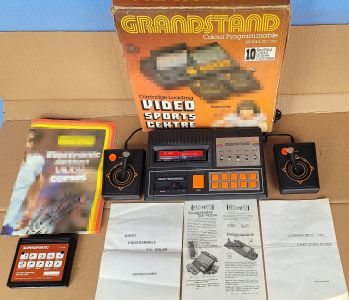 The boxed set, with the Spanish-language instructions
 -
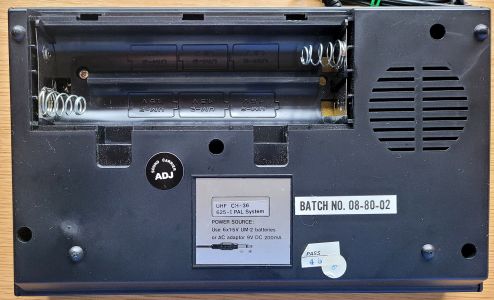 Base label: UHF channel 36, 625-I PAL, 9 V DC 200 mA with the tip positive
 -
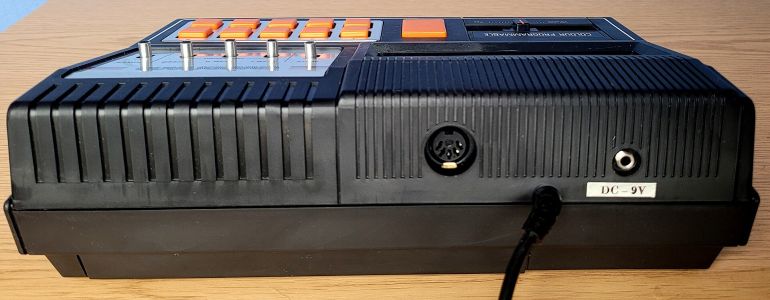 Rear: DIN socket for the light gun and the DC-9V socket
 -
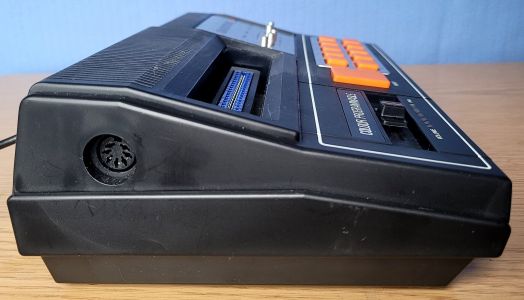 Side, with the DIN socket for one joystick
 -
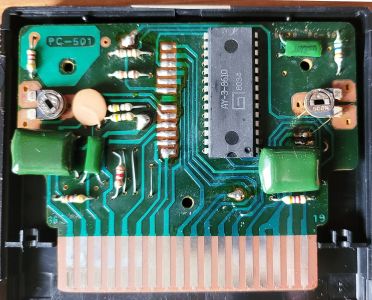 Inside the Supersportic PC-501 cartridge: a GI AY-3-8610
 -
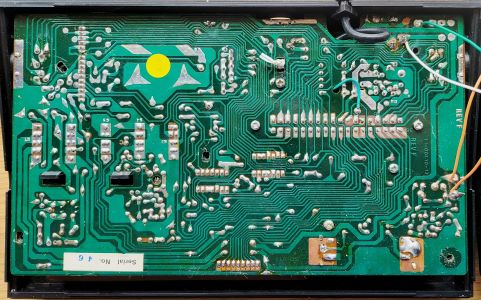 Main board, solder side: SD-070, REV F
.jpg)
.jpg)
.jpg)
.jpg)
.jpg)
.jpg)
Related pages
[edit | edit source]- Grandstand Colour Programmable SD070 General Maintenance
- Grandstand Colour Programmable SD070 Troubleshooting Guide
- Grandstand Programmable Cartridges
- Grandstand Universal Mains Adaptor
- Category:Grandstand, for Grandstand's other TV games
References
[edit | edit source]- ↑ 1.00 1.01 1.02 1.03 1.04 1.05 1.06 1.07 1.08 1.09 1.10 1.11 1.12 1.13 1.14 1.15 1.16 1.17 Photographs File:Grandstand Colour Programmable SD070 (1).jpg, File:Grandstand Colour Programmable SD070 (2).jpg, File:Grandstand Colour Programmable SD070 (3).jpg, File:Grandstand Colour Programmable SD070 (4).jpg, File:Grandstand Colour Programmable SD070 (5).jpg, File:Grandstand Colour Programmable SD070 (6).jpg, File:Grandstand Colour Programmable SD070 (8).jpg, File:Grandstand Colour Programmable SD070 (11).jpg and File:Grandstand Colour Programmable SD070 (12).jpg (José Antonio Ortigueira Amor, CC BY 4.0, from Wikimedia Commons), examined at full resolution. Box: "GRANDSTAND Colour Programmable MODEL SD 070", "10 Exciting Colour Games Cartridge", "Cartridge Loading VIDEO SPORTS CENTRE", "Endorsed by". Base label: "UHF CH-36 / 625-I PAL System / POWER SOURCE: Use 6x1.5V UM-2 batteries or AC adaptor 9V DC 200mA" with a plug drawing marked negative on the sleeve and positive on the tip; "SOUND CARRIER ADJ" label; "BATCH NO. 08-80-02". Control panel: SERVE (AUTO/MANU), TEAM L, TEAM R and SPEED (PROFESSIONAL/AMATEUR), POWER, VOLUME slider, RESET and game buttons 1 to 10. Joysticks: an orange button marked SERVE/FIRE on each. Rear: DIN socket and "DC-9V" socket. Main board solder side: "SD-070", "REV F", serial label 46. Cartridge label: "SUPERSPORTIC PC-501", "Left bat adjust" and "Right bat adjust" holes, games 1 to 10 (Squash, Hockey, Tennis, Target II, Target I, Basketball, Soccer, Gridball, Basketball Practice, Practice). Cartridge board: "PC-501", "REV B", a General Instrument AY-3-8610 with date code 8034 as the only IC, two trimmers (one marked 500K), edge contacts numbered 1 to 36, two springs in the shell.
- ↑ 2.00 2.01 2.02 2.03 2.04 2.05 2.06 2.07 2.08 2.09 2.10 2.11 2.12 2.13 2.14 2.15 José Antonio Ortigueira Amor, "Consola Grandstand Colour Programmable (Model SD 070) (Video Sport Centre) (Endorsed by Kevin Keegan) (1980)", Retro Ordenadores Orty (collector's blog, in Spanish), March 2026 (retrieved 2026-10-18). First-hand description of the photographed set: made in Hong Kong and sold by Adam Imports in 1980, also in Spain with Spanish instructions; a late version of Soundic's SD 070C, batch 08-80-02, serial number 46; supplied with the Supersportic (PC-501) cartridge, two joystick controllers, the manual, a Kevin Keegan poster and a sales leaflet; the leaflet lists the console alongside the 3600 Mk II and the Video Entertainment Computer (1980-1981); PAL System I picture, with no sound on continental PAL G televisions; internal speaker with volume control; detachable joysticks on DIN-7 sockets on the sides; DIN-5 socket for a light gun, 9 V DC centre-positive socket and RF lead (UHF channel 36) at the rear; six LR14 cells; SOUND CARRIER ADJ hole under the ADJ label on the base (in the battery compartment on earlier versions); four screws hold the lower case, one of them inside the battery compartment; three screws and two clips hold the main board to the upper case; the speaker is screwed to the lower case; main board marked 11-00110-13, REV F, SD-070; the PC-501 cartridge has two holes for adjusting the vertical position of the bats, opens with one screw, carries board 11-40140-02 REV B and a General Instrument AY-3-8610 (8034) as its only IC; the console works.
- ↑ 3.0 3.1 3.2 3.3 3.4 Wikipedia, "PC-50x family" (retrieved 2026-10-18). The consoles have no central processor; the games are in General Instrument AY-3-8xxx chips in the cartridges; "SD" in the model names stands for Soundic (Hong Kong), the real maker; Grandstand rows for an SD-050 (colour, UK), a "Programmable game" (colour, UK) and the "Colour Programmable SD070 / Video Sports Centre SD070" (colour, 1978); a cartridge table giving the chip in each PC-50x cartridge. The table rows are not individually cited.
- ↑ 4.0 4.1 4.2 4.3 Pong-Story, "PC-50x cartridges" (retrieved 2026-10-18). Each cartridge contains a single General Instrument chip which holds most of the game circuits, so that "the console is more an interface than a real videogame system"; the cartridges fit many Asian-made systems sold in Europe under different names and exist in black and cream cases with different labels; table of the eight cartridges with French and English titles and rarity (PC-501 Sports/Supersportic, PC-502 Motor cycle, PC-503 Tank Battle, PC-504 Racing cars/Grand Prix, PC-505 Submarine, PC-506 Super Wipeout, PC-507 Shooting Gallery, PC-508 Fundamental); "PC-50x cartridges contain a bakelite circuit board with poor quality solders"; the PC-501 example contains an AY-3-8610; PC-502 is a Stunt Cycle clone; PC-503 uses the AY-3-8710; PC-504 is the RACE game and PC-505 the Submarine game of the "PONG in a Chip" page.
- ↑ 5.0 5.1 5.2 5.3 5.4 Pong-Story, "SD 070 / SD 090 clones" (retrieved 2026-10-18). SD 70 and SD 90 systems were sold from the end of the 1970s until around 1984, all made in Asia and all compatible with PC-50x cartridges; "the ITMC SD 90 is same as another British system manufactured by Grandstand"; photo caption "Grandstand Programmable game (UK). This is the color version of ITMC SD 90, as pictured on the ITMC SD 90 box."
- ↑ Photograph File:Grandstand Video Sports Center SD070.jpg (Edelseider, Pixel Museum, CC BY-SA 4.0, Wikimedia Commons), examined at full resolution: an SD070 on display with the museum card "SD070 Video Sports Centre Kevin Keegan / 1978, Royaume-Uni / console de salon / Grandstand".
- ↑ 7.0 7.1 7.2 Avon Fox, "Hanimex TVG 070C TV Game-Programmable Rev F PAL", The Liberator (collector's site; retrieved 2026-10-18). Photographs of a Hanimex TVG 070C taken apart, examined at full size (1600 × 1200): main board solder side marked "11-00110-13 REV F"; base label "HANIMEX MODEL: TVG 070C / VHF CH-1 / 625-B PAL system / POWER SOURCE: Use 6x1.5V UM-2 batteries or AC adaptor 9V DC 200mA" with a plug drawing marked plus under the sleeve and minus under the tip; electrolytic capacitor markings on the component side not legible at this size. The photographs are not freely licensed.
- ↑ General Instrument Corporation, GIMINI TV Game Circuits, January 1978, pp. 26-29, PDF hosted by Pong-Story (retrieved 2026-10-18). AY-3-8610 and AY-3-8610-1 ("Superstar"): ten games (tennis, hockey, soccer, squash, practice, gridball, basketball, basketball practice, one- and two-player target); 625-line (AY-3-8610) and 525-line (-1) versions; two-axis player motion; "intended to be battery powered"; 28-pin pin-out with VSS on pin 1 and VCC on pin 16; game selection by connecting one of four strobe outputs to one of three select inputs; bat position set by a variable resistor and capacitor; VCC +6 to +7 V, -0.2 to +12 V maximum on any pin, power supply current 60 mA maximum at +7 V.
- ↑ Grandstand, Astro Wars instruction leaflet (Adam Leisure Group, 1981), p. 2, "Batteries" box: the game "can be operated from the mains with a GRANDSTAND Universal Mains Adaptor (not included). Set polarity switch to negative polarity." Hosted here as File:Grandstand Astro Wars Instructions.pdf.
- ↑ 10.0 10.1 Pong-Story, "SD-050 clones from Europe" (retrieved 2026-10-18). SD-050 systems use PC-50x cartridges containing a GI chip, not a ROM; the ITMC SD 050S as a typical example: made in Hong Kong, six 1.5 V UM2 cells or a 9 V DC 200 mA transformer, cartridges PC-501 to PC-508, two detachable joysticks with serve buttons, UHF channel 36, a five-pin DIN socket for the gun, settings for bat size, serve, ball speed, power, reset and volume. No Grandstand model is described on the page.
.jpg)
.jpg)
