

Grandstand Astro Wars
 | |
| Grandstand Astro Wars, white-lettered version, on its box at Wardown Park Museum, Luton (Geni, CC BY-SA 4.0) | |
| Specifications | |
|---|---|
| Manufacturer | Epoch (made in Japan) for Grandstand (Adam Leisure Group, Harrogate)[1] |
| Type | Tabletop electronic game |
| Released | 1981[1][2] |
| CPU | NEC μPD553C 4-bit microcontroller (uCOM-43), marked D553C 153[3] |
| Memory | 96 × 4-bit RAM inside the microcontroller[4] |
| Storage | — |
| Display | NEC FIP10xM20T vacuum fluorescent display, cyan and red, behind a magnifier, with a colour overlay[3] |
| Sound | 1-bit, from the microcontroller[3] |
| ROM | 2K × 8-bit mask ROM inside the microcontroller[4] |
| Input | Joystick (left and right), FIRE, SELECT (skill level) and START buttons, POWER switch[1] |
| Power | Four C (Duracell MN1400) cells, or the Grandstand Universal Mains Adaptor set to negative[1] |
| OS / Firmware | — |
| Model no. | 11183 (Grandstand);[2] Epoch Galaxy II is model 8100[5] |
Grandstand Astro Wars is a battery-powered tabletop space game with a vacuum fluorescent display (VFD), made in Japan by Epoch and sold in the UK under the Grandstand name from 1981.[1] Epoch sold the same game in the USA as Galaxy II and in Japan as Astro Wars.[3][5] It is a Galaxian-style shooter in four phases, the last a docking manoeuvre against the clock, played on a magnified display in an upright cabinet-shaped case.[1] An NEC μPD553 4-bit microcontroller runs the game and drives the display directly.[3][4] Astro Wars is built on the same Epoch platform as Scramble, and shares its battery cover with Scramble, Firefox F-7 and Star Force.[6]
History
[edit | edit source]Grandstand was the brand under which Adam Imports of Harrogate sold imported electronic games in the UK.[7] The Astro Wars leaflet carries the imprint of the Adam Leisure Group PLC, Harrogate, and states that the game was made in Japan, copyright 1981 Epoch Company Ltd of Tokyo.[1] The Handheld Museum and the Centre for Computing History also date the Grandstand game to 1981.[2][8] A UK television advertisement for it survives on the Internet Archive, uploaded with the note "Aired 30/9/82. From VHS"; it shows children at a spaceship-style control desk and ends on the game and the Grandstand name, with retailers' names along the bottom of the screen.[9] A collector's guide gives a recommended price of about £30 in 1981, discounted to about £23 in later Argos catalogues; it does not reproduce the catalogue pages.[10]
Epoch's own version, Galaxy II (model 8100), was sold in the USA by Epoch Corporation of Englewood, New Jersey, and its leaflet carries the same 1981 copyright.[11][5] MAME and the Handheld Museum give the Japanese title as Astro Wars. Wikipedia gives it as Super Galaxian, and a collector's guide describes Super Galaxian as a separate Epoch release that shows "Astro Wars" on its display. The sources conflict, and none of them cites a Japanese leaflet or box.[3][5][12][10] Wikipedia also says the game was made in Great Britain; the Grandstand leaflet says it was made in Japan.[12][1]
Grandstand's version was sold with white "Astro Wars" lettering and with red lettering. The red-lettered version sits upright in its box, the white one horizontally.[2] Wikipedia and a collector's guide call the red version the original or "launch" edition, without a source.[12][10] The white-lettered game photographed at Wardown Park Museum stands on a box printed with the Grandstand model number 11183, the number the Handheld Museum gives.[2]
.jpg)
Hardware
[edit | edit source]| Part | Detail |
|---|---|
| Main board | Marked 19096; stands upright in the hood and carries the display |
| Control board | Marked 96062; START, SELECT and FIRE; the joystick is on a small board of its own |
| Microcontroller | NEC μPD553C, marked D553C 153: 4-bit PMOS, 2K × 8 ROM, 96 × 4 RAM, runs from −10 V |
| Display | NEC FIP10xM20T VFD, ten grids, cyan and red; revisions B (no. 1-8) and D (no. 2-21) have different graphics |
| Overlay | Score blue; top and bottom rows yellow; rows 2 and 3 red |
| Display supply | Transformer converter switched by S02 (D882 NPN), with a zener, S06, of about 140 V |
| Sound | 1-bit, from the microcontroller |
| Power | Four C cells (6 V), or an adaptor |
Board numbers, microcontroller, display and overlay from MAME's driver notes,[3] with the board numbers confirmed by the Handheld Museum's photograph of an opened game;[13] microcontroller characteristics from NEC's data sheet;[4] display supply as traced by owners.[14][15]
The μPD553 holds the game program in mask ROM. MAME's copy is a 2 KB dump of the D553C 153 and serves both display revisions.[16] A failed microcontroller can therefore only be replaced from another Astro Wars or Galaxy II. The chip's outputs drive the display grids and segments directly, which NEC rated for up to −35 V.[4]
The batteries supply 6 V, but the microcontroller needs about −10 V and the display about −39 V, and its filament needs its own low-voltage supply. A small transformer, switched by the power transistor S02, makes all three; the filament is fed from one of its windings. These figures and connections were measured and traced by owners on working games, as no schematic was published.[14][17] An owner's own drawing of the circuit is on iFixit; its author did not guarantee it.[18]
Shared Epoch platform
[edit | edit source]Astro Wars is one of seven Epoch games Grandstand sold, and has the most in common with Scramble, Epoch's Astro Command: an NEC μPD553 microcontroller (D553C 202), an NEC FIP-series display, a D882 power transistor in the display supply, and four C cells.[3][19] A repairer mended the display supply of an Astro Wars with the pair of diodes from a scrapped Grandstand Scramble board, which has the same circuit.[15] Firefox F-7 and Star Force are later Epoch games that take the same battery cover.[6] The earlier Invader From Space uses the smaller μPD552.[3]
The game
[edit | edit source]The player has five earth ships at the bottom of the display and moves left and right with the joystick, firing upwards with the FIRE button. A new missile can be fired only after the last one has hit an alien or left the display. SELECT sets one of four skill levels before a game:[1]
- Level 1: alien fighters attack one at a time.
- Level 2: one at a time, faster.
- Level 3: two at a time.
- Level 4: two at a time, faster.
The game always starts at level 1 when switched on. START begins play.[1]
Play runs through four phases:[1]
- Three enemy command ships (100 points, but not vulnerable yet) sit at the top, with two rows of warships (20 and 10 points) below them. Fighters attack in a zigzag (50 points) or a horizontal and vertical pattern (40 points). Destroying ten fighters ends the phase.
- A squadron attacks in a circular pattern; each fighter is worth 70 points. Ten hits end the phase.
- The command ships become vulnerable, move left and right and fire barrages of missiles. Hitting all three earns a "GOOD" rating.
- The bonus docking manoeuvre: the earth ship launches a space shuttle and moves back and forth on its own while a countdown runs down from 1,000. The player steers the shuttle into the docking position with the joystick, and can press FIRE to send it back up and try again. The faster the docking, the more points.
Play then continues until all five earth ships are lost. The highest score is 10,000, marked by a victory tune.[1][2]
Batteries and power
[edit | edit source]Grandstand recommends four Duracell MN1400 cells, the C size, and says the game will not work properly on weak batteries; if play or the display becomes erratic, the batteries should be checked. It tells owners to switch off after play and to take the batteries out if the game is not used for long periods.[1] A collector's guide says four D cells; the leaflet and the Handheld Museum say C.[10][2]
For mains use the leaflet names the Grandstand Universal Mains Adaptor, not included, with its polarity switch set to negative. It gives no voltage.[1] Epoch's Galaxy II leaflet asks for 6 V DC at 250-300 mA, with the centre pin negative.[11] The game has no protection against reversed polarity, and two owners traced their games' failure to the wrong adaptor.[20][17][21] It will run from 5 V, but the display is dimmer.[20] See Grandstand Astro Wars General Maintenance#DC socket and adaptor and Grandstand Universal Mains Adaptor.
Repair
[edit | edit source]Astro Wars has its own repair guides:
- Grandstand Astro Wars General Maintenance: opening the case, batteries and contacts, the DC socket, the controls, the display filters and storage.
- Grandstand Astro Wars Troubleshooting Guide: how the power circuit works, symptoms, the S02, S06 and S03 faults, display faults and the voltages measured on working games.
- Grandstand Astro Wars Capacitor Replacement Guide: the four electrolytic and seven ceramic capacitors on the main board.
Astro Wars has more repair evidence than any other Grandstand tabletop game: forum threads, repair logs and videos from 2015 to 2025 by owners working without a schematic. The usual fault is a dead game whose power transistor, S02 (D882), gets hot within seconds. Sometimes the transistor itself has failed, and a new D882 cures it.[22][21] In other games a new transistor overheats too, because the zener diode S06 in the display supply has failed short and is overloading the converter.[14][17][20] S06 breaks down at about 140 V, and a 140 V zener (1N5275B), or two 68 V zeners in series, has been fitted in its place; 32 V and 39 V zeners and a Schottky diode did not work.[15][23][21][14] Wikipedia and a collector's guide mention the D882 and S06 faults without a source; the forum repairs confirm them.[12][10]
The display cannot be replaced new. A tube from a scrapped game must be the same revision, because revisions B and D have different graphics.[3][10] Later boards have a second diode, S11, in series with S06, while earlier boards carrying the Epoch logo have S06 alone, so note the board version before ordering parts.[15] A 3D-printable replacement battery cover fits Astro Wars and the other Epoch tabletop games.[6]
Documentation
[edit | edit source]- Grandstand Astro Wars instruction leaflet (1981): controls, skill levels, the four phases, batteries and adaptor.
- Epoch Galaxy II instruction leaflet (1981): Epoch's US version, with the adaptor rating and polarity.
- UK television advertisement (1982), on the Internet Archive.
- MAME driver notes for Epoch Galaxy II.
- Owner-drawn schematic on iFixit (login needed; not checked).
Gallery
[edit | edit source]-
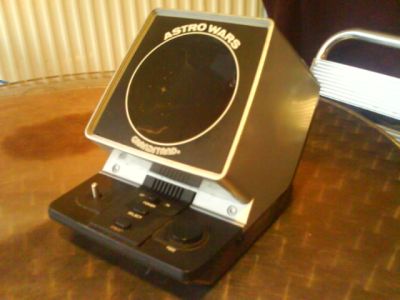 Grandstand Astro Wars, white-lettered version (Jimbobadahey, CC BY-SA 3.0)
 -
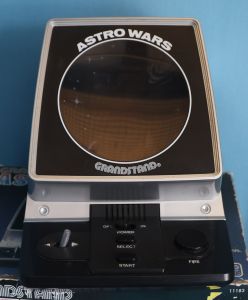 The same version from the front, on its box at Wardown Park Museum (Geni, CC BY-SA 4.0)
 -
 Epoch Galaxy II, the original sold by Epoch in the USA (Joe Haupt, CC BY-SA 2.0)

Related pages
[edit | edit source]- Grandstand Astro Wars General Maintenance
- Grandstand Astro Wars Troubleshooting Guide
- Grandstand Astro Wars Capacitor Replacement Guide
- Grandstand Scramble: the Epoch game closest to Astro Wars in construction.
- Grandstand Firefox F-7 and Grandstand Star Force: later Epoch games with the same battery cover.
- Grandstand Invader From Space: Epoch's earlier invaders game.
- Grandstand Universal Mains Adaptor
- Coleco Galaxian Mini-Arcade: Coleco's licensed Galaxian tabletop of 1982.
References
[edit | edit source]- ↑ 1.00 1.01 1.02 1.03 1.04 1.05 1.06 1.07 1.08 1.09 1.10 1.11 1.12 1.13 Grandstand, Astro Wars instruction leaflet (Adam Leisure Group PLC, Harrogate; © 1981 Epoch, made in Japan), hosted here as File:Grandstand Astro Wars Instructions.pdf (PDF page numbers): p. 2, controls, skill levels and the batteries box (four Duracell MN1400; Grandstand Universal Mains Adaptor with the polarity switch set to negative; the game will not work properly on weak batteries; check batteries if play or display is erratic; remove batteries for long periods); p. 3, "move the Joy Stick gently. Do not press hard on the Fire Button ... Do not leave in the sun or allow it to get wet", and a perfect score of 10,000; pp. 4-5, the four phases; p. 6, imprint.
- ↑ 2.0 2.1 2.2 2.3 2.4 2.5 2.6 Handheld Museum, "Grandstand Astro Wars" (retrieved 2026-10-18): 1981, VFD, four C cells, model 11183; licensed from Epoch (Galaxy II); two versions, one with "Astro Wars" in red that sits upright in its box; maximum score 10,000.
- ↑ 3.00 3.01 3.02 3.03 3.04 3.05 3.06 3.07 3.08 3.09 MAME source, hh_ucom4.cpp at commit d404316 (retrieved 2026-10-18). Driver notes, written from real boards, for Epoch Invader From Space (PCB 36010(A/B); NEC uCOM-44 MCU labelled D552C 054; cyan VFD NEC FIP9AM18T; UK release by Grandstand), Epoch Galaxy II (PCB 19096/96062; uCOM-43 labelled D553C 153; cyan and red VFD NEC FIP10xM20T, rev B no. 1-8 and rev D no. 2-21 with different graphics; UK release by Grandstand as Astro Wars), Epoch Astro Command (PCB 96111/96112; D553C 202; NEC FIP9AM20T no. 42-42; UK release by Grandstand as Scramble), Tomy Pac-Man (PCB TN-08 2E108E01; D553C 160; NEC FIP8AM18T no. 2-21; round yellow case; UK release by Grandstand as Munchman) and Tomy Caveman (PCB TN-12 2E114E03; D553C 209; NEC FIP8AM20T no. 2-42; UK release by Grandstand). The file header explains the NEC FIP part numbers (the first figure is the number of grids) and notes that VFD colours fade after decades.
- ↑ 4.0 4.1 4.2 4.3 4.4 NEC Electronics USA, 1982 Microcomputer Catalog, data sheet "μPD552/μPD553 4-bit single chip microcomputers with vacuum fluorescent display drive capability", p. 165. Bitsavers copy on the Internet Archive. Both chips are PMOS parts in a 42-pin DIP running from a single −10 V supply; 27 of their I/O and output lines "are capable of being pulled to −35V in order to drive Vacuum Fluorescent Displays directly". The μPD553 has 2000 × 8 ROM and 96 × 4 RAM, the μPD552 1000 × 8 and 64 × 4.
- ↑ 5.0 5.1 5.2 5.3 Handheld Museum, "Epoch Galaxy II" (retrieved 2026-10-18): 1981, VFD, four C cells, model 8100; Epoch's Galaxian-style game, sold in Japan as Astro Wars and by Grandstand in the UK as Astro Wars.
- ↑ 6.0 6.1 6.2 YoxxxoY Jorge, "Battery cover Epoch electronic games", Thingiverse 3399673 (2019), archived on the Internet Archive (retrieved 2026-10-18). 3D-printable battery cover; the designer lists Astro Thunder, Astro Thunder 7, Firefox F-7, Astro Command, Astro Wars, Space Defender, Galaxy II, Star Force and Scramble. CC BY 4.0.
- ↑ Grandstand, Firefox F-7 instruction booklet (Adam Imports Ltd, Ripon Way, Harrogate; © 1983; made in Japan), hosted here as File:Grandstand Firefox F-7 Instructions.pdf (PDF page numbers): p. 1, control drawing (left and right speaker switches) and batteries box (four Duracell MN1400; Universal Mains Adaptor on negative polarity; weak-battery warning; care note); pp. 2-4, controls, three skill levels, high and low speed and the display; pp. 5-7, the five phases of combat and the sixth against the enemy base; p. 8, scoring and a perfect game of 1,000 points.
- ↑ Centre for Computing History, "Grandstand Astro Wars", CH34165 (retrieved 2026-10-18): 1981; four skill levels; box text describing the attack and the docking manoeuvre.
- ↑ "Grandstand Astro Wars Tabletop game (1982)", Internet Archive (retrieved 2026-10-18). A UK television advertisement of about 30 seconds, uploaded with the description "Aired 30/9/82. From VHS" (originally posted to YouTube in 2014). The closing frame shows the game beside the Grandstand name, with retailers' names along the bottom of the screen.
- ↑ 10.0 10.1 10.2 10.3 10.4 10.5 Retro Games Now, "Astro Wars by Grandstand" (retrieved 2026-10-18). Collector's buying guide: games left in lofts with batteries in have corroded terminals and acid on the board; a display that fades "cannot be replaced"; repeats the D882 and S06 points; red-lettered version described online as the "launch" edition; recommended price about £30 in 1981, later about £23 in Argos catalogues. It says four D cells; the Grandstand leaflet says MN1400, which is the C size.
- ↑ 11.0 11.1 Epoch, Galaxy II instruction leaflet (Epoch Corporation, Englewood, New Jersey; © 1981 Epoch Company Ltd, Tokyo; made in Japan), hosted here as File:Epoch Galaxy II Instructions.pdf: p. 2, four C cells, or an adapter of 6 V DC, 250-300 mA, with a polarity symbol showing the centre pin negative.
- ↑ 12.0 12.1 12.2 12.3 Wikipedia, "Astro Wars" (revision of 1 June 2025). Hardware section, without references: the D882 power transistor "is known to fail frequently", the S06 zener less often; the display has "a glass nipple which can easily be fractured"; isopropyl alcohol for contacts; the same battery compartment on Astro Thunder, Astro Thunder 7, Firefox F-7, Astro Command, Space Defender and Scramble. The article also calls the game "made in Great Britain", which the Grandstand leaflet contradicts.
- ↑ Handheld Museum, "Guts" (retrieved 2026-10-18): photographs of opened Grandstand Astro Wars (main board 19096 standing in the hood with the display; control board 96062 marked START, SELECT and FIRE; joystick on its own small board), The Big Game Soccer (main board in the centre with the display; battery holder along the top; DC socket at the top right; a control board each side) and Firefox F-7 (display on a bracket above the main board, with "FIP" and an illegible number in the silkscreen beside it; two chips on the main board, neither legible; control board with round contact pads below).
- ↑ 14.0 14.1 14.2 14.3 Handheld Museum forum, "Astro wars / galaxy ii repair", December 2018 - February 2019 (retrieved 2026-10-18). A dead Astro Wars: the D882 power transistor ran hot, the supply fell to about 1.5 V and the game drew 1.5-1.7 A; a replacement D882 did the same; diode S06 read about 20 Ω both ways; with S06 removed the μPD553 received its −10 V and ran when the display was fed from a separate supply; S06 taken from a working unit cured it. Also the μPD553-to-VFD pin map (filament on VFD pins 1 and 30), an out-of-circuit test of the display, the transformer connections, and the note that a red-lettered unit had a slightly different board revision. The site's administrator (Rik) writes that the wrong AC adapter "will usually fry" a transistor, "the most frequent damage I've seen to VFD games", and advises keeping the rubber buttons, springs and speakers from scrapped games. Another member expected a healthy game to draw about 100 mA. The owner traced S06 to the transformer at one end and, through R07, to the piezo speaker at the other; with S06 removed the game made no sound. Measured with a basic oscilloscope he thought might be inaccurate: about 200 V peak to peak from the transformer at S06 and −39 V DC on its other side. Lower-voltage zeners tried in place of S06 (32 V, then 39 V) left the D882 or the zener overheating.
- ↑ 15.0 15.1 15.2 15.3 Retro Tech Repair, "Astro Wars Repair (sound but no display or faint display)", YouTube, 29 January 2021 (transcript read 2026-10-18). Faint sound and no display on several games. Measured on a working board: about −1.5 V at the D882 base, −3 V at the base of S03 (a C945), fed from a −9 V line through the zener S09, and the −10 V microcontroller supply (24:00-33:00). A 10 μF capacitor next to the transistor and transformer, rated 16 V, was replaced with a 25 V part, and later the whole board was recapped, without effect (21:00-31:00). Earlier boards, with the Epoch logo, have one diode S06 under the display; later boards have two, S06 and S11, in series (39:00-46:00). The removed diodes broke down at about 140-143 V when tested on a stack of 9 V batteries, which he warns is not safe (48:00-54:00). On a Japanese Astro Wars ruined by the wrong charger, the D882 was burnt; a new D882 still overheated until S06 was replaced with a 1N5275B; the game then drew about 0.2 A with the D882 a little warm, and ran for several hours (57:00-67:00). S06 sits under the bottom edge of the display; bending the tube risks cracking it (61:00). The flat cables to the joystick board and power board broke after repeated handling (39:00).
- ↑ MAME source, hh_ucom4.cpp at commit d404316, ROM definitions: the Galaxy II program is a 2 KB (0x800-byte) dump of the D553C 153, used for both display revisions; the Astro Command program is a dump of the D553C 202 taken from a Tandy Astro Command.
- ↑ 17.0 17.1 17.2 All About Circuits forum, "Grandstand Astro Wars Game (Faulty) - help with component identification", February 2019 - January 2024 (retrieved 2026-10-18). The owner's own measurements and hand-drawn schematic (which he did not guarantee): 6 V in, about −10 V for the microcontroller and −39 V for the display; with a faulty S06 the D882 (S02) overheated and the game drew 1.5 A; a good S06 from another unit cured it; a 39 V zener did not; S06 is a glass diode with red and brown bands (another owner's has a single red band). Later posts: one member fixed the same fault with a 1N5275B zener; another fixed his, damaged in about 1985 by the wrong mains adaptor, by replacing S06.
- ↑ "Schematic Astro Wars", iFixit document (retrieved 2026-10-18; the PDF needs an iFixit login, only the public preview was seen). Titled "Grandstand Astro Wars / Epoch Galaxy II VFD game", revision 0.1, drawn in EasyEDA; the same 63.8 KB file as the schematic an owner attached to the All About Circuits thread, which he said he could not guarantee. Its notes mark some voltages as uncertain.
- ↑ Handheld Museum forum, "EPOCH Astro Command - dead or dying", January-February 2016 (retrieved 2026-10-18). An Epoch Astro Command (the Epoch version of Grandstand Scramble): rusty battery contacts cleaned and filed; before failing it showed incorrect play and a rapidly flashing display; the Radio Shack version has almost the same parts; MCU D553C 202, transistors D882 and C2785; power from the batteries runs through the control board and a ribbon cable that frayed after the board was turned over repeatedly; unresolved. Rik (site administrator): the game plays and makes sounds without the display or its transformer; displays fade unevenly with heavy use; a broken filament wire leaves an area dim; he has never had a display fail unless the glass was broken.
- ↑ 20.0 20.1 20.2 Andy van Stokkum, "Repairing an Astro Wars", codify.nz, 15 June 2019 (retrieved 2026-10-18). Repair log: S02 ran hot and was replaced; the game worked for about a month, then S02 failed again and S03 ran hot; finally replaced S06 (a 140 V zener; 2 W parts used where 500 mW would do), S03-S05 (2SA1175), S02 (D882) and all electrolytic capacitors. The adaptor plug is outer-positive and the game has no reverse-polarity diode; he added one. It runs from 5 V but the display is dimmer than at 6 V.
- ↑ 21.0 21.1 21.2 All About Circuits forum, "Help with replacement part - Repairing old electronic game", August-October 2022 (retrieved 2026-10-18). Two Astro Wars: one cured by a new D882; the other, which had been given the wrong adapter, had the zener fault. The 1N5275B is a 140 V, 0.5 W zener; two 1N4760 68 V zeners in series were fitted instead and the game worked.
- ↑ bpharoah, "More Astro Wars!", 24 April 2023 (retrieved 2026-10-18). A dead Astro Wars: 6 V with negative polarity at the DC socket; the supply traced through a red wire to the power switch and through the control panel cable; the power transistor had a base-emitter short; a new transistor cured it.
- ↑ All About Circuits forum, "Grandstand Astro Wars Game (Faulty) identification", January 2020 (retrieved 2026-10-18). Two Astro Wars with the S06 fault: a BAT85 Schottky diode fitted in place of S06 burnt out; a 1N5275B zener worked in both.