

Grandstand TV Game 2000
 | |
| Adman Grandstand TV Game 2000, with its two control pods in their recesses either side of the speaker grille | |
| Specifications | |
|---|---|
| Manufacturer | Made in Korea; distributed in the UK by Adam Imports, Harrogate (sold as Adman Grandstand)[1][2] |
| Type | Dedicated home video game console (Pong-type TV game) |
| Released | 1977 (see History)[3] |
| CPU | None; Texas Instruments TMS1965NL single-chip game IC[4] |
| Memory | None |
| Storage | — |
| Display | RF output to a 625-line UHF television, black and white[5] |
| Sound | Speaker in the console[6] |
| Power | 9 V DC: six UM-2 (C) cells or a 9 V adaptor; 360 mW[1] |
| OS / Firmware | — |
| Model no. | 2000 |
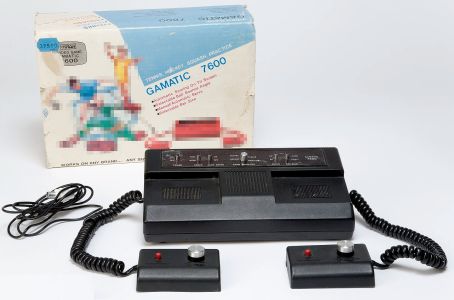
The Grandstand TV Game 2000 (sold as the Adman Grandstand TV Game 2000, model 2000) is a black-and-white Pong-type TV game sold in the UK by Adam Imports of Harrogate under its Adman Grandstand name. It plays four bat-and-ball games on a television, football, tennis, squash and practice, and runs on six C cells or a 9 V adaptor.[5][1] The photographed board is built around a Texas Instruments TMS1965NL game chip and carries the silkscreen "GAMATIC-7600", the name of a Korean-made Pong console that was sold under many brands.[4][6][7]
History
[edit | edit source]The TV Game 2000 is the black-and-white model; Wikipedia lists the colour Grandstand TV Game 3000 beside it with the same four games, also made in Korea.[3] Its box reads "Adman MODEL 2000 GRANDSTAND T.V. GAME", with a roundel marked "B/W VIDEO T.V. GAME".[5] The label on the base reads "ADMAN GRANDSTAND TV GAME 2000" and "MADE IN KOREA".[1] The Science Museum Group records that the colour TV Game 3000 was made in Korea for Adam Imports, a Harrogate electronics importer and distributor.[8]
Wikipedia gives 1977 for the UK release.[3] The TMS1965NL in the photographed console is marked "KA 7740", which in the usual year-and-week form is week 40 of 1977, so that unit was built late in 1977 at the earliest.[4] The Science Museum dates its example of the related TV Game 3000 to 1975, which conflicts with the 1977 date; see Grandstand TV Game 3000#History.[8]
The Home Computer Museum in Helmond describes the Gamatic 7600 as a Pong console "sold worldwide under many brands, as the Grandstand T.V. Game Model 2000 for example", made in Korea, with a board labelled "F'GAMATIC-7600"; the earliest it knows is a Japanese Gamatic 7600 of 1976.[7] The board in the Commons photographs reads "GAMATIC-7600", which agrees.[6] The Centre for Computing History holds an Otron Gamatic 7600 built on the TMS-1965 and notes that Otron was a trading name of the Olympos Electronic Company; the Danish computer history society DDHF also records the Gamatic 7600 as made by Olympos Electronic Co. Ltd.[9][10] No source found names the maker of the Grandstand-badged version directly.
Hardware
[edit | edit source]| Part | Detail |
|---|---|
| Game chip | Texas Instruments TMS1965NL, marked "KA 7740"[4] |
| Other IC | RCA CD4071BE (CMOS quad 2-input OR gate)[4] |
| Main board | Silkscreen "GAMATIC-7600"; wired to the panel switches, control pods and RF can with flying leads[6] |
| RF modulator | Metal can labelled "KDC UM-1111E 30"; picture on a 625-line UHF television[6][5] |
| Picture | Black and white[5] |
| Sound | Speaker in the case under the grille[6] |
| Adjustment | Hole in the rear labelled "HORI - HOLD"[11] |
| Power | 9 V DC from six UM-2 cells or a 9 V adaptor; "POWER CONSUMPTION 360mWATT, 9V DC" moulded in the base[1] |

Texas Instruments released the TMS-1955 and TMS-1965 game chips in 1976. Pong-Story describes both as pin-compatible with General Instrument's AY-3-8500, the chip used in the Grandstand 3600 Mk II and 4600.[12] The TV Game 2000 does not use a GI chip, so information written for AY-3-8500 consoles does not carry over to its board without checking.
The main board is screwed to the upper half of the case at its four corners, with its solder side towards the base, so it is the first thing seen when the base is removed. It is joined to everything else by flying leads: the RF modulator, the speaker, the panel switches and the cables to the two control pods.[6][2] Besides the two ICs, the component side carries a large electrolytic capacitor marked 85 °C, several smaller electrolytics, a trimmer potentiometer and a transistor marked 9016.[4] Their values are not legible in the photograph, and no parts list or schematic for the 2000 has been found.
Games
[edit | edit source]The selector and the box list four games: football, tennis, squash and practice.[13][5] The box describes "Realistic Sound Effects", "Variable Speed. Variable Angle. Variable Player Size." and "Automatic On-Screen Digital Scoring and Manual/Automatic Service".[5]
| Control | Positions |
|---|---|
| POWER | ON, OFF |
| SPEED | FAST, SLOW |
| AUTO SERVE | ON, OFF |
| GAME SELECTOR | FOOTBALL, TENNIS, SQUASH, PRACTICE |
| ANGLE | 20°, 40° |
| BAT SIZE | LARGE, SMALL |
Controls and light gun
[edit | edit source]Each player has a control pod with a BAT CONTROL knob and a red button: SERVE on the left pod and RESET on the right. The pods sit in recesses at the front of the console and are connected by coiled cables, which the box describes as "Integral or Remote Player Controls".[13][5] The 2000 has no light gun and no target games.
Power
[edit | edit source]The base label reads "POWER SUPPLY: 9V-DC (6xUM-2 BATTERY) OR AC ADAPTER 9V", and the rear socket is labelled "AC 9V ADAPTOR". Neither label gives the adaptor current or the plug polarity.[1][11] The owner of the photographed console describes the socket as taking a 9 V DC supply with the centre pin negative.[2] Measure any adaptor's voltage and polarity before plugging it in. Grandstand also sold a switchable Grandstand Universal Mains Adaptor (6-9 V DC, with a polarity switch) for its handheld and tabletop games; no source found says it was meant for the TV games, so check its voltage and polarity setting against the console before using one.[14]
Cells left in the battery box can leak onto the contacts; remove them for storage, and see Battery Explosion, Capacitor or Corrosion Damage for cleaning up after a leak.

One TV Game 2000 on Wikimedia Commons had a 470 µF 16 V electrolytic capacitor (SAMHWA brand) burst and come loose. The owner writes that the capacitor, near the left side of the board, scattered its contents over the inside of the console and knocked a resistor off its solder pads, and that the console does not work.[15][2] Check the electrolytics on any console of this age; Capacitor Failure Symptoms describes what to look for.
Repair
[edit | edit source]No service manual, schematic or parts list for the TV Game 2000 has been found. The TV Game 2000 has its own repair guides:
- Grandstand TV Game 2000 General Maintenance: opening the case, cleaning the switches, control boxes and coiled leads, the cells and the adaptor socket, the RF output and HORI-HOLD, and TMS1965 test points.
- Grandstand TV Game 2000 Troubleshooting Guide: what should happen at power-on, expected measurements and a symptom table.
- Grandstand TV Game 2000 Capacitor Replacement Guide: the burst SAMHWA 470 µF capacitor and what can be read of the other electrolytics.
Documentation
[edit | edit source]An instruction leaflet headed "Adman MODEL 2000" came in the box, and one is visible in the Commons photograph of a boxed console.[5] No scan of it has been found, but the owner of that console has published a photograph of pages 2 and 3: the controls and functions with top, rear and bottom views, the features, a warning to use only the approved Adman adaptor, and the operating procedure, which sets the game for UHF channel 30.[16] No Grandstand service information for the 2000 has been found.
Gallery
[edit | edit source]-
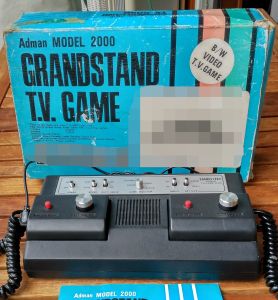 The console in front of its box, with the instruction leaflet at the bottom
-
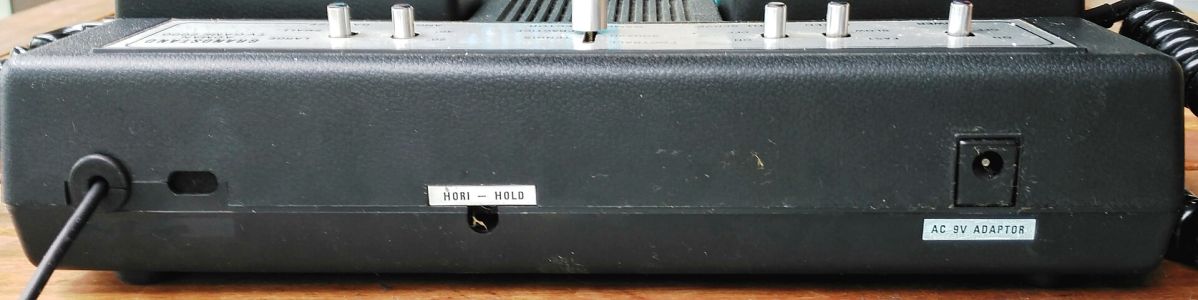 Rear: RF lead, HORI - HOLD adjustment hole and the AC 9V ADAPTOR socket
-
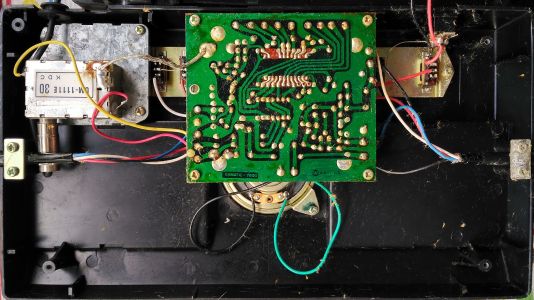 Inside: the board with its GAMATIC-7600 silkscreen, the KDC RF modulator and the speaker
-
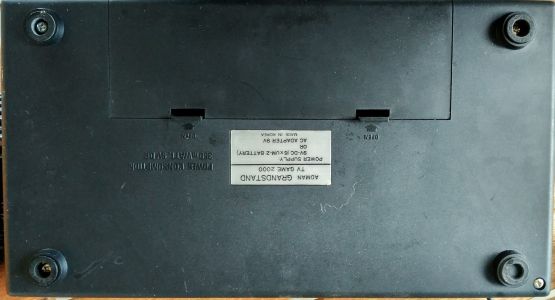 Base label: 9 V DC, six UM-2 cells or a 9 V adaptor, made in Korea
-
 For comparison: an Otron Gamatic 7600 at the Tekniska museet, Stockholm, the same design under its maker's own name, with HOCKEY in place of football on the selector


Related pages
[edit | edit source]- Grandstand TV Game 3000, the colour model with the same four games
- Grandstand TV Game 3600 Mk II and Grandstand Model 4600, Grandstand TV games built on General Instrument's AY-3-8500
- Atari Super Pong, a four-game Pong console of 1976 built on a single Atari game chip, for comparison
- Category:Grandstand
References
[edit | edit source]- ↑ 1.0 1.1 1.2 1.3 1.4 1.5 Photograph by José Antonio Ortigueira Amor, File:Grandstand Adman TV Game 2000 (8).jpg (CC BY 4.0, from Wikimedia Commons): base label "ADMAN GRANDSTAND TV GAME 2000 / POWER SUPPLY: 9V-DC (6xUM-2 BATTERY) OR AC ADAPTER 9V / MADE IN KOREA" and the moulding "POWER CONSUMPTION 360mWATT, 9V DC".
- ↑ 2.0 2.1 2.2 2.3 José Antonio Ortigueira Amor, "Consola Pong Adman Grandstand TV Game 2000", Retro Ordenadores Orty (blog, in Spanish), 7 November 2023 (retrieved 2026-10-18). Owner's description of his console: distributed in the UK in 1977 by Adam Import Ltd; the board is marked GAMATIC-7600 and WK-I HB on its solder side and is exposed by removing four screws and the lower case; the rear socket marked "AC 9V ADAPTOR" is for an external 9 V DC supply with the centre pin negative ("9V DC, centro negativo"), next to the HORI-HOLD control and the RF lead (UHF channel 30).
- ↑ 3.0 3.1 3.2 Wikipedia, "Grandstand (game manufacturer)", table of integrated Pong consoles (retrieved 2026-10-18): the TV Game 2000 as a black-and-white, four-game console made in Korea and released in the UK in 1977, and the TV Game 3000 as its colour equivalent. Secondary source: the row's date cites VTech's corporate history page and its name an old-computers.com page that now shows only a hosting placeholder; the other details in the row have no citation.
- ↑ 4.0 4.1 4.2 4.3 4.4 4.5 Photograph by José Antonio Ortigueira Amor, File:Grandstand Adman TV Game 2000 (6).jpg (CC BY 4.0, from Wikimedia Commons): component side of the main board; "TMS1965NL KA 7740" with the Texas Instruments logo, "CD4071BE RCA 707", a transistor marked 9016, electrolytics and a trimmer. Read from the full-size image; capacitor values are not legible.
- ↑ 5.0 5.1 5.2 5.3 5.4 5.5 5.6 5.7 5.8 Photograph by José Antonio Ortigueira Amor, File:Grandstand Adman TV Game 2000 (2).jpg (CC BY 4.0, from Wikimedia Commons): box text "Adman MODEL 2000 GRANDSTAND T.V. GAME", "B/W VIDEO T.V. GAME", "Plays on any make, any size T.V. (625 Lines UHF)", the four games, the feature list and "Integral or Remote Player Controls"; the "Adman MODEL 2000" instruction leaflet. Read from the full-size image.
- ↑ 6.0 6.1 6.2 6.3 6.4 6.5 6.6 Photograph by José Antonio Ortigueira Amor, File:Grandstand Adman TV Game 2000 (5).jpg (CC BY 4.0, from Wikimedia Commons): the upper case seen from below with the base removed, the board screwed to it at the four corners; board silkscreen "GAMATIC-7600", RF modulator labelled "KDC UM-1111E 30", speaker and wiring. Read from the full-size image.
- ↑ 7.0 7.1 HomeComputerMuseum, Helmond, "Gamatic 7600" (retrieved 2026-10-18): sold under many brands including "the Grandstand T.V. Game Model 2000"; made in Korea; board labelled "F'GAMATIC-7600"; earliest known a Japanese Gamatic 7600 of 1976; TMS-1965 chip; six CM2 cells or 9 V DC, 360 mW.
- ↑ 8.0 8.1 Science Museum Group, "Grandstand TV Game", object Y2005.53 (retrieved 2026-10-18): the Adman Grandstand TV Game 3000, "manufactured in Korea for Adam Imports, a Harrogate based electronics importer and distributor"; made 1975.
- ↑ Centre for Computing History, "OTRON Video Game Gamatic 7600", CH34880 (retrieved 2026-10-18): Pong system on the Texas Instruments TMS-1965; "Otron was a trading name for the Olympos Electronic Company"; dated 1977.
- ↑ Dansk Datahistorisk Forening, "11001527 - GAMATIC 7600 spilkonsol" (retrieved 2026-10-18): producer Olympos Electronic Co. Ltd., model GAMATIC 7600, dated 1978.
- ↑ 11.0 11.1 Photograph by José Antonio Ortigueira Amor, File:Grandstand Adman TV Game 2000 (1).jpg (CC BY 4.0, from Wikimedia Commons): rear labels "HORI - HOLD" and "AC 9V ADAPTOR".
- ↑ David Winter, Pong-Story, "PONG in a Chip" (retrieved 2026-10-18): Texas Instruments' TMS-1955 and TMS-1965 of 1976, pin-compatible with the General Instrument AY-3-8500.
- ↑ 13.0 13.1 13.2 Photograph by José Antonio Ortigueira Amor, File:Grandstand Adman TV Game 2000 (3).jpg (CC BY 4.0, from Wikimedia Commons): the control strip legends, the game selector positions, the two control pods with their BAT CONTROL knobs and SERVE and RESET buttons.
- ↑ Handheld Museum, "Grandstand Universal Mains Adapter", model UGT (retrieved 2026-10-18): sold by Grandstand in the UK for its handheld and tabletop games; 240 V input; switch for polarity and off; 6-9 V DC output. Collector's description.
- ↑ Photograph by José Antonio Ortigueira Amor, File:Grandstand Adman TV Game 2000 (7).jpg (CC BY 4.0, from Wikimedia Commons), with the photographer's description "Exploded and detached capacitor (together with a resistor)": the capacitor is marked SAMHWA 470 µF 16 V. One unit.
- ↑ Adman, TV Game Model 2000 instruction leaflet, pages 2 and 3, photographed by José Antonio Ortigueira Amor and published on Retro Ordenadores Orty (CC BY 4.0), 7 November 2023 (retrieved 2026-10-18): Figure 1 with fifteen numbered parts (including the 9 V adaptor jack, "HORI LOCK" and the battery cover); "Dual power system: 6 x 1.5V UM cell or external 9V AC adaptor"; "Video signal supplied through 75 ohm coaxial cable"; a warning to use only the Adman 2000 TVG adaptor; plugging in the adaptor "disconnects internal battery supply"; the game "is designed for use on channel 30".