

Grandstand Video Entertainment Computer
 | |
| Adman Grandstand Video Entertainment Computer (Schnurrikowski, CC BY-SA 4.0) | |
| Specifications | |
|---|---|
| Manufacturer | Fairchild Camera and Instrument (board marked FAIRCHILD); sold in the UK under the Adman Grandstand name[1][2] |
| Type | Home video game console (ROM cartridge) |
| Released | 1978-1980 (sources differ; see History) |
| CPU | Fairchild F8: 3850 CPU (SL31291) with two 3851 program storage units (SL31253, SL31254)[2][3] |
| Memory | 64 bytes in the CPU; 2 KB video RAM in four 4096 × 1 DRAMs[4][5] |
| Storage | None |
| Display | RF output to a television |
| Sound | Three tones, played through the television[6][7] |
| Graphics | 128 × 64 video RAM at 2 bits per pixel, about 102 × 58 visible; 8 colours[5][3] |
| Media | Fairchild Videocart cartridges[1] |
| Input | Two detachable hand controllers on 9-pin D-sub plugs; five console buttons[8][9] |
| Power | Plug-in mains adaptor (rating not confirmed for the UK unit)[1] |
| OS / Firmware | Built-in Hockey and Tennis in the two program storage units[10][3] |
| Predecessor | Fairchild Video Entertainment System (Channel F) |
The Grandstand Video Entertainment Computer (VEC) is the UK version of the Fairchild Channel F System II, a cartridge video game console built around the Fairchild F8 microprocessor. It was sold in Britain under the Adman Grandstand name; the console carries a "FAIRCHILD" badge on its front panel and the board inside carries the same name.[9][2][1] Like every Channel F it has two games built in, Hockey and Tennis, and takes Fairchild's Videocart cartridges. The System II differs from the original 1976 Channel F in having detachable hand controllers, sound through the television and a much smaller board, on which two custom chips replace most of the original's standard logic chips.[7][10]
The hardware sections below describe the Channel F System II in general and say where a detail is known only for another version (the US System II or the Swedish Luxor equivalent). Grandstand's other products are listed on Category:Grandstand.
History
[edit | edit source]Fairchild launched the Video Entertainment System in the US in 1976. A paper in the proceedings of the first Gametronics conference, published in January 1977, called it the industry's first microprocessor-based ROM cartridge game and set out how its cartridge connector worked.[11] Fairchild licensed the design in Europe, where it was sold under other names, among them Luxor in Sweden, SABA, ITT and Nordmende in Germany, Ingelen in Austria and Grandstand in the United Kingdom.[7][3]
The redesigned System II followed. Its built-in games leaflet is headed "Channel F System II, Fairchild Video Entertainment Computer" and gives the address of Fairchild Video Products in Santa Clara, California.[10] Wikipedia gives two accounts: that the System II grew out of improvements made at Fairchild, and that Zircon International, which bought the rights in 1979 after Fairchild left the video game market that April, redesigned the console as the System II.[7] The dates for the Grandstand version vary by source:
- Binary Dinosaurs, a private collection in Yorkshire, describes the VEC as "released in 1978/9" and says its boxed example has guarantee papers dated January 1980.[1]
- The chips on the scanned Grandstand board carry date codes from week 27 to week 40 of 1978.[2]
- MAME dates the Channel F II to 1978.[3]
- A Grandstand sales leaflet for Spain lists the console as the "Computador de Video" among the products on sale in 1980-1981.[12]
- The Centre for Computing History's two records for the console give August 1976, the date of the original Fairchild launch, not of the Grandstand version.[13]
Binary Dinosaurs describes Adman as the UK importer and distributor and shows the console in a Grandstand-branded box with Videocarts, instruction leaflets and a plug-in mains adaptor.[1]
Hardware (Channel F System II)
[edit | edit source]| Grandstand board (marking as read) | Luxor 9583 schematic | Function |
|---|---|---|
| F 3850, SL31291, 7827 | U1, 3850 CPU (SL31291) | F8 central processing unit |
| F SL31253, 7840 | U3, 3851 PSU (SL31253) | Program storage unit: first 1 KB of the built-in program, controller and video ports |
| SL 31254, 7834 | U2, 3851 PSU (SL31254) | Program storage unit: second 1 KB of the built-in program |
| FCM 9102, 7839 | U5, 9102 audio/buffer | Controller input buffer and tone output |
| 40-pin purple ceramic package, no marking visible | U4, 9111 video (Fairchild's PAL drawing: 9101) | Video generation |
| Four 16-pin Mostek DRAMs, MK4015N, Malaysia | U6-U9, "330470" (EVEN 0, ODD 0, EVEN 1, ODD 1) | Video RAM, 4096 × 1 bits each |
| Crystal (no marking visible) and trimmer capacitor | Y1, 8.863278 MHz as printed, with C18, 3-15 pF trimmer | Master clock |
| 25 V 100 µF (two), 25 V 47 µF (two) | C52 100 µF on +12 V, C50 47 µF on +5 V | Supply decoupling |
Grandstand markings are read from Incog88's scan of the board, which also shows the "FAIRCHILD" silkscreen;[2] Luxor positions and roles are from the circuit diagram in Luxor's service manual for its version of the System II.[14] Fairchild's own PAL drawing of the board uses the same reference numbers for these parts.[15] On a US System II board the video chip is marked FCM 9101/N, and a forum contributor reports FCM 9111 on some units.[16]
Processor and memory
[edit | edit source]
The F8 splits a microprocessor across several chips. The 3850 holds the arithmetic unit, the accumulator, 64 bytes of scratchpad RAM and two 8-bit ports; each 3851 program storage unit (PSU) holds 1 KB of mask-programmed ROM, its own program counter, a timer and two more ports. There is no shared address bus: every chip keeps its own copy of the program counter and follows five ROMC control lines from the CPU.[4][11] MAME maps the console's built-in program as two 1 KB ROMs, SL31253 at 0000 and SL31254 at 0400 (hexadecimal), with the cartridge from 0800 upwards.[3] These are the part numbers on the two PSUs of the Grandstand board.[2]
The CPU's two ports read the front-panel buttons and the right-hand controller and trigger writes to video RAM; the two ports of one PSU read the left-hand controller and set the video RAM column and row, and two bits of the last port select the sound.[17]
The NTSC console runs the F8 at 1.79 MHz, half the colour-burst frequency. MAME runs its PAL versions at 2.0 MHz; Wikipedia gives 2.0 MHz for first-generation PAL consoles and 1.97 MHz for the second generation.[3][7] The Luxor schematic shows an 8.863278 MHz crystal with a trimmer; Fairchild's PAL drawing gives 8.867238 MHz, which is twice the PAL colour subcarrier.[14][15] The crystal on the Grandstand board has no legible marking in the scan.[2]
Video
[edit | edit source]Video RAM holds 128 × 64 positions at 2 bits each, 2 KB in all, but the program can only write to it, never read it back. About 102 × 58 positions are visible on a typical television. Columns 125 and 126, off the visible screen, set the palette for each row, which gives eight colours in all.[5][3] A 1977 account of the original console describes the memory as "four semiconductor random access memories",[11] and the Luxor schematic shows the same four, labelled EVEN 0, ODD 0, EVEN 1 and ODD 1.[14]
The type of RAM changed between generations. VESwiki gives MK4027-compatible DRAM for the first-generation board and MK4015N-compatible DRAM for the second-generation board with the custom video chip.[5] The scanned Grandstand board has four Mostek MK4015N chips,[2] US System II boards have been reported with RAM marked SCM90004C,[16] and Luxor's schematic labels the RAM "330470".[14] On the Luxor board the RAM's pin 1 is fed with -5 V and pins 8 and 9 with +12 V.[14] See Grandstand Video Entertainment Computer Troubleshooting Guide#Video RAM before fitting substitutes.
Sound
[edit | edit source]The sound is three fixed tones divided down from the television line frequency, on a PAL console about 977 Hz, 488 Hz and 122 Hz, which programs switch on and off to make other sounds.[6][18] The original console has a speaker of its own; the System II sends the sound to the television through the RF modulator, so the volume is set on the TV.[7][13] Luxor's System II still lists a loudspeaker among its parts, and its circuit diagram shows a speaker driven from the 9102's tone output as well as the sound feed to the RF modulator.[14] Whether the Grandstand version has a speaker is not recorded in the sources found.
Controllers and front panel
[edit | edit source]Each hand controller is a grip with a triangular knob on top. The knob moves in eight directions, twists clockwise and anticlockwise, pulls up and pushes down, which Binary Dinosaurs counts as "12 way movement".[3][10][1] Fairchild's leaflet tells players to hold the controller with the recessed triangle on the knob pointing at the screen, and never to twist or wrench the knob violently.[10]
The System II controllers unplug from the console and are stored at the back of it.[7] VESwiki lists the plug as a 9-pin D-sub (DE-9) on the Channel F II, Grandstand, Nordmende and Luxor consoles. The connector has the same shape as the Atari joystick port but a different wiring, so Atari-type joysticks are not interchangeable with it.[8][7]
| Pin | 1 | 2 | 3 | 4 | 5 | 6 | 7 | 8 | 9 |
|---|---|---|---|---|---|---|---|---|---|
| Function | Twist anticlockwise | Twist clockwise | Pull up | Push down | Right | Forward | Back | Left | Ground |
Pin assignment from VESwiki.[8]
The front panel is labelled POWER and RESET, followed by four selector buttons numbered 1 to 4 and labelled TIME, MODE, HOLD and START.[9][10] Fairchild's leaflet notes that the selector buttons respond at once and should not be held down for more than a second.[10]
Cartridge slot
[edit | edit source]The cartridge goes into a slot on the right of the console and is released by pressing the panel marked "Press to Eject Cartridge".[9] The cartridge connector has 22 contacts: ground on 1 and 2, +5 V on 19 and 20 and +12 V on 22, with the eight data lines, the five ROMC control lines, the clock (PHI), WRITE and the interrupt request on the rest.[8] Inside a Videocart are usually two more 3851 PSUs. Some cartridges add RAM: MAME emulates a 2102 RAM in Videocarts 10 and 18 and a 3853 memory interface in SABA's chess cartridge.[8][19]
On the original console the cartridge entered a rotating Burndy connector joined to the main board by flat cable.[11] Luxor's parts list for its System II includes an 8-way and an 11-way flat cable and a separate cassette holder,[14] and an owner of a US System II describes unplugging "the ribbon cable from the cartridge reader".[16] Replacement eject buttons for the System II have been published as 3D-printable files.[20]
Power supply
[edit | edit source]Luxor's version runs from the mains through its own power unit: an 80 mA slow-blow fuse, a transformer, a double-pole power switch, 1N4001 rectifier diodes, a 1000 µF reservoir on a +20 V rail and a 2200 µF reservoir on a +10 V rail, plus the power LED and the console's five buttons. On the processor board a µA7812 makes +12 V, a µA78L12 feeds a +14 V line and a µA7805 makes +5 V; a transistor circuit makes the -5 V, 800 µA supply for the video RAM.[14]
The US System II uses an external power "brick". It feeds a power-switch daughter board in the console that carries two electrolytic capacitors, 1000 µF 25 V and 2200 µF, and the 7812 and 7805 regulators sit with their tabs against the metal case. One owner measured 23.3 V in and 12.19 V out at the 7812, and 11.63 V in and 5.03 V out at the 7805.[21]
Binary Dinosaurs' photograph of a boxed Grandstand VEC shows a plug-top mains adaptor packed with the console.[1] No source found gives its rating or says whether it delivers AC or DC, and the Grandstand power-switch board has not been photographed. Read the adaptor's label before using any substitute.
RF output
[edit | edit source]The System II produces an RF signal for the aerial socket of a television. Luxor's version offers channel E3 or E4 (54-62 MHz) at 1-10 mV into 75 ohms, selected by a switch,[14] and US consoles use channel 3 or 4.[21] The scanned Grandstand board has a screened RF section at its top left;[2] the channel it uses is not given in any source found. VESwiki documents a composite video and audio modification for the Channel F II.[22]
Built-in games
[edit | edit source]Hockey and Tennis are built into the console. Pressing RESET puts "G?" on the screen; button 1 chooses Hockey and button 2 Tennis. The console then asks "S?", and button 4 starts at once with an average speed and no time limit; button 1 sets a time limit ("T?") and button 2 a speed ("M?"), each answered with buttons 1 to 4, before button 4 starts the game. Tennis ends when a player reaches 15 points. Button 3 holds the game, so the time or speed can be changed part way through, and a tied Hockey game can go to overtime.[10] The hand controllers move the players up and down in Tennis; in Hockey all the knob's movements are used, including twisting for angled shots and pulling up or pushing down to move the goalkeeper.[10]
The built-in games make a quick test of a console without a cartridge: switch on, press RESET, then 1 and 4, and Hockey should start.[10][23]
Videocarts
[edit | edit source]The VEC plays Fairchild's Videocarts. The cartridges kept with Binary Dinosaurs' Grandstand console are numbers 1 (Tic-Tac-Toe, Shooting Gallery, Doodle, Quadra-Doodle), 2 (Desert Fox, Shooting Gallery), 3 (Video Blackjack), 4 (Spitfire), 8 (Magic Numbers, Mindreader, Nim), 9 (Drag Strip), 10 (Maze, Jailbreak, Blind-man's-buff, Trailblazer), 11 (Backgammon, Acey-Deucey), 14 (Sonar Search) and 17 (Pinball Challenge).[1] Scans of many Fairchild Videocart instruction leaflets are on the Internet Archive.[24]
PCB schematics and service information
[edit | edit source]No Grandstand service manual has been found. These documents cover the same design:
- File:Luxor TV Computer Game 1909583 Service Manual.pdf: Luxor's service manual for its System II (type 190 9583, May 1980), with the full circuit diagram of the processor board, the mains unit and a spare parts list. It and Fairchild's drawing below are the two published schematics of the System II board.[14]
- File:Fairchild Channel F II PAL VHF Schematic 060190-A.jpg: Fairchild's drawing 060190-A of the System II board for PAL television on VHF, published by VESwiki as the SABA Videoplay 2 schematic. It is the only Fairchild drawing of the System II board found.[15]
- File:Fairchild Video Entertainment System Service Manual.pdf: Fairchild's service notes for the original console, with a test cartridge procedure and a table of faulty screen pictures and their causes.[25]
- File:Luxor TV Computer Game 1909574 Service Manual.pdf: Luxor's manual for its first-generation console, with a 1979 service bulletin of common faults.[26]
- File:Fairchild Channel F System II Built-in Games Instructions.pdf: the System II leaflet for Hockey and Tennis.[10]
General maintenance
[edit | edit source]Cleaning, power checks, the controllers and cartridge contacts are covered on Grandstand Video Entertainment Computer General Maintenance.
Capacitor replacement
[edit | edit source]The main board has four electrolytic capacitors, two 25 V 100 µF and two 25 V 47 µF, read from the board scan and matched to the +12 V and +5 V rails of the Luxor and Fairchild diagrams.[2][14][15] The list, the power-section reservoir capacitors of the Luxor and US versions and the procedure are on Grandstand Video Entertainment Computer Capacitor Replacement Guide.
Troubleshooting
[edit | edit source]Fault-finding by symptom, from green screens to failed video RAM, is on Grandstand Video Entertainment Computer Troubleshooting Guide.
Gallery
[edit | edit source]-
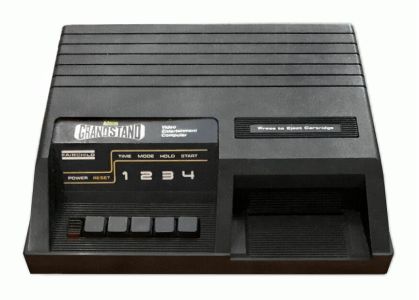 The console (Schnurrikowski, CC BY-SA 4.0)
 -
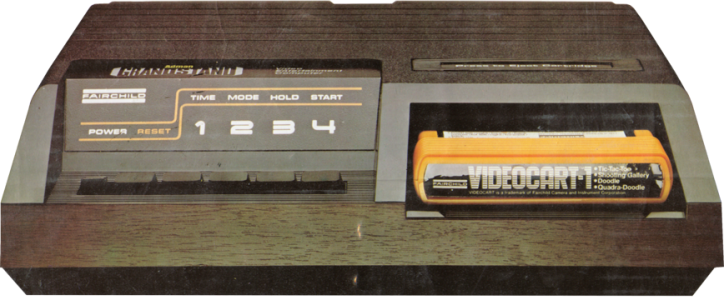 With Videocart-1 in the slot (Incog88, CC BY-SA 3.0)
 -
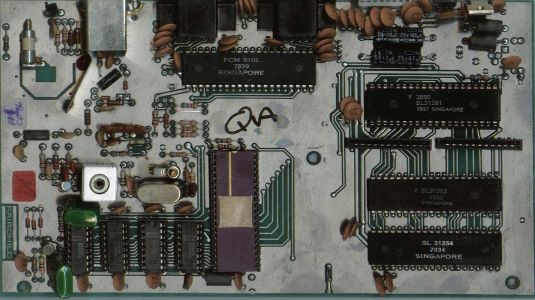 The main board (Incog88, CC BY-SA 3.0)


Related pages
[edit | edit source]- Grandstand Video Entertainment Computer General Maintenance
- Grandstand Video Entertainment Computer Troubleshooting Guide
- Grandstand Video Entertainment Computer Capacitor Replacement Guide
- Grandstand Colour Programmable SD070
- Category:Grandstand
References
[edit | edit source]- ↑ 1.0 1.1 1.2 1.3 1.4 1.5 1.6 1.7 1.8 Adrian Graham, "Grandstand VEC", Binary Dinosaurs (private collection; retrieved 2026-10-18): "Released in 1978/9, the VEC was the UK equivalent of the Fairchild Channel-F II"; guarantees dated January 1980; Adman as UK importers and distributors; "12 way movement" controllers; Pong (the built-in games) in the console; boxed set in a Grandstand box with a plug-in mains adaptor (photograph); list of Videocarts owned. A companion page shows the same console in its original Fairchild box.
- ↑ 2.00 2.01 2.02 2.03 2.04 2.05 2.06 2.07 2.08 2.09 Incog88, scan of the Grandstand Video Entertainment Computer main board, from Wikimedia Commons (CC BY-SA 3.0), read at full size (2477 × 1389): "FAIRCHILD" silkscreen; "F 3850 SL31291 7827 SINGAPORE"; "F SL31253 7840 SINGAPORE"; "SL 31254 7834 SINGAPORE"; "FCM 9102 7839 SINGAPORE"; four 16-pin Mostek DRAMs marked "MK4015N MALAYSIA"; one 40-pin purple ceramic package with no visible marking; crystal with no visible marking, trimmer capacitor beside it; electrolytics 25 V 100 µF (two) and 25 V 47 µF (two); screened RF section top left.
- ↑ 3.0 3.1 3.2 3.3 3.4 3.5 3.6 3.7 3.8 MAME source, channelf.cpp (commit 774a180, August 2026): BIOS ROMs SL31253 (0000-03FF) and SL31254 (0400-07FF), cartridge from 0800; F8 at 3.579545 MHz/2 for NTSC and 4 MHz/2 for PAL versions; panel buttons TIME, HOLD, MODE, START; controller inputs (eight directions, twist both ways, pull up, push down); Channel F II dated 1978, with SABA Videoplay 2, Luxor Video Entertainment Computer, ITT and Ingelen Tele-Match Processor as its clones. Emulator source written from real hardware; channelf_v.cpp for the 128 × 64 video RAM and the per-row palette.
- ↑ 4.0 4.1 VESwiki (channelf.se, maintained by Fredric Blåholtz), "F8" (retrieved 2026-10-18): the F8 chip family; 3850 CPU with 64-byte scratchpad and two ports; 3851 PSU with 1 KB ROM, program counter, timer and two ports; no address bus, each chip with its own program counter, controlled by five ROMC lines.
- ↑ 5.0 5.1 5.2 5.3 VESwiki, "VRAM" (retrieved 2026-10-18): 8192 × 2 bits (2 KB), write-only through the ports; columns 125 and 126 set the row palette; about 102 × 58 visible; MK4027-compatible DRAM in first-generation consoles and MK4015N-compatible DRAM in the second generation (VLSI); MK4027/MK4015 pinout; a 4164 substitution described for the "System Fairchild unit".
- ↑ 6.0 6.1 VESwiki, "Outputting Sound" (retrieved 2026-10-18): three tones derived from the line frequency, on PAL about 976.56 Hz, 488.28 Hz and 122.07 Hz; second-generation consoles send the sound to the TV.
- ↑ 7.0 7.1 7.2 7.3 7.4 7.5 7.6 7.7 Wikipedia, "Fairchild Channel F" (retrieved 2026-10-18), for history and framing: European versions including the Grandstand Video Entertainment Computer; System II changes (removable controllers on a connector shaped like the Atari joystick port but not Atari-compatible, storage at the back, sound through the TV, two custom chips replacing TTL logic); Fairchild left the market in April 1979 and Zircon sold the System II; NTSC and PAL clock rates.
- ↑ 8.0 8.1 8.2 8.3 8.4 VESwiki, "Pinouts" (retrieved 2026-10-18): 22-contact cartridge pinout; hand controller pinout for the "Channel F II, Grandstand, Nordmende, Luxor 9 pin D-SUB female connector"; colour code for the wired controllers of the first-generation consoles; FCM9102 described as the audio/buffer chip.
- ↑ 9.0 9.1 9.2 9.3 Schnurrikowski, photograph of the Adman Grandstand Video Entertainment Computer, 5 July 2019, from Wikimedia Commons (CC BY-SA 4.0): "Adman GRANDSTAND Video Entertainment Computer" and "FAIRCHILD" badges; POWER, RESET, 1 TIME, 2 MODE, 3 HOLD, 4 START legends; cartridge slot with "Press to Eject Cartridge" bar.
- ↑ 10.00 10.01 10.02 10.03 10.04 10.05 10.06 10.07 10.08 10.09 10.10 Fairchild Video Products, Channel F System II, Fairchild Video Entertainment Computer: Playing Tennis / Playing Hockey, two-page leaflet, Santa Clara, California. Hosted here as File:Fairchild Channel F System II Built-in Games Instructions.pdf: RESET and the G? prompt; 1 Hockey, 2 Tennis; S?, T? and M? options; button 4 starts; Tennis to 15 points; button 3 holds the game; Hockey overtime; controller movements in each game; selector buttons not to be held down for more than a second; knob triangle towards the screen; do not twist or wrench the controllers violently.
- ↑ 11.0 11.1 11.2 11.3 Proceedings of the First Annual Gametronics Conference, Electronic Engineering Times, January 1977, Internet Archive scan: Robert M. Bogursky (Burndy Corporation), "A home video game cartridge connector system: interconnection considerations and techniques", pp. 89-108 (the Fairchild VES as "the industry's first microprocessor-based ROM cartridge game"; rotating cartridge connector joined to the main board by flat cable); Ronald L. Baldridge (Mostek Corporation), "Applying the F8 microcomputer family to games", pp. 45-64, at p. 47 (3850 CPU with 16 bits of I/O and a 64-byte scratchpad; 3851 PSU with 16 bits of I/O, 1 KB ROM and a timer); Jerry Eimbinder, "TV game background", pp. 159-165, at p. 165 (the console uses an F8 and "four semiconductor random access memories").
- ↑ José Antonio Ortigueira Amor, "Consola Grandstand Colour Programmable (Model SD 070) (Video Sport Centre) (Endorsed by Kevin Keegan) (1980)", Retro Ordenadores Orty (collector's blog, in Spanish), March 2026 (retrieved 2026-10-18): a Grandstand sales leaflet packed with a Spanish-market SD070 lists the products on sale in Spain in 1980-1981, among them three consoles: the Grandstand "Programable" (SD070), the Grandstand "Computador de Video" (the Video Entertainment Computer) and the Grandstand 3600 Mk II.
- ↑ 13.0 13.1 Centre for Computing History, "Adman Grandstand (Fairchild Channel-F) Video Entertainment Computer" (CH5768) and "Grandstand Video Entertainment Computer (Fairchild Channel-F)" (CH50207) (retrieved 2026-10-18): museum records of the UK Adman Grandstand version, dated August 1976 (the Fairchild launch date); System II sound passed to the television through the RF switch; detachable controllers on the System II.
- ↑ 14.00 14.01 14.02 14.03 14.04 14.05 14.06 14.07 14.08 14.09 14.10 Luxor, Service Manual, TV Computer Game, type 190 9583, May 1980, document 66 79583-01. Hosted here as File:Luxor TV Computer Game 1909583 Service Manual.pdf (from VESwiki's Schematics page): technical data (220-250 V 50 Hz; 4.43361875 MHz subcarrier; RF channel E3 or E4, 54-62 MHz, 1-10 mV into 75 ohms); spare parts list (flat cables 8-way and 11-way, cassette holder, eject button, loudspeaker, mains unit, diode switch); mains unit circuit (80 mA T fuse, centre-tapped transformer, 1N4001 rectifiers, 1000 µF on +20 V, 2200 µF on +10 V, TIL220 LED, Reset, Time, Mode, Hold and Start buttons); processor board circuit: U1 3850 (SL31291), U2 3851 (SL31254), U3 3851 (SL31253), U4 9111 video, U5 9102 audio/buffer driving an 8 ohm speaker through Q2, U6-U9 "330470" RAM with -5 V on pin 1 and +12 V on pins 8 and 9, Y1 8.863278 MHz with C18 3-15 pF trimmer, Q4 µA7805 with C50 47 µF, Q5 µA7812 with C52 100 µF, Q6 µA78L12 for +14 V, -5 V at 800 µA from Q1, RF oscillator with a CH3/CH4 switch.
- ↑ 15.0 15.1 15.2 15.3 Fairchild Camera and Instrument, Video Products Division, drawing 060190-A, "IC PAL VHF Schematic". Hosted here as File:Fairchild Channel F II PAL VHF Schematic 060190-A.jpg (from VESwiki, where it is published as the SABA Videoplay 2 schematic): U1 3850 CPU; U2 and U3 3851 PSUs; U4 9101 video; U5 9102 audio/buffer; U6-U9 "330470" RAM; Y1 8.867238 MHz with C18 3-15 pF trimmer; Q4 7805 with C50 47 µF on +5 V; Q5 7812 with C52 100 µF on +12 V; -5 V at 800 µA.
- ↑ 16.0 16.1 16.2 AtariAge Forums, "Fairchild Channel F System 2 Chip", February 2020 to November 2021 (retrieved 2026-10-18): chips on a US System II board (SL31291, SL31253, SL31254, FCM 9102, FCM 9101/N, four SCM90004C RAMs); FCM 9101/N reported as the video chip, labelled FCM 9111 in some units; the ribbon cable to the cartridge reader.
- ↑ VESwiki, "Port" (retrieved 2026-10-18): CPU ports 0 and 1 (console buttons, video RAM write, right controller, pixel colour bits) and PSU ports 4 and 5 (left controller, video RAM column and row, tone bits).
- ↑ MAME source, channelf_a.cpp (commit 774a180): three tone modes (about 1 kHz, 500 Hz and a low tone) derived from the vertical pixel counter, with a decay envelope.
- ↑ MAME source, bus/chanf/rom.cpp (commit 774a180): Channel F cartridge types: ROM only; ROM with a 2102 RAM (Videocarts 10 and 18); ROM with a 3853 (SABA Schach).
- ↑ Nathan Mitchell (Parzval47), "Fairchild Channel F System 2 Replacement Cartridge Eject Button" and "Fairchild Channel F System 2 Eject Button", 2021, CC BY 4.0, Thingiverse designs 4747828 and 4745385, mirrored on the Internet Archive as thingiverse-4747828 and thingiverse-4745385.
- ↑ 21.0 21.1 AtariAge Forums, "Explosive Fairchild Channel F problems", August 2018 to June 2020, two pages (retrieved 2026-10-18): US System II with an external power brick and a power-switch daughter board carrying a 25 V 1000 µF and a 2200 µF capacitor; µA7812 and µA7805 with their tabs against the metal case; measured 23.3 V to 12.19 V and 11.63 V to 5.03 V; channel 3 or 4 output.
- ↑ VESwiki, "Modding" (retrieved 2026-10-18): composite video and audio modification, with hook-up points for the Channel F, the Channel F II and the SABA Videoplay 2.
- ↑ AtariAge Forums, "Fairchild Channel F Repair - Help Request", October 2016 to May 2017 (retrieved 2026-10-18): starting Hockey by pressing 1 then 4 as a test.
- ↑ Internet Archive, Fairchild Channel F manuals and the individual "Fairchild Channel F Videocart ... Manual" items.
- ↑ Fairchild, Service Manual for the Video Entertainment System, c. 1976, 8 pages. Hosted here as File:Fairchild Video Entertainment System Service Manual.pdf (from the Internet Archive): first-generation console; test cartridge; RAM test; disassembly; frequency and colour adjustment; "Analysis Aid" fault table.
- ↑ Luxor, Service Manual, TV Computer Game, type 1909574, August 1978, with Servicemeddelande No. 5, 15 February 1979, "Servicetips TV-datorspel typ 190 9574". Hosted here as File:Luxor TV Computer Game 1909574 Service Manual.pdf: first-generation console; parts list (LM309 5 V and LM341T12 12 V regulators, 4027 RAM, SL31253, SL31291, SL31254); fault tips in Swedish.

