

IBM PS/2 Model 60
 | |
| IBM PS/2 Model 60 (8560) MCA 286 tower | |
| Specifications | |
|---|---|
| Developer | IBM Entry Systems Division, Boca Raton (1987–1989); IBM Raleigh, North Carolina (1989–1990) |
| Manufacturer | IBM |
| Type | Floor-standing tower personal computer |
| Released | April 2, 1987 |
| Discontinued | October 1990 |
| CPU | Intel 80286 @ 10 MHz, 1 wait state (125-ns DRAM throughout life) |
| Memory | 1 MB on planar; 7 MB max via MCA memory cards |
| Storage | 1.44 MB 3.5" diskette + 44 MB ST-506 (8560-041) or 70 MB ESDI (8560-071) via MCA controller |
| Display | Integrated VGA on planar (15-pin DSUB) |
| Sound | PC speaker |
| Dimensions | 597 H × 166 W × 482 D mm |
| Weight | 21.3 kg (47 lb) |
| OS / Firmware | IBM PC DOS 3.3 and later; IBM OS/2 1.x; IBM AIX PS/2 |
| Predecessor | IBM PC AT (5170) |
| Successor | IBM PS/2 Model 65 SX (March 1990) — same chassis, 386SX, SCSI |
| Model no. | 8560 |
The IBM Personal System/2 Model 60 (machine type 8560) is a high-end floor-standing tower in IBM's PS/2 family, announced on April 2, 1987 alongside the IBM PS/2 Model 30, IBM PS/2 Model 50 and IBM PS/2 Model 80. The Model 60 shares the Model 50's Intel 80286 at 10 MHz and integrated VGA, but in a tower case with eight MCA slots (vs the Model 50's four), four drive bays (vs three) and a much larger 207 W or 225 W PSU (vs the Model 50's 94 W). Together with the IBM PS/2 Model 80 (in the same tower chassis), the Model 60 was IBM's first Intel-based PC in a tower form factor and was influential in popularising the tower in PC case design.
Although a poor seller (it was the worst-selling PS/2 in the line by January 1990), the Model 60 launched the PC-class tower trend that PCs from a dozen vendors had adopted by 1988. IBM directly replaced the Model 60 with the Personal System/2 Model 65 SX (8565) in March 1990, which shares the same tower chassis but moves to an Intel 386SX at 16 MHz and a SCSI hard drive. The Model 60 was discontinued in October 1990.
History
The Model 60 launched at US $5,295 for the 8560-041 (44 MB ST-506 hard drive) or $6,295 for the 8560-071 (70 MB ESDI hard drive). It sat between the mid-range Model 50 (US $3,595, desktop) and the Model 80 (starting at US $6,995, tower with 386).
The Model 60 was launched at IBM's Boca Raton factory in April 1987. By July 1987 the factory was producing approximately 800 Model 60s per day, vs 1,000 Model 50s — establishing the Model 60 as a slow seller from the outset. The Model 60 continued to sell poorly throughout its three-year lifespan; by January 1990 it was the worst-selling PS/2 in the line-up, with IBM shipping fewer units per month than even the more expensive Model 80. In early 1989 IBM moved Model 60 production from Boca Raton to Raleigh, North Carolina, after shutting down the Boca Raton system production lines.
PC Magazine journalist Winn L. Rosch concluded in a long-form review that the Model 60 was "priced out" for single-user customers, but for multiuser file-server applications "will serve well." InfoWorld's Steve Satchell wrote that the Model 60's video performance was "nothing less than astounding."
In March 1990 IBM introduced the PS/2 Model 65 SX (8565) in the same tower chassis. The 65 SX uses an Intel 386SX at 16 MHz, has all 16-bit MCA slots (same as the Model 60), and ships with a SCSI hard drive in place of ESDI. The 65 SX directly replaced the Model 60. Final Model 60 units left the line at IBM's Raleigh factory in October 1990.
A specialised variant, the 6152 Academic System, was introduced in February 1988. The 6152 is a Model 60 chassis with a RISC Adapter Card on the MCA bus carrying an enhanced ROMP-C microprocessor, MMU, FPU and up to 8 MB of dedicated RISC memory. The 6152 ran the IBM Academic Operating System (AOS), a version of BSD UNIX for the ROMP processor, and was sold to universities only.
Submodels
| Submodel | Stock RAM | Max RAM | HDD | MCA slots | Drive bays | Released | Notes |
|---|---|---|---|---|---|---|---|
| 8560-041 | 1 MB | 7 MB | 44 MB ST-506 | 8 (1 × 8-bit + 7 × 16-bit) | 4 | April 1987 | US $5,295 launch |
| 8560-071 | 1 MB | 7 MB | 70 MB ESDI | 8 (1 × 8-bit + 7 × 16-bit) | 4 | April 1987 | US $6,295 launch |
The Model 65 SX successor (8565-061 / 121 / 321 with 60 MB / 120 MB / 320 MB SCSI drives) used a different planar with a SCSI host adapter and is documented separately.
Architecture
The Model 60 planar uses an Intel 80286 at 10 MHz with the IBM PS/2 Model 50/60 chipset family. The planar carries:
- CPU: Intel 80286 in a 68-pin PGA socket, 10 MHz, 1 wait state to memory (the same 125-ns DRAM throughout the Model 60's life — IBM never gave the Model 60 the 85-ns DRAM upgrade that made the Model 50 into the Z).
- Math coprocessor: Intel 80287 socket adjacent to the 80286. Optional.
- MCA bus: Eight MCA slots total. One is 8-bit MCA (for legacy 8-bit MCA cards); the other seven are 16-bit MCA. No 32-bit MCA slots; no ISA compatibility.
- Integrated VGA on the planar with the IBM VGA gate-array implementation and an Inmos IMSG171P-style RAMDAC. Modes: 80×25 / 80×50 text, 640×480×16, 320×200×256, 720×400×16 text (8×16 character box). Output on 15-pin DSUB at rear. Analog monitors only.
- Integrated I/O:
- PS/2 keyboard (Mini-DIN-6).
- PS/2 pointing-device port (Mini-DIN-6).
- Asynchronous serial (DB-25 male).
- Centronics parallel (DB-25 female).
- Floppy controller: PS/2 single-cable interface integrated on the planar, 1.44 MB 3.5" half-height drive.
- Hard drive interface: None on the planar — the hard drive is supplied through an MCA controller card. The drive plugs directly into a connector on the rear edge of the controller card, eliminating a separate ribbon cable to the planar. The 8560-041 uses the IBM Fixed Disk Adapter/A (ST-506); the 8560-071 uses the IBM ESDI Fixed Disk Adapter/A.
- BIOS: 128 KB total, split between CBIOS (DOS-compatible) and ABIOS (OS/2 protected-mode). Two 64 KB EPROM / mask-ROM chips at U-positions.
- CMOS / RTC: Battery-backed via the Motorola MC146818 RTC on early Model 60 units (with a discrete external 4×AA battery pack feeding the planar via a 4-pin header), or the Dallas DS1287 / DS12887 integrated module on later production units.
Memory subsystem
The Model 60 has four 30-pin PS/2 SIMM sockets on the planar, each accepting 256 KB parity SIMMs (1 MB on planar standard, 4 × 256 KB). Additional RAM is provided via MCA memory cards, with the system maximum at 7 MB. SIMMs are IBM PS/2-pinout 125-ns parity.
Storage
- Floppy: 1.44 MB 3.5" half-height, PS/2 single-cable interface.
- Hard drive (8560-041): 44 MB Seagate ST-506-class drive on the IBM Fixed Disk Adapter/A.
- Hard drive (8560-071): 70 MB Maxtor / Miniscribe / Western Digital ESDI drive on the IBM ESDI Fixed Disk Adapter/A.
Additional drives can be fitted in the four-bay drive cage; the Model 60 supports up to two hard drives plus a 5.25" full-height device (often a tape drive).
Chassis
The Model 60 chassis is a floor-standing tower, 597 H × 166 W × 482 D mm, weighing 21.3 kg (47 lb). The same tower chassis is used by the IBM PS/2 Model 80 and the later Model 65 SX. The drive cage runs vertically up the front; the MCA cards plug into the riser on the left side; the planar mounts on the floor; the PSU sits at the top.
The tower introduced PC-class machines to the floor-standing form factor and inspired competitors to follow within 12 months.
Power Supply
- 207 W (8560-041) — sufficient for ST-506-equipped machines.
- 225 W (8560-071) — uprated for the higher-current ESDI drive.
Both PSUs are 110/220 VAC auto-sensing with auto-restart. PS/2 single-cable drive power feed — no Molex 4-pin connectors.
The Model 60 PSU is not interchangeable with the Model 50 PSU (different planar connectors). It is interchangeable with the Model 80 PSU in the same chassis.
BIOS and Reference Diskette
The Model 60 has no built-in SETUP screen. All configuration through the Model 60-specific Reference Diskette (version 1.07 final). The Reference Diskette is not interchangeable with the Model 50 Reference Diskette.
ADF files for each fitted MCA card must be on the working Reference Diskette before Auto Configuration can complete.
General Maintenance
Tower chassis opening, drive cage access, MCA card handling, ESDI drive servicing and CMOS battery replacement (DS12887 or external pack) are documented in IBM PS/2 Model 60 Maintenance Guide.
Troubleshooting
Audio beep codes, the full PS/2 numeric POST code reference (including ESDI 104xx errors specific to the 8560-071), 165 card-ID-mismatch handling, ECA recalls and the documented Model 60 Reference Diskette quirks are in IBM PS/2 Model 60 Troubleshooting Guide.
Capacitor Replacement
Planar tantalums, the larger 207 / 225 W PSU recap, the ESDI Fixed Disk Adapter/A capacitors and the ESDI / floppy drive logic board recap procedures are in IBM PS/2 Model 60 Capacitor Replacement Guide.
Gallery
-
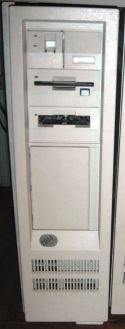 IBM PS/2 Model 60 (8560) tower
 -
 Model 60 front badge

Related Pages
- IBM PS/2 Model 60 Maintenance Guide
- IBM PS/2 Model 60 Troubleshooting Guide
- IBM PS/2 Model 60 Capacitor Replacement Guide
- IBM PS/2 Model 50 — desktop sibling
- IBM PS/2 Model 80 — 32-bit MCA 386 in the same tower chassis
- IBM PS2 Model 60 Technical Reference (May 1988) — official IBM Technical Reference (PDF on the wiki)
References
- IBM PS/2 Model 60 — Wikipedia. Source for release dates, US $5,295 / $6,295 launch pricing, eight MCA slots (1 × 8-bit + 7 × 16-bit), four drive bays, 21.3 kg weight, slow seller status, Boca Raton → Raleigh production move, October 1990 discontinuation, PC Magazine / InfoWorld reviews, and the 6152 Academic System ROMP-C variant.
- IBM PS/2 Model 60 — Technical Specifications, Ardent Tool of Capitalism (IBM document GJAN-43VS3S). Source for the 207 W / 225 W PSU ratings, FRU breakdown and submodel-by-submodel hardware details.
- IBM, IBM Personal System/2 Hardware Maintenance Manual (S52G-9971-02, October 1994). Authoritative FRU listings and ECA recall data.