Grandstand TV Game 3000 Capacitor Replacement Guide

The Grandstand TV Game 3000 (Adman Grandstand TV Game 3000) is a four-game colour Pong console made in Korea, dated about 1977 to 1979 by the Museum of Design in Plastics.[1][2] It shares its case, base and control boxes with the black-and-white Grandstand TV Game 2000,[2][3] but nobody has published a photograph of a 3000's board, its chip, a parts list or a schematic, so none of its capacitors is known. A TV Game 2000 in the same case has had an electrolytic burst inside it.[4][5] What follows is everything published that bears on the 3000's capacitors, the 2000's findings labelled as the 2000's, and how to open a 3000, record its board and replace its parts.
Opening and care are on Grandstand TV Game 3000 General Maintenance; symptoms are on Grandstand TV Game 3000 Troubleshooting Guide.
What is known for the 3000
[edit | edit source]- The base label reads "POWER SUPPLY: 9V-DC (6xUM-2 BATTERY) OR AC ADAPTER 9V", and the base is moulded "POWER CONSUMPTION 360mWATT, 9V DC".[2] At 9 V, 360 mW is a current of 40 mA.
- The museum's example came with a plug-in mains adaptor.[1][2] A collector who bought another 3000 found it worked on fresh batteries, and notes that it "takes the usual 9V but has a different plug".[6] No source gives the socket's polarity.
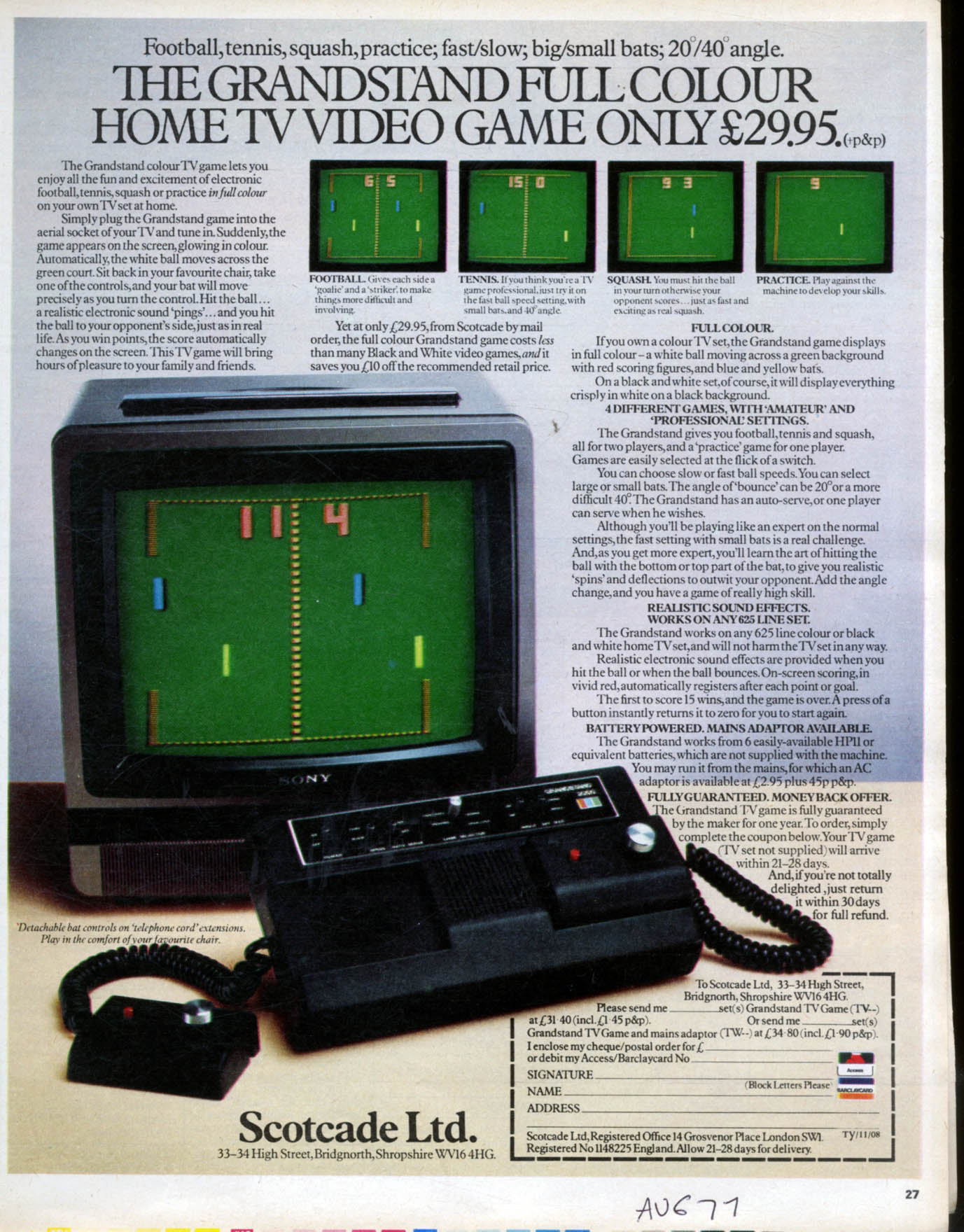
- Its panel carries a red, green and blue block beside the model name.[2] A 1977 mail-order advertisement for a four-game "full colour" Grandstand TV game, whose model number cannot be read in the scan, describes the picture as a white ball, a green background, blue and yellow bats and red scores on any 625-line set, with sound effects when the ball is hit or bounces.[7] A colour console needs a colour circuit that the black-and-white 2000 lacks; nothing about the 3000's has been published.
- No capacitor value, position or failure has been reported for a 3000.
The TV Game 2000, for comparison
[edit | edit source]| Position on the 2000 board | Capacitance | Voltage | Notes |
|---|---|---|---|
| Burst part, near the left side of the board, left of the other large capacitor (owner's description) | 470 µF | 16 V | SAMHWA, lavender sleeve; exploded |
| Large lavender electrolytic at the left edge of the component side | Not legible | Not legible | Only "85°C" can be read |
| Three white electrolytics with silver tops, left of the CD4071BE | Not legible | Not legible | Printing faces away |
| Two small lavender electrolytics, lower left | Not legible | Not legible |
From the owner's description and photographs of the 2000, examined at full size.[4][5][8] The 2000's own guide is Grandstand TV Game 2000 Capacitor Replacement Guide.
The 2000's board is a Gamatic 7600 design built around a Texas Instruments TMS1965NL, a black-and-white chip.[8][9] Whether the 3000 uses a version of that board with a colour circuit added, or a different board, is not known. Treat the table as a pointer to the kind of part to look for: a 470 µF 16 V electrolytic, the largest value known on that board, failed on the 2000, so check the largest electrolytics on a 3000 first.
Signs of trouble
[edit | edit source]- A capacitor that has burst. On the 2000 the burst one scattered its contents through the case, was hard to clean off and knocked a resistor off its pads, and that console no longer works.[4] Look for fibrous or grey debris inside the case and on both sides of the board.
- Swollen tops, split sleeves, brown stains or electrolyte at the base of a capacitor.
- A picture that rolls, shows hum bars, or loses its colour, once the cells or adaptor and the television's tuning have been checked. See Grandstand TV Game 3000 Troubleshooting Guide and Capacitor Failure Symptoms.
- A wrong adaptor. The 2000's leaflet warns that only the Adman 2000 adaptor should be used, and the owner gives the 2000's socket as centre negative.[10][4] An electrolytic connected across a reversed supply is put under reverse voltage, which electrolytics do not tolerate. Measure the 3000's socket against its battery terminals before using any adaptor.
- Leaked cells: see Battery Explosion, Capacitor or Corrosion Damage.
Recording a 3000 board
[edit | edit source]No 3000 board has been described in public. When you open one:
- Photograph both sides of the board and the inside of the upper case before touching anything.
- Record the game chip's full marking and any marking on the board itself (the 2000's reads GAMATIC-7600 and WK-I HB on the solder side).[4]
- Record each electrolytic's position, capacitance, voltage, maker, size and stripe side. Turn parts gently to read printing that faces away.
- Note any parts around a crystal or trimmer that the 2000 does not have: they are likely to be the colour circuit.
- Test every part you take off the board on a capacitance or ESR meter and note the reading.
Opening and recapping
[edit | edit source]- Release the battery cover by its two tabs marked OPEN and take out the six cells. Unplug the adaptor.[2]
- Turn the console over onto a soft cloth with the control boxes in their recesses. Remove the screws recessed in the four rubber feet.[2] The museum's example has a small screw beside one corner, in the same place as one on the photographed 2000; check whether it also holds the base.[2][3]
- Lift the base slowly, watching for wires. On the 2000 the board stays in the upper half, screwed at its corners, with the RF modulator on a separate metal plate;[3] the 3000 may differ.
- If there is debris from a burst capacitor, clean all of it from both sides of the board and the case with isopropyl alcohol and a soft brush, and look for corroded tracks underneath.
- Replace one capacitor at a time: read and record it, desolder it with a pump or braid, and fit a new part of the same capacitance and the same or higher voltage, rated 105 °C, with the same lead spacing and polarity. Where a part has burst and its value is lost, find the value from another 3000, never from a guess.
- Look for resistors or other parts damaged by a burst capacitor, as happened on the 2000, and replace them with the value read from an identical board.[4]
- Refit the board, then the base, with the coiled control-box leads routed as before.
Recommended tools and parts
[edit | edit source]- Temperature-controlled soldering iron, desoldering pump or braid, flux, isopropyl alcohol and a soft brush.
- A multimeter and an ESR meter, or a capacitance meter, for the parts you take out.
- 105 °C radial electrolytics of current manufacture (Nichicon, Panasonic, Rubycon or similar) in the values your 3000 turns out to use.
- A current-limited 9 V bench supply, set to about 100 mA, with the polarity you measured on your own console. See also Recommended Tools.
Checks after recapping
[edit | edit source]| Check | Expected | Source |
|---|---|---|
| Supply at the socket or cells | 9 V DC | [2] |
| Supply current | About 40 mA (360 mW at 9 V, from the base moulding) | [2] |
| Picture | Steady colour picture on a 625-line set; the 1977 advertisement describes a white ball, green background, blue and yellow bats and red scores | [7] |
| Sound | Effects when the ball is hit or bounces | [7] |
| Games and switches | Football, tennis, squash and practice on the GAME SELECTOR; SPEED, AUTO SERVE, ANGLE and BAT SIZE all change play | [2][7] |
Related pages
[edit | edit source]- Grandstand TV Game 3000
- Grandstand TV Game 3000 General Maintenance
- Grandstand TV Game 3000 Troubleshooting Guide
- Grandstand TV Game 2000 Capacitor Replacement Guide, the black-and-white model in the same case
References
[edit | edit source]- ↑ 1.0 1.1 Museum of Design in Plastics, Arts University Bournemouth, "Grandstand TV Game 3000 console", AIBDC 0_2556 (retrieved 2026-10-19): a Grandstand TV Game "with two handsets in its original illustrated box. Complete with its power supply adaptor"; inscription "Adman Grandstand TV Game 3000. Made in Korea. Power supply 9V - DC Ax Adamptor 9v"; made in Korea; dated about 1977 to 1979.
- ↑ 2.00 2.01 2.02 2.03 2.04 2.05 2.06 2.07 2.08 2.09 2.10 Photographs on the Museum of Design in Plastics record for AIBDC 0_2556 (non-commercial educational use only; examined at the largest size offered, retrieved 2026-10-18): the panel with POWER, SPEED, AUTO SERVE, a GAME SELECTOR lever for FOOTBALL, TENNIS, SQUASH and PRACTICE, ANGLE and BAT SIZE, and a red, green and blue block beside "GRANDSTAND ADMAN TV GAME 3000"; the base, with a battery cover held by two tabs marked OPEN, the label "ADMAN GRANDSTAND / TV GAME 3000 / POWER SUPPLY: 9V-DC (6xUM-2 BATTERY) OR AC ADAPTER 9V / MADE IN KOREA", the moulding "POWER CONSUMPTION 360mWATT, 9V DC", a rubber foot at each corner with a screw recessed in it and a small screw beside one corner; along the rear edge a plug in the adaptor socket and the fixed RF lead; and the plug-in mains adaptor.
- ↑ 3.0 3.1 3.2 The black-and-white Grandstand TV Game 2000 in the same case: photographs File:Grandstand Adman TV Game 2000 (1).jpg, File:Grandstand Adman TV Game 2000 (5).jpg and File:Grandstand Adman TV Game 2000 (8).jpg (José Antonio Ortigueira Amor, CC BY 4.0, from Wikimedia Commons) show the same base, feet, battery cover and rear layout, and inside a board screwed to the upper case at its corners with a separate KDC modulator on a metal plate.
- ↑ 4.0 4.1 4.2 4.3 4.4 4.5 José Antonio Ortigueira Amor, "Consola pong Adman Grandstand TV Game 2000 (WK-I HB) (1977)", Retro Ordenadores Orty (collector's blog, in Spanish), 7 November 2023 (retrieved 2026-10-19): the owner's TV Game 2000, with a TMS1965NL and a CD4071BE; rear socket "AC 9V ADAPTOR" for 9 V DC, centre negative; board marked GAMATIC-7600 and WK-I HB; it does not work, because a capacitor near the left side of the board, to the left of the other capacitor, exploded, scattered its contents through the case (hard to clean, and some remains on the board) and knocked a resistor off its solder pads.
- ↑ 5.0 5.1 Photograph by José Antonio Ortigueira Amor, File:Grandstand Adman TV Game 2000 (7).jpg (CC BY 4.0, from Wikimedia Commons), with the photographer's description "Exploded and detached capacitor (together with a resistor)", examined at full size: a lavender-sleeved capacitor printed "SAMHWA" and "470µF16V", a crumpled grey mass, and a resistor whose body is charred.
- ↑ Ian Hill, "Grandstand 3000", Ian's Retro Museum (collector's site; photographs not freely licensed) (retrieved 2026-10-19): controllers fixed to the unit and stored in recesses; switches for power, speed, auto/manual serve, game selector, bat angle and size; battery compartment in the base; aerial lead and external power connection at the rear, "it takes the usual 9V but has a different plug"; the button on one controller stuck down; the batteries supplied were dead, and on new batteries "the unit works ok".
- ↑ 7.0 7.1 7.2 7.3 Scotcade Ltd, Bridgnorth, mail-order advertisement "The Grandstand full colour home TV video game only £29.95 (+p&p)", scan at fulltable.com marked "AUG 77" (retrieved 2026-10-18): football, tennis, squash and practice; on a colour set a white ball, a green background, blue and yellow bats and red scores; works on any 625-line set; the model number is not legible in the scan; sound effects when the ball is hit or bounces; six HP11 batteries or a mains adaptor.
- ↑ 8.0 8.1 Photograph by José Antonio Ortigueira Amor, File:Grandstand Adman TV Game 2000 (6).jpg (CC BY 4.0, from Wikimedia Commons), examined at full size: the component side of a TV Game 2000 board with "TMS1965NL KA 7740" (Texas Instruments), "CD4071BE", a large lavender electrolytic of which only "85°C" can be read, three white and two small lavender electrolytics whose values cannot be read, and fibrous debris over the board.
- ↑ Ian Hill, "Grandstand TV Game 2000", Ian's Retro Museum (collector's site) (retrieved 2026-10-19): the TV Game 2000 "seems to be a clone of the Gamatic 7600 which uses the Texas Instruments TMS-1965"; "The case style would be used again by Grandstand for the 3000 which was a colour pong console".
- ↑ Grandstand, TV Game 2000 instruction leaflet, pp. 2-3, photographed on the owner's blog post above: "use only the ADMAN 2000 TVG adaptor", other adaptors may cause damage; the adaptor plug disconnects the internal batteries.