Grandstand The Big Game Soccer General Maintenance

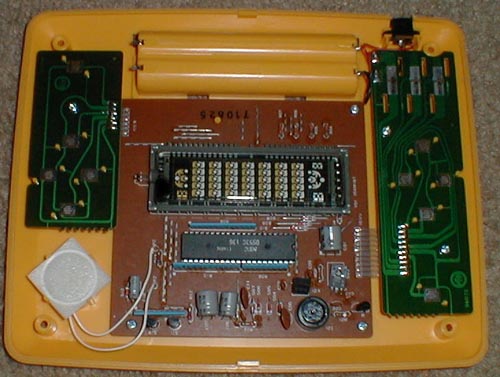
Grandstand The Big Game Soccer (Kevin Keegan's The Big Game Soccer) is Epoch's Exciting Soccer Game, a two-player VFD football game sold in the UK by Grandstand in 1981.[2][3] The two players face each other across a flat, wide yellow case, each with four direction keys and a SHOOT button.[2] No manual, leaflet or schematic for either version has been published, and the game is not in MAME.[4] There are two looks inside: the Handheld Museum's photograph of an opened Grandstand unit,[1] and a Korean collector's 2026 repair of Epoch's version with 38 photographs.[5] Both show the same layout and the same NEC microcontroller, so the construction described here applies to both. Fault-finding is on Grandstand The Big Game Soccer Troubleshooting Guide and the capacitors on Grandstand The Big Game Soccer Capacitor Replacement Guide.
The Big Game Soccer at a glance
[edit | edit source]| Part | Detail | Source |
|---|---|---|
| Microcontroller | NEC D553C 136 (μPD553, μCOM-43 family) on Epoch's board; the Grandstand unit's chip reads D553C 13x at the size photographed | [5][1] |
| Display | VFD tube at V01, with "10AM18T" printed beside it; red players for one side, blue for the other; a violet filter sheet in the top shell | [5][2] |
| Display supply | NEC D882 power transistor at S03, round TDK transformer TY-33 at I01, four electrolytic capacitors (C01, C06, C07, C10) | [5] |
| Controls | A control board at each side with rubber keys, joined to the main board by clear flat cables; POWER, LEVEL (AMA/PRO) and PLAYER (1/2) slide switches at the left | [5][2] |
| Sound | Piezo speaker in a white foam pad in one corner | [5][1] |
| Power | Four AA cells in a holder along one long edge, behind a separate battery door in the base; DC socket on leads in the corner beside the holder | [2][5][1] |
Before you start
[edit | edit source]- Switch off, take out the four AA cells, and unplug any adaptor.
- Tools: a cross-head screwdriver, isopropyl alcohol, cotton buds, a soft brush, contact cleaner and a multimeter. Clip leads from a 6 V bench supply let you run the board with the case open, as the Korean repairer did.[5]
- The display supply is a D882 switching the cells' 6 V into a TDK transformer, the same arrangement as in Epoch's Galaxy II, sold as Grandstand Astro Wars, where an owner measured about 200 V peak to peak on the transformer winding.[5][6] Keep fingers off the transformer and the parts round it while the board is powered.
- The only mains equipment is the adaptor. Inspect an old one before plugging it in; see Grandstand Universal Mains Adaptor.
Opening the case
[edit | edit source]From the Exciting Soccer photographs:[5]
- Take the battery door off the base and remove the cells.
- Remove the screws at the four corners of the base.
- Lift the top shell off. Inside it are the violet filter sheet over the display window and the SHOOT buttons, direction keys and switch knobs; keep it face down so the keys do not drop out.
- A white "stadium" moulding with the green pitch print sits over the main board. Lift it off to expose the board, the tube, the two control boards and the speaker.
- The control boards are joined to the main board by clear flat cables, and the DC socket and battery holder by red and black leads. Note how they run before lifting any board.
The display tube
[edit | edit source]The tube lies flat across the main board at position V01, beside the microcontroller.[5][1] Its sealed glass tip is at one end. Do not press on the tube or lay the board face down; a tube that loses its vacuum cannot be repaired, and the only replacement is the tube from another copy of this game, Epoch's or Grandstand's.
Cleaning
[edit | edit source]- Wash the yellow shells, the white stadium moulding and the rubber keys in warm soapy water with all electronics removed, and dry them fully.
- Clean the violet filter sheet and the window with a damp cloth only; the printed pitch on the stadium moulding is part of the playing field and should not be scrubbed.
- Clean the board with isopropyl alcohol and a soft brush.
Batteries and the adaptor
[edit | edit source]- Four AA cells.[2] Epoch's box says the game runs from four AA cells or an AC adapter sold separately.[5]
- No adaptor rating or polarity has been published for either version. Measure how the DC socket's contacts connect to the battery holder before connecting any supply: the cells give 6 V, and the board should see the same polarity from the socket as from the holder. Grandstand's own adaptor had a polarity switch; see Grandstand Universal Mains Adaptor.
- Clean the holder's springs and plates, and check the red and black leads where they are soldered to the holder and the socket.
- Take the cells out for storage. See Battery Explosion, Capacitor or Corrosion Damage if they have leaked.
Controls
[edit | edit source]Each player has four direction keys and a SHOOT button on a separate control board, with rubber keys pressing on contacts.[2][5] The POWER, LEVEL and PLAYER slide switches are at the left-hand end.[2]
- If one player's keys fail and the other's work, the fault is on that side's board, its rubber keys, or its flat cable, because each side has its own.[1][5]
- Clean the contact pads under the rubber keys and the board contacts with isopropyl alcohol.
- Check the flat cables where they enter each board.
- PLAYER selects one or two players and LEVEL the difficulty; clean these switches if the game will not change mode.[2]
Wearing parts
[edit | edit source]| Part | What happens | Check |
|---|---|---|
| Four electrolytic capacitors | All four replaced in the Exciting Soccer repair[5] | See Grandstand The Big Game Soccer Capacitor Replacement Guide |
| Rubber keys and control boards | Dirty or worn contacts | Clean both sides |
| Flat cables to the control boards | Each player's keys depend on one cable | Check continuity end to end |
| Slide switches | Dirty contacts | Clean |
| Battery holder and DC socket leads | Corrosion and broken joints | Clean and resolder |
Storage
[edit | edit source]- Remove the cells.
- Store it flat, with nothing on the keys.
- Keep it dry and out of the sun.
Preventive maintenance checklist
[edit | edit source]- Take out the cells; clean the holder and check its leads.
- Measure any adaptor and the socket's polarity before use.
- Open the case and inspect C01, C06, C07 and C10 for leakage.
- Clean both players' keys and boards, and the three slide switches.
- Check the two flat cables.
- Reassemble and test both players' controls, both levels and both player modes.
Related pages
[edit | edit source]- Grandstand The Big Game Soccer
- Grandstand The Big Game Soccer Troubleshooting Guide
- Grandstand The Big Game Soccer Capacitor Replacement Guide
- Grandstand Universal Mains Adaptor
- Battery Explosion, Capacitor or Corrosion Damage
References
[edit | edit source]- ↑ 1.0 1.1 1.2 1.3 1.4 1.5 1.6 Handheld Museum, "Game Guts", photograph Grandstand-BigGameSoccerGuts.jpg (500 × 377 pixels, retrieved 2026-10-18), examined at full size: a Grandstand unit opened, with the main board in the centre carrying the display tube and an NEC microcontroller whose label, upside down, reads "D553C 13" and a last digit not clear at this size; a holder for four cells along the top; the DC socket at the top right; a control board at each side; the speaker at the lower left; the round transformer at the lower right.
- ↑ 2.0 2.1 2.2 2.3 2.4 2.5 2.6 2.7 2.8 Handheld Museum, "Grandstand The Big Game Soccer" and "Epoch Exciting Soccer Game" (retrieved 2026-10-18). The Grandstand game: 1981, VFD, four AA batteries, "Licensed from Epoch (Exciting Soccer Game)"; Epoch's: 1981, VFD, four AA batteries, "Sold in the U.K. by Grandstand as Kevin Keegan's The Big Game Soccer and in Germany by GAMAtronic as Fussball-Spiel". The photographs, examined: the Grandstand game, yellow, with "THE BIG GAME SOCCER" and "GRANDSTAND" on the green pitch printing, four direction keys and a SHOOT button at each end, POWER OFF/ON, LEVEL AMA/PRO and PLAYER 1/2 switches at the left, and a speaker grille at the right; the lit display, with red players for one side and blue for the other; the box ("THE BIG GAME ELECTRONIC SOCCER", Kevin Keegan roundel, "EXCITING ELECTRONIC SOUND EFFECTS", "2-COLOR FLUORESCENT DISPLAY WITH SHAPED PLAYERS").
- ↑ Centre for Computing History, "Grandstand The Big Game Soccer", CH77112 (retrieved 2026-10-18): "LED tabletop / handheld soccer game. Grandstand's only simultaneous 2 player tabletop game"; 1981.
- ↑ MAME source, hh_ucom4.cpp at commit d404316 (retrieved 2026-10-18): the chip list of NEC μCOM-4 games includes several μPD553C serials, among them 153 (Epoch Galaxy II, Grandstand Astro Wars), but no Epoch soccer game; the header explains NEC's FIP tube numbers (the figure after FIP is the number of grids).
- ↑ 5.00 5.01 5.02 5.03 5.04 5.05 5.06 5.07 5.08 5.09 5.10 5.11 5.12 5.13 5.14 analo9, "1981 에포크 VFD 휴대용 축구 게임기 (EPOCH Exciting Soccer)", 아날로그 탐구생활 (Naver blog, in Korean), 28 April 2026 (retrieved 2026-10-18); the same repair on YouTube as "1981 에포크 VFD 휴대용 축구 게임기 (EPOCH Exciting Soccer LSI Game repair)". An Epoch Exciting Soccer Game that would not power up, "disassembled and repaired" (the post's only text). Its 38 photographs, examined at full size (1,280 × 717 pixels), show: the Japanese box (デジコムサッカー, code no. 36070, "four AA (単III) batteries or AC adapter (sold separately)"); the base, with a screw hole at each corner and a separate battery door; the case opened, with the white stadium moulding and its green pitch print over the main board, the speaker in a white foam pad at one corner, a control board at each side with rubber keys, and the DC socket on red and black leads at one corner beside the battery holder; inside the top shell, a violet filter sheet over the display window; the main board, with an NEC microcontroller marked "D553C 136" and "E13326", the display tube at position V01 beside the silkscreen "10AM18T", with its sealed glass tip at one end, an NEC D882 power transistor at S03, a round TDK transformer marked TY-33 at I01, diodes S04 to S10 and S13, transistors marked C945 at S11 and S12, and four electrolytic capacitors: C01 (beside S03), C06 and C07 (side by side near the transformer) and C10 (beside the speaker leads); the four old electrolytics after removal, marked 330 µF 16 V, 47 µF 50 V, 220 µF 16 V and 10 µF 16 V, and the board before and after, showing that the grey part at C07 was the 220 µF, the light-blue part at C06 the 47 µF, the blue part at C01 the 330 µF and the small blue part at C10 the 10 µF; new Nippon Chemi-Con KMG parts in place, legible as 330 µF 16 V at C01 and 10 µF 50 V at C10; a removed C945 transistor and a resistor beside the board; clear flat cables joining the control boards to the main board; the game running on the bench from clip leads and then reassembled.
- ↑ Handheld Museum forum, "Astro wars / galaxy ii repair", pages 1 and 2, December 2018 to January 2019 (retrieved 2026-10-18): on Grandstand Astro Wars (Epoch Galaxy II), whose display supply is a D882 switching 6 V into a TDK transformer, the dead game's D882 ran hot and the supply fell to about 1.5 V; diode S06 read about 20 Ω both ways, and the game worked once S06 was replaced; with S06 removed, the full −10 V reached the μPD553 microcontroller. On a working game the owner measured about 200 V peak to peak on the transformer winding with a basic oscilloscope he said was probably not accurate at that level.