

IBM PC XT (5160)
 | |
 | |
| IBM Personal Computer XT (5160) | |
| Specifications | |
|---|---|
| Manufacturer | IBM |
| Type | Desktop personal computer |
| Released | March 1983 |
| Discontinued | April 1987 |
| Intro price | US$4,395 (Fall 1984: 256 KB, 10 MB fixed disk) |
| CPU | Intel 8088 at 4.77 MHz; socket for an Intel 8087 |
| Memory | 128 KB to 640 KB on the system board, depending on model and board version |
| Storage | 10 MB or 20 MB fixed disk; one or two 360 KB 5.25-inch diskette drives |
| Display | Separate adapter card: MDA with IBM 5151, or CGA with IBM 5153 |
| Sound | Speaker driven by 8253 timer channel 2 |
| Dimensions | 498 × 411 × 147 mm (19.6 × 16.2 × 5.8 in) |
| Weight | 14.2 kg (31.6 lb) |
| OS / Firmware | IBM PC DOS; IBM Cassette BASIC in ROM |
| Predecessor | IBM PC (5150) |
| Successor | IBM PC AT (5170) |
| Model no. | 5160 (models 068, 078, 086, 087, 088, 089, 267, 268, 277, 278; XT/370 models 568, 588, 589) |
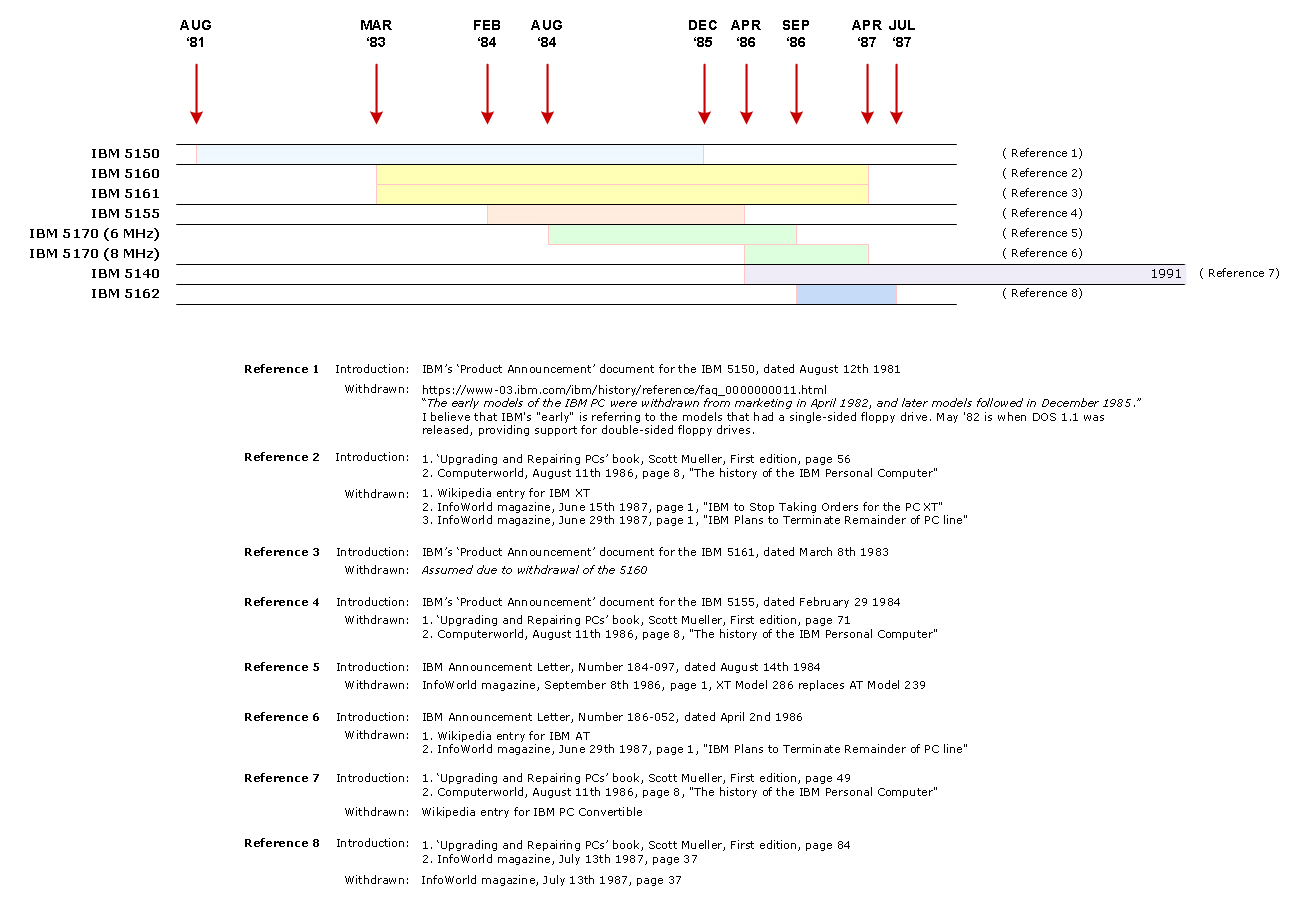
The IBM Personal Computer XT (machine type 5160) is the second machine in the IBM PC line. IBM introduced it in March 1983 and withdrew it in April 1987.[1] BYTE listed it at US$4,395 in autumn 1984 with 256 KB, one diskette drive and a 10 MB fixed disk.[2]
The XT uses the same Intel 8088 and 8-bit expansion bus as the 5150 and runs the same software. It has eight expansion slots instead of five, a 130 W power supply instead of the 5150's 63.5 W, a fixed disk in most models and no cassette port.[3][4] minuszerodegrees.net attributes the larger supply to the start-up demand of the hard drives of the period, which the 5150's supply could not meet.[5]
The XT's power-on self test shows the memory count in the top left corner of the screen as it runs; the 5150's does not.[3][6] The machine needs at least one diskette drive; there is no switch setting for none.[3]
Architecture and processor
The 8088 runs at 4.77 MHz, derived by dividing a 14.31818 MHz crystal by three. The same crystal divided by four gives the 3.58 MHz colour-burst signal.[7] A second socket takes an 8087 coprocessor.[7] The support chips sit at fixed I/O addresses: the 8237A-5 DMA controller at 000–01F hex, the 8259A interrupt controller at 020–03F, the 8253-5 timer at 040–05F and the 8255A-5 peripheral interface at 060–06F.[7] There is no video circuitry on the system board; the display controller is on the adapter card.
The 5160 system board has no keyboard controller chip. The keyboard interface is built from discrete logic on the board, so a keyboard fault can turn out to be a system board fault.[8] There is no battery-backed CMOS and no real-time clock on the board or on any IBM card for it. All configuration is set with the eight-position DIP switch SW1.[8]
| Switch | Function |
|---|---|
| 1 | Off for normal operation; on makes the POST loop continuously |
| 2 | Off if an 8087 coprocessor is fitted; on if not |
| 3–4 | Amount of memory on the system board |
| 5–6 | Display type |
| 7–8 | Number of 5.25-inch diskette drives |
IBM's switch table is on p. 6-3 of the service information manual.[9] minuszerodegrees.net gives the individual on/off combinations for each setting.[10]
Memory and ROM
IBM made two system board versions, which differ in how much RAM fits in the on-board sockets.[11]
| Marking | RAM banks | BIOS as supplied | Notes |
|---|---|---|---|
| 64-256KB SYSTEM BOARD | 4 banks of 64 KB | 11/08/82 | Printed on the board. Also used in the IBM 5155 Portable PC. IBM documents a modification to 256-640KB. |
| 256-640KB SYSTEM BOARD | 2 banks of 256 KB + 2 banks of 64 KB | 01/10/86 or 05/09/86 | Usually on a label rather than printed on the board. |
The 256-640KB board needs jumper E-2 to address 256 KB chips in banks 0 and 1; without it the board counts only 256 KB. IBM also notes that some boards in models 088, 089, 267, 277 and 278 were labelled 64Kb/256Kb in error. A module fitted at position U84 identifies a 256/640 KB board; the 64/256 KB board leaves U84 empty.[6]
The BIOS occupies two sockets, U18 and U19, where the 5150 has one. On the 1982-dated BIOS, U19 holds part of Cassette BASIC only, so a failed U19 gives an "F6000 ROM" message and the machine still boots. On the 1986-dated BIOS, U19 also holds part of the BIOS, and a failed U19 leaves the board apparently dead.[12]
BIOS revisions
There are four revisions, known by the date in the ROM. The 08/16/82 revision is rare, and minuszerodegrees.net suggests it may never have been released to the public.[12]
| Date | U18 / U19 part numbers | ROM type | Diskette support | Notes |
|---|---|---|---|---|
| 08/16/82 | U18=5000026, U19=5000027 | MK38000 / MK37000 mask ROM | 360 KB | Rare |
| 11/08/82 | U18=1501512 with U19=5000027, or U18=1501512 with U19=6359116 | Mask ROM, varies | 360 KB, partial 720 KB | First production BIOS |
| 01/10/86 | U18=62X0851 with U19=62X0854, or U18=62X0852 with U19=62X0853 | 27256 EPROM | 360 KB and 720 KB | |
| 05/09/86 | Mask: U18=62X0890, U19=68X4370. EPROM: U18=59X7268, U19=62X0819 | 27256 EPROM | 360 KB and 720 KB | Final XT BIOS |
The two 1986 revisions have three known drawbacks:[12]
- They contain code for 1.2 MB drives, but fitting a high-density controller is not enough on its own to use one.
- With some third-party floppy controllers they will read 1.44 MB diskettes but will not boot from them. The 11/08/82 revision does not have this problem.
- IBM's Personal Computer Family Service Information says the 5161 Expansion Unit "is not supported on 5160 Models 088, 089, 267, 268, 277, and 278", the 1986 models.[13][14]
Replacement EPROMs must be rated at 250 ns or faster, per IBM's Technical Reference.[12]
Storage and expansion
The XT has eight 8-bit expansion slots. Their positions differ from the 5150's.[3] Slot J8, the one nearest the power supply, is different: IBM's Technical Reference says any card in it must return a "card selected" signal whenever it is selected, and its timing requirements are stricter than those of J1 to J7.[7][15] IBM's service manual names the Asynchronous Communications Adapter, with jumper J13 fitted, as the only IBM card that provides the signal.[6] Most other cards do not work in slot 8, and an accelerator card there can cause an 1801 error at power-on.[15]
The IBM diskette adapter and drives are double density and cannot read 1.2 MB media.[8] Early models have one or two full-height drives; the 1986 models have half-height drives.[9]
IBM's fixed disk controller is the IBM Fixed Disk Adapter, built for IBM by Xebec with IBM's BIOS code. The first version supports only a 306-cylinder, 4-head drive, the Seagate ST-412 IBM shipped with it. A later version supports the 20 MB drives of the 1986 models.[16] The 20 MB drive in models 088 and 089 is IBM drive type 13; when the type label is missing, IBM identifies it by "WD25" on a label on its black cover.[6]
The optional IBM 5161 Expansion Unit adds seven slots and room for fixed disks. It connects through an extender card in the XT and a receiver card in the 5161, and has its own 130 W XT power supply.[14]
Display
The XT has no video on the system board. An adapter card drives a separate monitor: the MDA with the IBM 5151, or the CGA with the IBM 5153. The monochrome display takes its mains from a switched non-standard socket on the XT supply.[7] SW1 switches 5 and 6 must match the adapter fitted; a mismatch can leave the machine silent with a blank screen or a lone cursor (see POST beep codes).
Keyboard
Most models shipped with the 83-key keyboard, the same one used on the 5150, on a 5-pin DIN connector. Models 089, 268 and 278 shipped with the 101-key keyboard, and the two keyboards are interchangeable only on the six 1986 models (088, 089, 267, 268, 277, 278).[9] A keyboard made only for the AT will not work, because the AT uses a different keyboard protocol.[17] IBM's documents call it the "83-key keyboard"; "Model F" is a collectors' family name that also covers keyboards the XT cannot use.[17]
Power supply
The supply is a 130 W switching regulator with four outputs. IBM built separate 120 V and 220/240 V units, both fused.[7] It is rated at 15 A on +5 V, 4.2 A on +12 V, 0.3 A on −5 V and 0.25 A on −12 V.[7] Only the +5 V and +12 V ratings went up from the 5150's; the 5150 supply also gives 0.3 A on −5 V and 0.25 A on −12 V.[4]
Rail limits, sense levels and the checks that use them are in the maintenance guide.
Specifications
IBM's own documents give two slightly different sets of figures for the system unit.
| Measurement | Technical Reference (1986) | Service Information Manual (1989) |
|---|---|---|
| Length | 498 mm (19.6 in) | 500 mm (19.6 in) |
| Depth | 411 mm (16.2 in) | 410 mm (16.1 in) |
| Height | 147 mm (5.8 in) | 142 mm (5.5 in) |
| Weight | 14.2 kg (31.6 lb) | 14.5 kg (32 lb) |
| Power cable | 1.8 m (6 ft) | 1.83 m (6 ft), 18 AWG |
| Air temperature, system on | 15.6 to 32.2 °C (60 to 90 °F) | 15.6 to 32.2 °C |
| Air temperature, system off | 10 to 43 °C (50 to 110 °F) | 10 to 43 °C |
| Humidity, on / off | 8–80 % / 20–80 % | 8–80 % / 20–80 % |
| Heat output | 1,229 BTU/hr | 750 BTU/hr maximum |
| Noise | 43 dB average (without printer) | 49.5 dBA with monochrome display and expansion unit |
| Electrical | 450 VA; 100–125 V AC (115 V nominal) | 0.41 kVA maximum; 104–127 V AC (120 V nominal) |
Sources: Technical Reference pp. 1-29 to 1-30;[7] Service Information Manual p. 6-1.[9]
Models
IBM's 5160 feature chart lists these standard configurations.[9]
| Model | Memory | Diskette drives | Fixed disk | Keyboard | Notes |
|---|---|---|---|---|---|
| 087 | 128 KB | 1 full-height | 10 MB | 83-key | |
| 086 | 256 KB | 1 full-height | 10 MB | 83-key | |
| 068 | 256 KB | 1 full-height | none | 83-key | |
| 078 | 256 KB | 2 full-height | none | 83-key | |
| 088 / 089 | 512 or 640 KB | 1 half-height | 20 MB | 088: 83-key; 089: 101-key | 256-640KB board |
| 267 / 268 | 256 KB | 1 half-height | none | 267: 83-key; 268: 101-key | 256-640KB board |
| 277 / 278 | 256 KB | 2 half-height | none | 277: 83-key; 278: 101-key | 256-640KB board |
| 568, 588, 589 | 256 KB | 1 full-height | 588, 589: 10 MB | 83-key | IBM PC XT/370 |
| 788 | 256 KB | 1 full-height | 10 MB | 83-key | DunsPlus system, built for Dun & Bradstreet |
Models 086, 087, 088, 089 and 788 came with the Asynchronous Communications Adapter.[9]
Two related machines have their own machine types: the IBM PC XT Model 286 (type 5162), an 80286 machine from 1986,[1] and the IBM 3270 PC (type 5271).
Documentation
- IBM PC XT Technical Reference (First Edition): IBM's April 1983 XT Technical Reference, part 1502237.
- IBM PC XT 5155 5160 Technical Reference (March 1986): the March 1986 edition, part 6280089, covering both system board versions and the Portable PC.
- IBM Personal Computer Family Service Information Manual: IBM's 1989 service summary for the PC family, with the 5160 chapter, switch settings and parts catalogue.
- IBM Hardware Maintenance Service parts catalogue 6280087 for the PC, XT and Portable PC.
General maintenance
Cleaning, power supply checks, expansion slot notes and the floppy drive are covered in IBM PC XT Maintenance Guide.
Troubleshooting
POST messages, beep patterns, the minimum diagnostic configuration and fixed disk faults are covered in IBM PC XT Troubleshooting Guide.
Capacitor replacement
The 5160 system board has sixteen tantalum capacitors, thirteen of them on the +5 V line. On +12 V there are only C55, a ceramic, and C56, a tantalum; C56 is the known short-circuit failure and the board runs without it.[18][19] Positions, photographs and procedure are in IBM PC XT Capacitor Replacement Guide.
Gallery
-
 IBM 5160 PC XT
 -
 Marking of the early 64-256KB board (minuszerodegrees.net)
 -
 Marking of the later 256-640KB board (minuszerodegrees.net)
 -
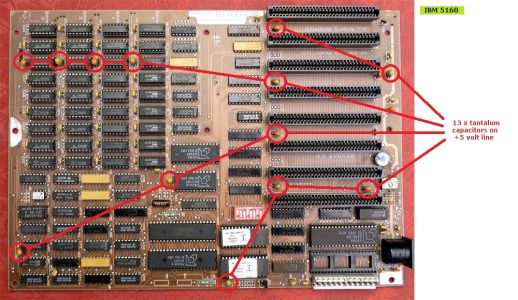 The thirteen +5 V tantalum capacitors (minuszerodegrees.net)


References
- ↑ 1.0 1.1 IBM 51xx timeline, minuszerodegrees.net, with its reference list. Introduction and withdrawal dates of the 5150, 5155, 5160, 5161, 5162 and 5170, including the March 1983 introduction and April 1987 withdrawal of the 5160 and the 8 March 1983 date of IBM's 5161 announcement.
- ↑ "The IBM Personal Computer XT", in "IBM Personal Computers at a Glance", BYTE Guide to the IBM PC, Fall 1984 (archive.org item byte-magazine-1984-09). Specification box and list price.
- ↑ 3.0 3.1 3.2 3.3 IBM 5160 – Significant Differences to the IBM 5150, minuszerodegrees.net. On-screen RAM count, the underside case well, the changed slot and keyboard-connector positions, the larger supply, and the requirement for at least one floppy drive.
- ↑ 4.0 4.1 IBM, Personal Computer Family Service Information Manual, SA38-0037-00, First Edition, January 1989, hosted as File:IBM Personal Computer Family Service Information Manual SA38-0037-00.pdf. Chapter 4, p. 4-2: the 5150 supply is "designed for continuous operation at 63.5 watts".
- ↑ IBM 5150 – Hard Drive Support, minuszerodegrees.net: the 5150 supply was inadequate for the hard drives of the time, "the reason why IBM put a 130W power supply in the 5160", with the +12 V start-up demand of a Seagate ST-412 compared against the 5150's +12 V rating.
- ↑ 6.0 6.1 6.2 6.3 IBM, Personal Computer Family Service Information Manual, SA38-0037-00 (1989), chapter 4, "5150/5160-Based System Diagnostics", pp. 4-3 to 4-14: POST sequence and timing, service voltage limits at the system board connectors, the dummy load for an unconnected supply, memory error-code decoding, the E-2 jumper and mislabelled 256/640 KB boards, the slot 8 and ASYNC J13 note, diskette and fixed disk service tips.
- ↑ 7.0 7.1 7.2 7.3 7.4 7.5 7.6 7.7 IBM, Personal Computer XT and Portable Personal Computer Technical Reference, part 6280089, March 1986, hosted as File:IBM PC XT 5155 5160 Technical Reference Mar86.pdf. Section 1: microprocessor and clock (p. 1-4), slot J8 and the DIP switch (p. 1-3), I/O address map (p. 1-24), 8255A bit map (p. 1-27), specifications (pp. 1-29 to 1-30). Section 3: XT power supply description, outputs, sense levels, fuses and power good (pp. 3-3 to 3-5).
- ↑ 8.0 8.1 8.2 IBM 5160 – Basics, for 5160 beginners, minuszerodegrees.net. No keyboard controller chip, no RTC or CMOS setup, the underside case well, the one-second minimum off time, double-density-only floppy subsystem, slot 8, and the POST being a confidence test that emits no POST-card codes.
- ↑ 9.0 9.1 9.2 9.3 9.4 9.5 IBM, Personal Computer Family Service Information Manual, SA38-0037-00 (1989), chapter 6, "5160 PC XT": specifications (p. 6-1), model feature chart and power supply description (p. 6-2), keyboards and SW1 switch functions (p. 6-3), display, diskette-count and fixed disk adapter switch settings (p. 6-4), extender card switch settings (p. 6-14).
- ↑ IBM 5160 – Motherboard Switch/Jumper Settings, minuszerodegrees.net. SW1 on/off combinations, trimmer capacitor C1, jumper pads E1 and E2.
- ↑ IBM 5160 – Motherboard Versions, minuszerodegrees.net. The two versions, their markings, bank layouts, the BIOS supplied with each, the use of the 64-256KB board in the 5155, and the IBM-supported 640 KB modification.
- ↑ 12.0 12.1 12.2 12.3 IBM 5160 – BIOS Revisions, minuszerodegrees.net. The four BIOS revisions with part numbers and ROM types, diskette support, U19 behaviour, 720 KB and 1.2 MB notes, the 1.44 MB boot problem with some third-party controllers, the 5161 note, the scarcity of the 08/16/82 revision, and the 250 ns EPROM requirement.
- ↑ IBM 5161 – 5160 models "not supported", minuszerodegrees.net, quoting IBM's Personal Computer Family Service Information. The list of unsupported models, and the finding that the extender card enables itself at power-on, so the BIOS code removed in 1986 is not actually needed.
- ↑ 14.0 14.1 IBM, Personal Computer Family Service Information Manual, SA38-0037-00 (1989), chapter 7, "5161 Expansion Unit", p. 7-1: "This unit is not supported on 5160 Models 088, 089, 267, 268, 277, and 278"; the expansion unit uses the PC XT 130 W supply.
- ↑ 15.0 15.1 IBM 5155/5160 – Expansion Slot 8, minuszerodegrees.net, quoting pp. 1-3 and 1-16 of the March 1986 Technical Reference. The card-selected requirement, stricter J8 timing, the external-bus explanation, named slot-8-capable cards with their jumpers, and the 1801 error with accelerator cards.
- ↑ IBM Fixed Disk Adapter, minuszerodegrees.net. Xebec manufacture with IBM BIOS code, the three versions with board and ROM part numbers, the 306-cylinder/4-head limit of the early versions, the ST-412, and later 20 MB support.
- ↑ 17.0 17.1 IBM 5160 – Keyboards, minuszerodegrees.net. The 83-key type 1 and type 2 keyboards, the 1986 enhanced keyboards, "Model F" as a family name, AT-only keyboards, and the LED and added-key limits of IBM 101-key keyboards on an XT.
- ↑ Short-circuit on the +12 volt line of an IBM 5150/5155/5160 motherboard, minuszerodegrees.net. C55 and C56 are the only components on the 5160's +12 V line; C56 is the known failure and not critical.
- ↑ Short-circuit on the +5 volt line of an IBM 5150/5155/5160 motherboard, minuszerodegrees.net: "On a 5160 motherboard (of both types), thirteen of the sixteen tantalum capacitors are on the +5 volt line."
Related pages
- IBM PC XT Maintenance Guide
- IBM PC XT Troubleshooting Guide
- IBM PC XT Capacitor Replacement Guide
- IBM PC XT/370
- IBM PC (5150)
- IBM Fixed Disk Adapter
- IBM Model F (83-key)
- IBM Monochrome Display Adapter and IBM Color Graphics Adapter
- Tandon TM100-2