(3 intermediate revisions by the same user not shown)
Line 26:
Line 26:
The '''Apple II''' — often styled '''Apple ][''' — was Apple’s first mass‑market microcomputer and the machine that ignited the late‑1970s home‑computer boom. Announced at the April 1977 West Coast Computer Faire, it combined color graphics, an integrated keyboard, BASIC in ROM, and '''eight open expansion slots''' in a single plastic enclosure — a radical departure from kit‑based contemporaries.
The '''Apple II''' — often styled '''Apple ][''' — was Apple’s first mass‑market microcomputer and the machine that ignited the late‑1970s home‑computer boom. Announced at the April 1977 West Coast Computer Faire, it combined color graphics, an integrated keyboard, BASIC in ROM, and '''eight open expansion slots''' in a single plastic enclosure — a radical departure from kit‑based contemporaries.
== 🕰️ Historical Context ==
== Historical Context ==
* '''Trinity of ’77:''' Launching alongside the Commodore PET 2001 and TRS‑80 Model I, the Apple II stood out for its color graphics and open slot bus.
* '''Trinity of ’77:''' Launching alongside the Commodore PET 2001 and TRS‑80 Model I, the Apple II stood out for its color graphics and open slot bus.
* '''From hobby to home:''' Ready‑to‑run BASIC and cassette I/O meant buyers could power up and program instantly, fostering a vast hobbyist software scene.
* '''From hobby to home:''' Ready‑to‑run BASIC and cassette I/O meant buyers could power up and program instantly, fostering a vast hobbyist software scene.
* '''Disk II revolution (1978):''' Wozniak’s low‑chip‑count floppy controller cut drive cost in half, driving Apple II adoption in business and education.<ref>{{Cite web|url=https://apple2history.org/history/ah03.html|title=Apple II History: The Disk II|access-date=2024-06-20}}</ref>
* '''Disk II revolution (1978):''' Wozniak’s low‑chip‑count floppy controller cut drive cost in half, driving Apple II adoption in business and education.<ref>{{Cite web|url=https://apple2history.org/history/ah03.html|title=Apple II History: The Disk II|access-date=2024-06-20}}</ref>
| On‑board RAM || 4 KB base (16 × 6116 SRAMs)<br />Sockets for 48 KB using eight 4 KB dynamic RAM banks†<ref>{{Cite web|url=https://www.oldcomputers.net/appleii.html|title=Apple II (original) - Old Computers|access-date=2024-06-20}}</ref>
| On‑board RAM || 4 KB base (16 × 6116 SRAMs)<br />Sockets for 48 KB using eight 4 KB dynamic RAM banks†<ref>{{Cite web|url=https://www.oldcomputers.net/appleii.html|title=Apple II (original) - Old Computers|access-date=2024-06-20}}</ref>
|-
|-
| ROM || 12 KB (Monitor + Integer BASIC + character generator)<ref>{{Cite web|url=https://www.computerhistory.org/revolution/computers/4/78/2290|title=Apple II | Computer History Museum|access-date=2024-06-20}}</ref>
| ROM || 12 KB (Monitor + Integer BASIC + character generator)
Apple II motherboards are robust but susceptible to:
Apple II motherboards are robust but susceptible to:
* '''RAM socket corrosion''' — reseat or replace ICs.
* '''RAM socket corrosion''' — reseat or replace ICs.
* '''RIFA line filters''' in early Astec PSUs — replace before they “magic smoke.”
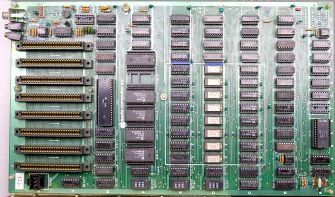
* [[File:Apple II Logic Board.jpg|thumb|335x335px|Apple II Logic Board]]'''RIFA line filters''' in early Astec PSUs — replace before they “magic smoke.”
* '''Keyboard foam‑pad failure''' (Datanetics Type B) — modern foam disks restore feel.
* '''Keyboard foam‑pad failure''' (Datanetics Type B) — modern foam disks restore feel.
Capacitor leakage is rare (all‑through‑hole design), but PSU electrolytics should be re‑formed or replaced after decades in storage.
Capacitor leakage is rare (all‑through‑hole design), but PSU electrolytics should be re‑formed or replaced after decades in storage.
[[File:Apple II Logic Board.jpg|thumb|335x335px|Apple II Logic Board]]
== Documentation & Schematics ==
== 📑 Documentation & Schematics ==
* '''Apple II Reference Manual''' (blue cover, 1977) — full schematics, Woz Monitor listings.
* '''Apple II Reference Manual''' (blue cover, 1977) — full schematics, Woz Monitor listings.
* '''Apple DOS Manual''' (1978) — Disk II architecture, DOS 3.1 commands.
* '''Apple DOS Manual''' (1978) — Disk II architecture, DOS 3.1 commands.
Line 99:
Line 97:
Scanned PDFs are archived on the [[:Category:Apple Documentation|Apple Documentation]] page.
Scanned PDFs are archived on the [[:Category:Apple Documentation|Apple Documentation]] page.
== 🧑🔧 Technical Details ==
== General Maintenance ==
{{main|Apple II General Maintenance}}
Regular maintenance of Apple II computers primarily involves reseating chips that aren't making good connections with their sockets, which is the number one problem with early Apple II and Apple II Plus machines. Clean the motherboard and case periodically using appropriate methods. For plastic cases, use a dilute solution of 50% Clorox and 50% water with a washcloth, followed by Pledge for finishing. For internal components, remove all expansion cards and use compressed air to clear dust. Always handle ICs with care using an anti-static mat or anti-static bag, as old chips from the 70s and 80s are particularly susceptible to ESD damage. For keyboards, use an IC chip extractor to remove keycaps safely, then clean with 99% isopropyl alcohol. Store computers in climate-controlled environments to prevent oxidation and component degradation.
== Troubleshooting Guide ==
{{main|Apple II Troubleshooting Guide}}
Common issues include display problems, boot failures, and keyboard malfunctions. If the system won't boot, first remove all expansion cards and reseat every chip on the board, then swap chips of the same type to identify failures. For no display output, check the data bus with an oscilloscope for proper signal levels. Bad RAM chips often cause green squares or bars on screen, particularly in the lowest 16K bank. For non-responsive keys, mark faulty keys during testing, then apply 99% isopropyl alcohol with a squeeze bulb at the key stem edges while repeatedly pressing the key. Use the built-in self-test routines and monitor commands for memory testing. Check power supply voltages - the +12V rail should remain above 11.4V under load, and the +5V should stay above 5V. The R/W line should toggle properly; if it never goes low, check the 74LS257 latches at B6 and B7.
== Capacitor Replacement ==
{{main|Apple II Capacitor Replacement}}
RIFA metallized-paper safety capacitors in Apple II power supplies deteriorate over time and require immediate replacement to prevent catastrophic failure with smoke. Replace the X2 safety capacitors (typically 0.1µF and 0.47µF at 275VAC) every year or two as preventive maintenance. Use polypropylene film capacitors from brands like KEMET or TDK as replacements - never use new RIFA capacitors as they have the same failure mode. The Panasonic ECQ-U2A104KL fits as a direct substitute with 20mm lead spacing. Also check capacitor C7 (220µF 10V), which sits near a power resistor and frequently fails due to heat - replace with a 105°C, 16V rated capacitor. When replacing capacitors, always disconnect power and discharge the power supply completely before working. Use proper safety equipment and never work on energized circuits.
''Soft-switches'' at $C050–$C057 flip graphics/text, hires/lores, full/half screen, etc.
*Soft-switches* at $C050–$C057 flip graphics/text, hires/lores, full/half screen, etc.
=== Video Timing & Color Generation ===
=== Video Timing & Color Generation ===
Line 234:
Line 243:
* First home computer with full '''color graphics''' on a cheap TV via NTSC artifacting.
* First home computer with full '''color graphics''' on a cheap TV via NTSC artifacting.
== 🧰 Replica & Emulation Resources ==
== Replica & Emulation Resources ==
* '''Replica II''' — Gerber‑faithful four‑layer re‑creation using modern DRAM.
* '''Replica II''' — Gerber‑faithful four‑layer re‑creation using modern DRAM.
* '''AppleWin / LinApple / MAME''' — full‑speed software emulators supporting Integer & Applesoft ROM sets and DOS/ProDOS disk images.
* '''AppleWin / LinApple / MAME''' — full‑speed software emulators supporting Integer & Applesoft ROM sets and DOS/ProDOS disk images.
== 🌟 Legacy ==
== Legacy ==
The expandable '''slot architecture''', affordable Disk II, and the industry‑shifting spreadsheet '''VisiCalc''' made the Apple II the '''first commercially successful mass‑produced microcomputer''', cementing Apple’s future and inspiring clones worldwide (Franklin Ace, Basis 108, ITT 2020).
The expandable '''slot architecture''', affordable Disk II, and the industry‑shifting spreadsheet '''VisiCalc''' made the Apple II the '''first commercially successful mass‑produced microcomputer''', cementing Apple’s future and inspiring clones worldwide (Franklin Ace, Basis 108, ITT 2020).
The Apple II — often styled Apple ][ — was Apple’s first mass‑market microcomputer and the machine that ignited the late‑1970s home‑computer boom. Announced at the April 1977 West Coast Computer Faire, it combined color graphics, an integrated keyboard, BASIC in ROM, and eight open expansion slots in a single plastic enclosure — a radical departure from kit‑based contemporaries.
Regular maintenance of Apple II computers primarily involves reseating chips that aren't making good connections with their sockets, which is the number one problem with early Apple II and Apple II Plus machines. Clean the motherboard and case periodically using appropriate methods. For plastic cases, use a dilute solution of 50% Clorox and 50% water with a washcloth, followed by Pledge for finishing. For internal components, remove all expansion cards and use compressed air to clear dust. Always handle ICs with care using an anti-static mat or anti-static bag, as old chips from the 70s and 80s are particularly susceptible to ESD damage. For keyboards, use an IC chip extractor to remove keycaps safely, then clean with 99% isopropyl alcohol. Store computers in climate-controlled environments to prevent oxidation and component degradation.
Common issues include display problems, boot failures, and keyboard malfunctions. If the system won't boot, first remove all expansion cards and reseat every chip on the board, then swap chips of the same type to identify failures. For no display output, check the data bus with an oscilloscope for proper signal levels. Bad RAM chips often cause green squares or bars on screen, particularly in the lowest 16K bank. For non-responsive keys, mark faulty keys during testing, then apply 99% isopropyl alcohol with a squeeze bulb at the key stem edges while repeatedly pressing the key. Use the built-in self-test routines and monitor commands for memory testing. Check power supply voltages - the +12V rail should remain above 11.4V under load, and the +5V should stay above 5V. The R/W line should toggle properly; if it never goes low, check the 74LS257 latches at B6 and B7.
RIFA metallized-paper safety capacitors in Apple II power supplies deteriorate over time and require immediate replacement to prevent catastrophic failure with smoke. Replace the X2 safety capacitors (typically 0.1µF and 0.47µF at 275VAC) every year or two as preventive maintenance. Use polypropylene film capacitors from brands like KEMET or TDK as replacements - never use new RIFA capacitors as they have the same failure mode. The Panasonic ECQ-U2A104KL fits as a direct substitute with 20mm lead spacing. Also check capacitor C7 (220µF 10V), which sits near a power resistor and frequently fails due to heat - replace with a 105°C, 16V rated capacitor. When replacing capacitors, always disconnect power and discharge the power supply completely before working. Use proper safety equipment and never work on energized circuits.
The expandable slot architecture, affordable Disk II, and the industry‑shifting spreadsheet VisiCalc made the Apple II the first commercially successful mass‑produced microcomputer, cementing Apple’s future and inspiring clones worldwide (Franklin Ace, Basis 108, ITT 2020).