

Macintosh Classic II
 | |
| Macintosh Classic II | |
| Specifications | |
|---|---|
| Manufacturer | Apple Computer, Inc. |
| Type | Personal computer |
| Released | 21 October 1991 |
| Discontinued | 13 September 1993 |
| Intro price | US$1,899 |
| CPU | Motorola 68030 at 16 MHz (16-bit data path) |
| Memory | 2 MB soldered; two 30-pin SIMM sockets, 10 MB maximum |
| Storage | Internal 1.4 MB SuperDrive; internal 40 or 80 MB SCSI hard disk |
| Display | 9-inch monochrome CRT, 512 × 342 pixels |
| Sound | 8-bit, 22 kHz sampling, mono; built-in microphone |
| ROM | 512 KB |
| Ports / interface | ADB; DB-19 external floppy; DB-25 SCSI; two RS-422 serial (mini-DIN-8); sound in and out |
| Expansion | None |
| Power | 100–120 V AC, 100 W maximum (220 V power/sweep boards also made) |
| Dimensions | 13.2 × 9.7 × 11.2 in (33.6 × 24.6 × 28.5 cm) |
| Weight | 16–17.1 lb (7.3–7.8 kg) without a hard disk |
| OS / Firmware | System 6.0.8L, System 7.0.1 to 7.6.1 |
| Predecessor | Macintosh Classic |
| Successor | Macintosh Color Classic |
| Codename | Apollo, Montana |
| Model no. | M4150 |
The Macintosh Classic II is a compact Macintosh with a 9-inch monochrome screen, introduced on 21 October 1991 at US$1,899 and discontinued on 13 September 1993. Apple also sold it as the Macintosh Performa 200 from 14 September 1992.[1] One Apple Service Source volume covers the Classic, Classic II and Performa 200.[2]
It uses the Classic's case, CRT and power/sweep board with a new logic board. The 68030 runs at 16 MHz, the same clock as the Macintosh SE/30, but the Classic II board is a modified Macintosh LC design with a 16-bit data path and no expansion slot, and it is the slower machine.[1]
Specifications
[edit | edit source]Apple's figures.[3]
| Item | Specification |
|---|---|
| CPU | Motorola 68030, 16 MHz, 32-bit internal data bus, 256-byte instruction and data caches |
| RAM | 2 MB soldered, expandable to 10 MB in two 30-pin SIMM sockets |
| ROM | 512 KB |
| PRAM | 256 bytes, lithium battery backed |
| Floppy | Internal 1.4 MB SuperDrive; optional external 800 KB or 1.4 MB drive |
| Hard disk | Internal 40 MB or 80 MB SCSI; external SCSI supported |
| Microphone | Electret, omnidirectional; output 4 mV peak to peak at normal volume |
| Ports | One ADB (mini-DIN-4); external floppy (DB-19); SCSI (DB-25); two RS-422 serial (mini-DIN-8); sound out; sound in |
| Sound | Mono, 8-bit D/A conversion at 22 kHz; the jack can drive stereo headphones |
| Video | 9-inch diagonal, 512 × 342 bit-mapped monochrome |
| Line voltage | 100–120 V AC, 47–63 Hz, single phase |
| Maximum power | 100 W |
| Dimensions | 13.2 × 9.7 × 11.2 in (33.6 × 24.6 × 28.5 cm) |
| Weight | 16–17.1 lb (7.3–7.8 kg) without an internal hard disk |
Apple's April 1992 Service Guide for the Classic II gives the same figures with two differences: SIMMs of 100 ns or faster (the Service Source says 120 ns) and a mains frequency of 50–60 Hz. It also lists the sound-input port (20 mV, 600 Ω source) and a clock chip with a "seven-year battery".[4] The 68030's caches are internal to the processor; the board's external data path is 16 bits wide.[1]
Memory
[edit | edit source]The logic board has 2 MB soldered and two 30-pin SIMM sockets. Both sockets are filled with SIMMs of the same size, or both are left empty: two 1 MB, two 2 MB or two 4 MB SIMMs give 4, 6 or 10 MB.[5] Apple's Sad Mac chart for the Classic II replaces the SIMMs in those two slots before the logic board.[6] Procedure and configurations: Macintosh Classic II Memory Upgrade Guide.
Boards
[edit | edit source]Logic board
[edit | edit source]Apple's service part is 661-0672, shared with the Performa 200.[7] Two versions exist. The earlier has four ROM chips at the bottom right and 13 surface-mount electrolytic capacitors; the later has two ROM chips and 17.[8] Console5 gives the board numbers as 630-0055 (bare board 820-0326) and 630-0401 (820-0401).[9] In Recap-a-Mac's photographs the four-ROM, 13-capacitor board carries label 630-0401-B and the two-ROM, 17-capacitor board 630-0055-B.[8][10] The PRAM battery is Apple part 742-0011; LEM gives it as a 3.6 V half-AA cell.[7][1]
Power/sweep board
[edit | edit source]The Classic II has no separate analogue board or power supply. One power/sweep board carries the mains supply, the sweep circuits and the yoke, fan and hard-disk power connectors, and it is shared with the Classic.[11] Apple lists four versions: 110 V and 220 V, each in Rev. A and Rev. B.[7] Rev. A and Rev. B boards are functionally equivalent but not interchangeable: a Rev. A board needs a Rev. A CRT yoke assembly, and a Rev. B board a Rev. B yoke and a Rev. B cover. The yoke connector tells them apart: Rev. A has plastic sleeves round the prongs, Rev. B has exposed prongs.[11]
The primary reservoir is either a series pair of 220 µF 250 V capacitors, with a wire link that sets the mains input, or, on some 220–240 V boards, a single 220 µF 400 V capacitor.[12][13] See Macintosh Classic II Capacitor Replacement Guide before ordering parts.
Upgrade from a Classic
[edit | edit source]Apple's Classic II upgrade kit for the Macintosh Classic contains a Classic II logic board, a Classic II rear housing (with the opening for the sound-input port), a microphone and an accessory kit. The technician transfers the original serial number from the old rear housing to the new one. 1 MB SIMMs of 100 ns or faster from the Classic's memory expansion board can go in the Classic II's sockets, as a matched pair.[14][15]
Service documentation
[edit | edit source]
- Macintosh Classic/ Classic II/Performa 200 Service Source: Apple's Service Source for the family (115 pages, embedded above). The exploded view gives Apple part numbers for every module. Apple's battery rule is replace below 3.0 V, and the Adjustments chapter covers light meter setup, video and yoke; there is no power-supply adjustment.[16]
- Apple Macintosh Service Guide Volume 2 1992: Apple's pocket guide, with a Classic II tab holding a parts list, video adjustment pot designators, symptom chart, specifications and memory rules.[4]
- File:Macintosh Classic II Schematic.pdf: BOMARC Services' hand-drawn schematic of the Classic II logic board 820-0401-B, eight sheets. Its first sheet shows the power connector from the power/sweep board: +12 V on pin 1, +5 V on pins 2 and 3, −12 V on pin 8, ground on pins 10–14.[17]
- File:MacintoshClassic LogicBoard Schematic.pdf: despite its name, this file opens with BOMARC's schematics of the Classic-family power/sweep board: board 820-0395-A ("early", PDF pp. 1–2) and 820-0525-A ("late", PDF pp. 4–5), followed by the Classic logic board 820-0390-B (PDF pp. 7–11).[12]
- File:Classic Analog Board Schematic.pdf is not a Classic document. Its internal title is SE30_Analog_Board and it shows an analogue board fed from a separate power supply, which is the Macintosh SE and SE/30 arrangement.
- The Dead Mac Scrolls (1992) does not cover the Classic or Classic II.[18]
All Apple service manuals on the wiki are listed at Apple Service Source.
Board photographs
[edit | edit source]-
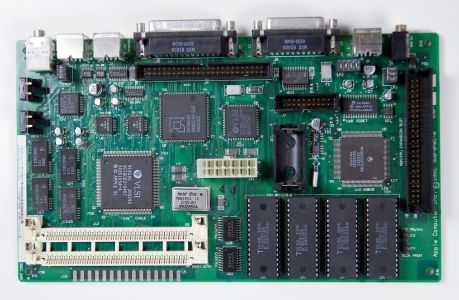 Classic II logic board
 -
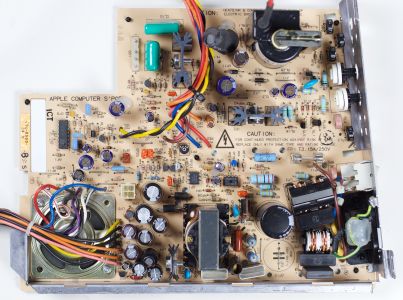 Classic-family power/sweep board


Maintenance, capacitors and troubleshooting
[edit | edit source]The Classic II's surface-mount electrolytic capacitors and its lithium PRAM cell both leak; Recap-a-Mac advises dealing with both at once on any machine whose history is unknown.[8]
- Macintosh Classic / Classic II General Maintenance
- Macintosh Classic II Capacitor Replacement Guide
- Macintosh Classic / Classic II Troubleshooting
- Macintosh Classic II Memory Upgrade Guide
- CRT Discharge Procedure: Apple's Service Guide adds that the Classic II's CRT must be discharged to the ground lug to avoid damaging the logic board.[19]
- Retrobrite for a yellowed case.
Sad Mac codes are decoded on Sad Mac Error Codes and with the Sad Mac Decoder.
Related pages
[edit | edit source]References
[edit | edit source]- ↑ 1.0 1.1 1.2 1.3 Low End Mac, "Mac Classic II", tech specs: dates, price, code names Apollo and Montana, model M4150, System 6.0.8L and 7.0.1 to 7.6.1, modified LC motherboard with a 16-bit data path, 3.6 V half-AA PRAM battery. Secondary source.
- ↑ Apple Computer, Macintosh Classic/Classic II/Performa 200 Service Source (115-page copy, File:Classic ii.performa 200.pdf), Basics, Overview p. 1 (PDF p. 3).
- ↑ Apple, Macintosh Classic/Classic II/Performa 200 Service Source, Specifications pp. 1–8 (PDF pp. 5–12): Processor, Memory, Disk Storage, I/O Interfaces, I/O Devices, Sound and Video, Electrical (100–120 V AC, 47–63 Hz, 100 W maximum), Physical.
- ↑ 4.0 4.1 Apple Computer, Apple Service Guide for Macintosh Computers, Volume II (Apr 1992), Classic II tab, Specifications p. 11 (PDF p. 17). Hosted as File:APPLE MACINTOSH SERVICE GUIDE VOL2 1992.pdf (see Apple Macintosh Service Guide Volume 2 1992).
- ↑ Apple, Service Guide for Macintosh Computers, Volume II, Classic II tab, Memory Upgrade p. 12 (PDF p. 18).
- ↑ Apple, Macintosh Classic/Classic II/Performa 200 Service Source, Troubleshooting, Symptom Charts pp. 2–15 (PDF pp. 15–28).
- ↑ 7.0 7.1 7.2 Apple, Macintosh Classic/Classic II/Performa 200 Service Source, Exploded View (PDF p. 115): logic boards 661-0596 (1 MB, Classic) and 661-0672 (2 MB, Classic II, Performa 200); power/sweep boards 661-0597 (110 V, Rev. A), 661-0599 (220 V, Rev. A), 661-0651 (110 V, Rev. B), 661-0652 (220 V, Rev. B); lithium battery 742-0011; CRT and yoke assembly 076-0546; floppy drive 661-0474.
- ↑ 8.0 8.1 8.2 Recap-a-Mac, "Macintosh Classic II (Rev A)": four ROM chips and 13 surface-mount electrolytics on the earlier board, two ROM chips and 17 on the later; prone to capacitor and battery leakage. Secondary source.
- ↑ Console5 TechWiki, "Macintosh Classic II". Secondary source.
- ↑ Recap-a-Mac, "Macintosh Classic II (Rev B)": photograph of the two-ROM, 17-capacitor board, label 630-0055-B. Secondary source.
- ↑ 11.0 11.1 Apple, Macintosh Classic/Classic II/Performa 200 Service Source, Take Apart, Power/Sweep Board pp. 4–11 (PDF pp. 33–40).
- ↑ 12.0 12.1 BOMARC Services, schematics of the "Macintosh Classic" series computer power supply / 9-inch monitor: board 820-0395-A "early" (Apple/Samsung, sheets 1–2, dated June 1992) and board 820-0525-A "late" (Apple/Hitachi, sheets 1–2, dated December 1991), PDF pp. 1–2 and 4–5 of File:MacintoshClassic LogicBoard Schematic.pdf. Reverse-engineered, not Apple documentation.
- ↑ Recap-a-Mac, "Macintosh Classic I + II Analog Board (220V – 240V version)": shared power/sweep board; photograph of a 240 V board, label 630-0525, with one 220 µF 400 V reservoir capacitor. Secondary source.
- ↑ Apple, Macintosh Classic/Classic II/Performa 200 Service Source, Upgrades, Classic II Upgrade pp. 8–12 (PDF pp. 75–79).
- ↑ Apple, Service Guide for Macintosh Computers, Volume II, Classic II tab, Classic II Upgrade p. 14 (PDF p. 20).
- ↑ Apple, Macintosh Classic/Classic II/Performa 200 Service Source, Additional Procedures, Battery Verification pp. 1–4 (PDF pp. 81–84): replace the battery if it reads below 3.0 V.
- ↑ BOMARC Services, schematic of Apple 820-0401-B "Classic II" computer motherboard, sheet 1, "Voltage regulation/distribution & ADB port" (connector labelled J11 on the drawing). Hosted as File:Macintosh Classic II Schematic.pdf. Reverse-engineered, not Apple documentation.
- ↑ Larry Pina, The Dead Mac Scrolls, Peachpit Press, 1992, introduction: "The Mac Classic and Classic II, the LC, IIsi, PowerBooks and Quadras aren't covered at all in this edition." Hosted as File:The Dead Mac Scrolls 1992.pdf.
- ↑ Apple, Service Guide for Macintosh Computers, Volume II, Safety p. 3 (PDF p. 5).